Last updated: October 2026 · Vanilla Atlas Insights.
Before choosing an Indonesian vanilla supplier, US importers should verify species, test methods, lot traceability and supporting documents. A low price does not compensate for mixed species, an incomparable moisture method, a pre-shipment sample from the wrong lot, or records that leave your FSVP team rebuilding the file after the container arrives.
This checklist is for US importers, extract manufacturers, flavor houses, procurement teams, and R&D food scientists assessing an Indonesian vanilla bean supplier. It turns ten broad questions into evidence you can place in an RFQ, specification, purchase order, or supplier-approval file. For the RFQ itself, see how to write a vanilla bean RFQ.
One regulatory distinction matters from the start: FDA requirements, buyer specifications, and trade conventions are not the same thing. For example, 21 CFR § 169.3(b) uses 25% moisture as the anchor for vanilla-constituent weight in standardized extract. It does not impose a general 25% maximum on imported beans. Your contract still needs a moisture range because economics, stability, and process yield depend on it.
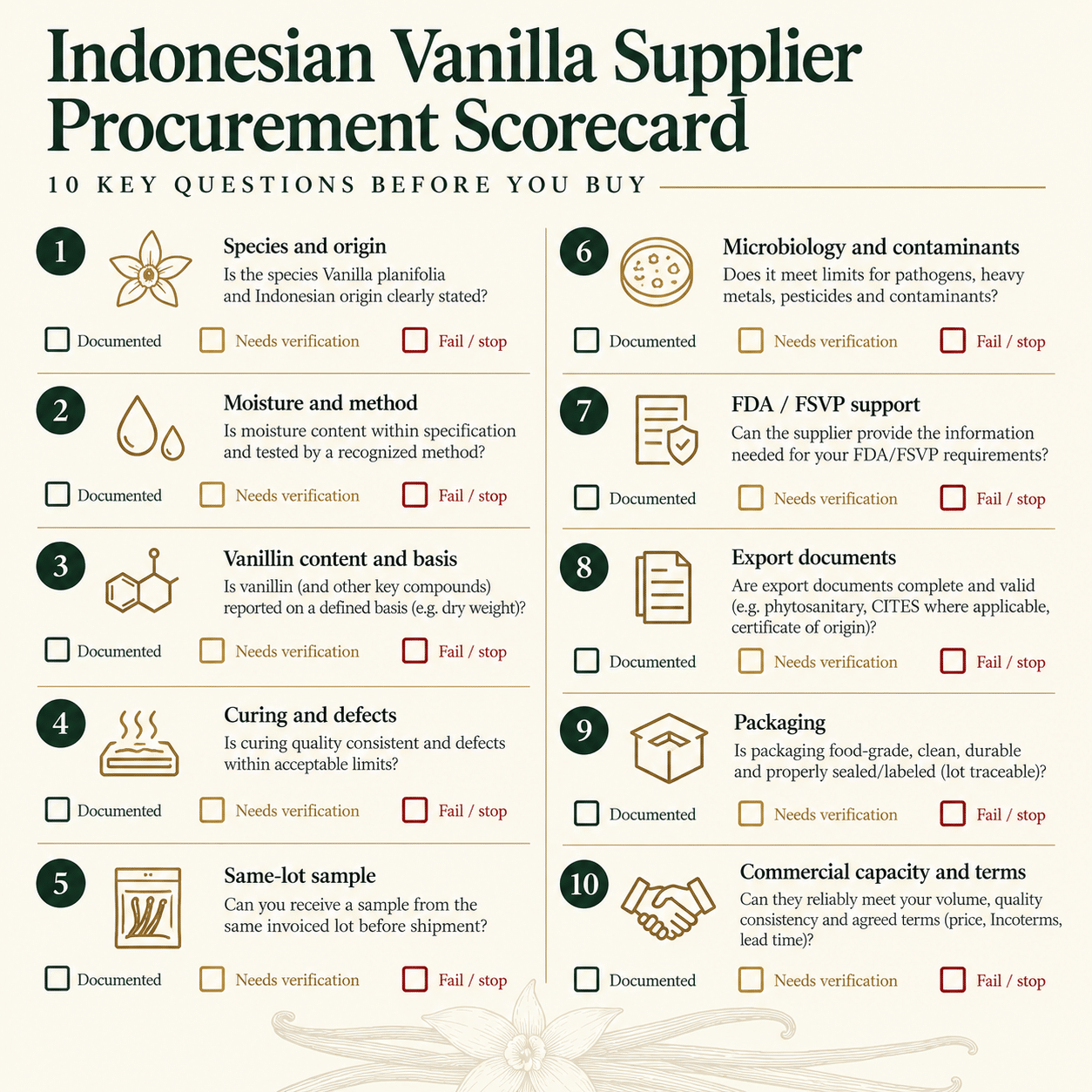
1. What Botanical Species Is in the Lot, and How Is Purity Controlled?
Why It Matters
Vanilla planifolia and Vanilla tahitensis are both recognized as vanilla beans under § 169.3(a), but they are not interchangeable in sensory profile or formulation. An undeclared blend compromises repeatability and may invalidate an approved reference sample.
Red Flag Answer
“It is Indonesian vanilla” or “Grade A vanilla” without a botanical name, origin records, or segregation controls.
Green Flag / Pro Answer
The supplier names the species, growing origin, aggregator or farm group, segregation step, and lot-level identity records. If blends are offered, the composition is declared.
Contract / RFQ Specification Anchor
State the accepted species, whether blending is prohibited, origin declaration, maximum foreign matter, and buyer rights to authenticity testing and rejection.
If you are still deciding which grade to request, see our comparison of gourmet vs extraction-grade vanilla beans.
2. What Is the Moisture Range, and Which Exact Method Produced It?
Why It Matters
Moisture affects price per unit of dry solids, microbial stability, texture, and—in extract manufacturing—the bean weight counted under § 169.3(b). A result without a method is not comparable.
Red Flag Answer
“Around 25%,” measured with an unspecified handheld meter, oven, or halogen balance, with no calibration, sample preparation, tolerance, or test date.
Green Flag / Pro Answer
The COA states the result, method, sample preparation, laboratory, uncertainty or tolerance, and date. The supplier can explain how its routine method correlates with the modified AOAC distillation method incorporated in § 169.3(b).
Contract / RFQ Specification Anchor
Define a buyer-set range, method/version, sampling plan, acceptance tolerance, retest laboratory, and which result controls a dispute. Do not describe 25% as a universal legal maximum.
3. What Is the Vanillin Content, and Is It Reported As-Is or on a Dry Basis?
Why It Matters
The same lot produces different percentages depending on moisture basis. A 2.0% as-is result at 25% moisture equals 2.67% on a dry basis. Comparing unlabelled figures can select the wrong supplier.
Red Flag Answer
“Vanillin 2%” with no reporting basis, chromatogram, method, lab identity, or lot code—or a result copied from a generic product sheet.
Green Flag / Pro Answer
The supplier reports as-is and dry-basis values, moisture used in the conversion, and a named method such as HPLC under ISO 5565-2. Spectrophotometric results are clearly identified rather than presented as equivalent to HPLC.
Contract / RFQ Specification Anchor
Set the minimum, reporting basis, formula, method/version, laboratory qualification, and buyer confirmation-testing right.
For the moisture and dry-basis vanillin calculations used in extract manufacturing, see our extraction-grade specification guide.
4. Where Were the Beans Harvested and Cured, and How Are Sensory Defects Controlled?
Why It Matters
Farm origin alone does not describe curing. Killing, sweating, drying, and conditioning decisions affect aroma, mould risk, and smoky or phenolic defects. Artificial heat or smoke exposure must be disclosed.
Red Flag Answer
“Sun-dried traditionally” with no curing location, process record, drying endpoints, mould inspection, or off-odour rejection standard.
Green Flag / Pro Answer
The supplier maps harvest and curing locations, process stages, drying surfaces or equipment, temperature controls where used, conditioning time, sensory release criteria, and corrective action for mould or smoke taint.
Contract / RFQ Specification Anchor
Name permitted curing methods, prohibited smoke contact, sensory reference, unacceptable odours, visible-mould rejection, and record-retention period.
For growing regions, curing styles and grade vocabulary, see our guide to understanding Indonesian vanilla.
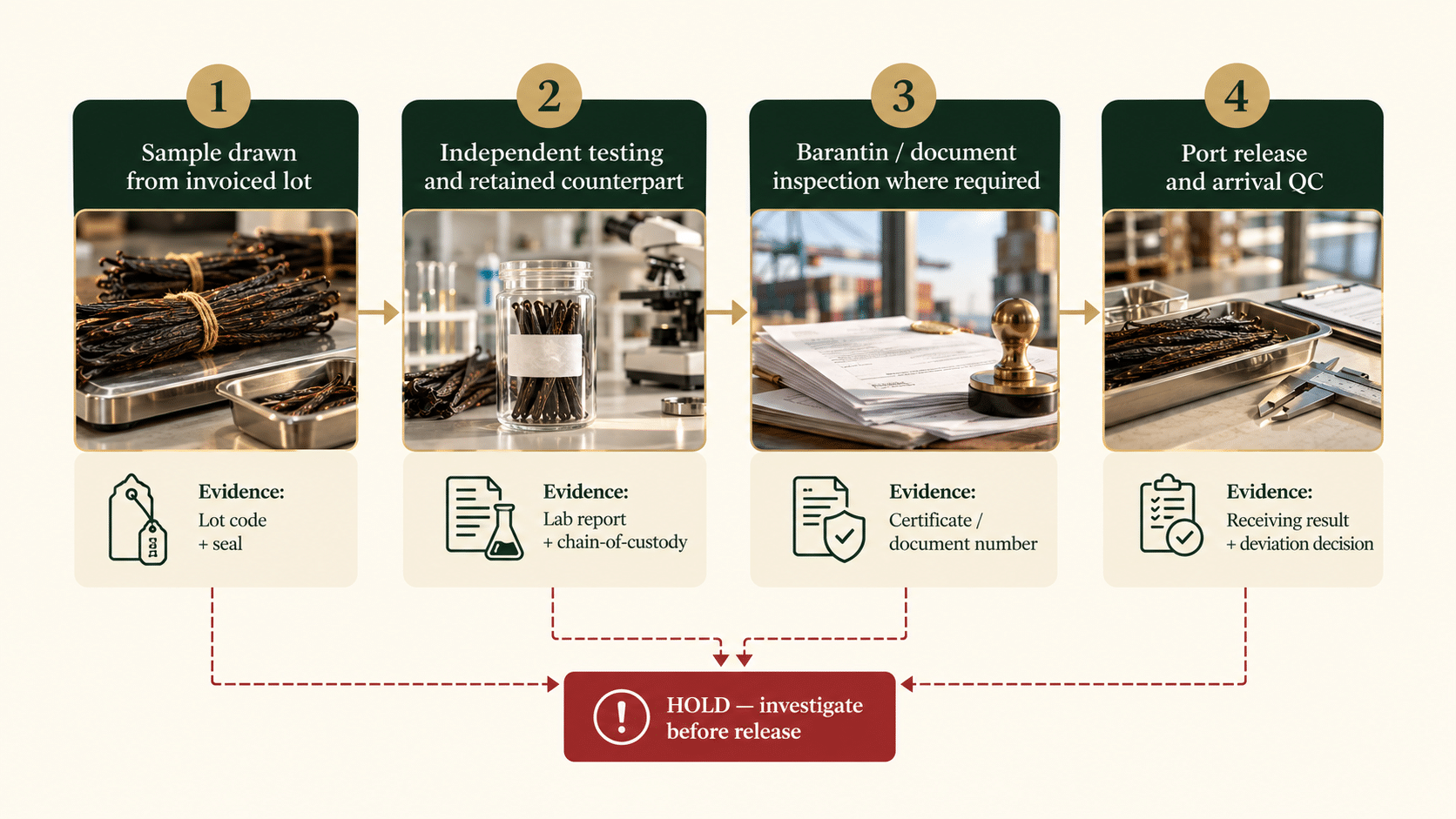
5. Was the Pre-Shipment Sample Drawn From the Invoiced Commercial Lot?
Why It Matters
A good sample proves only that the sample was good. It does not prove the invoiced lot matches unless the sample, COA, bags, cartons, packing list, and invoice share a traceable lot identity.
Red Flag Answer
The supplier sends a “representative sample” before production, cannot identify who drew it, or changes lot codes between sample approval and shipment.
Green Flag / Pro Answer
An authorized person draws the sample after lot assembly, seals and codes it, records date and method, and retains a counterpart sample. Commercial packaging carries the same lot code.
Contract / RFQ Specification Anchor
Require same-lot sampling, sealed retain samples for both parties, chain-of-custody, approval validity, no substitution without written consent, and remedies for mismatch.
6. Which Microbiology and Contaminant Panel Applies to This Lot?
Why It Matters
FSVP hazard analysis is risk-based. Typical buyer panels may include total plate count, yeast and mould, Salmonella, E. coli, pesticide residues, and toxic elements. Limits and methods remain buyer- and use-specific.
Red Flag Answer
“Food grade” or “lab tested” without analytes, limits, method, sample size, date, laboratory, or lot reference.
Green Flag / Pro Answer
The COA identifies each test, acceptance limit, unit, validated method, analytical unit, compositing plan, detection limit where relevant, and laboratory accreditation scope.
Contract / RFQ Specification Anchor
Define numeric TPC and yeast/mould limits, Salmonella not-detected criterion and sampling plan (25 g or an agreed composite program), E. coli, risk-based pesticide and heavy-metal panels, and release/hold rules.
7. Which FDA and FSVP Records Can the Supplier Support?
Why It Matters
Facilities that manufacture/process, pack, or hold food for US consumption generally register under § 1.225 unless exempt under § 1.226. The US importer—not the foreign supplier—owns the FSVP duty.
Red Flag Answer
“FDA approved” or a certificate sold by an intermediary, with no legal facility name, address, role, exemption basis, hazard-control records, or corrective-action history.
Green Flag / Pro Answer
The supplier identifies every relevant facility and its role, provides registration confirmation where applicable without exposing credentials, explains any exemption, and supplies records suitable for importer review.
Contract / RFQ Specification Anchor
Require facility identity, registration or exemption representation, US-agent details where applicable, hazard-control records, document-access terms, and notification of FDA warning letters, import alerts, or material changes.
8. Which Export, Quarantine, and Entry Documents Will Accompany the Shipment?
Why It Matters
Prior Notice, customs data, origin evidence, and plant-health requirements depend on the shipment. HS 0905.10 covers vanilla neither crushed nor ground; 0905.20 covers crushed or ground vanilla. Final classification belongs with the broker.
Red Flag Answer
“All documents included” without a document matrix, responsible party, issuing authority, timing, or confirmation against US entry requirements.
Green Flag / Pro Answer
The supplier maps commercial invoice, packing list, bill of lading or air waybill, Certificate of Origin, lot COA, and a Barantin Phytosanitary Certificate where required. It also discloses every origin, curing, processing, packing, and holding location.
Contract / RFQ Specification Anchor
List each document, issuer, deadline, consignee data, HS classification review, Prior Notice data responsibility, and APHIS/broker confirmation. Add an FDA Import Alert 99-52 certification gate if any spice is tied to Java or Lampung.
9. How Will Packaging Protect the Beans During Ocean Transit?
Why It Matters
Vacuum loss, weak moisture barriers, carton compression, temperature swings, and container condensation can change the lot after approval. A planned 30–45-day route needs packaging validated for the actual lane, not a generic claim.
Red Flag Answer
“Vacuum packed” with no food-contact declaration, material specification, seal check, carton strength, liner, pallet plan, humidity control, or transport history.
Green Flag / Pro Answer
The supplier provides pack construction, net weight, seal-integrity checks, lot labels, master-carton specification, palletization, desiccant or liner rationale, and a response plan for puncture or condensation.
Contract / RFQ Specification Anchor
Specify approved food-contact materials, barrier and seal requirements, pack weight tolerance, carton/pallet configuration, container inspection, temperature/humidity logger where justified, and arrival inspection criteria.
10. What Are the Real MOQ, Scalable Capacity, Lead Time, Incoterm, and Payment Terms?
Why It Matters
Capacity should mean repeatable compliant output, not peak harvest volume. MOQ, seasonality, testing release, packing, and inland transport all affect lead time and working capital.
Red Flag Answer
“Any quantity, every month,” a CIF or FOB price without named port and Incoterms version, or a request for full TT payment before due diligence.
Green Flag / Pro Answer
The supplier separates current stock, monthly cured output, scalable output, and committed volume; states seasonality and bottlenecks; and quotes named-place Incoterms 2020 with clear cost and risk allocation. LC and TT options are tied to milestones and counterparties.
Contract / RFQ Specification Anchor
Lock MOQ, monthly capacity band, allocation, lead time definition, Incoterm and named place, payment instrument, inspection/release milestone, document set, delay notice, and non-conforming-lot remedy.
Indonesian Vanilla Supplier Evaluation Matrix
| Parameter | Minimum pass criterion | Evidence to retain |
|---|---|---|
| Species and purity | Declared species; blend policy; lot segregation | Origin record, lot sheet, authenticity clause |
| Moisture | Range, tolerance, named method | Lot COA, method/version, intake retest |
| Vanillin | Minimum plus basis and method | HPLC/other report, moisture conversion |
| Curing and sensory | Mapped process; defined defect rejection | Curing log, sensory release record |
| Sample-to-lot | Same invoiced lot; sealed retain | Chain-of-custody, sample seal, lot code |
| Micro/contaminants | Buyer limits and sampling plan met | Accredited report, raw results if required |
| FDA/FSVP support | Facilities and records identified | Registration/exemption basis, hazard records |
| Export documents | Document matrix confirmed | Invoice, packing list, COO, PC if required |
| Packaging/transit | Validated pack and arrival checks | Pack spec, seal check, logger where used |
| Commercial terms | Evidence-based capacity and named terms | Capacity record, quote, Incoterms 2020 term |
Frequently Asked Questions
Is 25% moisture the legal maximum for vanilla beans imported into the United States?
No. In 21 CFR § 169.3(b), 25% is the anchor for calculating a unit weight of beans used in standardized vanilla extract. Beans above 25% require more weight to provide equivalent moisture-free solids; the section is not a general import ban.
Should vanillin be reported as-is or on a dry basis?
Require both when possible, and identify the contractual basis. Dry-basis reporting supports fair comparison between lots with different moisture. The COA should also name the analytical method, such as HPLC under ISO 5565-2.
Does a negative pre-shipment sample guarantee the commercial lot?
No. It becomes useful evidence only when it is drawn from the invoiced lot under documented chain-of-custody, carries the same lot code as the shipment and COA, and has retained counterparts for dispute testing.
Do Indonesian vanilla shipments always need a phytosanitary certificate?
Do not assume so. The requirement depends on product form, origin, processing, and current USDA APHIS entry conditions. Confirm the shipment in APHIS ACIR with the customs broker; obtain a Barantin certificate when required.
Where Vanilla Atlas Stands
Vanilla Atlas is currently validating direct farm and supplier evidence in Indonesia. We have not published our own lot-level moisture, vanillin, microbiology, monthly capacity, or export-readiness claims because those figures are still being verified. We will not substitute generic market data for a lot COA or present a supplier statement as an independent laboratory result.
What we can do now is evaluate a buyer’s specification against the evidence available, identify the missing tests and documents, and build the validation plan. If you share your species, moisture method, vanillin basis, microbiology panel, volume, packaging, and destination, we will respond with what can be supported today and what still requires proof.
Send Your Sourcing Specification
Species · moisture method · vanillin basis · microbiology · volume · destination.
We will separate what is evidenced now from what still needs validation.
No invented COA values. No unverified capacity promise.