
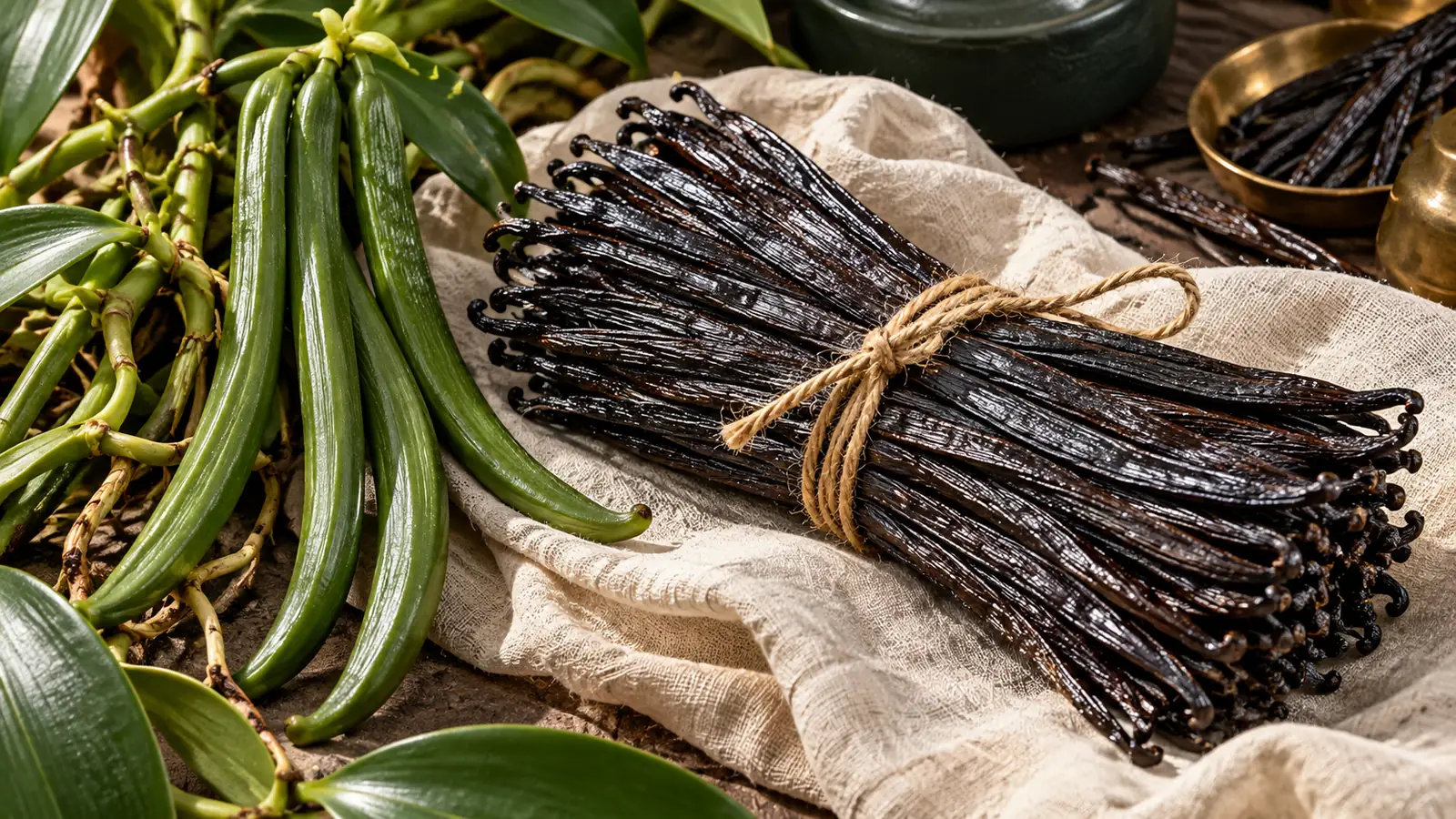
Last updated: September 2026 · Vanilla Atlas Insights. Header image is illustrative, not a photograph of a Vanilla Atlas product lot.
Indonesian vanilla is the cured seed pod of the Vanilla planifolia orchid grown by smallholder farmers across Java, Bali, Nusa Tenggara, Sulawesi and Papua. It is sold to the world under the old trade name “Java vanilla”, and it is one of the few origins outside the Indian Ocean that supplies the global market in commercial volume.
That one sentence hides most of what a buyer needs to know. This guide explains where the name comes from, where the vanilla actually grows today, how a green pod becomes a cured bean, what the flavour is usually described as, and how big Indonesia’s supply really is. Where published figures disagree, we show both and explain why.
1. What “Indonesian vanilla” means
Botanically, there is nothing uniquely Indonesian about the plant. Vanilla planifolia is native to the Americas: Kew’s Plants of the World Online records its native range as “S. Mexico to N. Brazil” (Kew POWO). The US food code defines vanilla beans as “the properly cured and dried fruit pods of Vanilla planifolia Andrews and of Vanilla tahitensis Moore” (21 CFR § 169.3).
“Indonesian” therefore describes where the vine was grown and, just as important, where and how the pod was cured. Two beans from the same species can smell and perform very differently depending on the farm, the harvest timing and the curing method.
A 2024 study of Indonesian farmers and exporters found that “the vanilla raw material used by both farmers and exporters is obtained domestically from the Vanilla planifolia Andrews type”, while “exporters occasionally bring in Vanilla tahitensis from Papua New Guinea” (Munarso et al., 2024). In practice, “Indonesian vanilla” means planifolia unless a supplier states otherwise. Ask.
2. A short history: why it is called “Java vanilla”
According to Indonesia’s Directorate General of Estate Crops, vanilla was introduced to Indonesia in 1819. Cultivation grew rapidly on Java through the 1960s, which is why the world came to refer to vanilla from Indonesia as “Java Vanilla Beans” (Ditjenbun, Ministry of Agriculture, 2022).
The name stuck, but the geography moved. Today most production no longer comes from Java alone.
3. Where vanilla grows in Indonesia
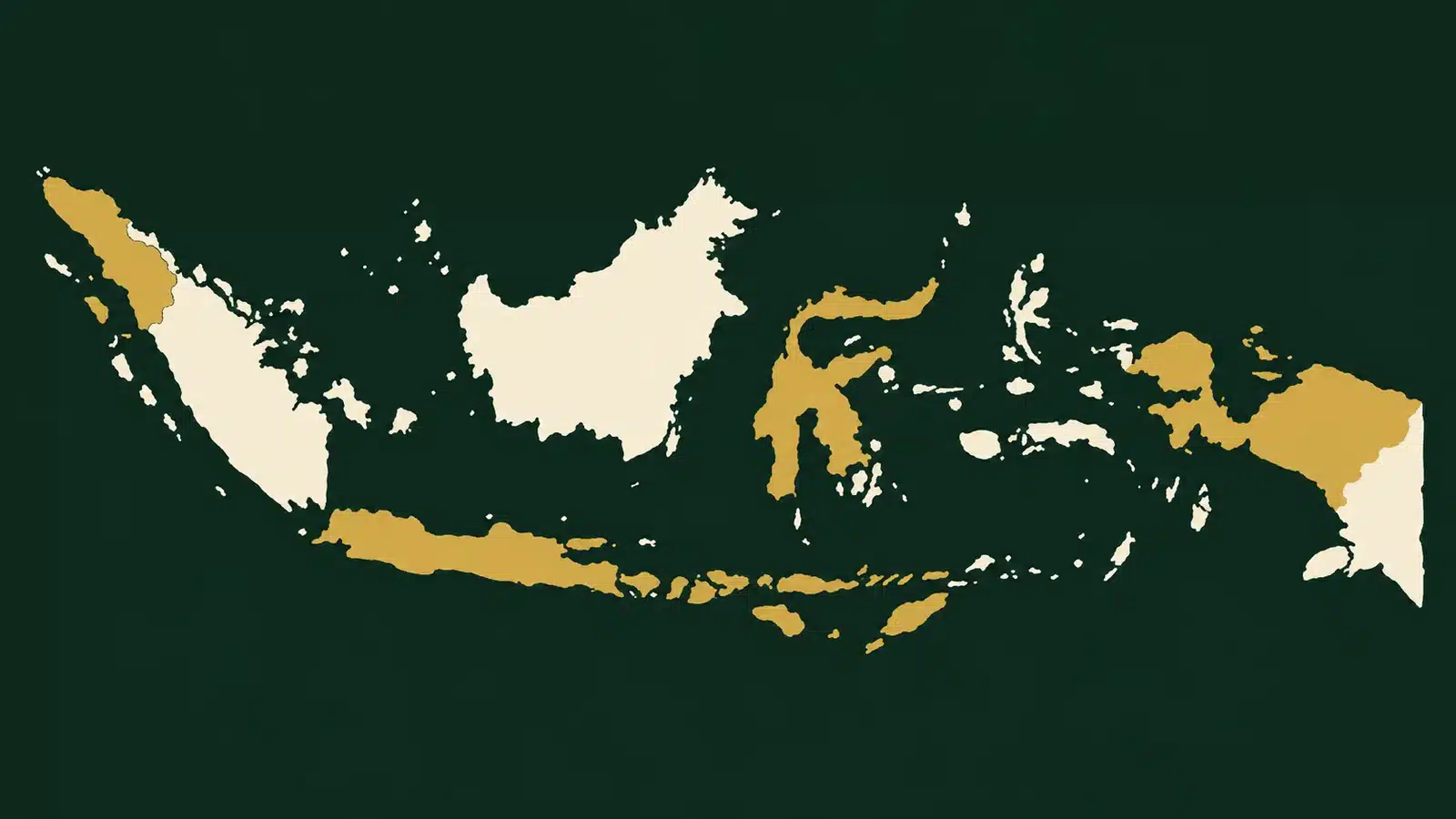
The same ministry source says cultivation, once concentrated in Central and East Java, has spread to West Java, West Nusa Tenggara, East Nusa Tenggara, North, Central, West, South and Southeast Sulawesi, and Papua.
| Region | Provinces named by the ministry | Also covered in the 2024 field study |
|---|---|---|
| Java | Central Java, East Java, West Java | Central Java, East Java |
| Bali & Nusa Tenggara | West Nusa Tenggara, East Nusa Tenggara | Bali, West Nusa Tenggara, East Nusa Tenggara |
| Sulawesi | North, Central, West, South, Southeast Sulawesi | North Sulawesi |
| Sumatra | Not listed | North Sumatra |
| Papua | Papua | Not covered |
Why this matters: Indonesia spans very different climates and farming traditions. A North Sulawesi lot and a Flores lot can differ as much as two different countries. Always ask for the province, and ideally the regency, of the lot you are being offered.
4. From flower to cured bean: how Indonesian vanilla is produced
Vanilla is one of the most labour-intensive crops in agriculture. Outside its native range the flower has no natural pollinator, so every pod starts with a farmer pollinating the flower by hand.
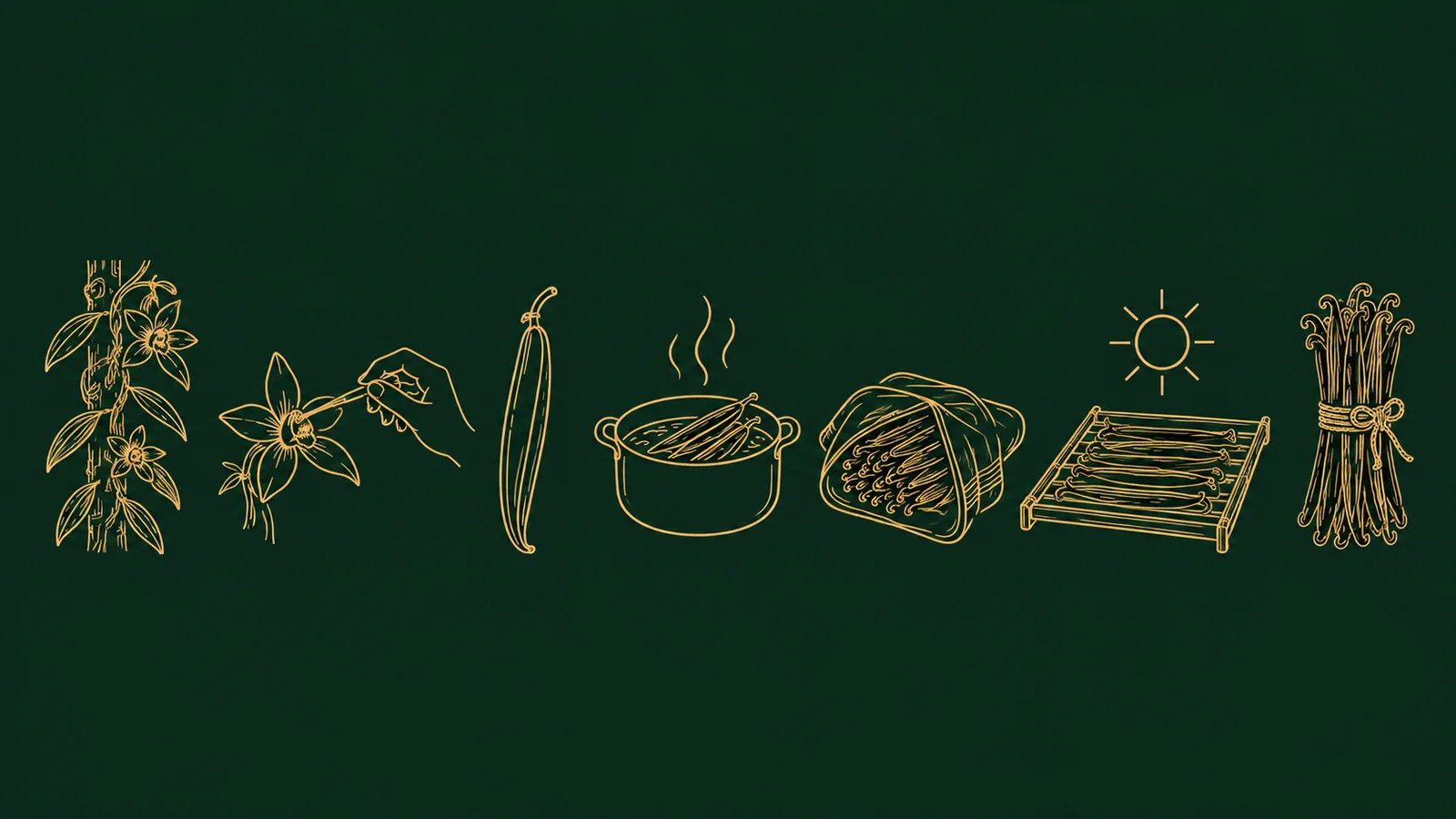
The production path, in order:
- Planting and training the vine. The vine climbs a living support tree and takes around three years before its first commercial flowering.
- Hand pollination. Each flower opens for a single day and must be pollinated that day.
- Pod maturation on the vine. The Munarso study notes that harvesting occurs “when the plants reach 9 months of age when the color changes to faded green and yellow tips.”
- Killing (blanching). Indonesian farmers and exporters mostly use the Bourbon method, “immersing vanilla beans in hot water at a temperature of 63–65°C for a duration of 3–5 min.” The study also records blanching temperatures ranging from about 60 to 90°C by region.
- Sweating (fermentation). Beans are wrapped and kept warm so enzymes start producing aroma compounds, including vanillin. Among farmers in the study this step lasted anywhere from 24 hours to 5 days.
- Sun drying and slow drying. Beans are dried in the sun by day and wrapped by night, then slowly dried to the moisture level the target market wants.
- Conditioning, sorting and grading. Beans rest for weeks to months so the aroma rounds out, then they are sorted by length, appearance and moisture.
The important point for buyers is the variation. Blanching temperature and fermentation length differ from farm to farm, and those differences show up in aroma, moisture and vanillin. That is why two “Indonesian Grade A” offers are not interchangeable.
5. The early-harvest problem
Indonesian vanilla has carried a reputation risk for years, and the cause is well documented. Mature vanilla pods are valuable and easy to steal from the vine. The 2024 study reports that “some farmers choose to harvest younger vanilla plants at 7 months” because of theft risk, and that harvesting before seven months means “the quality of the vanilla fruit produced is not good because the vanilla content is still low.”
An immature pod never develops full aroma, however well it is cured. It is the single most important quality question to ask about any Indonesian lot: when was it harvested, and how does the supplier know the pods were mature?
6. What Indonesian vanilla tastes like
There is no standardised, peer-reviewed flavour wheel for Indonesian vanilla. What exists is trade description, and it is broadly consistent: Indonesian planifolia is often described as woody, earthy and slightly smoky, with dried-fruit notes such as fig or raisin, and with less of the creamy top note associated with Madagascar vanilla. Flavour houses sometimes blend it with Madagascar vanilla for that deeper, darker character.
Treat those descriptions as a starting point rather than a promise. Flavour depends on maturity, curing and storage far more than on the country name. A properly matured, well-cured Indonesian bean and an early-picked one will not taste like the same product.
7. How Indonesian vanilla compares with other origins
| Indonesia | Madagascar | Papua New Guinea | Uganda | |
|---|---|---|---|---|
| Main species | V. planifolia | V. planifolia | V. tahitensis (and planifolia) | V. planifolia |
| Trade name | Java vanilla | Bourbon vanilla | Tahitian-type | None widely used |
| Typical description* | Woody, earthy, smoky, dried fruit | “Rich and creamy” | “Flowery, fruity and smooth” | “Floral, cherry and chocolate” |
| Scale (CBI) | See section 8 | “Just under 3,000 tonnes annually” | “About 495 tonnes” (2020) | “185 tonnes” (2020) |
The useful takeaway is not “which origin is best”. Each origin suits different applications, and the gap between a good and a poor lot within one origin is often larger than the gap between origins.
8. How much vanilla does Indonesia produce?
This is where published numbers diverge sharply, and a buyer should know why.
| Source | Figure | What it measures |
|---|---|---|
| Ditjenbun, Ministry of Agriculture (2022 article) | 9,291 ha planted, 1,412 tonnes produced (2020), fewer than 30,000 farmers | Smallholder estate-crop statistics |
| CBI (EU market study) | “Indonesia produces some 2,300 tonnes“, but “the real production is much lower at some 300 tonnes in 2022″ | Reported vs estimated real production |
| Munarso et al. (2024) | 395 tonnes exported in 2022; fourth-largest exporter after Madagascar, France and Papua New Guinea | Export volume |
Why the gap? CBI explains that Indonesian production “is becoming increasingly difficult to estimate given the large quantities of vanilla from Papua New Guinea which are now brought into the country and re-exported as Indonesian vanilla.” Reported production figures may also count green (uncured) weight, while trade figures count cured beans, which lose most of their water during curing.
What we can say with confidence: Indonesia is a meaningful but secondary supplier next to Madagascar, and the “Indonesian” label on an export does not always guarantee Indonesian farm origin. Traceability back to the farm or collector is the only reliable answer.
9. Grades, briefly
Indonesian suppliers quote in commercial shorthand such as “Gourmet / Grade A”, “Grade B” and “Extraction”. Indonesia also has a national standard, SNI 01-0010-2002 Panili. Those labels only become useful once they are converted into measured moisture, vanillin, length and defect rates.
We cover this in detail, including published data on how grade bands overlap, in our buyer’s guide to Indonesian vanilla grades, uses and supplier evaluation.
Frequently asked questions
Is Indonesian vanilla the same as Bourbon vanilla?
Both are usually Vanilla planifolia, and Indonesia mostly uses the Bourbon curing method. “Bourbon vanilla” as a trade name normally refers to the Indian Ocean origins, especially Madagascar. Flavour differs because of climate, harvest timing and curing practice.
What is Java vanilla?
“Java vanilla” is the historical trade name for Indonesian vanilla, from the period when Java was the main growing area. Today the name covers vanilla from several islands, not only Java.
Which Indonesian regions grow vanilla?
Java, Bali, West and East Nusa Tenggara, most provinces of Sulawesi, Papua and parts of Sumatra, according to the Ministry of Agriculture and recent field research.
Why does Indonesian vanilla vary so much in quality?
Mainly because of early harvesting (partly driven by theft) and because blanching temperature and fermentation time differ between farms and regions.
Is Indonesian vanilla good for extract?
It is widely used in extract and flavour blends, often for its darker, woody character. Suitability depends on the lot’s measured moisture and vanillin, not on origin alone.
What this means if you are sourcing
Indonesian vanilla is a real, established origin with a long trade history and a wide growing area. It is also an origin where the label tells you less than it should: species, province, harvest maturity and curing method all need to be confirmed lot by lot.
Vanilla Atlas is building its Indonesian supply position on exactly that evidence, and we publish figures only when we hold the data behind them. If you are researching the origin for a specific application, talk to Vanilla Atlas and tell us what you need to know. You can also browse more sourcing insights.
