
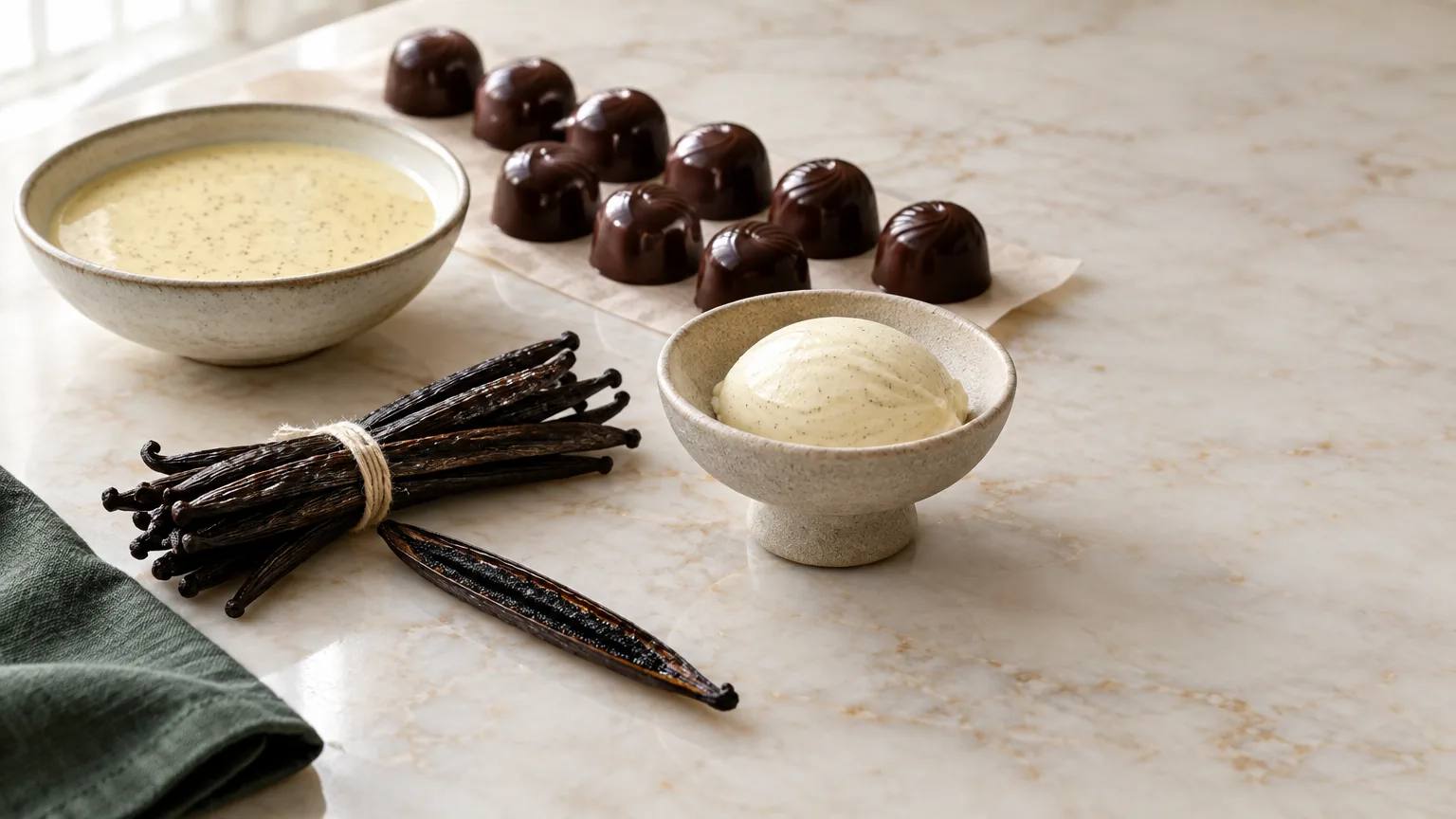
A vanilla éclair, a quenelle of glace and a dark ganache can all be built on the same pod. They do not ask the bean to do the same job. In pâtisserie it has to flavour a custard; in a ganache it has to come through cocoa; in ice cream it has to survive the cold.
Chefs choosing Indonesian vanilla beans in France get the best results in pâtisserie, chocolate and ice cream by matching each lot to the job. Use supple, seed-rich beans where the seeds show, in crème pâtissière, crème anglaise and glace. Use beans chosen for aroma strength in ganache, and dry whole beans or shorts where vanilla is milled. Indonesian Vanilla planifolia is often described as woody and deep, which can suit dark chocolate and caramel. Test every lot in the finished recipe before you set a dose.
This guide is for pastry chefs, chocolatiers, glaciers and the buyers who source Indonesian vanilla beans in France. It covers what Indonesian vanilla is, where it sits in French imports, which bean traits suit each application, how to trial a new lot, and what “natural vanilla” wording requires on an EU label.
What are Indonesian vanilla beans?
Indonesian vanilla beans are the cured pods of vanilla orchids grown and processed in Indonesia, mostly Vanilla planifolia. That is the same species sold as Madagascar “Bourbon” vanilla. The difference a chef notices comes from farm, harvest timing and curing, not from a separate plant. Our guide to Indonesian vanilla origin, curing and flavour covers the growing regions and the curing steps in detail.
Trade descriptions of Indonesian planifolia are broadly consistent: woody, earthy and sometimes lightly smoky, with dried-fruit notes and less of the creamy top note associated with Madagascar. The Dutch import-promotion agency CBI describes Indonesian beans as having “a deep and rich vanilla flavour” suited to dark chocolates, cakes and caramels. Lots vary, though. Some Indonesian lots are not smoky at all, so treat these descriptions as a starting point for tasting rather than a specification.
Indonesian vanilla beans in France: a small share of a large market
France is Europe’s largest vanilla importer. CBI reports that France imported 1,081 tonnes of vanilla worth €166 million in 2021, re-exported part of it, and used the rest mainly in the food industry and food service. By new product launches, chocolate confectionery was the most active French vanilla segment, followed by bakery, desserts and ice cream.
Madagascar supplies most of that vanilla, so Indonesian vanilla beans in France remain a niche origin. UN Comtrade data reported by France for whole vanilla beans (HS 090510) show Indonesia at 0.5% to 2.0% of import volume between 2023 and 2025.
France: imports of whole vanilla beans (HS 090510) by origin, 2023–2025
| Partner | 2023 tonnes | 2024 tonnes | 2025 tonnes | 2025 share of volume | 2025 unit value (USD/kg) |
|---|---|---|---|---|---|
| All partners | 644.9 | 2,034.3 | 1,195.6 | 100% | 64.0 |
| Madagascar | 487.0 | 1,714.5 | 874.8 | 73.2% | 65.4 |
| Uganda | 47.2 | 118.4 | 71.4 | 6.0% | 33.4 |
| Papua New Guinea | 12.1 | 12.7 | 11.8 | 1.0% | 92.0 |
| Indonesia | 13.1 | 12.4 | 6.4 | 0.5% | 110.1 |
| French Polynesia | 6.8 | 7.6 | 6.5 | 0.5% | 555.6 |
Source: UN Comtrade, France as reporter, import flow, net weight and reported value in US dollars, retrieved 30 October 2026. Unit value is reported value divided by net weight. Figures can be revised by the reporting country.
Three cautions apply when reading these numbers. The trade code does not separate grades or species, so a unit value is not a price for gourmet beans. Volumes from the Netherlands and Germany are re-exports whose growing origin is not recorded here. And Indonesia’s higher average unit value in 2025 reflects a small, mixed set of shipments; it says nothing about the quality of a particular lot. For a full origin comparison, see Indonesian vs Madagascar vanilla beans.
For a French kitchen, the practical point is simple. Indonesian vanilla is a less familiar origin, which can be useful when you want a different aroma profile or a second source, but you will usually need to evaluate it yourself rather than rely on a reputation.
Which vanilla beans suit pâtisserie, chocolate and glace?
Choose the bean by what it must do in the recipe, whether you need vanilla beans for pâtisserie, vanilla for chocolate or vanilla for glace. A pod that will be split and scraped needs moist, abundant seed paste. A pod that will only be infused needs aroma more than looks. A bean that will be milled needs to be dry. The table below maps common French uses to the traits worth specifying and to the Vanilla Atlas selection we would compare first.
Vanilla bean traits by French culinary application
| Application | What the vanilla must do | Bean traits to specify | Selection to compare first |
|---|---|---|---|
| Crème pâtissière, crème anglaise, crème brûlée | Flavour a dairy base during a warm infusion | Supple pods, plenty of moist seed paste, clean aroma | Gourmet or Select |
| Visible-seed pastry: mille-feuille, flan pâtissier, crème légère | Show seeds to the customer as well as flavour | Length, suppleness, seed yield, few splits or blemishes | Gourmet |
| Ganache and bonbons | Carry aroma through cream into cocoa | Aroma strength in a cream infusion test; flexible, oily pods | Gourmet or Select |
| Bars, coatings and milled additions | Supply ground vanilla in a dry process | Dry pods that mill cleanly; checks for foreign matter | Dry Whole or Shorts |
| Glace and ice-cream bases | Flavour a cold dessert, where aroma is perceived less strongly | Aroma at your chosen dose; seed visibility if you show specks | Gourmet or Select |
| Caramel, sauces and syrups | Infuse a hot sugar or dairy mixture | Consistent aroma; pod length matters less | Classic or Shorts |
Grade names are commercial labels, not universal quality ranks. Our comparison of gourmet vs extraction-grade vanilla beans explains why, and our guide to vanilla bean moisture content covers why suppleness affects seed yield and storage.

Vanilla beans for pâtisserie: crème pâtissière, crème anglaise and visible seeds
Most French custards use the same method. Split the pod lengthwise, scrape out the seed paste, and put both seeds and pod into the milk or cream. Bring it to a simmer, take it off the heat, cover and leave it to infuse. Lift the pod out before the liquid goes onto the yolks and sugar.

Many French recipes count pods, often one pod per half-litre of milk. Counting is imprecise, because pods differ in length, weight and moisture. A small, dry pod and a long, plump one can differ markedly in what they release. Weigh the beans instead, and record grams per litre of liquid or per kilogram of finished cream.
Where the seeds are on display, such as in a mille-feuille or a flan pâtissier, vanilla beans for pâtisserie are judged on appearance as much as aroma. Supple beans give a moist paste that disperses evenly. Dry beans give fewer, grittier seeds. If the seeds are part of how you sell the pastry, put length, suppleness and seed yield into your order, not only the grade name.
Indonesian beans with a deeper, woody profile can stand up to brown butter, caramelised puff pastry and toasted nuts. In a delicate crème anglaise, compare them side by side with your current vanilla before you switch, because the difference is easier to taste there.
Vanilla for chocolate: ganache, bonbons and dark chocolate
CBI notes that chocolate makers use vanilla to soften bitterness and round out flavour. For a ganache, infuse the split pods in the cream, strain them out, then weigh the cream again. Infusion loses some liquid to evaporation and to the pods, and a ganache recipe is a balance of fat, sugar and water. Topping the cream back up to its original weight keeps texture consistent from batch to batch.

When choosing vanilla for chocolate, remember that dark chocolate with high cocoa content can mask a mild vanilla. This is where a deeper Indonesian lot can earn its place, but judge it in the finished bonbon, after the ganache has crystallised, rather than in warm cream. Milk and white chocolate show vanilla more clearly, so they are useful test beds for comparing two lots.
For bars and coatings, vanilla is usually added as ground bean or powder at a point set by your own process. That calls for dry beans that mill cleanly, which is the role of Dry Whole beans and Shorts. Moist gourmet beans tend to clog a grinder and add water you do not want in chocolate.
Vanilla for glace: ice-cream bases and visible specks
When you choose vanilla for glace, remember that cold dulls how strongly we perceive aroma, and CBI notes that ice cream may be dosed with more vanilla than chocolate. Infuse the split pods while you heat the base, then age the base in the refrigerator with the pods still in it before straining and churning. Ageing gives the vanilla more contact time and lets the base mature for a smoother texture.
Black specks tell the customer that vanilla seeds are present. They do not measure flavour strength. A glace with plenty of visible seeds can still taste faint if the dose is low or the beans are dry. If specks matter to your product, specify seed-rich beans and check the look and the taste separately.
If you make ice cream commercially in France and want to name vanilla on the label, check the flavouring rules before choosing your wording. Under Article 16(4) of EU Regulation (EC) No 1334/2008, “natural vanilla flavouring” may only be used if at least 95% of the flavouring component, by weight, comes from vanilla. Below that, the wording becomes “natural vanilla flavouring with other natural flavourings”, and only where the vanilla flavour is easily recognisable. Have the final label reviewed; this guide is not legal advice.
How to trial an Indonesian vanilla lot in a French kitchen
The fastest way to know whether a lot suits your recipes is a controlled side-by-side test. Run it in the product you actually sell, because vanilla behaves differently in custard, chocolate and frozen desserts. Our vanilla bean sample checklist covers the physical checks; the steps below cover the kitchen trial.
- Fix the base. Use one batch of milk, cream or ganache for every trial so the vanilla is the only variable.
- Weigh the beans. Record grams of bean per litre or per kilogram, not number of pods.
- Test three doses. Make the new lot at roughly 75%, 100% and 125% of your current dose, plus one control with your usual vanilla.
- Rest before tasting. Taste custards and glace after chilling, and ganache after it sets. Warm samples mislead.
- Taste blind and write it down. Code the samples, ask two or three people, and note aroma, aftertaste, seed visibility and colour.
- Turn the winner into a specification. Record the dose, the lot, and the bean traits that mattered, so the next order can be checked against them.
Trial sheet for comparing a new vanilla lot
| Sample code | Vanilla and dose by weight | Base and resting time | What to record |
|---|---|---|---|
| A | Current vanilla, current dose (control) | Same batch, same rest for every sample | Aroma, aftertaste, seed visibility, colour |
| B | New lot, about 75% of current dose | Same batch, same rest | Same fields; note if the vanilla disappears |
| C | New lot, same dose as A | Same batch, same rest | Same fields; direct like-for-like comparison |
| D | New lot, about 125% of current dose | Same batch, same rest | Same fields; note any woody or smoky notes that dominate |
The percentages are trial points, not recommended doses. They show whether the new lot needs more or less than your current vanilla for the same result.
Storing vanilla beans between orders
Keep whole beans in an airtight container away from heat and light, and open it only when you need beans. Check them when you do. Fine white crystals that glint on the pod surface are often vanillin, known in French as givre. Fuzzy, raised or musty-smelling growth suggests mould: set those beans aside and contact your supplier.
Spent pods still hold aroma. Rinse pods that have been in dairy, dry them thoroughly, then grind them into sugar or use them for a second infusion. Keep them out of the dose calculation for the first infusion, or your recorded dose will stop meaning anything.
Where Vanilla Atlas fits
Vanilla Atlas sells Indonesian Vanilla planifolia in five selections, from Gourmet beans for visible use to Dry Whole beans and Shorts for processing. You can compare all five selections in the shop. To order Indonesian vanilla beans in France, check our Shipping & Destinations page: France is a listed country, and availability, charges, timing and any required documents are confirmed for each order.
Selection names describe how we sort our beans. They are not lot test results. Before a larger order, ask which lot you would receive and what has been measured for it, and run the trial above. For wholesale volumes, our vanilla bean RFQ guide shows how to put your application and traits into writing.
Tell us what you are making and how the vanilla should show, whether that is seeds in a crème pâtissière, aroma through a dark ganache or specks in a glace. We will suggest which selection to test first. Share your intended application.
Frequently asked questions
Are Indonesian vanilla beans good for French pâtisserie?
They can be, when the lot suits the recipe. Supple, seed-rich beans work in crème pâtissière, crème anglaise and visible-seed pastry. Indonesian vanilla is often described as woody and deep, so compare it with your current vanilla in the finished pastry before switching.
Is Indonesian vanilla the same as Bourbon vanilla?
Most Indonesian vanilla is Vanilla planifolia, the same species sold as Madagascar Bourbon vanilla. Bourbon is a geographic trade name, not a separate species. Differences in aroma come mainly from farm, harvest timing and curing, so confirm the species and taste each lot.
How much vanilla should I use per litre of ice-cream base?
There is no universal dose, because pods vary in weight, moisture and aroma. Weigh the beans, then test the new lot at about 75%, 100% and 125% of your current dose in the same base. Taste after ageing and churning, and record the winning dose in grams per litre.
Which vanilla beans are best for chocolate and ganache?
For ganache, choose beans with strong aroma in a cream infusion test, then strain and re-weigh the cream. For bars and coatings, dry whole beans or shorts mill more cleanly. Judge the result in the set bonbon or bar, not in warm cream.
Can ice cream made with Indonesian beans be labelled natural vanilla?
Origin does not decide it. Under EU Regulation 1334/2008, natural vanilla flavouring requires at least 95% of the flavouring component, by weight, from vanilla. Below that, a different wording applies. Have the final label reviewed by a qualified adviser.
Can I order Indonesian vanilla beans in France from Vanilla Atlas?
Yes. France is listed on the Vanilla Atlas Shipping and Destinations page. Availability, delivery charges, timing and any required documents are confirmed for each order, so share your quantity and intended application before ordering.
Sources and review scope
Sources checked 30 October 2026. Trade figures are aggregate customs statistics, not prices or grades for any Vanilla Atlas lot. Kitchen methods are general practice; trial doses are test points, not recommendations. Labelling notes are not legal advice.
- CBI (Netherlands Enterprise Agency): The European market potential for vanilla, updated 2 May 2023.
- UN Comtrade: France imports, HS 090510 vanilla, neither crushed nor ground, 2023–2025, retrieved 30 October 2026.
- Regulation (EC) No 1334/2008 on flavourings, Article 16.
- Vanilla Atlas: Indonesian Vanilla Explained, for species, curing and trade flavour descriptions.



2 Comments