

A supplier can send a polished folder and still leave the important question unanswered: do these records describe the vanilla beans you are about to buy?
US buyers should request vanilla supplier documents covering the legal supplier and handling facilities, agreed product specification, lot traceability, relevant test reports, packaging, and shipment details. Add food-safety verification records and any certificates required for the product, origin, or claim. Assign each item to a reviewer before approving dispatch.
Start the request before agreeing a shipment date. Some records can be reviewed during supplier selection; others only exist once a lot is allocated or transport is booked. This guide covers cured vanilla beans for food use. Extracts, compounded flavors, and planting material need their own review.
Vanilla supplier documents: the buyer's request checklist
Use the table as a purchasing checklist. It is not a statement that every item is a universal US import requirement, or that Vanilla Atlas currently holds every document listed.
Vanilla supplier documents to request by purchase stage
| Document or record | When to request it | What the buyer should check |
|---|---|---|
| Supplier identity and facility details | Before supplier approval | Legal seller, business address, processor, packer, storage sites, and the role of any trader |
| Product specification | Before sample approval or purchase | Species, origin, product form, agreed quality limits, intended use, packaging, and revision date |
| Lot and traceability records | At lot allocation; confirm before dispatch | Lot codes connecting source, processing, packing, test samples, and the shipment |
| COA and underlying test reports, where required | Before lot release | Actual lot, sample identity, methods, dates, results, units, and agreed acceptance criteria |
| Relevant food-safety records | During supplier evaluation and as required by the verification plan | Hazard controls, relevant audits or records, corrective actions, and who reviewed them |
| Packaging and storage information | Before packing approval | Actual food-contact material, pack size, lot marking, supported storage conditions, and handling instructions |
| Commercial invoice and packing list | Review drafts before dispatch; reconcile final versions | Parties, product description, origin, quantity, price, package count, net/gross weight, and marks |
| Transport document | At the applicable booking or shipment stage | Air waybill or bill of lading details matched to the shipment and consignee |
| Conditional certificates and declarations | Identify early; obtain before the applicable deadline | Origin, organic, plant-health, import-alert, or buyer-specific requirements and their exact scope |
Which vanilla supplier documents are required or optional?
Separate routine shipment paperwork from buyer approval records and conditional requirements. A COA depends on the applicable verification or purchase requirements. Optional certifications become part of the order when the buyer requires them or a claim depends on them.
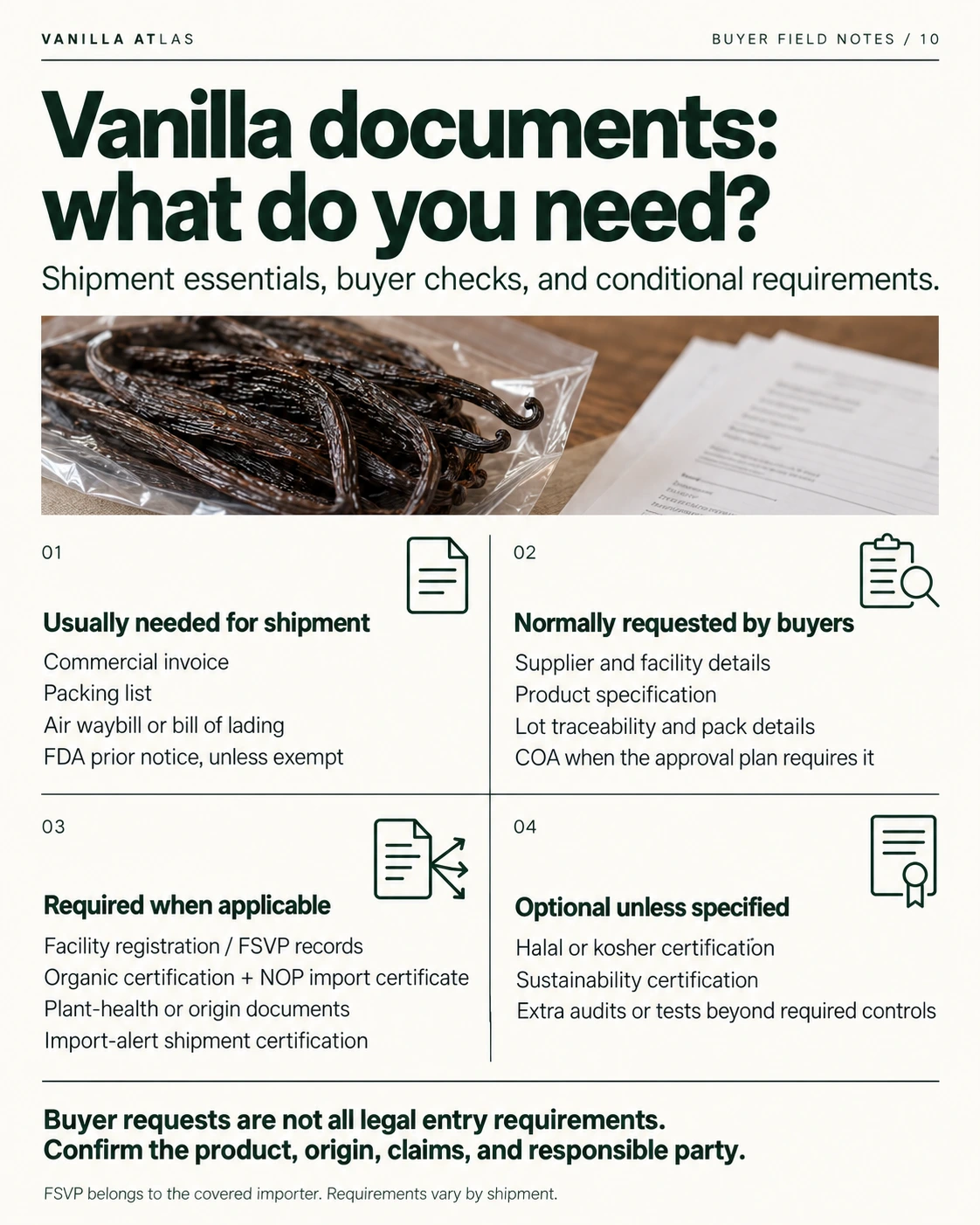
Keep a document register with these fields: requirement, file/version, lot or facility covered, issuer, review date, reviewer, status, and next action. Use “not applicable” only with a recorded reason. An empty attachment field does not explain whether a document is missing or unnecessary.
Identify the seller and the facilities behind the beans
Ask who sells the goods, who cures or processes them, who packs them, and where they are stored. A trading company's invoice address may differ from the facility handling the product. Record those relationships before comparing certificates.
For each facility, request the legal name, physical address, activities performed, and a contact for document questions. Ask for relevant business-registration evidence and check that the seller named in the purchase agreement matches the commercial paperwork. Keep sensitive identifiers in the controlled supplier file.
A useful follow-up is specific: “This audit names a packing site. Which site cured the beans, and what records cover that operation?” That resolves more than asking for a larger certificate bundle.
For the wider commercial discussion, use our questions to ask an Indonesian vanilla supplier.
Separate the specification from the COA
A specification describes what you agreed to buy. A certificate of analysis (COA) reports results for an identified sample or lot. A general specification sheet cannot establish that the offered batch meets those limits.
The specification should identify the botanical species, origin, whole beans or other product form, and the characteristics that matter to your application. Define how moisture and vanillin results are expressed if they are part of the purchase criteria. Include the agreed methods, units, and reporting basis where relevant; a percentage without its basis can be misleading.
Do not add a standard-looking laboratory panel just to fill the page. Your quality team should select testing from the product, intended use, supplier history, and applicable requirements. Commercial quality tests and food-safety verification serve different purposes.
What should you check on a vanilla bean COA?
How to review a vanilla bean COA
| COA field | Review question | Action if unclear |
|---|---|---|
| Product and lot | Does the report identify the beans offered for this order? | Ask for a documented link to the shipment lot |
| Sample identity | Who collected the sample, when, and from what material? | Resolve sampling and chain-of-custody gaps |
| Dates | Do sampling, receipt, testing, and issue dates fit the lot history? | Ask for an explanation or revised evidence |
| Method and reporting basis | Are method, units, and wet/dry basis stated where relevant? | Obtain the missing details before comparing results |
| Results and criteria | Are there actual results and agreed limits, rather than only “pass”? | Ask for the underlying report and applicable criteria |
| Laboratory and authorization | Is the issuer identifiable, and can the report be authenticated? | Verify directly through a trusted contact; check relevant accreditation scope if required |
A report for an earlier lot can help you understand a supplier's testing practice. It does not become evidence for the current lot because the product name is the same. For example, if a COA identifies Lot A while the packing list identifies Lot B, hold the review open until the relationship is explained. This is an illustrative mismatch, not a report about a Vanilla Atlas shipment.
Evaluate the physical sample alongside the documents using our vanilla bean sample checklist.
Request traceability that reaches the shipment
Ask the supplier to show how a lot code follows the beans through sourcing, curing or processing, grading, packing, storage, and dispatch. Where lots are combined or repacked, request the record that connects the input lots with the new output lot and quantities.
A practical review starts with one proposed carton: can the supplier trace its marking back to the packed lot, the relevant test sample, and the source records? Then check whether the same mapping works across the packing list.
Country of origin and shipment departure country are different fields. Record both. A shipment leaving a port in one country does not, by itself, establish where the vanilla was grown or handled.
For Indonesian sourcing, request precise growing and handling locations. As checked on 29 October 2026, FDA Import Alert 99-52 covers certain foods, including spices, from Java and Lampung and distinguishes firm-specific Red List treatment from regional Yellow List certification requirements. For covered spice shipments, BPOM is the designated certifying entity for shipment-specific certification. Have the importer and customs filer check the actual product, supply chain, and current list status before booking. An ordinary COA is not a substitute for the certification required by that alert.
Which records support the importer's FSVP?
The Foreign Supplier Verification Program (FSVP) is the responsibility of the importer covered by the rule. Supplier records support that work; a supplier's certificate folder does not replace it.
FDA describes risk-based supplier evaluation and verification, with activities such as audits, sampling and testing, or review of relevant food-safety records. The applicable work depends on the food, supplier, and any exemption or modified requirement. See FDA's FSVP requirements.
Request the records your reviewer needs to evaluate identified hazards and controls. Where an audit is used, examine the site, product scope, date, findings, and corrective actions. A certificate's logo alone cannot answer those questions.
Put a name beside each responsibility
Assign responsibility for supplier evidence and US entry
| Workstream | What to obtain or assign | What remains to be reviewed |
|---|---|---|
| Supplier evidence | Supplier and relevant facility contacts | Whether the records cover the actual product, site, and lot |
| FSVP | Identify the responsible FSVP importer and qualified reviewer | Applicability, evaluation, verification, decisions, and records |
| Customs and FDA entry | Agree the filing roles with the importer and broker or filer | Accurate entry data, applicable prior notice, and required supporting records |
| Commercial lot release | Buyer QA and purchasing approval | Unresolved discrepancies, agreed specifications, and dispatch conditions |
Under FDA's definition, the FSVP importer is generally the US owner or consignee at entry, or a consenting US agent or representative when there is no US owner or consignee. Do not assume the supplier's facility-registration US agent or a freight forwarder has accepted that role. FDA FSVP guidance explains the framework.
Check registration and conditional certificates carefully
FDA registration is not product approval
Request relevant facility-registration information where registration applies, or the stated basis for an exemption. FDA says it does not issue food-facility registration certificates or recognize certificates sold by private businesses. A registration number does not establish that a vanilla lot meets your specification. See FDA's clarification on registration certificates.
FDA also states that it does not preapprove individual food importers, products, labels, or shipments. Agree who provides the information for applicable prior notice and entry review. See Importing Human Foods.
Organic and other claims need their own evidence
If you are buying organic vanilla, check the certified operation and product scope and arrange a valid NOP Import Certificate associated with the shipment. USDA explains that the exporter's certifier issues the electronic certificate through the Organic Integrity Database. An operation's organic certificate and an NOP Import Certificate serve different purposes. See USDA's electronic organic import certificates.
For halal, kosher, sustainability, or other requested claims, identify the standard, issuer, covered site/product, and validity before relying on a document. Request only the claims relevant to the order.
Do not assume every shipment needs the same plant-health or origin certificate
Have the importer or broker confirm whether a phytosanitary certificate, permit, treatment record, or formal certificate of origin is required for the actual product and transaction. APHIS directs importers to commodity- and origin-specific requirements in ACIR and its import guidance. A traveler's allowance is not a commercial import clearance decision.
Reconcile packaging and shipment documents before dispatch
The invoice, packing list, and transport document should describe the same shipment. Check product names, parties, lot references, package marks, quantities, and weights. Reconcile differences while the supplier can still correct the records and inspect the cargo.
The International Trade Administration's document guide distinguishes commercial invoices, packing lists, air waybills, and bills of lading. A packing list does not replace the invoice. Ask the filer what additional entry information is needed for your transaction.
For the inner pack, request the material identification and evidence of suitability for its intended food-contact use. FDA notes that a manufacturer can provide a letter of guaranty addressing that use; a generic “food-grade” label leaves the material and conditions unresolved. See FDA food-contact guidance.
Use our bulk vanilla bean packaging guide to agree pack sizes, lot labels, storage conditions, and receiving checks alongside the document review.

What if a document is missing or does not match?
Record the gap and the decision it prevents. Then assign the next action. A missing optional marketing certificate and a missing required shipment certificate have different consequences.
Resolve missing or inconsistent supplier documents
| Finding | Buyer action | Close the item when |
|---|---|---|
| Generic specification supplied as a COA | Request lot-specific evidence required by your approval plan | The reviewer accepts relevant results for the identified lot |
| Certificate names another facility or excludes the product | Ask for the correct scope or document the limitation | Site and product coverage are established |
| Lot, package count, or weights disagree | Reconcile records with the supplier and filer | Corrected versions agree and retain an audit trail |
| Required certificate or verification remains unresolved | Hold dispatch approval and escalate to the responsible reviewer | The applicable requirement is satisfied or a documented lawful alternative is accepted |
Keep the original file and the corrected version. Record who accepted the correction and why. Do not relabel a report or edit a supplier-issued result to make it fit the order.
A document request you can send to a vanilla supplier
Adapt this request to your purchase and your reviewer's requirements:
Please provide the document pack for the vanilla beans proposed for our US order. Identify the legal seller, processing and packing facilities, product species and form, origin, and proposed lot.
Include the current specification, lot-traceability information, relevant COA/test reports, packaging and storage details, and the food-safety records requested by our reviewer. Please distinguish a general example from evidence for the offered lot.
Confirm which invoice, packing-list, transport, registration, and conditional certificate information will be available, who provides it, and at what stage. For each unavailable item, state the gap and proposed next action. Please flag any change of lot, facility, source, or packing arrangement before dispatch.
Add the agreed requirements to the purchase specification. Our vanilla bean RFQ guide helps connect those requirements to the order.
Frequently asked questions
Is a COA required for every vanilla shipment to the US?
Do not assume one universal COA requirement. Identify testing and reporting needs through applicable rules, the importer's verification program, and the purchase specification. A COA that your approval process requires must relate to the relevant sample or lot. It does not replace a separate required import certificate.
Can a specification sheet replace a COA?
No. The specification sets agreed characteristics or limits. The COA reports results for an identified sample or lot. Review both when your purchasing or verification process requires test evidence.
Is an FDA registration certificate proof that a supplier is approved?
No. FDA does not issue food-facility registration certificates or recognize private registration certificates. Ask for applicable registration information and review the supplier and product separately. Registration is not a lot approval.
Does an organic certificate cover the import shipment?
An operation's organic certificate establishes its certification scope. A valid NOP Import Certificate must also be associated with covered organic imports. Coordinate this with the exporter, certifier, and importer before shipment.
Can the supplier prepare the buyer's entire FSVP?
The supplier can provide supporting records. The covered FSVP importer remains responsible for the program and must arrange the required review and verification. Do not treat a supplier's folder as a completed importer program.
Tell us your required documents
Send Vanilla Atlas your intended application, product form, order size, and document checklist, including any buyer-specific standards. State which items are required before sample approval, purchase, and dispatch.
Document availability must be confirmed for the actual lot and transaction. This checklist is not a claim that Vanilla Atlas currently holds every report or certification described.
Tell us your required documents.
Sources and review scope
Sources checked on 29 October 2026. The tables are a buyer-side working checklist; the linked authorities describe the relevant regulatory frameworks. Confirm transaction-specific requirements with the responsible importer, qualified food-safety reviewer, and customs filer before dispatch.
- FDA: FSVP rule and key requirements.
- FDA: FSVP guidance for industry.
- FDA: Food-facility registration and private certificates.
- FDA: Importing Human Foods.
- FDA: Import Alert 99-52.
- USDA AMS: Electronic Organic Import Certificates.
- USDA APHIS: How to Import Plants and Plant Products.
- International Trade Administration: Common Export Documents.
- FDA: Regulatory status of food-contact materials.


