
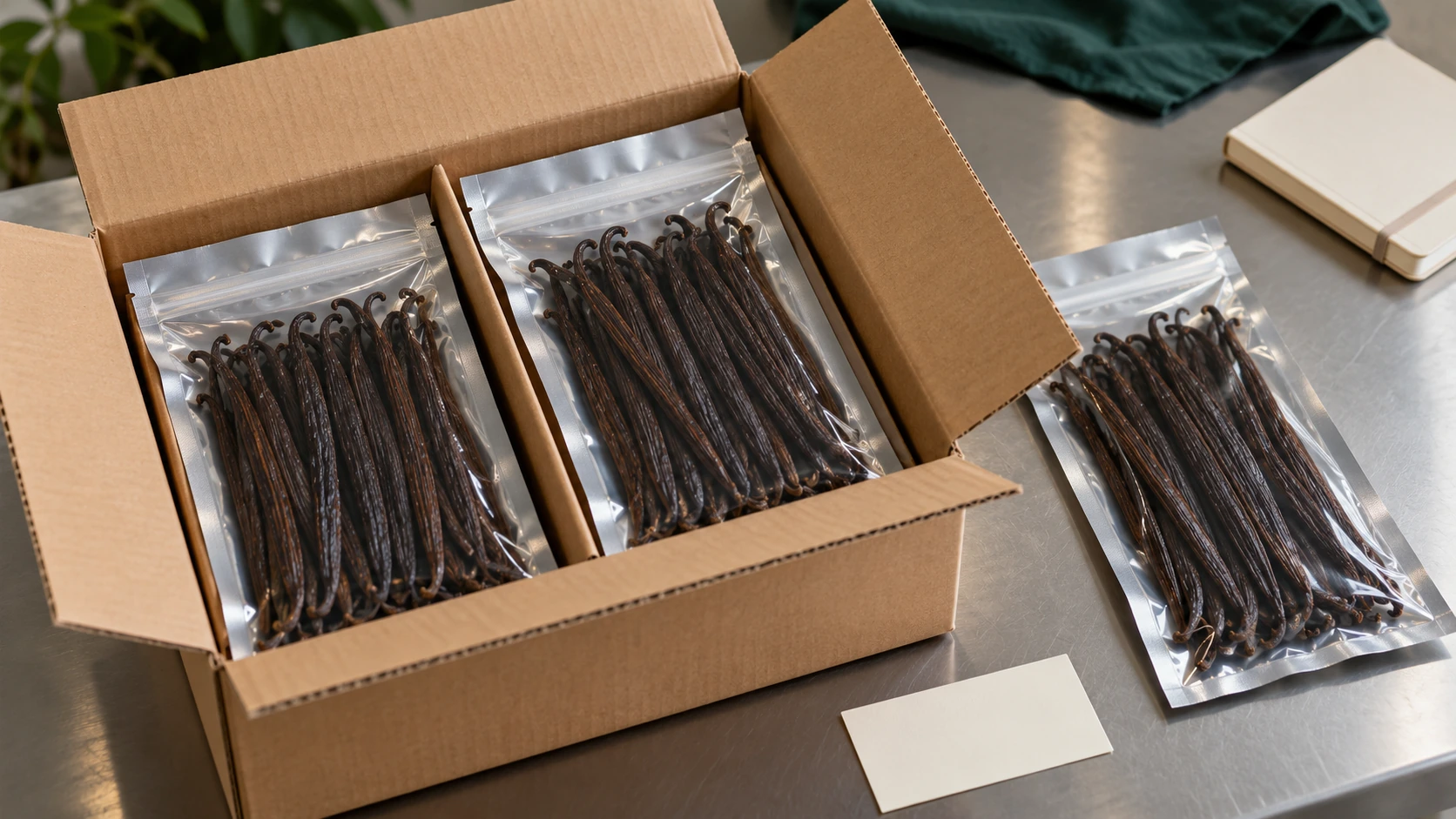
A dry shipping carton does not tell you whether the pouches inside kept their seals. Ask for the inner-pack specification before you approve the box.
For a US shipment, bulk vanilla bean packaging should protect the identified lot from moisture exchange, foreign odors, contamination, and handling damage. Agree on the food-contact pack, seal checks, storage conditions, transit plan, and receiving criteria before dispatch. Keep the lot code connected to the packing and shipment records.
This guide is for importers and distributors arranging commercial shipments of cured vanilla beans. It provides a buyer-side packing brief, not a universal temperature setting or a shelf-life guarantee.
8 bulk vanilla bean packaging checks at a glance
Use these eight checks as the short version of this guide. Each one maps to a field in the packing specification below, so a gap in any line is a question to resolve before the goods leave the packing site.
- Lot and product: confirm the lot code, species, product form, and the specification the buyer approved.
- Inner-pack size: agree the net weight per pack around how the receiver will open and use the beans.
- Food-contact material: identify the actual pouch, liner, or container and its intended-use documentation.
- Pack performance: state the barrier information, closure method, and any validation the route requires.
- Seal controls: keep the sealing area clean and inspect every finished pack against agreed defects.
- Outer protection: specify cartons, internal restraint, stacking, and pallet arrangement.
- Vanilla bean storage and transit: agree conditions, holding time, monitoring, and the action for delays.
- Receiving decision: define the arrival checks, hold criteria, and who may release stock.
Good bulk vanilla bean packaging is the result of all eight checks working together. A strong pouch cannot compensate for a missing lot record, and a well-documented lot can still be damaged by a carton that lets packs slide.
Bulk vanilla bean packaging starts with lot release
Confirm what is being packed: botanical species, lot code, product form, quantity, and the specification against which the buyer approved it. A sample from an earlier lot does not establish the condition of the stock being sealed today.
Record the relevant pre-pack observations and measurements. Include moisture and its reporting basis, and water activity where the hazard assessment or storage validation calls for it. Manitoba Agriculture explains that moisture content alone cannot establish food safety or predict shelf life. The two measurements answer different questions.
Resolve unexplained condition changes before packing. Vacuum sealing does not resolve a missing lot identity, unacceptable condition, or an unresolved quality result. Our sample evaluation checklist covers the link between the approved sample and the bulk lot.
Agree the packing specification in writing
Packing specification to agree before dispatch
| Specification field | What to agree before dispatch | Record to retain |
|---|---|---|
| Lot and product | Lot code, species, whole/split/cut condition, and approved specification | Lot-linked release record |
| Inner-pack size | Net weight per pack and the receiving team's expected use after opening | Pack count and net-weight check |
| Food-contact material | Identified material or pack code, supplier, and intended-use documentation | Packaging specification and supporting declaration |
| Pack performance | Required barrier information, closure method, and validation appropriate to the lot and route | Agreed test methods, conditions, and results |
| Seal controls | Clean sealing area, equipment settings, inspection method, and defined response to failures | Packing and seal-check record |
| Outer protection | Carton, internal restraint, stacking, and pallet arrangement | Packing photographs and load plan |
| Storage and transit | Temperature/humidity conditions where specified, duration, monitoring, and delay actions | Handling instructions and logger plan where required |
| Receiving decision | Checks, sampling arrangements, hold criteria, and person authorized to release stock | Receiving procedure and contact details |
Set numerical limits where your QA team has a basis for them. A blank field should trigger a question before booking, rather than an assumed industry default.
Choose the food-contact pack before the carton
In bulk vanilla bean packaging, the primary pack touches or directly contains the beans. The carton protects those packs during handling. Both need a specification.
Ask the packaging supplier to identify the material and provide documentation for its intended food-contact use. Include the relevant storage temperatures and contact conditions in that request. FDA explains that regulatory status depends on the components and their authorized uses, and that a manufacturer can provide a letter of guaranty for an intended application. See FDA's food-contact material guidance.
“Food grade” in a sales message is not a complete material specification. Ask which actual pouch, liner, coating, or closure the supporting document covers.
Compare packaging configurations by their evidence
Packaging configurations and evidence to request
| Configuration under consideration | What the buyer should assess | What still needs confirmation |
|---|---|---|
| Sealed pouch with specified barrier properties | Suitability for the intended contact, protection during storage, puncture resistance, and closure performance | Actual material construction and performance under the agreed conditions |
| Vacuum-packed pouch | The qualified pouch, achievable vacuum, seal integrity, and how the packed beans respond during handling | Product suitability, packing procedure, and response to an unexplained loss of vacuum |
| Rigid food-contact container with a suitable liner where needed | Closure, liner compatibility, protection from damage, and practicality at the receiver | Food-contact documentation, usable pack size, and storage performance |
These options are not mutually exclusive: a vacuum pack can also use a barrier pouch. Vacuum describes a packing condition, not the composition or performance of the film.
FAO's vanilla post-harvest compendium describes lined containers and protection against aroma loss, foreign odors, and moisture exchange. It is useful background, last reviewed in 2009; it does not validate a current supplier's packaging or establish US compliance.
If barrier data are part of your specification, request the units, test method, and test conditions. Have QA compare those results on a consistent basis. Approve the actual pack proposed for the order rather than a photograph of a similar bag.
Check seals, then protect the packed units
During filling, keep bean tips, folds, product residue, and other obstructions out of the sealing area. Leave the clearance required by the approved pack and sealing procedure.
Inspect each finished pack for the agreed visible defects: an interrupted seal, trapped material, punctures, damaged corners, or a closure that has not formed as intended. Where leak or seal-strength testing is required, define the method and frequency with QA. A neat-looking seam alone is not a measured leak-test result.
For vacuum packs, document the expected packed appearance and how unexplained relaxation will be investigated. An appearance change is a reason to check the pack and product; it does not establish the cause by itself.
Use clean, dry cartons with enough restraint to keep the inner packs of bulk vanilla beans from sliding or being crushed. Keep staples, sharp edges, and closures clear of the food packs. Agree carton weight and stacking arrangements with the forwarder and receiver.
For palletized shipments, specify the load pattern and restraint. GDV's vanilla cargo guidance highlights protection against damp handling, foreign odors, and package damage. Those risks belong in the handling brief, even when the beans are inside a sealed pack.
If regulated wood packaging is used, check treatment and marking before loading. USDA APHIS states that regulated wood packaging entering the United States must meet ISPM 15 requirements. A compliant pallet does not establish the food's admissibility.
How should bulk vanilla beans be stored before shipment?
Store sealed bulk vanilla beans in a clean, dry area, protected from direct sunlight, unwanted odors, pests, and physical damage. Keep it identifiable and separate released stock from material awaiting review.
Agree the vanilla bean storage range and maximum planned holding time for the actual product and pack. FAO discusses temperature-controlled and refrigerated storage arrangements, while cargo guidance addresses travel conditions. Neither supplies a shelf-life result for your offered lot. Ask for the evidence behind the supplier's proposed conditions and remaining storage period.
Keep avoidable temperature swings out of the route plan. For goods moving between cooler and warmer environments, agree an acclimatization procedure and when sealed packs may be opened. The procedure must remain compatible with the product's specified temperature limits.
Plan monitoring around a clear question. A logger in the carton or cargo space measures its local environment; its record should identify the position and what the reading represents. Set the response to a departure from agreed conditions before the shipment leaves.
For vanilla bean storage in the warehouse, use first-expiring stock first where a supported expiry system exists; otherwise maintain a dated lot-rotation procedure. Do not invent an expiry date to fill a label field.
Plan for the whole route, including delays
Ask the forwarder to map the journey from the packing site to the receiving warehouse. Include collection, export handling, the main carriage, inspection or customs holds, and final delivery. The quoted flight or sailing time is only part of the exposure period.
For container shipments of bulk vanilla beans, review moisture introduced by cargo, cartons, pallets, dunnage, and loading conditions. The IMO/ILO/UNECE CTU Code, Annex 3, explains how internal humidity can cause condensation damage. Loading dry materials and planning for the expected climate matter alongside the inner pack.
Route problems and controls to document
| Route problem | Control to put in the packing or handling brief | Evidence to review |
|---|---|---|
| Damp loading or wet outer packaging | Protect the goods during loading and check cartons, pallets, and restraint materials before use | Loading photographs and condition check |
| Heat exposure or temperature changes | Agree storage/handling conditions and the action for a departure from them | Route plan and monitoring record where specified |
| Foreign odors or unsuitable adjacent cargo | Keep the load away from odor sources and incompatible goods | Vehicle/container condition and stowage arrangements |
| Inner-pack puncture or crushing | Use the agreed carton layout, protection, and stacking limits | Pack trial or handling assessment and dispatch photographs |
| Unplanned hold | Name the responsible contact, storage arrangement, review trigger, and release authority | Written delay instructions and communication record |
| Repacking or lot separation during inspection | Maintain lot identification and document who opened, sampled, or resealed a pack | Inspection and resealing records |
Container desiccants, ventilation, insulated arrangements, or temperature-controlled transport need a route-specific decision. Have the responsible logistics and QA teams select the controls; do not treat any one accessory as a substitute for suitable cargo and packaging.
Keep the lot visible in every record
Use identifiers that connect inner packs, cartons, the packing list, and shipment records. Record pack quantity and net weight, and make any lot breakdown clear. Preserve the mapping when more than one lot travels in a consignment.
Take dispatch photographs showing the closed packs, readable identifiers, carton arrangement, and the secured load where applicable. Retain the relevant material specification, packing record, release decision, and handling instructions.
Bulk vanilla bean packaging is one part of shipment readiness. Have the US importer and broker review the applicable entry documentation separately. FDA's importing-human-foods overview covers matters including prior notice, registration where applicable, labeling, and import-alert checks. A good pack is not an entry authorization.
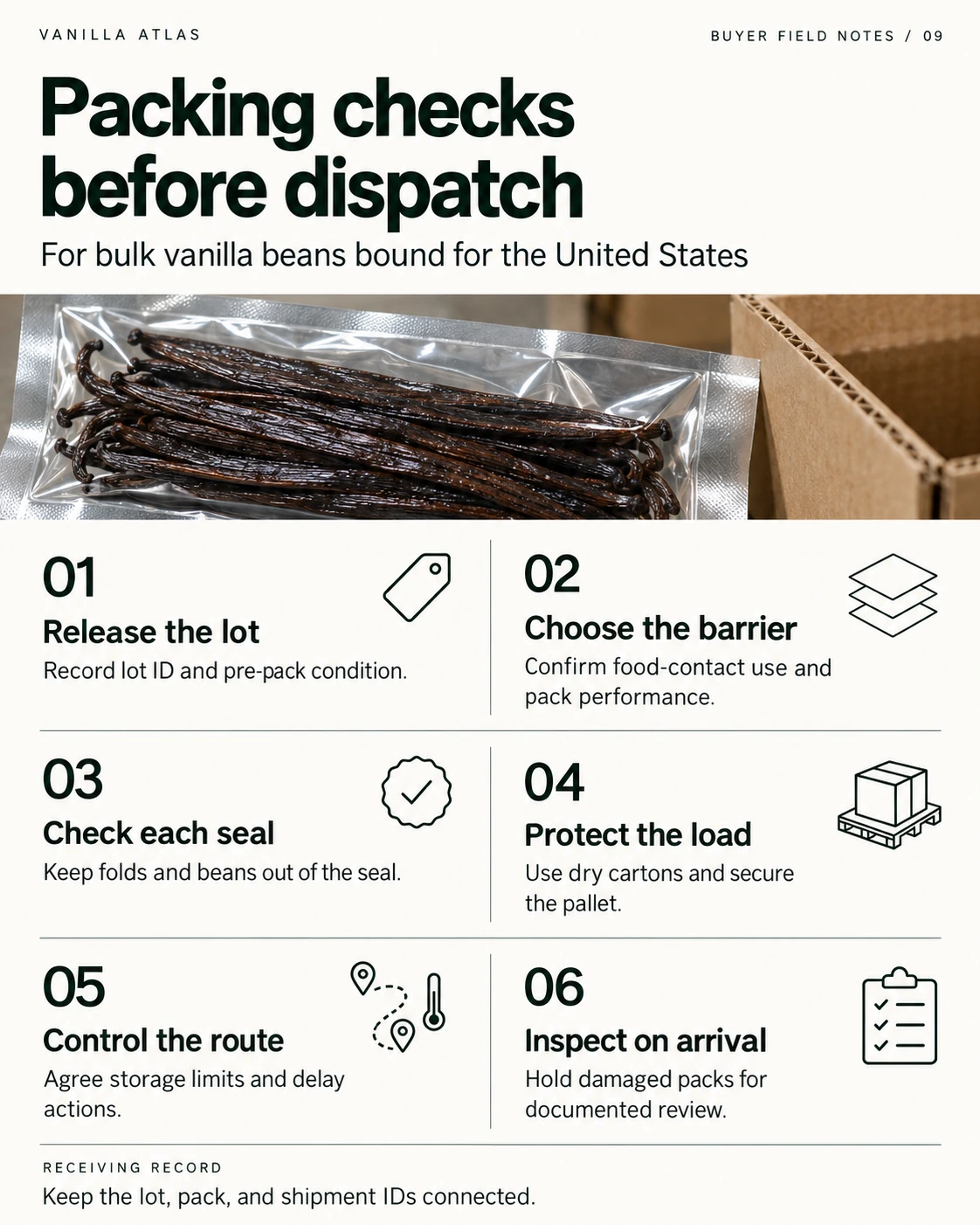
Inspect bulk vanilla beans before releasing received stock
Before opening the shipment, photograph the load and record arrival details, carton condition, identifiers, and any available seal or monitoring information. Reconcile the pack count and lot codes with the packing list.
Carry out the agreed inspection and sampling procedure. Keep findings tied to the affected pack or lot, particularly if one damaged carton sits among otherwise intact cases.
Receiving findings and provisional decisions
| Receiving finding | Provisional decision | Next action |
|---|---|---|
| Identification, pack condition, and required records match; receiving checks are complete | Proceed through the agreed release process | Record the authorized decision and move stock into the specified storage |
| Open seal, puncture, unexplained loss of vacuum, or damaged inner pack | Hold affected stock | Identify the affected units, photograph the condition, and request QA disposition |
| Condensation inside the pack, foreign odor, or suspected contamination | Hold and segregate for assessment | Preserve evidence and obtain the review or testing required by the responsible QA team |
| Temperature record, lot code, quantity, or documentation is missing or inconsistent | Hold pending reconciliation | Resolve the discrepancy before use or redistribution |
A hold is an instruction to investigate, not a diagnosis. Do not classify a suspicious deposit as harmless or release a wet pack from a photograph alone. Record any rework, replacement, or rejection decision with the responsible party.
After release, keep the same discipline in the warehouse. Move the bulk vanilla beans into the agreed vanilla bean storage area promptly, keep opened packs resealed or transferred to a suitable food-contact container, and keep the lot code with every partial quantity issued to production or customers. If a later complaint arises, those records show which packs, cartons, and storage locations the affected beans passed through.
A bulk vanilla bean packaging brief you can send
Use the following message as a starting point, then complete the fields for the order:
Please propose packaging for [lot/species/product form] for delivery to [US destination]. Confirm the available lot quantity, net weight per inner pack, pack count per carton, identified food-contact materials, closure method, and supporting intended-use documentation. Provide the planned seal checks, storage conditions, door-to-door duration, handling instructions, and action for delays. Explain how the lot code will connect the inner packs, cartons, packing list, and receiving record. Please identify any requested condition or document that is not currently available.
Add your acceptance criteria and required reports before approving the proposal. The vanilla RFQ guide covers the wider purchasing specification, and the moisture-content guide explains why moisture affects the comparison.
Frequently asked questions
What is the best bulk vanilla bean packaging for a US shipment?
Choose an identified food-contact pack with performance suited to the lot, storage conditions, and route, then protect it with the agreed outer packaging. Confirm material documentation, seal controls, traceability, and receiving criteria. A material name or photograph alone is not enough to approve it.
Should bulk vanilla beans be vacuum packed?
Vacuum packing can be considered when the product, pouch, and packing procedure are suitable and supported by the required checks. Confirm the barrier material, seal performance, expected packed condition, and response to an unexplained loss of vacuum. Vacuum does not establish product safety or shelf life by itself.
Should bulk vanilla beans be refrigerated?
Use the storage and transport conditions agreed for the actual lot and packaging. Some technical references describe refrigerated arrangements, but a universal refrigerator rule does not account for the product, route, or temperature transitions. Ask the supplier and QA team to define the conditions and handling procedure.
How long can bulk vanilla beans be stored before shipment?
Ask for the evidence supporting the proposed storage period, the lot's packing date, storage history, and remaining period under the specified conditions. Include expected transit and receiving time. This guide does not assign a universal shelf life to untested lots or packaging.
Should desiccants be placed inside the vanilla pack?
Do not add them as a default. Define any moisture-control accessory through the packaging and hazard review, including its compatibility, location, separation from food where needed, and effect on the product. A container-level moisture control and an insert inside the food pack are different proposals.
Share your packaging requirements
Planning bulk vanilla bean packaging for a shipment to the United States? Send Vanilla Atlas your product requirements, quantity, preferred inner-pack size, destination, expected route, and receiving checks. Ask which packaging formats, lot information, and supporting documents are currently available.
References
- FDA: Determining the regulatory status of components of a food-contact material. Intended-use documentation and component-specific regulatory status.
- Manitoba Agriculture: Water content and water activity. Why moisture alone cannot establish safety or shelf life.
- FAO: Vanilla, Post-harvest Operations. Packing and storage background, sections 2.3 and 2.4; last reviewed June 2009. Not current US legal guidance or validation of a supplier's lot.
- GDV Transport Information Service: Vanilla. Cargo-care background on damp handling, odors, package damage, and securing. No origin-quality ranking or universal storage guarantee is adopted here.
- IMO/ILO/UNECE CTU Code: Annex 3, Prevention of condensation damages. Moisture sources and condensation in cargo transport units.
- USDA APHIS: Wood packaging material. ISPM 15 requirements for regulated wood packaging entering the United States.
- FDA: Importing human foods. Entry-documentation context, separate from packaging performance.
Sources checked 28 October 2026. This is a buyer-side framework. Product release, numerical limits, packaging validation, storage period, and shipment requirements must be set for the actual lot and intended route.


