

Vanillepudding, Vanillekipferl and Vanilleeis all carry the same word on the pack, yet each asks something different of the vanilla. The custard needs aroma that survives cooking, the biscuit needs a dry ingredient that mixes into dough, and the ice cream needs visible seeds and a clean microbiological profile. One grade rarely serves all three well.
Choosing vanilla beans for food manufacturers in Germany starts with the vanilla’s job in the product. Use supple, high-moisture beans where seeds must be seen, whole beans or cuts for infusing milk and cream, and drier whole beans or shorts for grinding into dry mixes. Then check the German food-book rules for any product named “Vanille”.
Kurz gesagt: Die Wahl der Vanille richtet sich nach ihrer Aufgabe im Produkt. Für sichtbares Vanillemark eignen sich geschmeidige Schoten mit höherem Wassergehalt, für das Ausziehen in Milch und Sahne ganze Schoten oder Stücke, für Pulver und Trockenmischungen trockenere Schoten. Wird ein Produkt als „Vanille…“ bezeichnet, verlangen die Leitsätze des Deutschen Lebensmittelbuchs Vanille aus gemahlenen Schoten, Vanillemark, Extrakt und/oder natürlichem Vanillearoma.
This guide is for R&D, QA and purchasing teams at bakeries, confectioners and dairies in Germany. It maps grade, moisture and format to vanilla for bakery, vanilla for confectionery and vanilla for dairy, summarises what German guidelines expect when a product is named after vanilla, compares cost in use, and ends with a specification worksheet. For grade definitions, see our comparison of gourmet and extraction-grade vanilla beans.
How do you choose vanilla beans for food manufacturers in Germany?
Choosing vanilla beans for food manufacturers in Germany depends on how the vanilla works in the product. Supple, oily beans with higher moisture give the most seeds for visible use; plump whole beans or cuts release aroma when steeped in warm milk or cream; and drier whole beans or shorts grind more easily into powder for doughs, fillings and dry mixes.
Application matrix: vanilla for bakery, confectionery and dairy
| Application | Vanilla’s job | Format | Bean type to test |
|---|---|---|---|
| Custard, pudding, crème pâtissière | Aroma through cooking, visible seeds | Whole beans infused, seeds scraped | Gourmet or Select (supple, 25–35% moisture) |
| Ice cream mix | Clear vanilla taste, specks | Infusion before pasteurising; treated seeds after | Select or Gourmet; Classic for infusion only |
| Yoghurt, quark, dairy desserts | Flavour and specks after heat treatment | Treated seed paste or extract | Select or Classic, processed by a specialist |
| Biscuit doughs, Vanillekipferl | Even flavour in a dry mix | Ground vanilla beans | Dry Whole or Shorts (18–25% moisture) |
| Cake, sponge, fillings | Flavour through baking or in cream | Ground beans in batter; infused or seeds in fillings | Classic for batter; Select for fillings |
| Chocolate, pralines, fondant | Rounding note, specks in white products | Ground beans or seeds, added late | Dry Whole for powder; Gourmet for visible seeds |
| Syrups, sauces, beverages | Aroma in liquid | Cuts or whole beans steeped, or extract | Classic or Shorts |
The bean types in the last column are Vanilla Atlas selections with reference specifications, given as starting points for trials rather than rules. Your process, heat load and target taste decide the final choice of vanilla beans for food manufacturers in Germany.

What do German guidelines require for products named “Vanille”?
German food-book guidelines (Leitsätze) for ice cream, fine bakery wares and puddings say that products named “Vanille…” get their vanilla taste only from ground vanilla beans, vanilla seeds (Vanillemark), vanilla extract and/or natural vanilla flavouring, and the vanilla taste must be clearly noticeable. Products flavoured mainly with other flavourings are named “mit Vanillegeschmack”.
What the German Leitsätze expect when a product is named after vanilla
| Product group | Named “Vanille…” | “Vanille” highlighted or vanilla pictured | Origin claim |
|---|---|---|---|
| Ice cream (Vanilleeis) | Ground beans, seeds, extract and/or natural vanilla flavouring | Same four sources only | Vanilla wholly from the named origin, e.g. Bourbon |
| Fine bakery wares | The four sources, or natural vanilla flavouring with other natural flavourings | The four sources only | General rules on origin claims |
| Puddings and desserts | Ground beans, seeds, extract and/or natural vanilla flavouring | Same four sources only | Vanilla wholly from the named region |
Under the EU flavourings regulation, a “natural vanilla flavouring” must come at least 95% from vanilla (Regulation (EC) No 1334/2008, Article 16(4)). The pudding guidelines add that wording suggesting traditional craft production fits only when traditional ingredients such as vanilla beans or seeds give the flavour. The Leitsätze are not legally binding, as a Bundestag research note confirms, but food authorities and courts use them to judge what consumers expect.
What is the best vanilla for bakery?
For vanilla for bakery, match the format to the stage. Ground vanilla beans from drier whole beans or shorts disperse evenly in doughs and batters, while whole supple beans suit custards and creams that are infused and then strained. Add vanilla to fillings and glazes after baking where you can, because long, hot bakes reduce the aroma that remains.
For traditional biscuits such as Vanillekipferl, many bakers use vanilla sugar or ground vanilla in the coating sugar, where the flavour meets the palate first. If the product is named “Vanille…”, the fine bakery guidelines allow ground beans, seeds, extract and natural vanilla flavouring, plus natural vanilla flavouring with other natural flavourings, unless vanilla is highlighted or pictured. Our gourmet vanilla guide for pastry covers visible-seed use in fine pâtisserie. Good vanilla for bakery is the one that still tastes of vanilla after the oven.
What is the best vanilla for confectionery?
For vanilla for confectionery, low moisture and late addition matter most. Pralines, fondant, marzipan and chocolate are dry or fat-based, so ground vanilla from drier beans, or a fat-soluble preparation, blends without adding water. Add vanilla after the hottest cooking step where the process allows, and use scraped seeds only where visible specks are part of the product.
When you buy vanilla for confectionery, remember that very supple beans can be hard to mill and may bring extra water into a low-moisture product; drier whole beans grind more cleanly. In white chocolate, fondant and light fillings, specks become a visual signal, so judge seed size and distribution in a trial batch before you fix the grade. These are Vanilla Atlas processing notes rather than published limits, so confirm them on your own line. The best vanilla for confectionery is usually the driest one that still gives the aroma you want.
What is the best vanilla for dairy and ice cream?
For vanilla for dairy, whole beans or cuts infused in the mix before pasteurisation give flavour with the lowest microbiological risk, because the heat step treats the vanilla too. Seeds or ground vanilla added after pasteurisation, as in many yoghurts and ice creams with specks, need a microbiological specification or a heat-treated vanilla preparation.
The CBI market guide for spices notes that Salmonella must be absent from spices for the European market and that European buyers increasingly ask for steam sterilisation. For Vanilleeis and other vanilla for dairy products, the German guidelines also expect a clearly noticeable vanilla taste from vanilla sources; consumer tester Stiftung Warentest has noted that specks from extracted vanilla pods add appearance rather than flavour. Good vanilla for dairy therefore combines real flavour, the right format for the heat step and documented microbiology.

Whole beans, ground vanilla, seeds or extract: which format should you use?
Across vanilla for bakery, confectionery and dairy, use whole beans or cuts when you infuse a liquid and strain it, scraped seeds when specks must be visible, ground vanilla beans for dry mixes and doughs, and extract when you need consistent liquid dosing. Many manufacturers buy whole beans and have a specialist mill, extract or treat them, so the raw material choice still starts with the bean.
Vanilla formats for food manufacturers
| Format | Best for | Watch |
|---|---|---|
| Whole beans (infused) | Custard, ice cream mix, sauces, syrups | Steep time and temperature; strain or recover pods |
| Seeds (Vanillemark) | Visible specks in premium desserts and ice cream | Labour or paste supplier; microbiology if added after heat |
| Ground vanilla beans | Doughs, biscuits, dry mixes, coatings, chocolate | Bean moisture before milling; particle size; dark specks |
| Cuts and shorts | Infusion, extraction, syrups | Lot consistency, foreign matter |
| Vanilla extract | Consistent dosing in liquids and batters | Alcohol or carrier, strength, labelling as flavouring |
| Extracted (spent) pods | Visual specks only | Little flavour left; check the claim you make |
How does moisture change the cost of vanilla in use?
Moisture changes the cost of vanilla because you pay for water as well as aroma. At Vanilla Atlas reference prices for 10 kg or more, Gourmet costs about US$263 per kilogram of dry matter and Dry Whole about US$108, while the price gap per kilogram as sold is US$180 versus US$85. Drier grades also carry lower reference vanillin ranges, so compare them in a trial.
Vanilla Atlas selections: reference moisture, vanillin and cost in use
| Selection | Moisture (reference) | Vanillin (reference) | Price, 10 kg+ (USD/kg) | Per kg dry matter (USD) |
|---|---|---|---|---|
| Gourmet | 28–35% | 1.0–2.0% | 180 | 263 |
| Select | 25–30% | 0.8–1.8% | 165 | 228 |
| Classic | 24–28% | 0.6–1.6% | 150 | 203 |
| Dry Whole | 18–25% | 0.4–1.0% | 85 | 108 |
| Shorts | 18–25% | 0.2–0.8% | 75 | 96 |

Dry matter uses the midpoint of each moisture range. Prices are from our product pages on 9 November 2026, exclude shipping, and apply per grade; reference values are not batch test results. Vanillin is one marker, not the whole aroma, so the cheapest kilogram of dry matter is not automatically the cheapest flavour.
How much vanilla should a food manufacturer use?
There is no single dose for vanilla beans for food manufacturers in Germany, because heat, fat, sugar and the other flavours change how vanilla reads. Run a dose ladder instead: make the same product with three vanilla levels for each candidate grade, taste them blind against your target, and calculate the vanilla cost per kilogram of finished product for the level that wins.
The calculation is simple: vanilla price per kilogram multiplied by the dose in grams per kilogram of product, divided by 1,000. For example, an illustrative dose of 2 g of Classic per kilogram of product at US$150 per kilogram adds US$0.30 per kilogram of product. Run the same sum for each grade at its own winning dose, then decide.
What specification should you send a vanilla supplier?
Send a vanilla supplier a specification that names the species (Vanilla planifolia), form, length where appearance matters, a moisture range with its test method, vanillin with method only if you extract, defect limits including no mould, microbiological limits if vanilla goes in after heat treatment, packaging and lot coding. Give your application and annual volume so the supplier can suggest a grade, whether you need vanilla for bakery, vanilla for confectionery or vanilla for dairy.
Germany’s spice guidelines also list a usual upper level of 1.0 g per 100 g of acid-insoluble ash for vanilla, a useful line against sand and soil (Leitsätze für Gewürze, Annex 1). Our vanilla bean quality guide explains moisture and defects, and the supplier evaluation guide for Germany covers the documents to request.
How do you run a vanilla application trial?
Run a vanilla application trial by fixing the product claim first, then testing two or three grades in the same recipe, at the same dry-matter dose, through your real process. Judge taste, specks and colour after shelf life, not only on day one, and finish with cost per kilogram of finished product.
- Fix the claim. Decide whether the product will be “Vanille…” or “mit Vanillegeschmack”, because that limits the vanilla sources you can use.
- Choose candidates. Pick two or three grades of vanilla for confectionery, bakery or dairy from the application matrix, with samples from the lots you would buy.
- Standardise the dose. Dose on dry matter, or adjust for moisture, so a wetter bean is not favoured just by weight.
- Use the real process. Same heat steps, holding times and packaging as production.
- Test after storage. Check aroma, speck distribution and colour at the end of shelf life.
- Cost it. Calculate cost per kilogram of finished product and lock the winning grade into your specification.
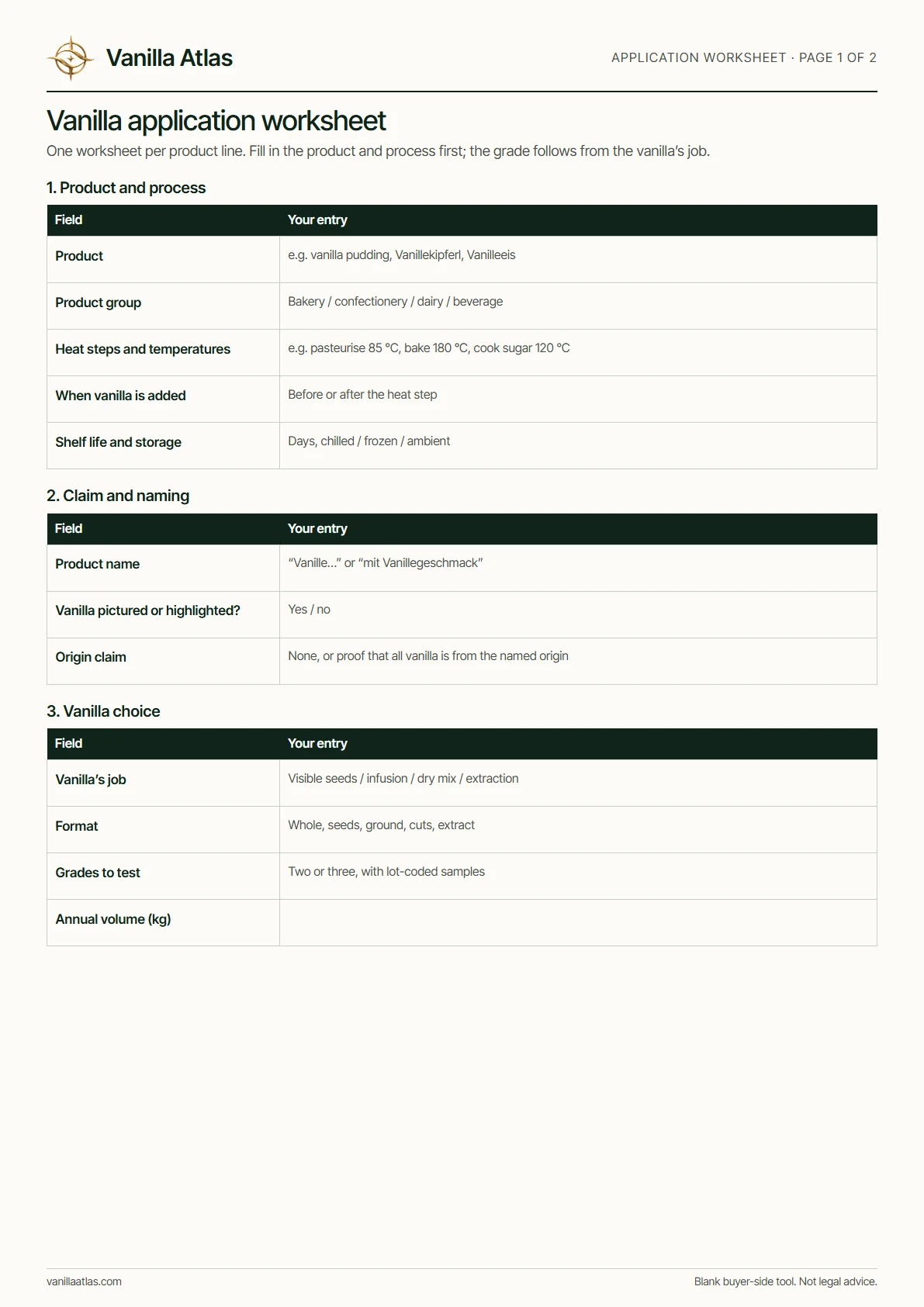
Download the vanilla application worksheet
The two-page PDF covers your product, process and claim, the grade and format you plan to test, the specification lines, and a trial record with cost in use. It turns this guide into one form for choosing vanilla beans for food manufacturers in Germany, for each product line.
Download the application worksheet (PDF)
Subject: Vanilla for [bakery / confectionery / dairy] production in Germany
We are [company], producing in Germany, with an expected annual vanilla volume of [x] kg. The vanilla’s job is [visible seeds / infusion / dry mix / extraction], and the product will be named [“Vanille…” / “mit Vanillegeschmack”].
Please suggest a grade, send reference specifications with test methods, and quote a lot-coded sample for an application trial.
Where Vanilla Atlas fits
Vanilla Atlas supplies vanilla beans for food manufacturers in Germany: Indonesian Vanilla planifolia in five selections, from supple Gourmet beans for visible use to Dry Whole and Shorts for milling and processing. We sell whole beans; milling, extraction and heat treatment are done by the buyer or a specialist processor. Germany is on our Shipping & Destinations page.
Our specification ranges are reference values, not batch test results, and a batch-specific certificate of analysis is not currently available. This guide is buyer-side information, not legal advice; confirm product naming with your own adviser or food authority.
Share your application and annual volume, and we will suggest the selection to test and send a lot-coded sample.
Frequently asked questions
Which vanilla beans are best for ice cream in Germany?
For ice cream and other vanilla for dairy uses, supple Select or Gourmet beans give the most flavour and visible seeds, while Classic beans work well for infusion. Infuse whole beans or cuts in the mix before pasteurising, and use treated seeds if specks go in afterwards. A product named Vanilleeis needs a clearly noticeable vanilla taste from vanilla sources.
Can a product be called “Vanille” if it uses vanillin?
Under the German Leitsätze for ice cream, puddings and fine bakery wares, a product named “Vanille…” gets its taste from ground vanilla beans, seeds, extract or natural vanilla flavouring. If flavourings such as vanillin give the taste, the usual name is “mit Vanillegeschmack”.
Can Indonesian vanilla be sold as Bourbon vanilla?
No. The German guidelines for ice cream and puddings say that when a geographic origin such as Bourbon is named, the vanilla comes wholly from that origin. Indonesian vanilla should be described as vanilla, or by its own origin if you can prove it.
Should vanilla for bakery be whole or ground?
For vanilla for bakery, use ground vanilla beans in doughs, batters and dry mixes, where they spread evenly, and whole beans for creams and custards that are infused and strained. Drier beans grind more cleanly. Add vanilla to fillings and glazes after baking where possible to keep more aroma.
Why are dry vanilla beans cheaper?
Dry vanilla beans carry less water and usually come from lower grades with lower reference vanillin and weaker aroma. Per kilogram of dry matter they are still cheaper, which makes them practical for milling, syrups and extraction, but test the flavour in your product before switching.
What should I tell a vanilla supplier about my application?
Tell the supplier the product, the vanilla’s job (visible seeds, infusion, dry mix or extraction), your process heat steps, the product name you plan, and your annual volume. With that, a supplier can suggest the right grade for vanilla beans for food manufacturers in Germany and send a matching sample.
Sources and review scope
Sources checked 7 November 2026. This is buyer-side guidance, not legal advice. Guideline summaries are simplified; read the full Leitsätze before naming a product. Processing notes on milling, late addition and dosing are Vanilla Atlas guidance, not published limits. Prices and specifications are Vanilla Atlas reference values, not batch results.
- Leitsätze für Speiseeis, 29 November 2016, last amended 14 January 2026, sections 2.2.2.1 and 2.2.2.2.
- Leitsätze für Feine Backwaren, 9 January 2025, section 2.1.10.
- Leitsätze für Puddinge, andere süße Desserts und verwandte Erzeugnisse, 26 March 2021 as amended, section 2.17.
- Leitsätze für Gewürze und andere würzende Erzeugnisse, 9 October 2025, section 2.1.42 and Annex 1.
- Regulation (EC) No 1334/2008 on flavourings, Article 16.
- Bundestag research service WD 5-031-17 on the legal status of the Leitsätze.
- CBI: Entering the European market for spice mixes.
- Stiftung Warentest: Vanilleeis.
- Vanilla Atlas product pages, reference specifications and prices, 9 November 2026.


One Comment