

Open a box of vanilla and three questions arrive at once. Are these beans moist enough? Will they bend or snap? And is that white dust on the tips something to celebrate or something to throw away?
To judge vanilla bean quality, check three things together: moisture, flexibility and defects. Supple, oily beans with even colour suit scraping and display. Drier beans suit extraction and milling. Splits and stains matter mainly for visible use, while mould, off smells and foreign matter are reasons to reject a lot. Decide against the job the beans must do, not a single grade name.
En bref : pour évaluer la qualité de la vanille, examinez ensemble l’humidité, la souplesse et les défauts. Une gousse souple et huileuse convient à la pâtisserie ; une gousse plus sèche, à l’extraction. Les gousses fendues comptent surtout pour l’usage visible ; la moisissure justifie un refus.
This vanilla bean quality guide for France is written for importers, pastry buyers and QA teams, and treats vanilla moisture, flexible vanilla beans and vanilla defects as one decision. It explains what each physical trait tells you, how to inspect a lot on arrival, and how to turn what you see into a decision. For the commercial maths of moisture, see our vanilla bean moisture content guide.
What makes a good vanilla bean?
A good vanilla bean is one that suits its intended use. For pastry, that usually means a whole, supple, oily pod with abundant seed paste and clean aroma. For extraction or milling, a drier bean can be better value. No single grade name settles quality; a written specification and a test in the product do.
CBI, the Dutch import-promotion agency, says no single organisation sets vanilla standards, and that beans are graded under national standards. It describes buyers looking for moisture of 20–30%, a minimum vanillin of 1.5–2%, and good length and condition. Those are reference points, not limits that apply to every order.
What vanilla moisture level should you look for?
CBI describes Grade A gourmet beans at about 30% vanilla moisture and Grade B extraction beans at about 20%. It also flags a softer 35–38% class as unstable and prone to mould. Choose a range for your use, then ask for the measured result, the method and the basis behind it. Our guide to vanilla bean grades compares these trade terms with the ISO 5565-1 categories.
Vanilla moisture classes and what they mean for buyers
| Class (CBI) | Moisture | Feel | Typical use |
|---|---|---|---|
| Very soft “gourmet” | 35–38% | Very soft and moist | Visible use, but flagged as unstable and prone to mould |
| Grade A / TK | About 30% | Flexible and soft | Pastry, scraping, display |
| Rouge (red) | 22–25% | Firmer, redder | Infusion, some extraction |
| Grade B / extract | About 20% | Usually too dry to scrape | Extraction |
| Very dry | 15–20% | Brittle and shrunken | Milling or extraction |
For vanilla moisture, the method matters as much as the number. Oven drying, distillation methods such as ISO 939 for spices, and handheld moisture analysers can give different results, and a dry-basis figure is not comparable with a wet-basis one. Ask which was used, and compare lots on the same method.
Is moisture the same as water activity?
No. Moisture content measures how much water a bean contains. Water activity measures how available that water is to microbes and chemical reactions. Two lots with similar vanilla moisture can have different water activity, which is why water activity is often the better guide to mould risk during storage.
The USDA Agricultural Research Service explains the difference for foods in general. We have not found a published water activity limit specific to cured vanilla, so treat any figure a supplier gives as lot data to discuss, and ask for the instrument and temperature behind it.
What are flexible vanilla beans, and why does flexibility matter?
Flexible vanilla beans bend gently without cracking and spring back slightly. Flexibility shows the pod still holds enough moisture and oil to split cleanly and release seed paste. A stiff or brittle pod may still have good aroma, but it is harder to scrape and better suited to infusion, extraction or milling.
Test flexible vanilla beans on a counted sample rather than one pod. Bend each pod gently into a shallow curve and count how many crack. Do not bend hard enough to damage good beans, and keep the test the same between lots so the counts compare. Our guide to gourmet vanilla beans for pastry covers the related scrape test.
Which vanilla defects should French buyers look for?
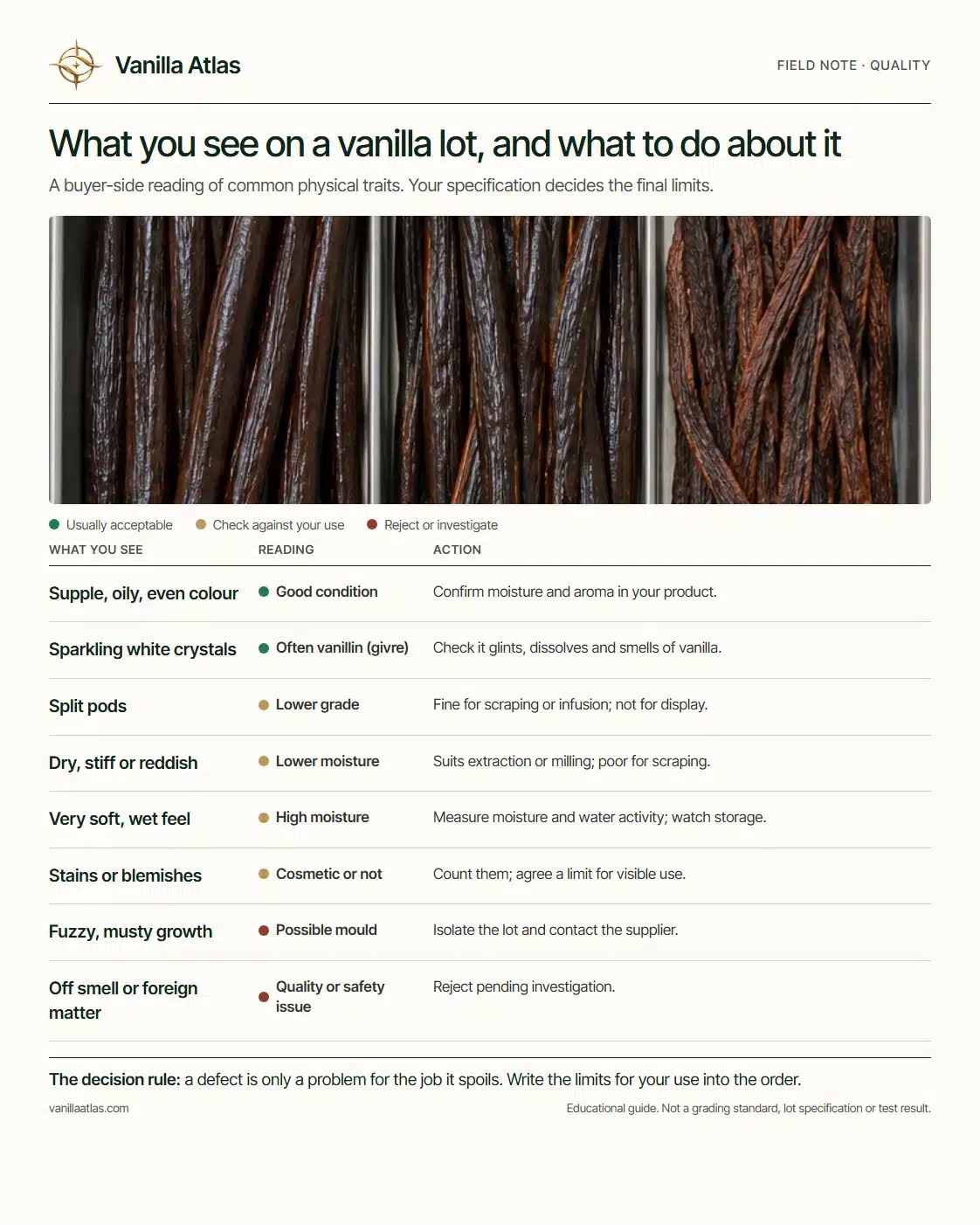
The main vanilla defects to check are splits, dryness, stains or blemishes, mould, off smells and foreign matter. Some, such as splits and stains, mainly affect appearance and price. Others, such as mould, musty or fermented smells and foreign matter, affect quality or safety and are reasons to stop and investigate.
Vanilla defects: what they mean and what to do
| Defect | What it usually means | Effect on use | Typical action |
|---|---|---|---|
| Split pods (gousses fendues) | Pod opened during curing or handling | Mainly cosmetic; lowers grade | Accept for scraping or infusion; set a limit for display |
| Dry, stiff or reddish pods | Lower moisture or overdrying | Harder to scrape; may suit extraction | Measure moisture; reassign to another use |
| Stains and blemishes | Marks from handling, curing or disease | Cosmetic unless widespread | Count them; agree a limit for visible use |
| Very soft, wet pods | High moisture | Good handling, higher storage risk | Measure moisture and water activity; check storage |
| Fuzzy or musty growth | Possible mould | Quality and safety concern | Isolate the lot and contact the supplier |
| Off smells | Fermented, smoky, musty or chemical notes | Flavour fault, sometimes a sign of spoilage | Reject pending investigation |
| Foreign matter or insects | Poor sorting or storage | Quality and safety concern | Reject pending investigation |
Practitioner guidance for sorting green beans shows how vanilla defects such as splits are commonly treated. A 2021 Pacific Island curing guide advises setting aside beans shorter than 12 cm, those split more than a third of their length, and any with disease marks. These are a curer’s rules, not a buyer’s legal standard, but they explain why splits and short pods often end up in lower grades.
Is the white coating on vanilla beans mould or vanillin crystals?
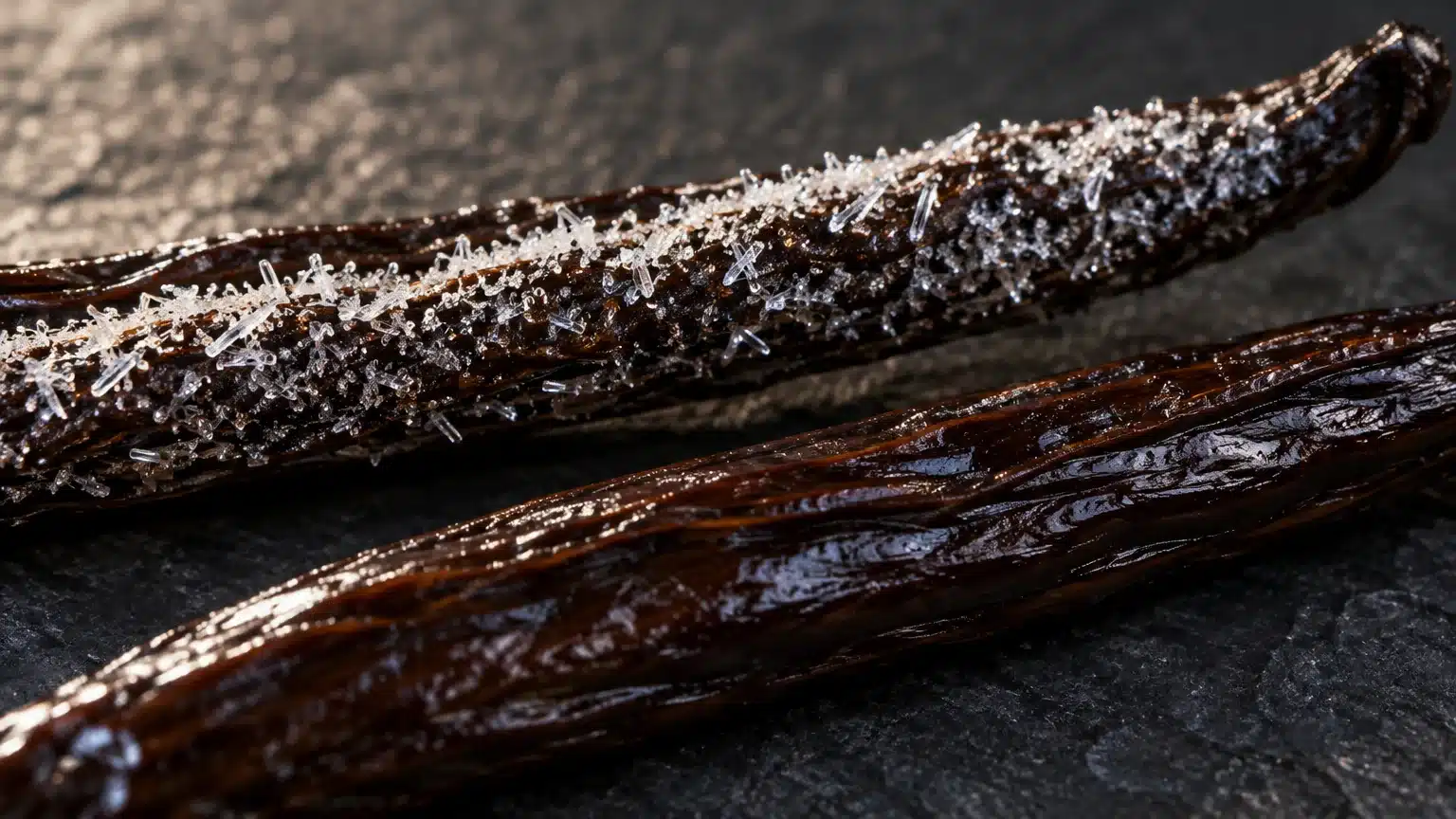
White coating on vanilla beans can be either. Vanillin crystals, called givre in French, look like fine sparkling needles that glint in light, smell of vanilla and dissolve when rubbed. Mould looks fuzzy, powdery or patchy, often grey or green, does not sparkle, and smells musty. When unsure, isolate the beans.
Givre is usually read as a good sign, but it is not proof of quality on its own, and most published guidance on it comes from vanilla sellers rather than independent research. Cook’s Vanilla notes that mould tends to smell bad and often starts at the ends of the pod. Photograph anything uncertain, keep it apart from the rest of the lot, and ask the supplier before using it.
How do moisture, flexibility and defects affect the price you should pay?
Moisture affects how much dry matter you buy in each kilogram, flexibility affects how easily the beans can be used, and defects affect grade. Pay for the vanilla moisture and condition your product needs. A pastry kitchen may pay more for supple, unsplit pods, while an extraction buyer may prefer drier, split beans at a lower price.
Matching vanilla traits to the application
| Application | Moisture and flexibility | Defects you can accept | Defects to reject |
|---|---|---|---|
| Visible pastry and plated garnish | Supple, about 30% moisture | Few; agree a small split and stain limit | Mould, off smells, brittle pods |
| Crème, ganache and glace infusions | Supple to firm | Clean splits, minor stains | Mould, off smells |
| Extraction | Drier beans acceptable | Splits, stains, dryness | Mould, off smells, foreign matter |
| Milling into powder | Dry and brittle preferred | Splits, stains, short pods | Mould, foreign matter |
Compare quotes for the same grade, form and moisture method. Our gourmet vs extraction-grade comparison covers the extraction side in more detail.
How do you inspect a vanilla lot on arrival?
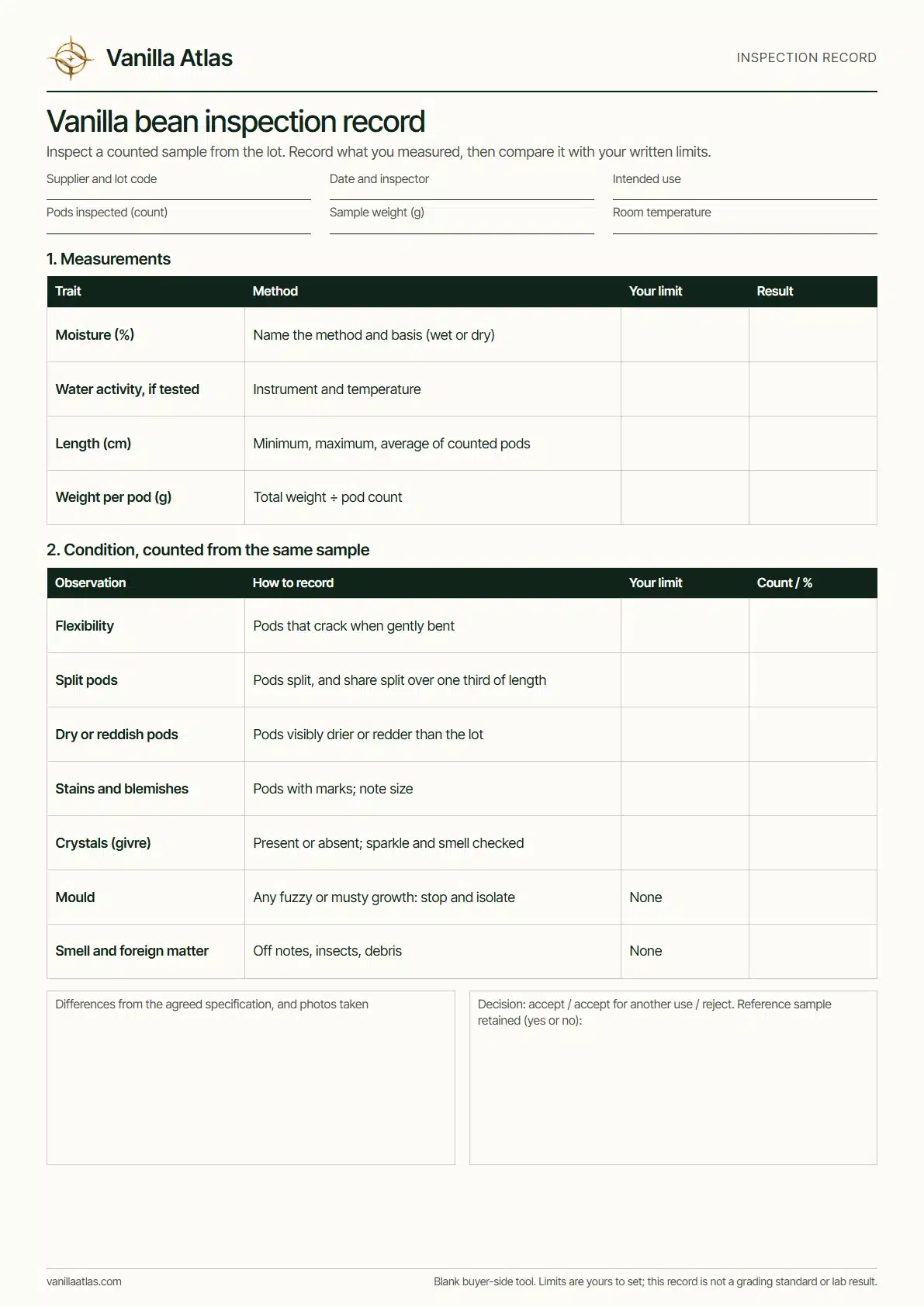
Inspect a vanilla lot on arrival in six steps: check the pack and lot code, count a sample, measure length and weight, test flexibility, count defects, and smell the beans. Compare each result with your written limits for vanilla moisture, flexibility and vanilla defects, then accept, reassign the lot to another use, or reject it.
- Check the pack. Confirm the lot code matches the documents and that seals and packaging are intact. Note any condensation inside the pack.
- Take a counted sample. Draw pods from more than one pack, and record how many you inspect.
- Measure. Record length and weight per pod, and moisture with its method if you can test it.
- Test flexibility. Bend each sampled pod gently and count those that crack.
- Count defects. Splits, dry pods, stains, crystals and anything suspicious, each as a count from the same sample.
- Smell and decide. Note off smells, then compare all results with your limits and record the decision.
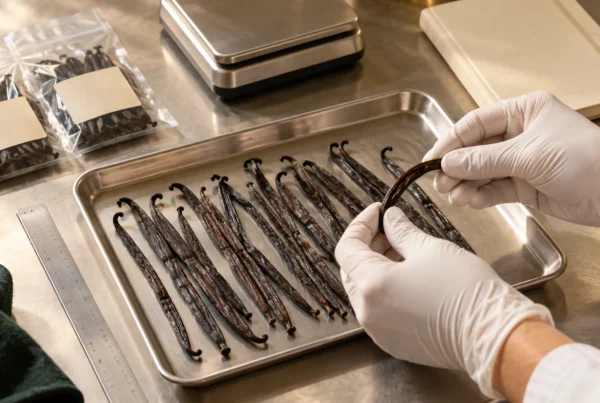
Run the inspection somewhere clean and well lit, and keep a sealed reference sample of every lot you accept. Our sample evaluation guide explains how to link a pre-order sample to the lot that arrives.
Download the inspection record (PDF)
Vanilla bean quality guide for France: what changes for French buyers?
French buyers use the same physical checks as anyone else, but they often buy for visible pastry, sell under French and EU labelling rules, and work with familiar French trade terms. A vanilla bean quality guide for France should therefore cover display quality, EU food safety duties and the vocabulary suppliers will use.
French vanilla trade terms and what to ask
| Term | Meaning | What to ask |
|---|---|---|
| Gousse fendue | Split pod | What share of the lot is split, and by how much? |
| Vanille givrée | Vanilla with vanillin crystals (givre) | How was the crystal coating checked against mould? |
| Vanille rouge | Red, firmer and drier vanilla | What is the measured vanilla moisture, and by which method? |
| Moisi | Mould | Has any mould been found in this lot or in storage? |
| Taux d’humidité | Moisture content | Wet or dry basis, which method, and on what date? |
Under EU food law, the importer must be able to trace each lot one step back and one step forward, and must not place unsafe food on the market. Vanilla defects such as mould and foreign matter are therefore more than a price issue in France. Our traceability guide covers the record side of the same lot.
How should you store vanilla beans to protect quality?
Store vanilla beans in airtight, food-grade packaging, away from heat, light and strong smells, and check them regularly. Flexible vanilla beans with high vanilla moisture risk mould if they are sealed warm or kept humid, while dry storage slowly makes them brittle. Agree storage conditions and a check routine with your supplier for each lot.
Open packs only when needed, and reseal them promptly. If condensation appears inside a pack, or a smell changes, inspect the beans before using them. For shipment and bulk storage controls, see our bulk packaging guide. We do not give a universal shelf life, because it depends on moisture, packaging and conditions.
What should a vanilla quality specification include?
A vanilla quality specification should name the species, form, length range, moisture range with method and basis, flexibility test, split and stain limits, a zero-mould rule, smell, foreign matter and lot coding. Add the sampling plan and what happens if a delivery falls outside the limits, so both sides know the next step.
Write limits for your application rather than copying a grade name; this vanilla bean quality guide for France gives the starting points. Then add the paperwork: our vanilla supplier checklist for France covers documents and importer roles, and our vanilla bean RFQ guide shows how to put the specification into an enquiry.
Where Vanilla Atlas fits
Vanilla Atlas sells Indonesian Vanilla planifolia in five selections, from supple Gourmet beans to Dry Whole beans and Shorts for processing. Our product pages give reference ranges for each selection. Those are reference values, not batch test results, and a batch-specific certificate of analysis is not currently available.
Apply this vanilla bean quality guide for France to our lots as well. Tell us your application and limits, and we will tell you which selection to test and what is known about the lot on offer. France is on our Shipping & Destinations page, with availability, charges and timing confirmed for each order.
Request measured specifications for the lot you are considering.
Frequently asked questions
How do you tell if vanilla beans are good quality?
Check moisture, flexibility and defects together. Good beans for pastry are supple, oily and evenly coloured, with no mould or off smell. Then confirm aroma in your product. The right quality depends on the job the beans must do.
What moisture should vanilla beans have?
CBI describes Grade A gourmet beans at about 30% moisture and extraction beans at about 20%, and flags 35–38% as unstable and prone to mould. Choose a range for your use, and always ask for the test method and basis.
Why are my vanilla beans dry and hard?
Dry, stiff beans have lower moisture, either from curing or from storage. They are harder to scrape but can still be aromatic. Use them for infusion, extraction or milling, and store beans in airtight packaging to slow further drying.
Are split vanilla beans a defect?
A split lowers the commercial grade and matters when the whole pod is on display. It does not by itself mean poor flavour. For scraping, infusion or extraction, clean split pods can perform well and often cost less.
How can you tell vanillin crystals from mould on vanilla beans?
Vanillin crystals sparkle like fine needles, smell of vanilla and dissolve when rubbed. Mould looks fuzzy or patchy, often grey or green, does not sparkle and smells musty. If you are unsure, isolate the beans and contact your supplier.
Can you use vanilla beans with mould?
No. Treat mould as a reason to isolate the affected beans and the lot, and contact your supplier. Do not wipe it off and use the beans in food. Check how the beans were stored and whether other packs are affected.
Sources and review scope
Sources checked 3 November 2026. Moisture classes come from CBI and are reference points, not universal limits. The green-bean sorting rules are a practitioner’s guidance, not a buyer standard. Guidance on telling givre from mould comes mainly from vanilla sellers; we found no independent study of it. We found no published water activity limit for cured vanilla. The inspection steps and limits are Vanilla Atlas suggestions.
- CBI: Entering the European market for vanilla, updated 2 May 2023.
- USDA Agricultural Research Service: Water activity in foods.
- Pacific Island Farmers Organisation Network: Vanilla curing day 1, sorting and grading, October 2021.
- Cook’s Vanilla: Mold versus crystals on vanilla beans, a seller’s guide.
- ISO 939, Spices and condiments: determination of moisture content (entrainment method), cited by title only.


2 Comments