

“Origin: Indonesia” fits on a single line of an invoice. It does not tell a French buyer which farms grew the beans, who cured them, or whether three lots were blended before packing.
Vanilla traceability in France means being able to show where a lot came from and where it went. EU law requires every food business, importers included, to trace one step back and one step forward. For vanilla, French importers should also ask suppliers for source areas, harvest period, curing site, any lot mixing, lot-to-pack links and change notices, and make claims only where records support them.
En bref : la loi européenne impose à l’importateur une traçabilité d’un maillon en amont et d’un maillon en aval. Pour la vanille, demandez aussi les zones d’origine, la période de récolte, le lieu de préparation, les mélanges de lots et le lien lot-colis, puis limitez vos allégations à ce que les documents prouvent.
This guide is for importers, quality teams and sustainability teams responsible for vanilla traceability in France. It answers the questions buyers most often ask about vanilla supply chain traceability, and ends with twelve questions to send a supplier. It is a working guide, not legal advice.
Vanilla traceability in France: what does EU law require?
Vanilla traceability is the ability to follow a lot of beans through each business that handled it. Under Article 18 of Regulation (EC) No 178/2002, every EU food business must identify its direct supplier and direct business customer. That is the legal floor for vanilla traceability in France; anything deeper comes from contracts.
The European Commission’s guidance explains that this duty reaches the importer, but that exporters in third countries are not themselves bound by Article 18. It suggests keeping supplier and customer names and addresses, product identification, and transaction dates and quantities. Article 19 adds duties to withdraw unsafe food and inform the authorities where required.
We have not found an EU traceability rule written specifically for vanilla. If a French customer wants to know which farms or curing sites supplied a lot, the importer has to ask for it, and the supplier has to agree to provide it.
Why is vanilla supply chain traceability harder than it looks?
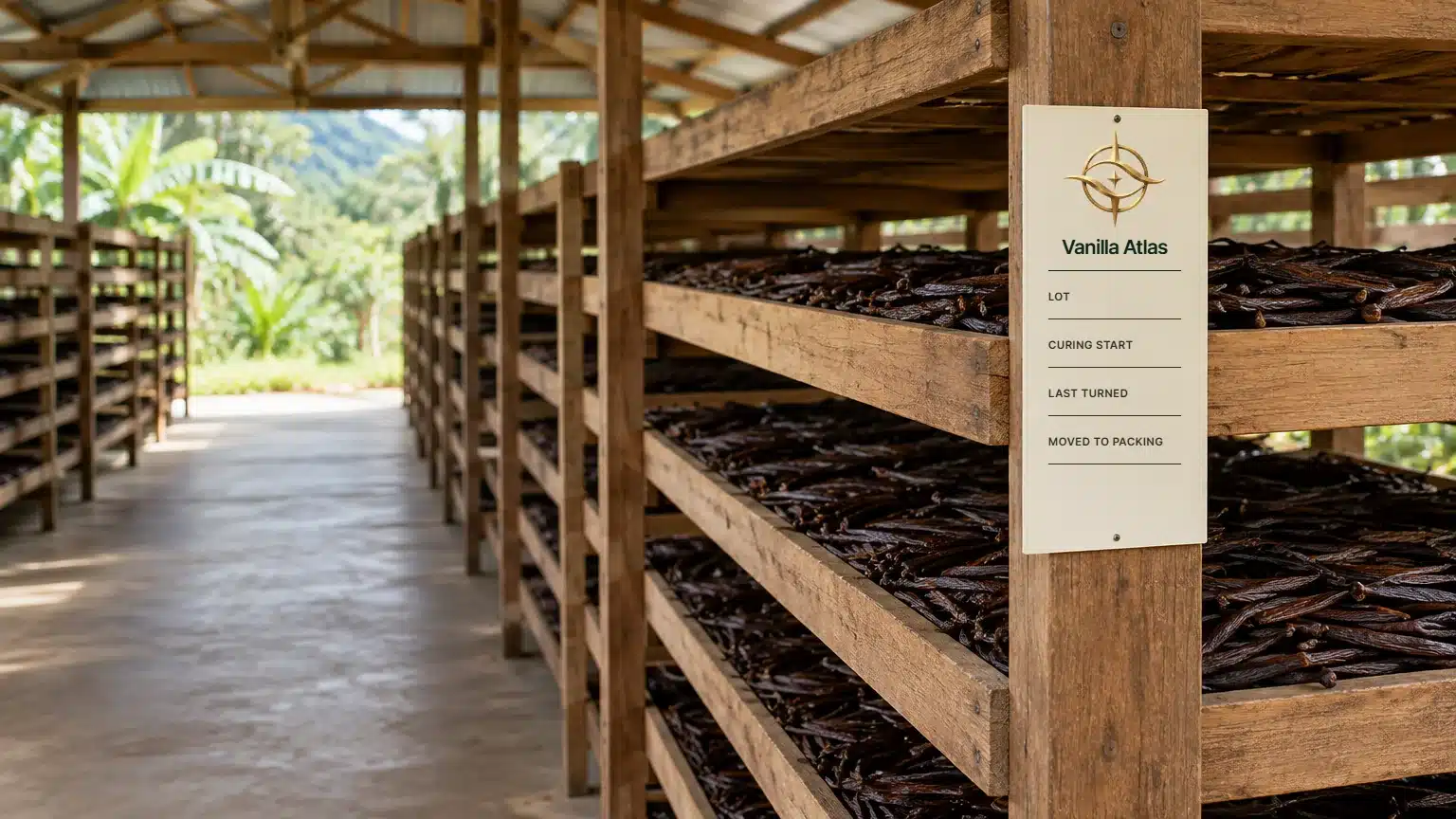
Vanilla supply chain traceability is hard because many hands touch a lot before export. In Indonesia, farmers often cure their own beans, collectors may consolidate them, and exporters buy from several sources. Each handoff can merge lots, so a single shipment may contain beans from many farms and curing batches.
A 2024 field study gives a sense of the scale. Munarso et al. interviewed 60 farmers and 8 exporters across seven Indonesian provinces in 2023. They found:
- Most farmers scald, ferment and dry their own beans before selling them.
- Exporters drew 25% of raw material from their own gardens, 37.5% from farmers in their group and 37.5% from farmers outside it.
- About half of farmers did not sort beans, while about 70% of exporters sorted by length and size.
- Fear of theft can push farmers to harvest before nine months.
The study did not describe a formal traceability system. So when an exporter says “traceable”, ask how far back the record actually goes and whether lots from different sources are kept apart. Our guide to Indonesian vanilla explains the growing regions and curing steps behind these handoffs.
What traceability information should French importers ask for?
Ask for a lot record that links the legal supplier, lot code, source farms or areas, harvest period, curing site and dates, any mixing or re-grading, quantities in and out, pack and carton codes, and shipment documents. Together these fields support vanilla traceability in France beyond the one-step legal minimum.
Vanilla traceability fields and why they matter
| Field | What to ask for | Why it matters |
|---|---|---|
| Legal supplier | Entity name, address, registration and role | Article 18 starts with the direct supplier |
| Lot code | The code and how it is assigned | Without a lot code there is nothing to trace |
| Source | Farms, farmer groups or areas, as precisely as the supplier can state | Supports origin statements and any withdrawal |
| Harvest period | Months or season of harvest | Links the lot to a crop year and to maturity questions |
| Curing | Site, operator and start and end dates | Curing shapes quality and is a common point of mixing |
| Mixing and re-grading | Input lots, output lots and quantities | Shows whether one lot became several, or several became one |
| Packing | Lot-to-pack and lot-to-carton links | Lets you find affected stock quickly |
| Shipment | Invoice, packing list, transport and origin papers | Connects the lot to what actually arrived |
| Certificates | Certificate, scope, site and date; organic e-COI if relevant | Confirms that a claim covers this lot |
The Commission’s Implementing Regulation (EU) No 931/2011 sets similar fields for food of animal origin. It does not apply to vanilla, but its list is a useful model. Our guide to tracing a lot through its documents shows how to reconcile these records with cartons and invoices.

What is a vanilla chain of custody?
A vanilla chain of custody is the sequence of records showing who held a lot and how it was handled at each step. ISO 22095 describes models that either keep material separate or allow mixing. Agreeing on a vanilla chain of custody model tells you which claims the records can actually support.
Chain of custody models applied to vanilla
| Model (ISO 22095) | What it means for vanilla | Claims it can support |
|---|---|---|
| Identity preserved | Beans from one identified source stay separate to the final pack | Claims about that specific source, if records prove it |
| Segregated | Beans meeting a defined criterion stay apart from others, but sources may mix | Claims about the criterion, not about a single farm |
| Controlled blending or mass balance | Qualifying and other beans mix, and quantities are tracked | Only volume-based claims; not that a given pack contains qualifying beans |
Ask the supplier which model applies to your lot, and get the answer in writing. A vanilla chain of custody that mixes lots is not wrong. It simply supports different claims from one that keeps them apart. ISO 22095:2020 is being revised, so check the current edition before citing it in a contract.
What is the difference between origin documentation for vanilla and traceability?
Origin documentation for vanilla, such as a certificate of origin, states the country where the goods originate, mainly for customs and tariff purposes. Traceability links a specific lot to its sources and handlers. A valid certificate of origin can say “Indonesia” while telling you nothing about the farms, collectors or curing sites behind the lot.
Ask for both, and keep them separate in your file, because vanilla supply chain traceability depends on the second, not the first. Origin documentation for vanilla answers a customs question, while the lot record answers a food safety and claims question. The vanilla supplier checklist for France covers the customs side, and our supplier documents guide separates usual paperwork from conditional requirements.
Does the EU Deforestation Regulation apply to vanilla?
No. Vanilla is not one of the seven commodities covered by the EU Deforestation Regulation: cattle, cocoa, coffee, oil palm, rubber, soya and wood. The Commission lists its application dates as 30 December 2026 for large and medium operators and 30 June 2027 for micro and small operators.
Two cautions apply. The scope has been amended and may change again, so check the Commission’s EUDR page before relying on it. And some French customers ask for deforestation or land-use information anyway. That is a contractual request, so agree what evidence is realistic before promising it.
Can you call vanilla sustainable or fully traceable in France?
Only with evidence. Since 27 September 2026, Directive (EU) 2024/825 prohibits generic environmental claims to consumers, such as “eco-friendly”, unless the trader can show recognised excellent environmental performance. A claim like “traceable to the farm” also needs records that prove it for the lot sold.
Write specific, checkable claims instead of general ones, and keep the records behind each claim. For vanilla traceability in France, that means a claim about a farm or region needs a lot record that reaches that farm or region. Separate certified statements, such as organic, from your own descriptions. This is a summary rather than legal advice, so have consumer-facing wording reviewed, especially for retail packs sold in France.
Which questions should French importers ask their vanilla suppliers?
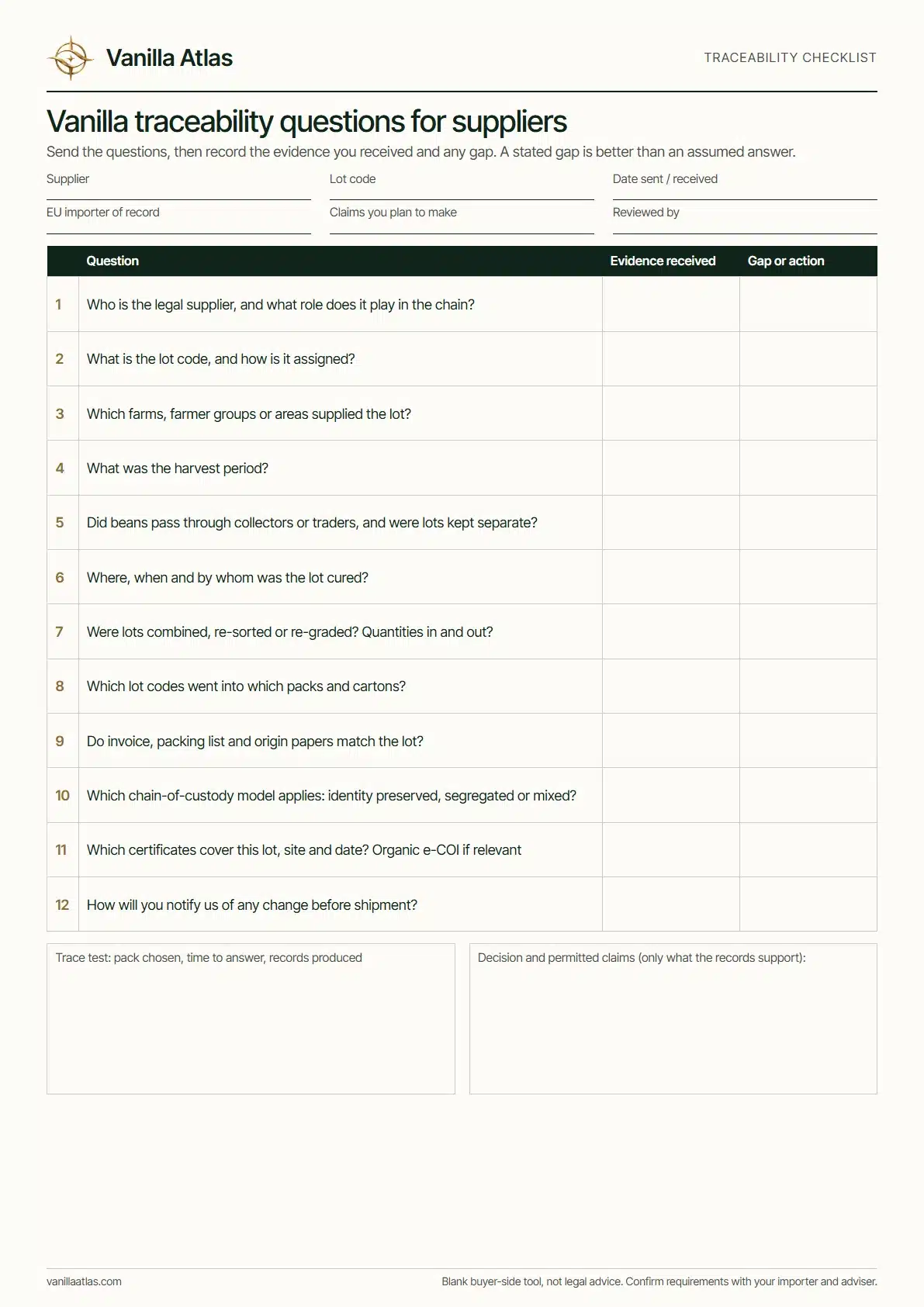
Ask twelve questions covering identity, lot coding, sources, harvest, collectors, curing, mixing, packing, documents, chain of custody, certificates and change control. Ask for the record behind each answer, including the origin documentation for vanilla that customs will need. If a record does not exist, ask the supplier to say so in writing rather than fill the gap with an assumption.
- Who is the legal supplier, and what role does it play in the chain?
- What is the lot code, and how is it assigned?
- Which farms, farmer groups or areas supplied the lot?
- What was the harvest period?
- Did beans pass through collectors or traders, and were lots kept separate?
- Where, when and by whom was the lot cured?
- Were lots combined, re-sorted or re-graded, and in what quantities?
- Which lot codes went into which packs and cartons?
- Do the invoice, packing list and origin papers match the lot?
- Which vanilla chain of custody model applies: identity preserved, segregated or mixed?
- Which certificates cover this lot, site and date, including an organic e-COI if relevant?
- How will you notify us of any change before shipment?
Download the traceability questions (PDF)
How can you test a supplier’s traceability claims?
Run a trace test before a large order. Pick one pack or carton code, ask the supplier to trace it back to its source and curing records, and note how long it takes and what they produce. Then check that quantities in and out roughly balance across any mixing steps.
- Pick the code yourself. A supplier choosing its best-documented lot tests less.
- Check quantities. Wet beans lose weight in curing, so ask how the supplier accounts for that loss rather than expecting identical weights.
- Compare documents. Lot codes on the record, the packs and the invoice should match.
- Record the result. Note the time taken and any gaps, and repeat with each new supplier.
The time limit and test method are our suggestions rather than a legal standard. For the physical side of a lot, use our sample checklist, and set packing and lot-marking rules with our bulk packaging guide. Put the agreed vanilla chain of custody and record fields into your vanilla bean RFQ.
What should a vanilla lot code contain?
A vanilla lot code should be unique, appear on every pack and document for that lot, and point to a record of its source, curing and packing. The code itself does not need to carry the information. It needs to lead reliably to records that do, at every step of vanilla supply chain traceability.
Many suppliers build codes from parts such as the supplier, harvest year and curing batch. That is fine, as long as the format is explained and never reused. Ask what happens to the code when lots are combined or re-graded, because that is where vanilla traceability in France usually breaks. A new code should appear for the new lot, with a record of which input lots went into it.
How long should vanilla traceability records be kept?
Article 18 of Regulation 178/2002 does not set a single retention period for all foods. Agree a period with your compliance team that covers at least the shelf life of the vanilla and the time needed to handle a complaint or withdrawal, and write the supplier’s matching duty into the contract.
Vanilla is stored and resold over long periods, so a record that disappears after one season may be too short. Ask the supplier how its records are stored and how quickly it can retrieve them. Then check that your own origin documentation for vanilla, invoices and lot records are kept for the same period, so the chain does not break on your side.
Where Vanilla Atlas fits
Vanilla Atlas supplies Indonesian Vanilla planifolia in five selections. Each quote states the lot’s handling chain, so you can see where it was grown, cured, packed and held. France is on our Shipping & Destinations page, with availability, charges and timing confirmed for each order.
We do not claim that every field in this guide is available for every lot. A batch-specific certificate of analysis is not currently available, and we make no sustainability or farm-level claims that our records cannot support. Send us the twelve questions and we will answer each one for a given lot, including where a record does not exist. That is how we approach vanilla traceability in France: specific answers, and stated gaps.
Share your documentation requirements, including the claims you plan to make and who will act as importer.
Frequently asked questions
Is vanilla traceability required by law in France?
Yes, at a basic level. Article 18 of Regulation 178/2002 requires every EU food business, including importers, to identify its direct supplier and direct business customer. Deeper vanilla traceability in France, back to farms or curing sites, has to be agreed with the supplier by contract.
What is vanilla supply chain traceability?
Vanilla supply chain traceability is the ability to follow a lot of beans through each business that handled it, from farm and collector to curing, sorting, packing, export and the EU importer. It relies on lot codes and records that link each step.
Does the EUDR apply to vanilla?
No. The EU Deforestation Regulation covers cattle, cocoa, coffee, oil palm, rubber, soya and wood, not vanilla. The scope has been amended before, so check the current text, and note that some customers request deforestation information under contract anyway.
Is a certificate of origin enough for vanilla traceability?
No. Origin documentation for vanilla, such as a certificate of origin, states the country of origin for customs purposes. Traceability links a specific lot to its farms, collectors, curing site and packs. Ask for both and keep them separate in your file.
What is a vanilla chain of custody model?
It describes how a lot is handled between sources. Identity preserved keeps one source separate, segregated keeps qualifying beans apart, and mass balance allows mixing while tracking quantities. Each model supports different claims, so agree which one applies to your lot.
Can I market vanilla as sustainable in France?
Only with evidence. Since 27 September 2026, generic environmental claims to consumers such as eco-friendly are prohibited under Directive 2024/825 unless recognised excellent environmental performance is shown. Use specific claims backed by records, and have retail wording reviewed.
Sources and review scope
Sources checked 3 November 2026. This is a buyer-side guide, not legal advice. The Commission guidance and the claims directive were reviewed through official summaries and search extracts, and ISO 22095 through catalogue listings rather than its full text. The trace test and its method are Vanilla Atlas suggestions. The Indonesian field study covers 68 interviews in seven provinces and does not describe every supply chain.
- European Commission: Guidance on Articles 11, 12, 14, 17, 18, 19 and 20 of Regulation (EC) No 178/2002.
- Munarso S.J. et al. (2024). From bean to market: exploring the chemical and production dynamics of high-quality Indonesian vanilla. Front. Sustain. Food Syst. 8:1425656.
- ISO 22095:2020, Chain of custody: General terminology and models.
- European Commission: Regulation on deforestation-free products.
- Directive (EU) 2024/825 on empowering consumers for the green transition.
- Commission Implementing Regulation (EU) No 931/2011, for food of animal origin, used here only as a model.


One Comment