

Your QA manager asks a simple question about the new vanilla supplier: “What is the bag made of, and where is the paperwork?” The supplier replies “food grade plastic”. That answer will not satisfy an auditor in Germany, and it tells you nothing about migration, PFAS or what happens in a humid container.
For vanilla food contact packaging, German importers should ask what the bag is made of and by whom, for the maker’s declaration of compliance, whether paper or board touches the beans, for a PFAS and bisphenol statement, how bags are sealed, the moisture at packing, lot coding on every layer, the carton and pallet specification, who registers the packaging in Germany, and how it will be inspected on arrival.
Kurz gesagt: Fragen Sie den Lieferanten nach Material und Hersteller des Beutels, der Konformitätserklärung nach Verordnung (EU) Nr. 10/2011, Papierkontakt, PFAS und Bisphenolen, Siegelung, Feuchte beim Verpacken, Chargennummer auf jeder Ebene, Karton und Palette, LUCID-Registrierung und Wareneingangskontrolle. „Lebensmittelecht“ allein ist kein Nachweis.
This guide is for importers and QA teams in Germany who receive vanilla beans in bulk. It turns the rules on vanilla food contact packaging into the questions you can send to a supplier, and ends with a free two-page questionnaire. Our bulk vanilla packaging guide for France covers vacuum packing and carton labels in more depth; this one focuses on the evidence German buyers ask for.
What should German importers ask about vanilla food contact packaging?
German importers should ask ten questions about vanilla food contact packaging, layer by layer: the bag material and maker, the declaration of compliance, paper contact, PFAS and bisphenols, sealing, moisture at packing, lot codes, carton and pallet, LUCID registration, and arrival checks. Each answer should come with a document or a measurement, not only a promise.

Ask the questions before the first order, when changing the pack is still cheap. After the beans are sealed, you can only inspect what arrives. Our supplier evaluation guide for Germany places packaging inside the wider nine-check process.
Which food-contact rules apply to vanilla packaging in Germany?
In Germany, vanilla food contact packaging must meet the EU framework Regulation (EC) No 1935/2004: it must not transfer substances in amounts that endanger health or change the beans unacceptably. Plastic bags also fall under Regulation (EU) No 10/2011, manufacture under good manufacturing practice, and national enforcement under the German food code (LFGB).
Germany adds one practical layer. The Federal Institute for Risk Assessment (BfR) publishes recommendations on food contact materials, for example Recommendation XXXVI for paper and board. They are not law, but German buyers and laboratories often use them as the benchmark where EU rules have no specific measure, such as for paper, rubber and silicone.
What should a declaration of compliance for vanilla bags include?
A declaration of compliance for vanilla bags should name who issued it and who made the material, identify the material, give a date, confirm compliance with Regulation (EU) No 10/2011 and Regulation (EC) No 1935/2004, and state the conditions of use: food types, time and temperature, and surface-to-volume ratio. Annex IV of the regulation lists these fields.
Declaration of compliance fields and what to check for vanilla
| Field (Annex IV, Regulation 10/2011) | What to check for vanilla |
|---|---|
| Issuer and material maker | A real packaging company, not only the vanilla exporter |
| Identity of the material | Matches the bag you receive: material, structure, thickness |
| Date | Current; ask for a new one if the bag or maker changes |
| Compliance statement | Names Regulation (EU) No 10/2011 and Regulation (EC) No 1935/2004 |
| Restricted substances | Information you can pass on, so your own checks are possible |
| Food types | Covers dry foods with some natural oil, such as vanilla beans |
| Time and temperature | Long-term storage at room temperature, matching your shelf life |
| Surface-to-volume ratio | Fits your bag size and fill weight |
| Functional barrier, if any | Confirmed for multi-layer films |
The full text of Regulation (EU) No 10/2011 also requires supporting test documents to be available to authorities on request. You usually receive the declaration, not the test reports. If the declaration names a food type or temperature that does not fit vanilla, ask the bag maker before you accept it as vanilla food contact packaging.
Which bag material works best for vanilla beans?
No single material is best for vanilla food contact packaging. Polyethylene liners are simple and common, polyamide-polyethylene bags hold a vacuum and keep aroma in well, and aluminium laminates add a strong barrier to light and moisture. Choose by route, storage time and use, then ask for the declaration covering that exact structure.
Common inner bags for bulk vanilla packaging
| Bag type | Strengths | Watch for |
|---|---|---|
| Polyethylene (PE) liner, heat-sealed | Simple, low cost, easy to reseal | Weaker aroma and oxygen barrier; seal quality varies |
| Polyamide-polyethylene (PA/PE) vacuum bag | Holds vacuum; good aroma barrier | Sharp pod tips can pierce; vacuum can press oil out |
| Aluminium laminate bag | Strong barrier to light, oxygen and moisture | Cannot see the beans; harder to inspect seals |
| Double bag (inner liner plus outer bag) | Backup if one layer fails | Two declarations needed if both touch food |
This comparison reflects common trade practice, not a published standard. Test a pack from the first shipment before you commit to a format for a full year of bulk vanilla packaging.
What if cardboard or paper touches the vanilla beans?
Avoid direct contact between vanilla beans and cardboard unless the paper is made for food contact and documented. Recycled board can contain mineral oil residues from printing inks, and the BfR has described their transfer into food. A documented inner bag between the beans and the carton is the usual vanilla food contact packaging solution.
If paper does touch the beans, such as wrapping paper or a paper label inside the bag, ask for evidence against BfR Recommendation XXXVI or an equivalent assessment. The BfR opened a public consultation on revising its paper recommendations in April 2026, so ask suppliers which version their evidence refers to.
Do PFAS and bisphenol rules affect vanilla packaging?
Yes. Since 12 August 2026, the EU Packaging and Packaging Waste Regulation limits PFAS in food-contact packaging, with caps for single PFAS, total PFAS and polymeric PFAS. Separately, Regulation (EU) 2024/3190 bans bisphenol A in food contact materials, mainly affecting coatings, varnishes and some rigid plastics.
For plain PE or PA/PE bags these rules are rarely a problem, but labels, adhesives, coated papers and tins can be. Ask for a written PFAS and bisphenol statement covering every component of the vanilla food contact packaging. The main BPA transition period ended on 20 July 2026, according to the Food Packaging Forum, with some later dates for specific items.
How should vanilla bags be sealed and checked?
Vanilla bags should be closed by a continuous heat seal or vacuum seal with no wrinkles or trapped beans in the seal line. Ask how seals are checked for each lot, for example by visual inspection and a pull or squeeze test on sample bags, and what happens to bags that fail.
A lost vacuum on arrival does not always mean a failed seal; sharp pod tips can make pinholes. Record the cause separately from bean quality. Our bulk vanilla bean packaging guide compares vacuum and non-vacuum packs and explains when vacuum packing helps or hurts.
Which vanilla storage packaging questions prevent mould?
Ask for the moisture result and method at packing, whether the beans were cooled before sealing, how long they wait before dispatch, and whether a temperature logger travels with the shipment. Mould in vanilla storage packaging usually starts with beans sealed too moist or too warm, then condensation when the container cools.
After arrival, good vanilla storage packaging still needs good storage. Keep cartons closed in a cool, dry, dark place away from strong smells, open one bag at a time, and reseal it promptly. Our guide to vanilla bean moisture explains how moisture links to mould risk and value.
What lot codes and labels should each packaging layer carry?
Each packaging layer should carry the same lot code: inner bag, carton, pallet label, invoice and packing list. Cartons should also show the product, species, net weight, origin, storage advice and the EU importer. Matching codes in bulk vanilla packaging let you trace a problem bag back to its lot and connect it to the supplier’s records.
Lot codes and labels by packaging layer
| Layer | What it should show | Why it matters |
|---|---|---|
| Inner bag | Lot code, net weight | Identifies the bag once the carton is opened |
| Carton | Product, species, lot, net weight, origin, storage advice, EU importer | Used at receipt, storage and recall |
| Pallet | Lot codes on the pallet, carton count, ISPM 15 mark if wooden | Checked at the dock and by customs |
| Documents | Same lot codes as the cartons | Links goods to invoice, lab report and declaration |
Our vanilla traceability guide for German buyers explains how these codes connect to one-step-back records under EU food law.
Who registers vanilla packaging in Germany?
In Germany, the business that first places packaged goods on the German market must register in the LUCID packaging register run by the Zentrale Stelle Verpackungsregister. When you import packed vanilla, that is usually you, not the Indonesian exporter. Packs that end up with private consumers also need participation in a licensed collection system.
German packaging law changed in 2026, when national rules were adapted to the EU regulation that applies from 12 August 2026. Check the current obligations for your role on the ZSVR website, especially if you repack bulk vanilla into retail jars or tubes for sale in Germany.
What should German importers check when vanilla packaging arrives?
On arrival, check that the pallet and cartons are intact, the lot codes match the documents, the logger shows no long temperature swings, and bags show no lost vacuum, split seals or condensation. Then open bags from top and bottom cartons and inspect the beans for moisture, mould and smell before accepting the lot.
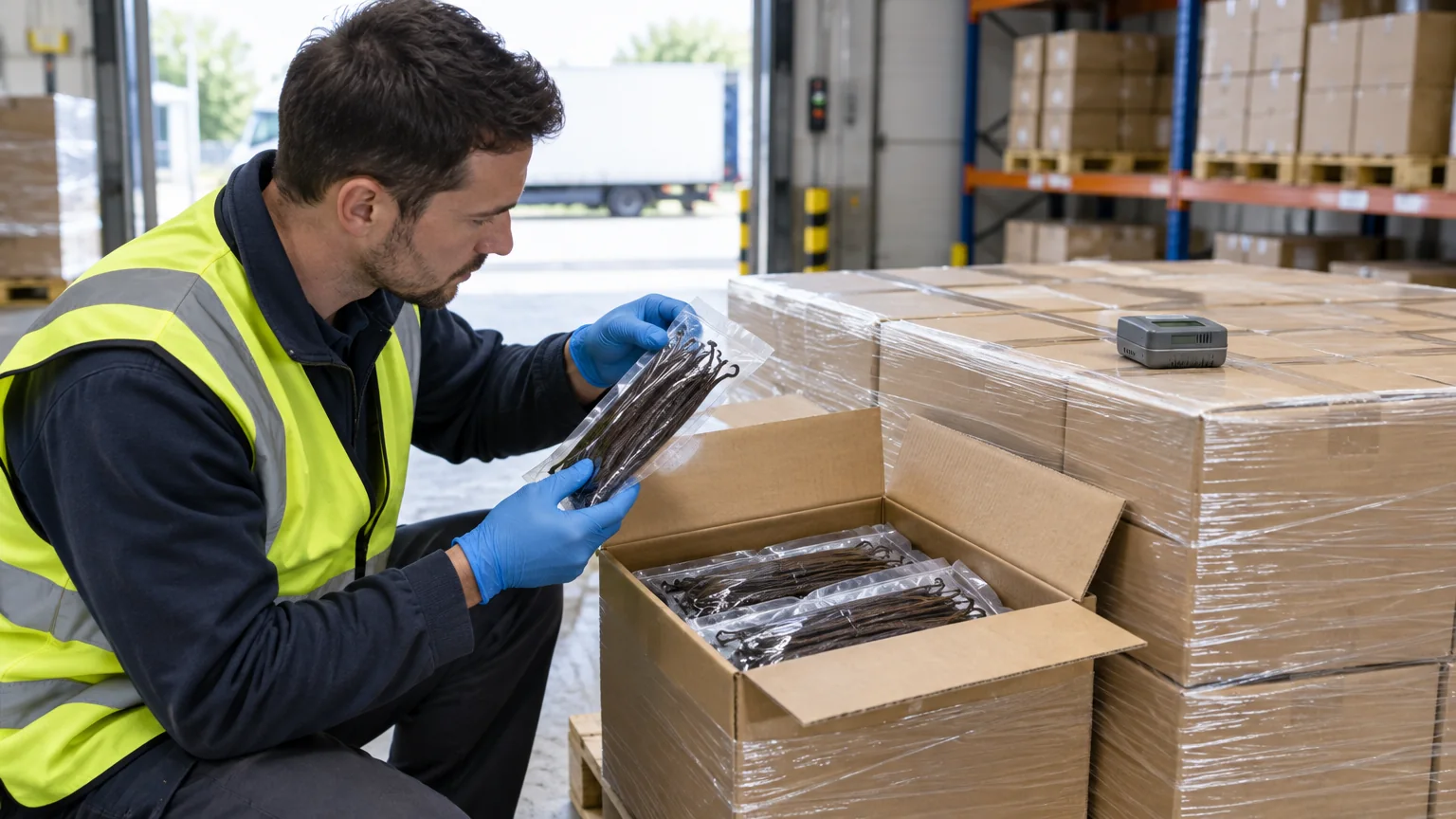
Photograph any damage before moving the goods, and keep packaging faults apart from bean faults in your records. For the bean side of the inspection, use our guide to comparing a sample with the bulk lot.
Download the vanilla packaging questionnaire
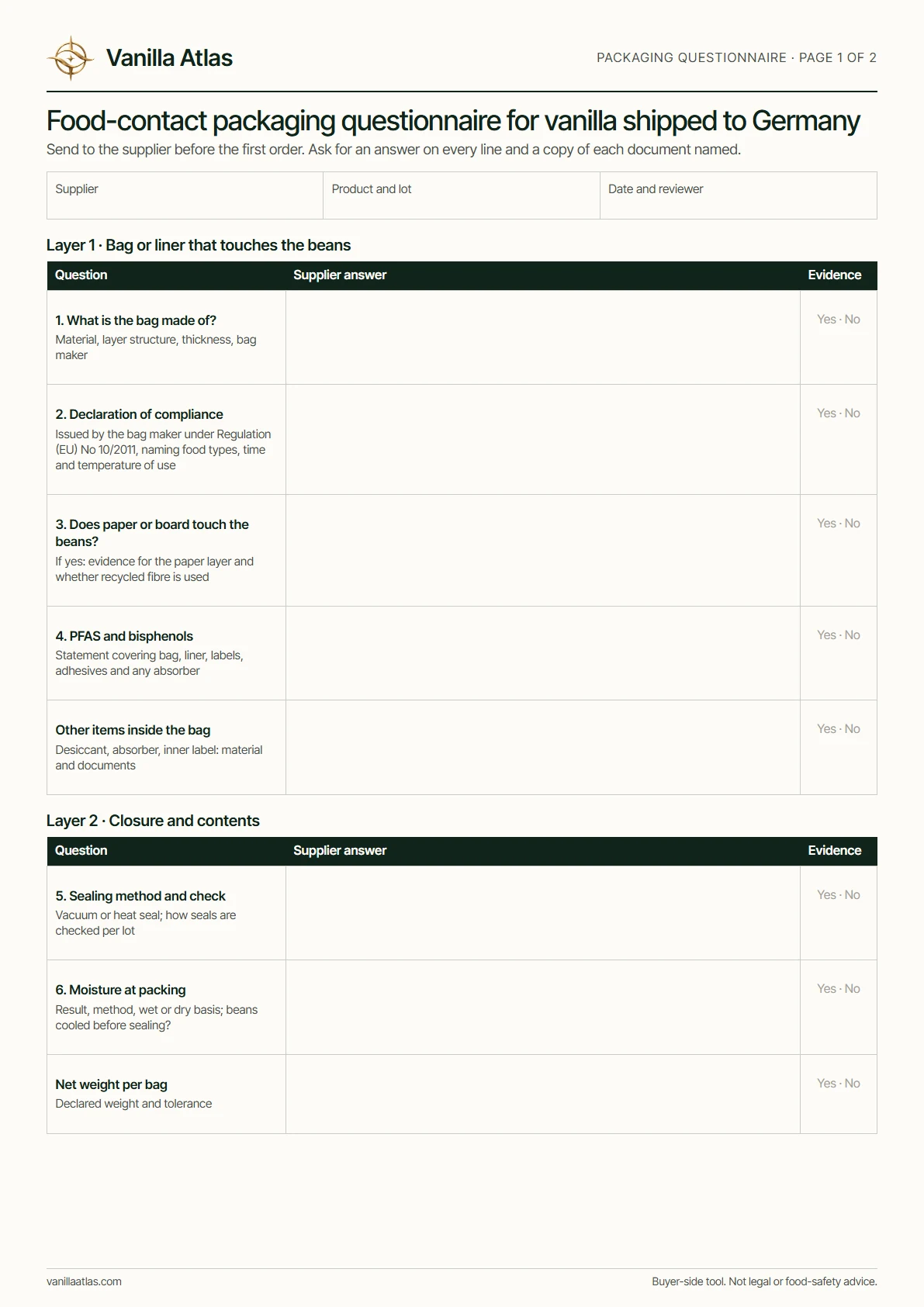
The two-page PDF lists all ten questions with space for the supplier’s answer and a column to record whether evidence was attached. Send it before the first order, and keep the completed copy with the lot records.
Download the packaging questionnaire (PDF)
German and English packaging terms
| German | English to use with the supplier |
|---|---|
| Lebensmittelkontaktmaterial | Food contact material |
| Konformitätserklärung | Declaration of compliance |
| Migrationsprüfung | Migration test |
| Siegelnaht | Seal line |
| Chargennummer | Lot or batch number |
| Wareneingangskontrolle | Arrival inspection |
Subject: Packaging questions before our first vanilla order, Germany
Before we confirm the order, please complete the attached packaging questionnaire. We need the bag maker’s declaration under Regulation (EU) No 10/2011, a PFAS and bisphenol statement for every component touching the beans, and your sealing and moisture checks.
Please mark any item you cannot provide. Lot code [code] should appear on every bag, carton, pallet label and document.
Where Vanilla Atlas fits
Vanilla Atlas supplies Indonesian Vanilla planifolia in five selections. We pack to the buyer’s agreed brief and can confirm pack format, net weights and lot coding before shipment. Germany is on our Shipping & Destinations page, with availability, charges and timing confirmed for each order.
Send us your vanilla food contact packaging specification or the completed questionnaire. We will answer each line, tell you which packaging documents we can provide for the agreed pack, and mark any we cannot rather than promise them.
Share your packaging specification and we will reply with what we can confirm.
Frequently asked questions
Is “food grade” enough for vanilla packaging in the EU?
No. “Food grade” is a description, not evidence. For plastic bags, ask for the bag maker’s declaration of compliance under Regulation (EU) No 10/2011, with food types and conditions of use that fit vanilla. Keep it with the lot records.
Can vanilla beans be shipped in recycled cardboard without a liner?
It is not advisable. Recycled board can contain residues such as mineral oils that may transfer to food, and cardboard gives little protection against drying or moisture. Use a documented food-contact inner bag between the beans and the carton.
Do I need migration test reports or only the declaration of compliance?
Buyers normally receive the declaration. The supporting test documents stay with the bag maker or supplier and must be made available to authorities on request. Ask for test reports when the declaration leaves a doubt about food type or storage conditions.
How long can vanilla beans stay in vacuum packaging?
There is no universal shelf life. It depends on moisture at packing, the bag, temperature and how often the bag is opened. Agree a best-before date with the supplier, store cool and dark, and check stored bags regularly for drying, condensation and mould.
Does German packaging registration apply if I only sell vanilla to businesses?
Usually yes. Registration in the LUCID packaging register applies to the business that first places packaged goods on the German market, including business-to-business packaging. System participation mainly concerns packs that end with private consumers. Check your role on the ZSVR website.
Which packaging records should a German importer keep?
Keep the declaration of compliance, PFAS and bisphenol statements, the supplier’s packaging answers, lot-coded packing lists, logger data and your arrival inspection with photos. Together they show which packaging touched which lot, which helps in an audit, complaint or recall.
Sources and review scope
Sources checked 8 November 2026. This is a buyer-side guide, not legal or food-safety advice. Material comparisons reflect trade practice, not a published standard. German packaging law was adapted to the EU regulation in 2026; confirm your obligations with the ZSVR. PFAS limits are summarised from Article 5 of Regulation (EU) 2025/40 and BPA dates from a Food Packaging Forum summary; check the legal text for your exact case.
- European Commission: Food contact materials legislation.
- Regulation (EU) No 10/2011 on plastic food contact materials, Annex IV.
- Regulation (EU) 2025/40 on packaging and packaging waste, Article 5.
- Regulation (EU) 2024/3190 on bisphenol A and other bisphenols.
- Food Packaging Forum: EU BPA ban reaches main transition deadline.
- BfR: Recommendations on food contact materials, including Recommendation XXXVI.
- Zentrale Stelle Verpackungsregister (ZSVR): LUCID packaging register.
- CBI: Buyer requirements for spices and herbs, updated 12 May 2026.


