A flavour house in Germany has two offers on the desk. Lot A costs less per kilogram but holds 32% moisture. Lot B is drier and dearer. Per kilogram, A looks cheaper; per kilogram of vanilla solids, B may win; and neither price says how much vanillin the extract will carry. That is the real decision for an extract maker.
The best vanilla beans for extract manufacturers are fully cured, mould-free beans bought on dry matter and vanillin content rather than length or looks. Splits, short beans and blemishes are fine for extraction; moisture, cure quality, clean aroma and lot-to-lot consistency decide yield and cost. In Germany, extraction also runs under EU flavouring rules and alcohol tax rules.
Kurz gesagt: Für die Extraktion zählen vollständig fermentierte, schimmelfreie Schoten, eingekauft nach Trockenmasse und Vanillingehalt, nicht nach Länge oder Aussehen. Gespaltene, kurze oder fleckige Schoten sind für Extrakte geeignet. Wassergehalt, Fermentationsqualität, sauberes Aroma und gleichbleibende Chargen bestimmen Ausbeute und Kosten. Unvergällter Alkohol zur Herstellung von Aromen kann mit Erlaubnis des Zolls steuerfrei verwendet werden.
This guide on vanilla beans for extract manufacturers is for flavour houses, extract makers and processors in Germany. It explains what matters in extraction grade vanilla, how to compare offers on dry matter and vanillin, which defects to accept, how to keep lots consistent, and which EU and German rules apply. US-standard extract rules are covered in our extraction-grade specification guide for US manufacturers.
What should vanilla beans for extract manufacturers deliver?
Vanilla beans for extract manufacturers should be fully cured, mould-free and rich in extractable vanilla solids, with a clean aroma and consistent quality from lot to lot. Length, appearance and whole-bean shape matter little, because the beans are cut or ground before maceration. Buy for what ends up in the extract: solids, vanillin content and clean aroma.
What matters in vanilla beans for extract manufacturers
| Property | Why it matters for extraction | What to specify |
|---|---|---|
| Dry matter | Vanilla solids are what the solvent extracts; water adds weight only | Moisture range, method and basis |
| Vanillin and aroma | Drive flavour strength and character of the extract | Vanillin minimum by HPLC, dry basis; sensory against a reference |
| Cure quality | Vanillin forms during curing; under-cured beans give weaker, greener extracts | Fully cured beans; harvest maturity and curing method stated |
| Mould and off-odours | Carry into the extract and can make the lot unusable | No mould; no smoky, phenolic or musty notes |
| Foreign matter and ash | Sand, soil and debris add weight and contamination | Foreign matter limit; acid-insoluble ash |
| Lot consistency | Keeps the extract on standard without reformulation | Per-lot results and a retained reference sample |
| Length and looks | Irrelevant after cutting | Accept splits, cuts, short beans and blemishes |
What is extraction grade vanilla?
Extraction grade vanilla is a trade term for beans sold for processing rather than visible use: usually drier, shorter, split or blemished, and priced below gourmet grades. There is no legal or universal definition. CBI describes extraction beans at about 20% moisture, against about 30% for gourmet beans.
Because the term varies by supplier, write the specification instead of relying on the grade name. In the Vanilla Atlas range, Dry Whole and Shorts are the processing selections, and Classic is a supple option for extracts that need a stronger aroma. Our comparison of gourmet and extraction-grade vanilla beans explains where each grade fits.

Why should you buy extraction grade vanilla on dry matter and vanillin?
Buy extraction grade vanilla on dry matter and vanillin because the price per kilogram includes water, and water extracts nothing. At Vanilla Atlas reference values for 10 kg or more, Shorts cost the least per kilogram of dry matter (about US$96), while Gourmet and Dry Whole cost the least per gram of reference vanillin (about US$12.0 and US$12.1).
Vanilla Atlas selections compared for extraction (reference values, 10 kg+ prices)
| Selection | Price (USD/kg) | Moisture | Vanillin | USD per kg dry matter | USD per g vanillin |
|---|---|---|---|---|---|
| Gourmet | 180 | 28–35% | 1.0–2.0% | 263 | 12.0 |
| Select | 165 | 25–30% | 0.8–1.8% | 228 | 12.7 |
| Classic | 150 | 24–28% | 0.6–1.6% | 203 | 13.6 |
| Dry Whole | 85 | 18–25% | 0.4–1.0% | 108 | 12.1 |
| Shorts | 75 | 18–25% | 0.2–0.8% | 96 | 15.0 |
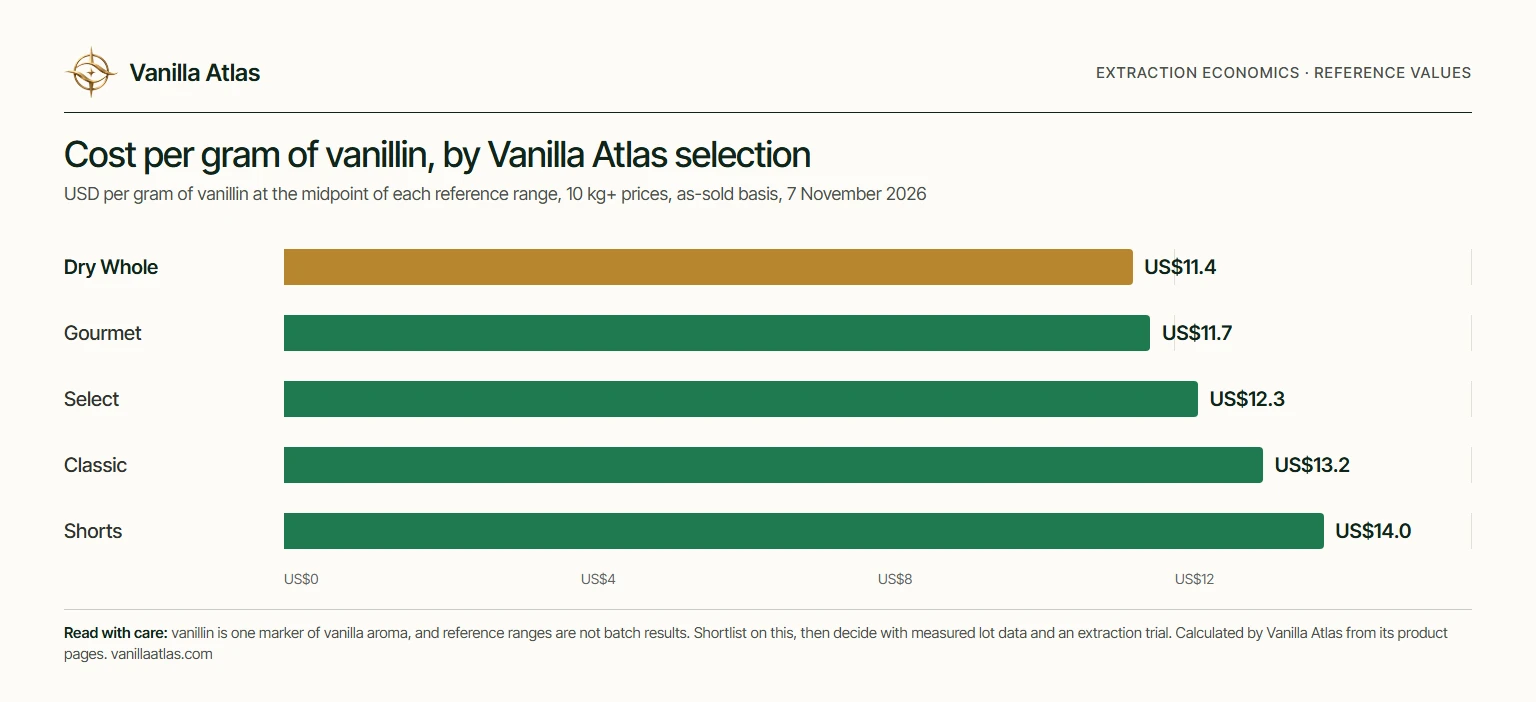
Dry matter uses the midpoint of each moisture range; vanillin per kilogram uses the midpoint of each vanillin range on an as-sold basis. These are reference values, not batch results, and vanillin is only one marker of vanilla aroma. Use the table to shortlist, then decide on measured vanillin content, lot data and an extraction trial.
How does moisture affect vanilla extraction?
Moisture affects vanilla extraction in three ways: it adds weight you pay for but cannot extract, it brings water into the menstruum, and it raises the risk of mould in storage. Ten kilograms of beans at 32% moisture hold 6.8 kg of dry matter; at 22% they hold 7.8 kg, about 15% more solids for the same weight.
Very dry beans have limits too. Beans that have lost much of their moisture can also lose aroma, and brittle beans may come from poor curing or long storage. Agree a moisture range, the method (for example oven drying or Karl Fischer) and the basis in the contract, especially when you buy dry vanilla beans in bulk. Our guide to vanilla bean moisture content explains why buyers pay for it.
If you also make US-standard extract, note that US rules count beans as no drier than 25% moisture when calculating the bean weight per gallon, so very dry beans earn no extra credit there. EU rules set no comparable fold standard, so in Germany the strength you sell is whatever you specify and declare to your customer.
Why does curing quality matter more than the grade name?
Curing quality matters because green vanilla holds most of its vanillin as glucovanillin, and the curing process releases it. A study of Vanilla planifolia curing found glucovanillin highest in green beans and vanillin highest in cured beans, with β-glucosidase hydrolysing the precursor as curing progresses. Short or rushed curing leaves flavour locked in the bean, which is why vanilla beans for extract manufacturers must be fully cured.
Harvest maturity matters as well. A 2024 study of Indonesian vanilla by Munarso and colleagues reported that some farmers harvest pods before nine months, often because of theft risk, and that this lowers vanillin content. Ask suppliers how they control harvest age and curing time, and judge the answer by measured vanillin content and a sensory test, not by colour alone (Chen et al., 2015).
Which defects matter for extraction, and which do not?
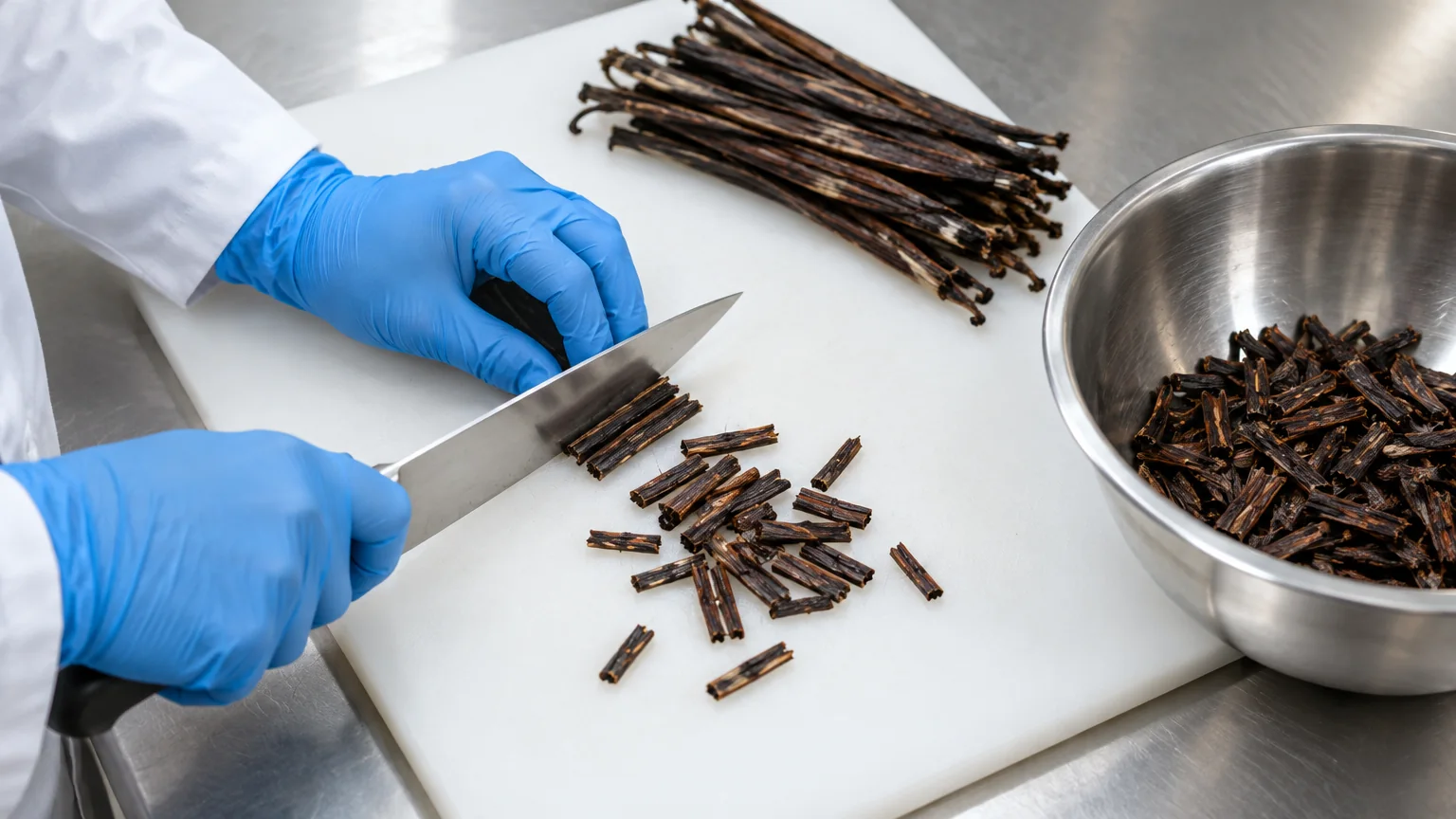
For extraction, mould, off-odours, foreign matter and signs of poor curing matter; splits, short length, scars and uneven colour do not. Accepting cosmetic defects is how extraction grade vanilla becomes cheaper, so state clearly which defects you accept and which lead to rejection, and keep the reject list short and absolute.
Defects in extraction grade vanilla: accept or reject
| Defect | For extraction | Note |
|---|---|---|
| Split beans | Accept | Cut before maceration anyway |
| Short beans and cuts | Accept | Check foreign matter in cut lots |
| Scars, uneven colour, reddish beans | Accept | Check aroma and vanillin, not looks |
| Vanillin frost (givre) | Accept | Crystals on the surface; not mould |
| Mould | Reject | No tolerance in the lot |
| Smoky, phenolic or musty odour | Reject | Carries into the extract |
| Sand, soil, stones | Reject above limit | Acid-insoluble ash usually up to 1.0 g/100 g |
| Green, under-cured beans | Reject or price down | Low vanillin, green notes |
The ash reference comes from Germany’s spice guidelines, which list a usual upper level of 1.0 g per 100 g of acid-insoluble ash for vanilla (Leitsätze für Gewürze, Annex 1). Our vanilla bean quality guide shows how to tell vanillin frost from mould.
How do you keep extract quality consistent across vanilla lots?
Keep extract quality consistent by testing every lot against a retained reference: vanillin by HPLC on a dry basis, moisture by an agreed method, and a coded sensory comparison of a small trial extract. Standardise each batch to your target strength, and blend lots in a recorded ratio when one lot runs strong or weak.
Ask the supplier to keep the same sorting rules and lot structure for repeat orders, to quote your annual volume as call-offs from known lots where possible, and to tell you before any change of origin region, curing site or grade mix. Our vanilla traceability guide for Germany lists the lot records to request. Consistent vanillin content from lot to lot is what lets you keep one extract standard.
How can you check that vanilla raw material and extract are authentic?
Check authenticity with isotope analysis. Vanillin from vanilla beans has a δ13C value around −20‰, while synthetic vanillin falls roughly between −36‰ and −25‰, according to a 2021 review in Foods. Because δ13C alone can be manipulated by blending, laboratories combine it with δ2H or site-specific NMR methods.
Whole beans are hard to fake, but ground vanilla, seeds, extracts and blends are not. When you buy anything other than whole beans, or when a customer requires proof for a “natural vanilla flavouring” claim, ask for an isotope report from an accredited laboratory, and test your own finished extract periodically.
What EU and German rules apply to vanilla extract production?
In Germany, vanilla extract is a flavouring preparation under EU Regulation (EC) No 1334/2008; it may be called “natural vanilla flavouring” only if at least 95% of the flavouring component comes from vanilla. Ethanol is a permitted extraction solvent, and undenatured alcohol used to make food flavourings can be tax-free with a customs permit.
EU and German rules for vanilla extract makers
| Topic | Rule | Source |
|---|---|---|
| Product category | Vanilla extract is a flavouring preparation | Regulation (EC) No 1334/2008 |
| “Natural vanilla flavouring” | At least 95% w/w of the flavouring component from vanilla | Regulation (EC) No 1334/2008, Article 16(4) |
| Extraction solvent | Ethanol permitted for all uses under good manufacturing practice | Directive 2009/32/EC, Annex I |
| Alcohol tax | Undenatured alcohol tax-free when used to make flavourings for foods, or drinks up to 1.2% vol | AlkStG § 27(1) No. 5 |
| Permit | Tax-free use needs a permit from customs | AlkStG § 28 |
| Extract strength | No EU fold standard; agree and declare strength by contract | Compare US 21 CFR 169.175 |
When your customers name a product “Vanille…”, German food-book guidelines expect the taste to come from vanilla sources such as extract or natural vanilla flavouring; our guide to vanilla beans for food manufacturers in Germany summarises those rules. This table is a summary, not legal or tax advice; check permits with your customs office.
How have vanilla prices changed for German buyers?
Vanilla prices for German buyers have fallen sharply. The average value of Germany’s whole vanilla imports (HS 090510) was 157.7 USD/kg in 2023, 41.2 in 2024 and 34.9 in 2025, according to UN Comtrade data analysed in our traceability guide. Averages mix grades and forms, so treat them as a trend, not a price.
Lower prices make it tempting to buy dry vanilla beans in bulk on price alone, and many vanilla beans for extract manufacturers are now offered at prices that hide wide quality differences. That is when specifications matter most: in a falling market, under-cured or poorly stored lots are offered alongside good ones, and only moisture, vanillin, sensory and lot records separate them.
How should you test dry vanilla beans in bulk before ordering?
Test dry vanilla beans in bulk with a small extraction trial on lot-coded samples: same cutting, same menstruum and ratio on a dry-matter basis, same time and temperature as production. Measure vanillin yield per gram of dry beans and judge the extract blind against your standard before you compare cost per litre.
- Request lot-coded samples from the lots you would buy, with moisture and vanillin results and the methods used.
- Measure moisture yourself on arrival, so you can dose on dry matter.
- Extract under production conditions: same particle size, solvent strength, ratio, time and temperature.
- Analyse the extract: vanillin by HPLC and, if you sell “natural”, an isotope check.
- Taste blind against your current standard and a retained reference.
- Cost it: bean cost per litre of extract at your target strength, including any standardisation.
What should a vanilla processing specification include?
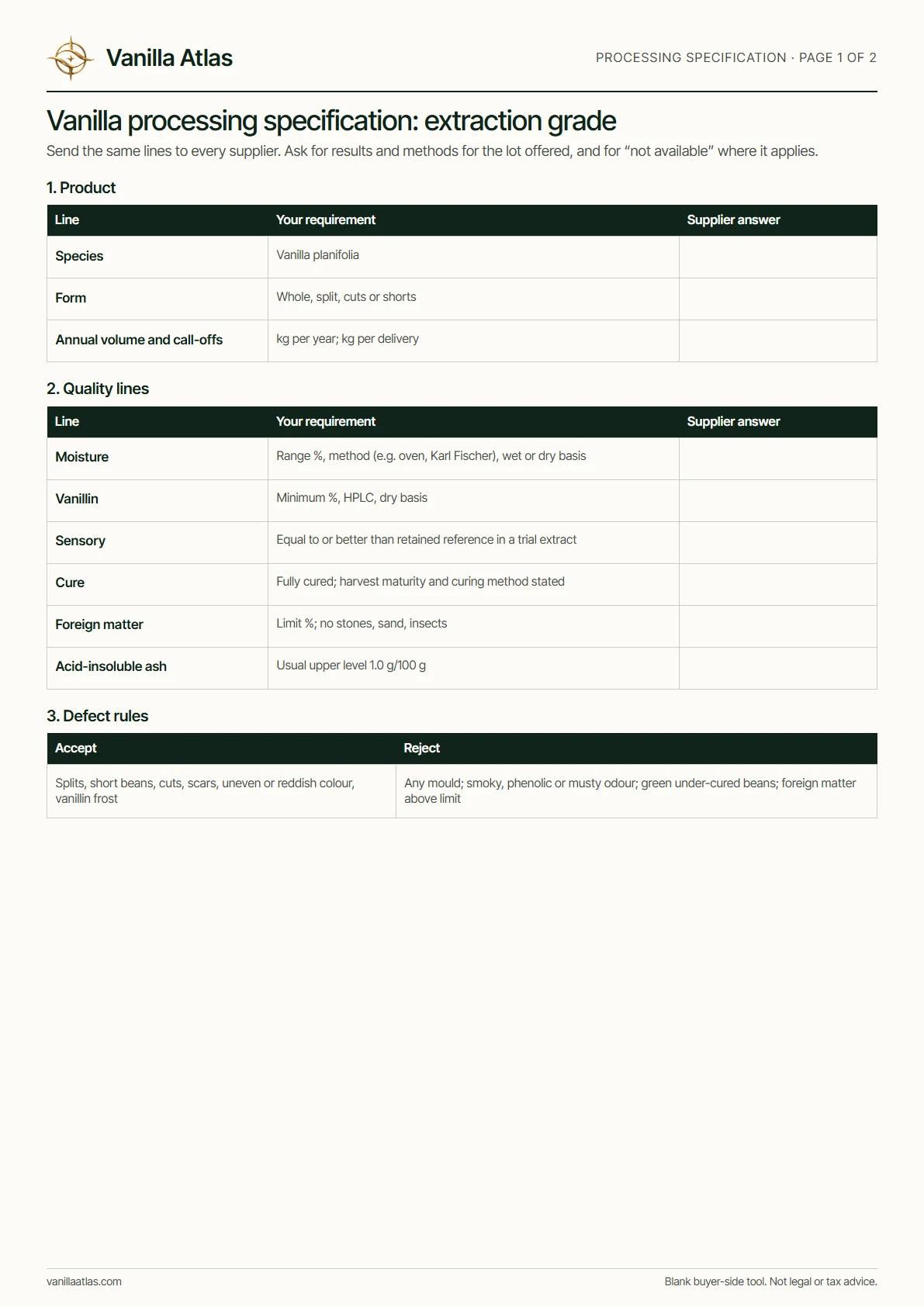
A vanilla processing specification should include species (Vanilla planifolia), form (whole, split, cuts or shorts), moisture range with method and basis, minimum vanillin by HPLC on a dry basis, sensory acceptance against a reference, defect rules (no mould, no off-odours), foreign matter and acid-insoluble ash, packaging, lot coding and annual volume.
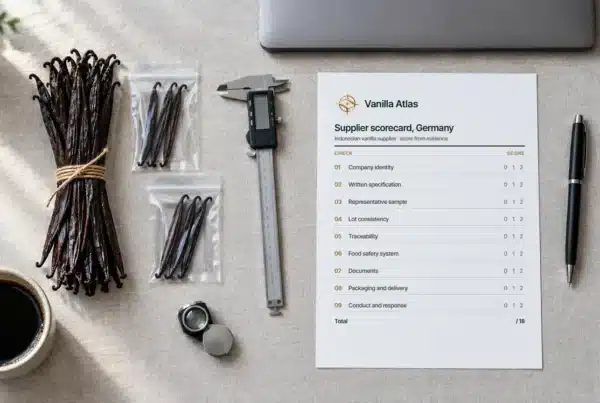
Whether you buy dry vanilla beans in bulk or smaller trial lots, add what you need for your own compliance: certificates of origin or organic certificates if you make claims, and authenticity reports for anything other than whole beans. The supplier evaluation guide for Germany covers the documents and questions to ask before approval.
Download the vanilla processing specification
The two-page PDF sets out the specification lines for extraction grade vanilla, the accept and reject defects, and an extraction trial record with yield and cost per litre. Use it to send the same requirements to every supplier of vanilla beans for extract manufacturers.
Download the processing specification (PDF)
Subject: Extraction grade vanilla for [company], Germany
We produce [vanilla extract / flavour preparations] in Germany and need about [x] kg of vanilla beans per year for extraction. Please quote beans to the attached processing specification, with moisture and vanillin results and methods for the offered lot.
Please also send a lot-coded sample of about [x] g for an extraction trial, and confirm whether you can supply repeat lots to the same specification.
Where Vanilla Atlas fits
Vanilla Atlas supplies Indonesian Vanilla planifolia for processing: Dry Whole beans for milling and extraction, Shorts for infusion and extraction, and Classic for extracts that need more aroma. Germany is on our Shipping & Destinations page.
Our specification ranges are reference values, not batch test results, and a batch-specific certificate of analysis is not currently available, so plan your own moisture and vanillin tests. This guide is buyer-side information, not legal or tax advice.
Submit your processing requirements, including annual volume, and we will suggest a selection and send a lot-coded sample for your extraction trial.
Frequently asked questions
What is the best vanilla grade for making extract?
The best grade is the one that gives the most vanillin and clean aroma per euro of dry matter, not the longest or best-looking bean. Fully cured, mould-free extraction grade vanilla, often drier and split or short, usually wins once you compare offers on dry matter, vanillin content and a trial extract.
Are split or short vanilla beans good for extraction?
Yes. Splits, short beans, cuts and blemishes do not affect extraction, because beans are cut or ground before maceration. What matters is full curing, no mould, no off-odours and low foreign matter. Accepting cosmetic defects is why extraction grade vanilla costs less.
What moisture should extraction grade vanilla have?
There is no single legal value. CBI describes extraction beans at about 20% moisture, against about 30% for gourmet beans, and Vanilla Atlas processing selections have reference ranges of 18–25%. Agree a range, the test method and the basis in your contract, and dose on dry matter.
How much vanilla is needed per litre of extract?
EU rules set no fold standard, so strength is agreed by contract. As a reference point, the US standard for single-fold extract works out to roughly 100 g of beans per litre of finished extract at 25% moisture. Set your own ratio through extraction trials on a dry-matter basis.
Is alcohol for vanilla extract taxed in Germany?
Undenatured alcohol used to make flavourings for foods, or for drinks with no more than 1.2% alcohol by volume, can be used tax-free under § 27(1) No. 5 of the German Alcohol Tax Act. You need a permit from customs under § 28 before using it tax-free.
How can you tell if vanilla extract contains synthetic vanillin?
Isotope analysis can tell. Vanillin from vanilla beans has a δ13C value around −20‰, while synthetic vanillin falls roughly between −36‰ and −25‰. Because blends can mask this, accredited laboratories add δ2H or site-specific NMR tests. Ask suppliers of vanilla beans for extract manufacturers for reports on anything other than whole beans.
Sources and review scope
Sources checked 7 November 2026. This is buyer-side guidance, not legal or tax advice. Prices and specifications are Vanilla Atlas reference values, not batch results; dry matter and vanillin per kilogram use range midpoints. The moisture example is a calculation. Isotope values are quoted from a published review and vary by laboratory and method.
- Regulation (EC) No 1334/2008 on flavourings, Article 16(4).
- Directive 2009/32/EC on extraction solvents, Annex I.
- Alkoholsteuergesetz § 27 and § 28.
- 21 CFR 169.175, vanilla extract (US, for comparison).
- CBI: Entering the European market for vanilla.
- Chen et al. (2015), Applied and Environmental Microbiology, glucovanillin hydrolysis during curing.
- Munarso et al. (2024), Frontiers in Sustainable Food Systems.
- Pironti et al. (2021), Foods, isotopic authentication of vanillin.
- Leitsätze für Gewürze und andere würzende Erzeugnisse, 9 October 2025, Annex 1.
- UN Comtrade: Germany, imports, HS 090510, 2023 to 2025.
- Vanilla Atlas product pages, reference specifications and prices, 9 November 2026.