

A new Indonesian supplier sends a friendly email, a price that looks good, and photos of glossy beans. Your QA team asks three questions: who exactly is this company, will the bulk lot match the sample, and what will we show an auditor if something goes wrong? This guide turns those questions into a process for choosing a vanilla supplier for Germany.
To evaluate a vanilla supplier for Germany, check nine things in order: company identity, a written specification, a representative sample, lot consistency, traceability, the food safety system, documents, packaging and delivery, and conduct. Score each check on evidence you have seen, and buy a small trial lot only when identity, sample and traceability are proven.
Kurz gesagt: Prüfen Sie einen indonesischen Vanillelieferanten in neun Schritten: Firmenidentität, schriftliche Spezifikation, repräsentatives Muster, Chargenkonstanz, Rückverfolgbarkeit, Lebensmittelsicherheit, Dokumente, Verpackung und Lieferung sowie Verhalten. Bewerten Sie nur Nachweise, keine Versprechen, und starten Sie mit einer Probecharge.
This guide is for importers, ingredient distributors and food manufacturers in Germany who are considering an Indonesian vanilla supplier for the first time. It answers the questions buyers ask before vanilla wholesale orders, and ends with a free two-page scorecard. For the same process from other markets, see our 10 questions for US importers and checklist for France.
How should German buyers evaluate an Indonesian vanilla supplier?
German buyers should evaluate an Indonesian vanilla supplier in a fixed order, asking for evidence at each step: identity, specification, sample, consistency, traceability, food safety, documents, packaging and conduct. Early checks are cheap and stop bad fits quickly. Later checks need more time from both sides, so only suppliers who pass the first steps reach them.

Nine checks for a vanilla supplier for Germany
| Check | Evidence that counts | Weak answer |
|---|---|---|
| 1. Company identity | Business registration, address, bank account in the company’s name, live video call | A personal account or only a messaging number |
| 2. Written specification | Length, moisture with method, defect limits in writing | “Grade A gourmet” with no numbers |
| 3. Representative sample | Lot code on the sample, retained reference | A sample with no link to any lot |
| 4. Lot consistency | Pre-shipment sample, written change notice | “Every lot is the same” |
| 5. Traceability | Source region, curing site, lot records | “From Java” and nothing more |
| 6. Food safety system | HACCP-based procedures, accredited lab reports | A certificate whose scope covers another site |
| 7. Documents | Copies you can read before you pay | “All documents available” with none attached |
| 8. Packaging and delivery | Sealed bags, lot codes, named Incoterm | Price “delivered” with no rule or place |
| 9. Conduct and response | Signed code of conduct, written answers | Pressure to pay before questions are answered |
How do you check that an Indonesian vanilla supplier is a real company?
Ask for the supplier’s Indonesian business identification number (NIB), registered address and company name, then check that invoices and the bank account use exactly that name. Hold a live video call at the grading or packing site. A real Indonesian vanilla supplier answers these requests without delay and does not mind being checked.
The NIB is a 13-digit number issued through Indonesia’s Online Single Submission (OSS) system. If you cannot verify it yourself, ask a local adviser or your bank.
Before the first payment, confirm the bank details by phone on a number you found independently, never only by email. Payment fraud through changed bank details is a common trade risk, whatever the origin.
What specification should a vanilla supplier for Germany confirm in writing?
A vanilla supplier for Germany should confirm in writing the species, form (whole, split or cuts), minimum length, a moisture range with its test method and basis, defect limits including no mould, and how aroma will be judged. Add vanillin content only if your application needs it, and ask which laboratory and method will measure it.
For reference points, CBI notes that European importers often prefer moisture of 20% to 30% and vanillin of at least 1.5% to 2%, and that Salmonella must be absent.
CBI also reports that many European spice buyers ask suppliers to meet the European Spice Association’s quality minima, a document available to ESA members. Our vanilla bean quality guide and extraction-grade specification guide help you set limits for your use.
How do you know the bulk lot will match the approved sample?
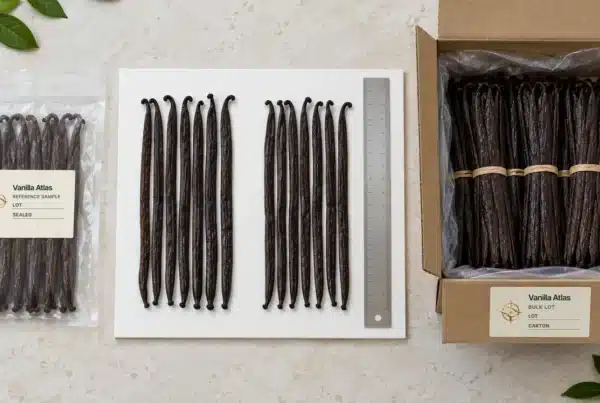
You know the bulk lot will match the sample only if the sample carries a lot code, the supplier keeps a retained reference from the same lot, and you approve a pre-shipment sample or measured photos before dispatch. Ask for a written promise to notify you of any change in source, curing site or packing before shipment.

On arrival, compare the delivery with your retained sample, not with your memory of it. Measure the same things you measured on the sample: length, moisture by the same method, defects and aroma in your product. Our guide to comparing a vanilla sample with the bulk lot includes a QA worksheet you can use in Germany too.
What traceability does EU law expect from a German vanilla importer?
Under Article 18 of Regulation (EC) No 178/2002, EU food businesses must be able to identify who supplied them and to whom they supplied, often called one step back and one step forward. For imported vanilla, the German importer carries this duty, so it needs reliable supplier and lot details.
The law sets the minimum. Many German buyers also ask suppliers to trace further back: the growing region, the collectors or farmer groups, the curing and grading site, and whether lots were mixed. CBI notes that transparency is often decisive in European supplier selection. Our vanilla traceability guide lists the record fields to request.
Which documents and certificates do German buyers usually ask for?
German buyers usually ask for a completed supplier questionnaire, a product specification, a lot-linked lab report from an accredited laboratory, evidence of HACCP-based procedures, any food-safety certificate with its scope, a declaration of compliance for plastic packaging, and a signed code of conduct. Organic buyers also need an electronic certificate of inspection for every consignment.
Documents a vanilla supplier for Germany may be asked for
| Document | What it shows | Check before you rely on it |
|---|---|---|
| Supplier questionnaire (Lieferantenselbstauskunft) | Company data, sites, food safety system, certifications | Signed and dated; answers match the other documents |
| Product specification | The limits the supplier commits to | Methods and units stated, not grade names only |
| Lab report | Results for a named lot, such as moisture, Salmonella, pesticide residues | ISO/IEC 17025 accredited lab; lot code matches |
| Food safety certificate | A GFSI-recognised scheme such as FSSC 22000, IFS or BRCGS | Holder, site, scope and expiry date |
| Declaration of compliance | Plastic inner bags are suitable for food contact | Names the material and Regulation (EU) No 10/2011 |
| Organic e-COI | The consignment is certified organic | Issued in TRACES for that shipment |
| Code of conduct | Labour, safety, environment and ethics commitments | Signed; audit evidence such as SMETA if you require it |
According to CBI, European buyers prefer GFSI-recognised certificates and accredited laboratories, while organic batches need an e-COI generated through TRACES under Delegated Regulation (EU) 2021/2306. Ask suppliers to state which documents are not available. Our supplier documents guide explains each request in more depth.
Does the German Supply Chain Act or the EUDR apply to vanilla?
The German Supply Chain Act (LkSG) applies to companies with at least 1,000 employees in Germany, whatever they buy, so it can cover vanilla purchases by large buyers. Smaller buyers usually meet it indirectly, through customers’ codes of conduct. The EU Deforestation Regulation covers seven commodities, and vanilla is not one of them.
A government bill, Bundestag printed paper 21/2474 of October 2025, proposes to drop the LkSG annual report while keeping the due-diligence duties. Check its current status before you plan reporting.
The European Commission lists cattle, cocoa, coffee, oil palm, rubber, soy and wood, applying from 30 December 2026 for larger operators. If you also buy cocoa or coffee, those purchases are covered.
How should packaging and delivery be agreed for Germany?
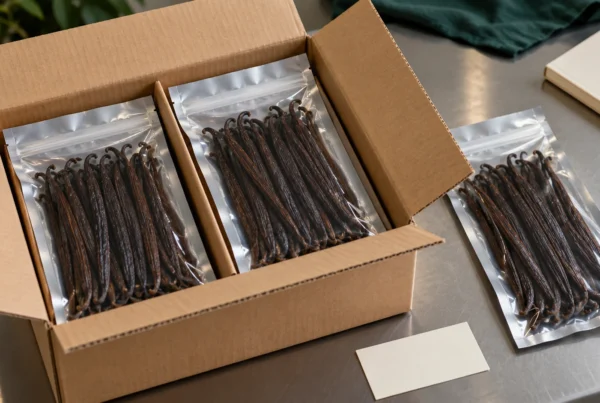
Agree sealed food-contact inner bags, a carton specification, a lot code on every bag and carton, and one Incoterms 2020 rule with a named place, such as “CIP Frankfurt Airport” or “CIF Hamburg”. Vanilla often travels by air, so any-mode rules such as FCA, CPT, CIP or DAP usually fit better than sea-only rules.
Ask any vanilla supplier for Germany to quote on the rule you choose. The ICC publishes the current Incoterms rules.
Under most rules the German buyer handles import clearance, so the importer needs an EORI number and should confirm the duty rate for heading 0905 10 in Access2Markets on the day it budgets. Our bulk vanilla packaging guide and RFQ template cover these fields.
What are the red flags when choosing a vanilla supplier?
The main red flags are a bank account in a different name, grade names with no measured limits, samples without lot codes, certificates you cannot verify, every document answered “yes” with none attached, and pressure to pay before questions are answered. One red flag is a reason to pause and ask, not always to walk away.
Red flags in vanilla wholesale and what to ask
| Red flag | Why it matters | What to ask |
|---|---|---|
| Bank account name differs from the seller | Common sign of payment fraud | Confirm by phone on a number you found yourself |
| Grade name with no numbers | Nothing to check the delivery against | Length, moisture with method, defect limits |
| Sample with no lot code | The bulk lot may come from elsewhere | Which lot, and is a reference retained? |
| Certificate you cannot verify | It may be expired or cover another site | Holder, scope, validity in the issuer’s database |
| Price far below the market | May mean lower grade, short weight or high moisture | What exactly is included in the price? |
| Pressure to pay quickly | Leaves no time to check evidence | Ask for answers first; pay against agreed milestones |
How do you score and compare vanilla suppliers?
Score each of the nine checks from 0 to 2: 0 for no evidence, 1 for a partial answer or promise, and 2 for evidence in writing that you have checked. Compare suppliers only on the same specification, and approve a trial lot when identity, sample and traceability score 2 and no check scores 0.
Re-score after the first delivery, using your arrival inspection. The scorecard below works for any vanilla supplier for Germany and is a starting point; set thresholds that fit your risk and customers. In vanilla wholesale, price belongs after the scorecard, not before it, because a cheap lot that fails arrival checks costs more than a fairly priced lot that passes.
Our origin comparison explains why lot evidence matters more than origin.
Download the supplier scorecard (PDF)

Should you contact Indonesian vanilla suppliers in German or English?
Contact Indonesian vanilla suppliers in English, which most exporters use for trade documents. Keep German terms your team depends on, such as Rückstellmuster or Chargennummer, with the English term beside them. Write numbers with units and a clear decimal point, because “1,5 %” and “1.5%” can be read differently.
German and English procurement terms for vanilla
| German | English to use with the supplier |
|---|---|
| Lieferantenselbstauskunft | Supplier self-assessment questionnaire |
| Spezifikation | Product specification |
| Analysenzertifikat | Certificate of analysis (lab report for a lot) |
| Chargennummer | Lot or batch number |
| Rückstellmuster | Retained reference sample |
| Rückverfolgbarkeit | Traceability |
| Konformitätserklärung | Declaration of compliance |
| Wareneingangskontrolle | Arrival or incoming-goods inspection |
Subject: Supplier evaluation, Indonesian vanilla beans for Germany
We are [company], buying vanilla for [application] in Germany. Before requesting a quotation, please send your company registration (NIB) and registered address, your product specification with test methods, and a list of the documents you can and cannot provide.
If we proceed, we will ask for a lot-coded sample and will keep a reference. Please reply to each point in writing by [date].
Where Vanilla Atlas fits
Vanilla Atlas supplies Indonesian Vanilla planifolia in five selections. We handle vanilla wholesale enquiries and retail orders, and Germany is listed on our Shipping & Destinations page, with availability, charges and timing confirmed for each order. Our background on Indonesian vanilla origin and curing explains where our beans come from.
We will share our Indonesian company registration details and answer the scorecard line by line. A batch-specific certificate of analysis is not currently available, and we will mark any other item we cannot provide rather than promise it. Send your requirements, and we will reply with what we can evidence and a sample proposal.
Submit your buyer requirements, or attach your completed scorecard and questions.
Frequently asked questions
How do I find a reliable Indonesian vanilla supplier for Germany?
Shortlist exporters that state their company details openly, then run the same checks on each: business registration, a written specification, a lot-coded sample, traceability records and copies of documents. Reliability shows in evidence and written answers, not in a website or a low price.
What certificates should a vanilla supplier have for the German market?
No single certificate is legally required for every buyer. Many German buyers prefer a GFSI-recognised food safety certificate such as FSSC 22000, IFS or BRCGS, accredited lab reports, and organic certification only when organic is claimed. Check the holder, site, scope and expiry of each certificate.
Is a sample enough to approve a vanilla supplier?
No. A sample shows what the supplier can send, not what the bulk lot will be. Approve a supplier only when the sample is lot-coded, a reference is retained, the specification is in writing and a trial lot passes your arrival inspection.
Who is the importer when a German company buys vanilla from Indonesia?
Usually the German buyer, unless the Incoterm and contract make someone else responsible for import clearance. The importer needs an EORI number, pays import duty and VAT, and carries EU food law duties such as traceability. Confirm the roles before you agree the price.
What does a Lieferantenselbstauskunft include?
A Lieferantenselbstauskunft is a supplier self-assessment questionnaire. It usually asks for company and site details, contacts, the food safety system, certifications, traceability, allergens, packaging and, often, social and environmental commitments. Ask the supplier to sign and date it and to attach evidence for key answers.
Does buying vanilla wholesale need a written contract?
It is strongly advisable. A purchase contract or confirmed order should name the specification, quantity, Incoterms 2020 rule and place, price, payment milestones, documents, sample reference and what happens if the lot fails your checks. This protects both buyer and supplier.
Sources and review scope
Sources checked 5 November 2026. This is a buyer-side guide, not legal, customs or food-safety advice. CBI reference values are buyer preferences, not legal limits. The LkSG amendment was a bill when checked; confirm its status in the Bundestag documentation system (DIP) or the Federal Law Gazette. No duty rate, price or MOQ is given, because they vary by supplier, lot and date.
- CBI: Buyer requirements for spices and herbs, updated 12 May 2026.
- CBI: Entering the European market for vanilla, updated 2 May 2023.
- CBI: The European market potential for vanilla, updated 2 May 2023.
- Regulation (EC) No 178/2002, Article 18 (traceability).
- Delegated Regulation (EU) 2021/2306 (organic import controls and certificates of inspection).
- Deutscher Bundestag, Drucksache 21/2474, 29 October 2025 (LkSG amendment bill).
- European Commission: Regulation on deforestation-free products.
- International Chamber of Commerce: Incoterms rules.

2 Comments