
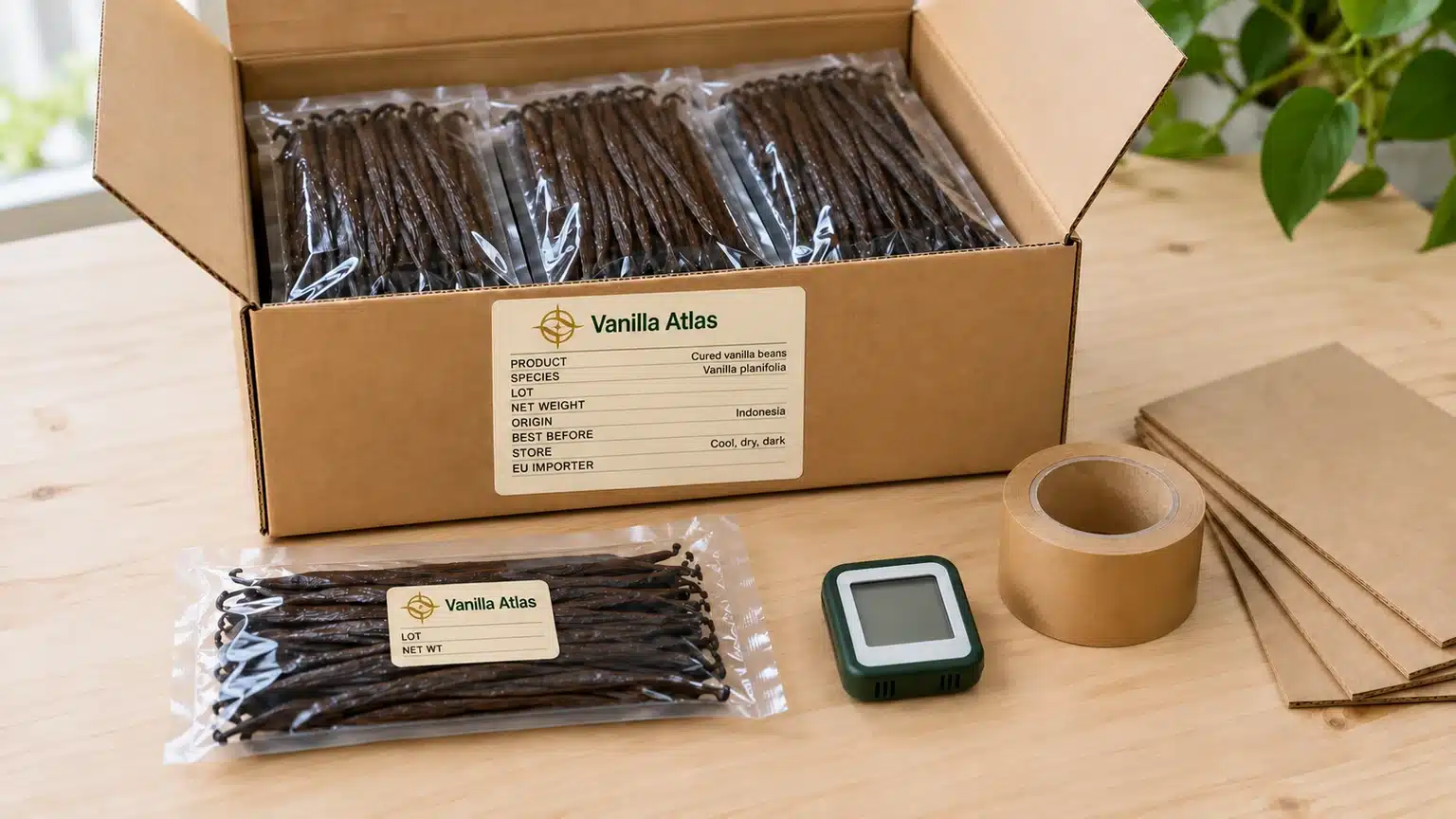
Most vanilla quality problems on arrival in France are not curing problems. They are packing problems: beans sealed while still warm, a liner nobody can document, a carton without a lot code, or a container that sweated for three weeks at sea.
Bulk vanilla packaging for France should use food-grade bags or liners with a declaration of compliance for any plastic, beans packed cool at a measured moisture, sealed bags inside sturdy cartons, ISPM 15 or plastic pallets, and a lot code on every layer. Since 12 August 2026, EU packaging rules also expect the manufacturer and the EU importer to be identified on the packaging.
En bref : pour la vanille en vrac vers la France, exigez des sachets alimentaires avec déclaration de conformité, des gousses conditionnées froides à une humidité mesurée, des cartons solides, des palettes ISPM 15 ou plastique et un numéro de lot sur chaque niveau d’emballage. Depuis le 12 août 2026, l’importateur doit aussi être identifié sur l’emballage.
This guide to bulk vanilla packaging for France is for importers and distributors receiving vanilla in France. It answers the questions buyers ask most often before agreeing a pack, from vacuum sealing to label wording, and ends with a brief you can send to a supplier. It complements our bulk packaging guide for US shipments, which covers route controls in more depth.
What is the best bulk vanilla packaging for France?
The best bulk vanilla packaging for France has four layers: a food-grade bag or liner touching the beans, a sealed closure suited to the lot’s moisture, a strong outer carton, and a pallet that meets EU wood rules. Each layer needs a lot code, and each material in contact with the beans needs documentation as food contact packaging for vanilla.

The four layers of bulk vanilla packaging for France
| Layer | What it does | What to confirm | Evidence to ask for |
|---|---|---|---|
| Food-contact bag or liner | Holds aroma and moisture, keeps beans clean | Material, thickness, closure method | Declaration of compliance for plastics |
| Moisture control | Prevents drying out or condensation | Moisture at packing, cooling before sealing | Moisture result, method and date |
| Outer carton | Protects bags in handling and stacking | Wall strength, size, net weight, stacking limit | Carton specification and packing list |
| Pallet and wrap | Keeps cartons together and off the floor | Pallet type, stretch wrap, corner protection | ISPM 15 mark for wood pallets |
What food contact packaging for vanilla is required in the EU?
Food contact packaging for vanilla in the EU must comply with Regulation (EC) No 1935/2004: it must not transfer substances in harmful amounts or change the beans unacceptably. Plastic bags and liners also fall under Regulation (EU) No 10/2011 and need a declaration of compliance passed along the supply chain.
The European Commission’s food contact materials page, the starting point for food contact packaging for vanilla, summarises the framework, including good manufacturing practice under Regulation (EC) No 2023/2006. In practice, ask the supplier for three things: what the material is, who made it, and the declaration of compliance from the packaging maker. A bag described only as “food grade”, with no document, is a claim rather than evidence of food contact packaging for vanilla.
Two newer points matter for French importers. Under the EU Packaging and Packaging Waste Regulation, stricter limits on PFAS in food-contact packaging apply from 12 August 2026, according to a summary by Reusch Law. And any absorber or desiccant placed with the beans must also count as food contact packaging for vanilla and be documented as such.
Should vanilla beans be vacuum packed for shipping?
Vacuum packing is common for vanilla and limits air contact, but it is not automatically better. It can press oil out of the pods, does not stop slow drying, and can trap moisture if beans are sealed too wet or too warm. Choose vacuum or a closed, heat-sealed liner deliberately, and agree it in writing.
The table compares vacuum packed vanilla with the two common alternatives.
Vacuum packed vanilla compared with a closed liner
| Option | Advantages | Watch for | Often suits |
|---|---|---|---|
| Vacuum-sealed bags | Less air, compact, easy to count and inspect by bag | Pressed, flattened pods; oil on the bag; moisture trapped if sealed wet | Smaller unit bags, retail repacking, long storage |
| Heat-sealed bags, not vacuumed | Pods keep their shape; less pressure on display beans | More air in the bag; seal quality must be checked | Gourmet beans for visible use |
| Folded or tied liner in a carton | Simple, cheap, easy to open | Less protection against drying and odours | Short routes, quick use, extraction beans |
Most published advice on vacuum packed vanilla comes from sellers rather than independent studies, so treat it as practice, not proof. Whatever you choose, test a pack from the first shipment before scaling up, and note whether vacuum packed vanilla arrived pressed or oily. Our guide to gourmet beans for pastry explains why pressed pods matter for visible use.
How do you stop mould and condensation in bulk vanilla shipments?
Stop mould in bulk vanilla shipments by measuring moisture before packing, cooling beans before sealing, using intact food-grade bags, and protecting cartons from temperature swings in transit. Condensation forms when warm, moist air cools, so a container crossing climates is a risk. Inspect the coolest and outermost cartons first on arrival.
- Measure before sealing. Agree a moisture range and method for the lot, and record the result at packing. Our vanilla bean quality guide for France explains moisture classes.
- Never seal warm. Beans packed warm can release moisture inside the bag as they cool.
- Protect the container. Ask your forwarder about container ventilation or desiccant strips for the container itself, kept away from the food bags.
- Plan for delays. Agree what happens if a shipment waits in a hot port, and who checks it.
Sea freight is cheaper but slower and crosses more temperature changes than air freight. For high-moisture gourmet beans or small, valuable lots, many buyers prefer air, and choose bulk vanilla packaging for France to match the route. That is a commercial choice, so compare cost against the risk for each lot.

What should a bulk vanilla carton label show for France?
A bulk vanilla carton label for France should show the product name, species, lot or batch code, net weight, country of origin, storage conditions, best-before date and the responsible operator’s name and address. Under the EU packaging regulation, the manufacturer and the EU importer must also be identified on the packaging.
What to put on bulk vanilla labels
| Field | Bag | Carton | Pallet | Source |
|---|---|---|---|---|
| Product name and species | Yes | Yes | Yes | CBI bulk label list |
| Lot or batch code | Yes | Yes | Yes | CBI; traceability |
| Net weight | Yes | Yes | Gross weight | CBI |
| Country of origin | Optional | Yes | Yes | CBI |
| Storage conditions and best before | Optional | Yes | Optional | CBI |
| Manufacturer name, address and contact | Optional | Yes | Optional | PPWR, from 12 August 2026 |
| EU importer name and address | Optional | Yes | Optional | PPWR, from 12 August 2026 |
The label fields come from CBI’s buyer requirements for spices and herbs and the PPWR summary above. Retail packs need the full food labelling of Regulation (EU) No 1169/2011 instead, and the PPWR’s harmonised recycling label is expected from 2028. Have the final wording reviewed for your own role in the chain before you approve bulk vanilla packaging for France.
Does EU packaging law apply to bulk B2B vanilla packaging?
Yes. The EU Packaging and Packaging Waste Regulation (EU) 2025/40 has applied generally since 12 August 2026, and it covers sales, grouped and transport packaging, not only consumer packs. For a French importer, that means checking documentation, identification on the packaging and, in time, recyclability and reuse targets.
The detail depends on your role: manufacturer, importer or distributor. Several obligations, such as recycled content and the harmonised label, depend on implementing acts and phase in from 2028 onwards. Treat this as an overview rather than legal advice, and confirm your obligations with an adviser or your packaging supplier.
France also plans an extended producer responsibility scheme for professional and industrial packaging. Its launch has been delayed, and in the meantime ADEME’s 2026 declaration guide explains how the first business placing packaged goods on the French market declares them. If you import packed vanilla into France, check whether that business is you.
Do wooden pallets need ISPM 15 for vanilla shipments to France?
Yes. Solid wood packaging, including pallets and crates, entering the EU from outside the EU must be treated and marked under the international ISPM 15 standard. Plastic pallets and processed wood such as plywood are outside its scope. Ask the supplier which pallet they use and check the mark before shipment.
An unmarked wooden pallet can delay clearance or lead to the packaging being treated or destroyed at your cost. It is a small detail that is easy to settle in the packing brief. Our vanilla supplier checklist for France covers the other shipping documents.
How should you store bulk vanilla beans after arrival in France?
To store bulk vanilla beans after arrival, keep cartons closed in a cool, dry, dark area away from strong smells, off the floor and away from walls. Open one bag at a time, reseal it promptly, and use lots in order of arrival. If you store bulk vanilla beans for months, check them more often. Check stored bags regularly for condensation, mould and drying.
How to store bulk vanilla beans in a French warehouse
| Practice | Why |
|---|---|
| Cool, stable temperature | Swings cause condensation inside bags |
| Dry area, off the floor | Limits moisture uptake and pests |
| Away from strong smells | Vanilla picks up odours from spices, chemicals and fuel |
| Dark, closed cartons | Protects aroma and colour |
| First in, first out by lot | Older lots dry and change first |
| Regular checks | Catches mould or condensation before it spreads |
How long you can store bulk vanilla beans depends on moisture, packing and conditions, so we do not give a universal shelf life. Ask the supplier for its storage guidance for each lot, and record how long each lot stays in stock. To store bulk vanilla beans well once a bag is open, choose bag sizes so that an opened bag is used quickly: smaller bags cost more to pack but spend less time open.
Which questions should importers confirm before the vanilla ships?
Before bulk vanilla ships to France, confirm the food-contact material and its declaration, the closure method, moisture at packing, carton and pallet type, net weights, lot coding, label content including the EU importer, the route and delay plan, and who inspects on arrival. Get each answer in writing, with evidence where possible.
Download the packaging checklist (PDF)

Subject: Packing brief for lot [code] to France
Please confirm, before shipment: the bag or liner material and its declaration of compliance; whether bags are vacuum-sealed or heat-sealed; the moisture result and method at packing; net weight per bag and per carton; carton type and stacking limit; pallet type and ISPM 15 mark if wooden; and that each bag, carton and document carries lot code [code].
Carton labels should show product, species, lot, net weight, origin, storage conditions, best before, and our company as EU importer: [name, address]. Please also confirm the route, expected transit time and how delays will be handled.
What should you check when bulk vanilla arrives?
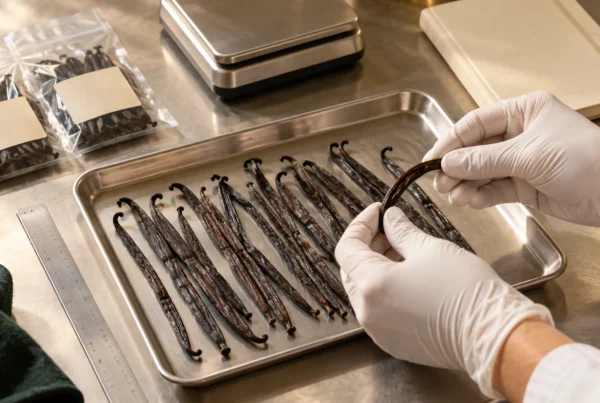
When bulk vanilla arrives, check that the pallet and cartons are intact, the lot codes match the documents, and there is no condensation inside bags. Then open bags from several cartons and inspect the beans for moisture, flexibility, mould and smell. Photograph any damage before moving the goods.
Compare the beans with your sealed reference sample, using the method in our guide to vanilla sample evaluation in France. Record packaging problems, such as a lost vacuum or a split bag, separately from bean quality, because they usually have different causes and different fixes. Our traceability guide covers how lot codes connect the cartons to the supplier’s records.
Where Vanilla Atlas fits
Vanilla Atlas supplies Indonesian Vanilla planifolia in five selections. We pack to the buyer’s agreed brief, including vacuum packed vanilla where requested, and can confirm pack format, net weights and lot coding before shipment. France is on our Shipping & Destinations page, with availability, charges and timing confirmed for each order.
We do not claim that every document in this guide is available for every lot. A batch-specific certificate of analysis is not currently available, and packaging documents depend on the materials chosen for your order. Tell us your requirements for food contact packaging for vanilla, labels and route, and we will say plainly what we can confirm.
Share your packaging requirements, including your preferred pack size, closure, labels and route.
Frequently asked questions
How should bulk vanilla beans be packed for export to France?
Pack them in food-grade bags or liners with a declaration of compliance for any plastic, cooled and at a measured moisture, inside strong cartons on ISPM 15 or plastic pallets. Put the lot code on every bag, carton and document, and identify the EU importer.
Is vacuum packing good for vanilla beans?
It can be. Vacuum packing limits air contact and suits smaller bags and long storage, but it can press oil out of pods and trap moisture if beans are sealed wet or warm. For display beans, a heat-sealed bag without vacuum may suit better.
What documents prove vanilla packaging is food safe in the EU?
Ask for a declaration of compliance for plastic bags and liners under Regulation (EU) No 10/2011, from the packaging maker, and confirm the material. The general rules are set by Regulation (EC) No 1935/2004 on food contact materials.
What must a bulk vanilla label show in France?
Show product name, species, lot code, net weight, country of origin, storage conditions and best-before date. Since 12 August 2026, the EU packaging regulation also expects the manufacturer and the EU importer to be identified on the packaging.
How do you store bulk vanilla beans in a warehouse?
Keep cartons closed in a cool, dry, dark area with a stable temperature, off the floor and away from strong smells. Open one bag at a time, reseal it quickly, use lots first in, first out, and check regularly for condensation and mould.
Do vanilla pallets need ISPM 15 for the EU?
Yes, if they are solid wood. Wooden pallets and crates entering the EU must be treated and marked under ISPM 15. Plastic pallets and processed wood such as plywood are outside its scope. Check the mark before the shipment leaves.
Sources and review scope
Sources checked 5 November 2026. This is a buyer-side guide, not legal advice. PPWR obligations are taken from a law-firm summary rather than the full regulation, and several depend on implementing acts not yet adopted. The French professional-packaging scheme was still delayed at the time of writing. Advice on vacuum packing reflects common trade practice; we found no independent study of it for vanilla. No universal shelf life or pack size is given.
- European Commission: Food contact materials legislation.
- Reusch Law: The new EU Packaging Regulation (PPWR) applies from 12 August 2026.
- Regulation (EU) 2025/40 on packaging and packaging waste.
- CBI: Buyer requirements for spices and herbs, updated 12 May 2026.
- ADEME: Guide de déclaration emballages professionnels 2026.
- ISPM 15, Regulation of wood packaging material in international trade (IPPC), cited by title.



2 Comments