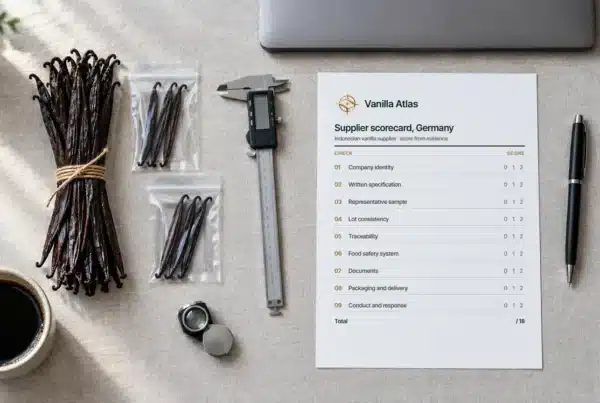
Indonesian vs Madagascar vanilla is a comparison of two origins that mainly supply the same species, Vanilla planifolia. For most German buyers, the useful question is not which origin is better, but whether Indonesian vanilla can qualify as a second origin beside Madagascar. The two differ in supply scale, EU duty, label wording and the evidence each supplier can give. Approve a specific lot, never a country.
Kurz gesagt: Indonesische Vanille ist für deutsche Einkäufer vor allem eine zweite Herkunft neben Madagaskar, kein Ersatz. Sie darf nicht als „Bourbon-Vanille“ bezeichnet werden. Entscheidend sind die Spezifikation, eine verdeckte Anwendungsprobe und die Gesamtkosten des konkreten Loses.
This guide compares Indonesian vs Madagascar vanilla for procurement, QA and R&D teams in Germany. This vanilla origin comparison uses German-reported import data for 2021–2025, the EU tariff schedule and German labelling guidance, then sets out a seven-step way to qualify a second origin. It does not claim that either origin is universally superior, and it is not legal advice.
At a glance
- Madagascar supplied 67.6–86.8% of the value of Germany’s whole-bean vanilla imports each year from 2021 to 2025. Indonesia supplied 1.8–9.0%.
- Indonesian vanilla was not reliably cheaper: its average unit value was lower than Madagascar’s in 2021–2023 and higher in 2024–2025.
- At the EU border, Madagascar vanilla enters duty-free under preferential arrangements. The third-country duty is 6%, and the standard GSP rate is 2.1% where it applies.
- In Germany, “Bourbon-Vanille” describes Indian Ocean origins, so Indonesian vanilla cannot carry that name.
- The 2026 market is oversupplied, which makes it a practical time to test a second origin without paying a scarcity premium.
What is the difference between Indonesian vs Madagascar vanilla for German buyers?
Use this vanilla origin comparison table as a buying checklist, not a quality ranking. Every row ends in something you can verify for the lot on offer.
| Buying question | Madagascar | Indonesia | What a German buyer should verify |
|---|---|---|---|
| Main species offered | Vanilla planifolia | Mostly V. planifolia | The botanical name for the specific lot |
| Role in German imports, 2025 | 67.6% of whole-bean import value | 1.8% of whole-bean import value | Whether a supplier can supply your annual volume |
| Average unit value, 2025 (CIF) | US$46.08/kg | US$60.19/kg | Matched quotations, not national averages |
| EU import duty, HS 0905 10 00 | 0% under preferential arrangements | 6% third-country rate; 2.1% if a GSP preference applies | The TARIC measure and proof of origin for your import date |
| “Bourbon-Vanille” wording | Permitted, as an Indian Ocean origin | Not permitted | Every label, specification and marketing claim |
| Typical sensory description | Often described as creamy and sweet | Varies; often described as woody or deep | A blind test in your own product |
| Supply-chain signal | Listed by the US Department of Labor for child labor in vanilla | Not listed for vanilla; smallholder supply still needs checks | Your own supplier-level risk analysis |
The table separates origin (a place), species (a plant) and grade (a commercial description). A comparison of Indonesian vs Madagascar vanilla only becomes fair once those three are written into one specification.
How dependent is Germany on Madagascar vanilla?
Germany relies heavily on Madagascar, and the Indonesian vs Madagascar vanilla gap is wide. In Germany’s own import records for HS 090510 (vanilla, neither crushed nor ground), Madagascar accounted for between 67.6% and 86.8% of import value in every year from 2021 to 2025. Indonesia’s share of value fell from 9.0% in 2021 to 1.8% in 2025.
| Year | Madagascar (t) | Madagascar share of value | Indonesia (t) | Indonesia share of value | Madagascar US$/kg | Indonesia US$/kg |
|---|---|---|---|---|---|---|
| 2021 | 305.7 | 82.7% | 39.1 | 9.0% | 194.76 | 165.61 |
| 2022 | 296.2 | 86.8% | 10.3 | 2.2% | 189.60 | 138.66 |
| 2023 | 151.4 | 81.6% | 11.5 | 2.8% | 229.96 | 105.18 |
| 2024 | 365.5 | 71.4% | 17.9 | 3.9% | 64.38 | 72.60 |
| 2025 | 381.6 | 67.6% | 7.9 | 1.8% | 46.08 | 60.19 |
Source: UN Comtrade, Germany as reporter, imports of HS 090510, retrieved 9 November 2026. Unit value is reported CIF value divided by net weight. Some weights are flagged as estimated. Figures may be revised.

Why value share, not tonnage? From 2023, Germany’s records show large, very low-value volumes from the Netherlands and Czechia, for example 324.6 tonnes from the Netherlands at about US$8.81/kg in 2024. Those flows record the trading partner, not the growing origin, and their unit values sit far below whole-bean prices. Share of value is therefore the steadier measure of origin concentration here.
Indonesian vanilla may also reach Germany through EU traders, so direct imports understate its presence. Even so, the pattern is clear. For most German manufacturers, any Indonesian vs Madagascar vanilla decision starts from a near single-origin position.
Is Indonesian vanilla cheaper than Madagascar vanilla in Germany?
Not reliably. Comparing Indonesian vs Madagascar vanilla in Germany’s import data, Indonesia had the lower average unit value in 2021, 2022 and 2023. In 2024 and 2025 it had the higher one: US$72.60 against US$64.38, then US$60.19 against US$46.08 per kilogram.
These are pooled averages. The trade code mixes gourmet and extraction grades, moisture levels and lot quality, and the Indonesian volumes are small. The unit values cannot price an Indonesian vs Madagascar vanilla quotation for a defined specification. They can only tell you not to assume an origin discount.
Compare Indonesian vs Madagascar vanilla on landed cost per usable kilogram
Compare offers on a basis that matches how you use the beans. For extraction or flavor work, that is often dry matter or a measured marker. For visible pastry use, it may be usable pods after receiving inspection.
Landed cost per kg of dry matter = (price + freight + insurance + duty + testing per kg) ÷ (1 − moisture fraction)
A hypothetical example shows why the lower quote can cost more:
| Hypothetical offer | Quote per kg | Duty | Moisture | Cost per kg of dry matter |
|---|---|---|---|---|
| Lot A, Madagascar | €40.00 | 0% | 30% | €57.14 |
| Lot B, Indonesia | €38.00 | 2.1% (€0.80) | 35% | €59.69 |
These figures are illustrations, not market prices or Vanilla Atlas quotations. Freight and testing are held equal for simplicity, and EU duty is assessed on the customs value rather than the quote alone. Use measured moisture with a stated method for each lot in your Indonesian vs Madagascar vanilla comparison. Our vanilla bean moisture guide explains why equal bean weights can contain different amounts of dry matter.
What EU import duty applies to Indonesian vs Madagascar vanilla?
The EU third-country duty on whole vanilla (CN 0905 10 00) is 6%. Madagascar is covered by the EU’s Eastern and Southern Africa Economic Partnership Agreement, which lists a 0% rate, and as a least-developed country it is also covered by Everything But Arms. The standard GSP arrangement lists 2.1%.
That difference belongs in every Indonesian vs Madagascar vanilla budget. For Indonesian vanilla, the duty you pay depends on whether a GSP preference applies to your import and whether the exporter provides a valid statement on origin. Without a preference, the 6% rate applies. Check the measure in TARIC for your import date, with origin set to Indonesia, before you budget.
The EU–Indonesia Comprehensive Economic Partnership Agreement (IEU-CEPA) was concluded in 2025. In September 2026 the European Commission’s proposals for signature were reported, with Indonesia targeting entry into force in early 2027. Until it applies, do not budget a CEPA rate. Once it does, check the product schedule and rules of origin for vanilla.
Can Indonesian vanilla be sold as Bourbon-Vanille in Germany?
No. The German consumer advice centre explains that “Bourbon-Vanille” is a geographical origin term, not a variety. It applies to vanilla from the “Bourbon islands”: Madagascar, the Comoros, Réunion, the Seychelles and Mauritius (Verbraucherzentrale, updated 30 July 2026). Indonesian vanilla is the same species in most cases, but it is not Bourbon vanilla.
This matters most in an Indonesian vs Madagascar vanilla switch, when you add a second origin to an existing product:
- Front-of-pack and ingredient claims. A product described as made with Bourbon or Madagascar vanilla needs that origin. Switching or blending requires a label review first. EU food information law prohibits information that misleads consumers about origin (Regulation (EU) No 1169/2011, Article 7).
- Natural vanilla flavouring. Under the EU flavourings regulation, a “natural vanilla flavouring” must derive at least 95% of its flavouring component from vanilla (Regulation (EC) No 1334/2008, Article 16). Changing the bean origin does not change that rule, but your supplier’s specification should still name the source material.
- B2B specifications. Write “Indonesian vanilla, Vanilla planifolia” rather than borrowing “Bourbon” as shorthand for quality.
Indonesian vs Madagascar vanilla flavor: how different are they?
Both origins mainly supply V. planifolia, so curing, harvest maturity and the individual lot often matter more than the country name. Madagascar vanilla is commonly described as creamy and sweet. Indonesian vanilla is often described as woody or deep, but published work also records creamy, vanilla-led Indonesian samples.
Our vanilla bean flavor profile chart compares cited research examples and shows that one Indonesian sample’s character changed with the food base. That is the practical lesson for an Indonesian vs Madagascar vanilla comparison: a country stereotype is a weak specification. Write the sensory target for your product, then test against it.
If your recipe was tuned to one Madagascar lot, expect to adjust dose or blend ratios when you introduce another origin. A different lot from Madagascar may require the same work. For a structured method, see how to compare vanilla aroma beyond country of origin.
What supply risks should German buyers weigh in 2026?
The main risk in Indonesian vs Madagascar vanilla sourcing is concentration, not quality. When one country supplies around 70–85% of the value you import, its policy, weather and market cycle reach nearly every lot you can buy.
- Policy changes. Madagascar imposed a US$250/kg minimum export price in 2020 and removed it in 2023 (Mintec). In June 2026 its Council of Ministers restored a floor price of 10,000 ariary/kg for green vanilla over 13 cm, under an order opening the 2026–2027 campaign (Capmad, 5 October 2026).
- An oversupplied market. Capmad reports extraction-grade prices around US$30/kg in 2026. The Aust & Hachmann May 2026 report expects a Madagascar crop of about 3,000–3,500 tonnes, describes a buyer’s market and suggests forward coverage into 2028.
- Quality variation within an origin. The same report warns of overly humid gourmet vanilla that was vacuum-packed too early. Moisture and receiving checks matter whichever origin you choose; see our guide to vanilla bean defects for German buyers.
- Indonesian scale. Indonesia is a major producer, but Aust & Hachmann report that its production has begun to decline. Confirm a supplier’s realistic annual volume before giving it a fixed share of your demand.
Low prices make this a sensible moment to qualify a second origin. Testing is cheaper when you are not buying under pressure.
How does supply-chain due diligence affect the choice?
For companies within its scope, the German Supply Chain Due Diligence Act (LkSG) requires a risk analysis of their own operations and direct suppliers. According to the IHK Chemnitz overview, updated 11 March 2026, the LkSG applies to companies with at least 1,000 employees in Germany. It remains in force until the EU’s Corporate Sustainability Due Diligence Directive (CSDDD) is transposed. BAFA has suspended its review of company reports. Check the current position with your compliance team, because the replacement law was still in progress at the time of writing.
Origin enters that analysis, so treat Indonesian vs Madagascar vanilla as two supply chains to assess. The US Department of Labor’s List of Goods includes vanilla from Madagascar under child labor (list as of 5 September 2024). That listing does not make every Madagascar supplier non-compliant. Nor does Indonesia’s absence from the vanilla entries prove that an Indonesian smallholder chain is risk-free. Ask both suppliers the same questions about farm sourcing, collectors, curing sites and their own controls. Our vanilla traceability guide for German B2B buyers lists the documents to request.
One regulation does not apply: vanilla is not among the commodities covered by the EU Deforestation Regulation (cattle, cocoa, coffee, oil palm, rubber, soya and wood). If you need certified organic or sustainability claims, see when certification matters in vanilla procurement.
How to qualify Indonesian vanilla as a second origin: 7 steps
Treat the Indonesian vs Madagascar vanilla decision as a qualification project with a written outcome, rather than a one-off purchase.
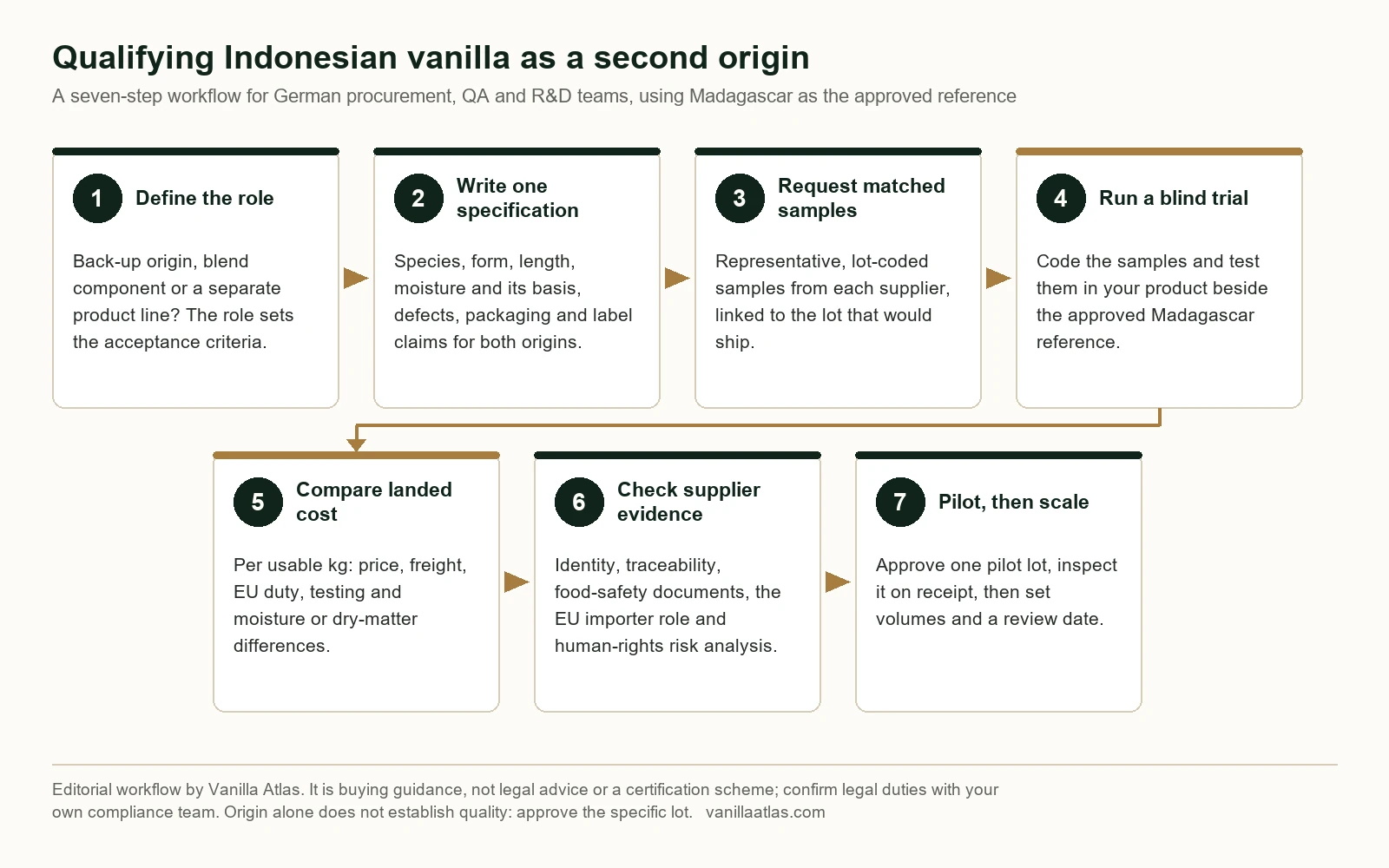
- Define the role. Decide whether Indonesia is a back-up origin, a blend component or a separate product line. The role sets the acceptance criteria and the volume you need.
- Write one specification for both origins. Include species, form (whole, split, cuts), length, moisture and its reporting basis, defect limits, packaging and label wording. Our German application guide maps these fields to bakery, confectionery and dairy uses.
- Request matched, representative samples. Ask each supplier for a lot-coded sample linked to the lot that would ship, with its moisture result and method.
- Run a blind trial. Code the samples so evaluators do not see the origin. Test them in your product beside your approved Madagascar reference, with the same dose, process and storage time, so the vanilla origin comparison rests on your product rather than on descriptions.
- Compare landed cost. Use the per-usable-kilogram formula above, including freight, duty, testing and moisture.
- Check supplier evidence. Confirm legal identity, traceability, food-safety documents, who acts as EU importer, and the human-rights questions in your risk analysis. See how to evaluate an Indonesian vanilla supplier.
- Pilot, then scale. Approve one pilot lot, inspect it on receipt against the agreed specification, then set volumes and a review date.
Extract and flavor manufacturers should add extraction parameters to step 4. See extraction-grade vanilla for German extract manufacturers and agree packaging in advance using the food-contact packaging questions.
When should a German buyer stay with Madagascar only?
Qualifying a second origin is not always worth the work. Use this decision table before starting an Indonesian vs Madagascar vanilla trial.
| Your situation | Recommendation |
|---|---|
| Your label or brand promises Bourbon or Madagascar vanilla | Stay with qualified Indian Ocean supply; a second Madagascar supplier may reduce supplier risk without a label change |
| The recipe cannot tolerate re-validation in the next year | Keep the current source; plan the trial for the next product review |
| Annual volume is small and one supplier performs well | Hold a qualified back-up sample on file rather than splitting orders |
| You need continuity across policy or weather shocks | Qualify Indonesia, or another origin, as a second source |
| You are developing a new product or a named-origin range | Test Indonesian vanilla from the start, before the recipe is fixed |
| Your LkSG risk analysis flags concentration in one supply chain | Add a second origin and supplier with separately verified evidence |
The comparison of Indonesian vs Madagascar vanilla often ends with both origins in use. Each has a defined role, specification and approved supplier.
What should you ask an Indonesian vanilla supplier before sampling?
Ask questions that make an Indonesian vs Madagascar vanilla comparison fair to both samples:
- Which species is offered, and where were the beans grown, cured and graded?
- Is the sample drawn from a lot available now, and how is it coded?
- What moisture result do you report, by which method, and on what basis?
- What lengths, splits and defects does the grade allow?
- How are the beans packed, and which food-contact declarations come with the packaging?
- Who will be the importer of record into the EU, and which origin documents will you provide?
Vanilla Atlas supplies Indonesian vanilla beans. Our five current vanilla bean selections are sold in 1 kg units, with reference specifications on each product page; these are not batch certificates of analysis. If you are qualifying a second origin, tell us your application, required specification, annual volume and delivery point in Germany. We will tell you plainly what we can and cannot document for the current lot.
Frequently asked questions
Is Indonesian vanilla as good as Madagascar vanilla?
In an Indonesian vs Madagascar vanilla comparison, neither origin is better in general. Both mainly supply Vanilla planifolia, and quality depends on harvest maturity, curing, grading and storage of the specific lot. Judge an Indonesian lot against the same written specification and blind application test you use for Madagascar vanilla.
Is Indonesian vanilla cheaper than Madagascar vanilla in Germany?
Not reliably. Germany’s Indonesian vs Madagascar vanilla import data show Indonesia with a lower average unit value in 2021–2023 and a higher one in 2024–2025. Trade averages mix grades, so compare matched quotations on landed cost per usable kilogram, including EU duty and moisture.
Can Indonesian vanilla be labelled Bourbon-Vanille in Germany?
No. In Germany, Bourbon-Vanille is an origin term for vanilla from Madagascar, the Comoros, Réunion, the Seychelles and Mauritius. Indonesian vanilla must be described by its own origin, and any label claim must not mislead consumers about where the vanilla comes from.
What EU import duty applies to vanilla from Indonesia and Madagascar?
Whole vanilla (CN 0905 10 00) carries a 6% third-country duty. Madagascar vanilla qualifies for 0% under EU preferential arrangements. Indonesian vanilla pays 2.1% only if a GSP preference applies with valid origin proof; otherwise 6%. Confirm the current measure in TARIC before budgeting.
Does switching from Madagascar to Indonesian vanilla change my product label?
It can. A natural vanilla flavouring stays natural vanilla flavouring regardless of bean origin. Claims such as “Bourbon vanilla” or “Madagascar vanilla” on pack or in marketing would need to change or be removed. Review labels before a switch or blend reaches production.
Does Indonesian vanilla always taste smoky or woody?
No. Indonesian vanilla is often described as woody or deep, but published studies also record creamy, vanilla-led Indonesian samples, and perceived character changes with the food base. Ask for the lot’s sensory description and test it blind in your own product.
Does the LkSG require us to stop buying Madagascar vanilla?
No. The LkSG requires in-scope companies to analyse and address human-rights risks with their suppliers, not to exclude a country. Madagascar vanilla’s child-labor listing should inform that risk analysis. Ask every supplier, in any origin, the same evidence-based questions and record their answers.
How much Indonesian vanilla should we buy for a first trial?
Start with representative samples from each origin for a blind Indonesian vs Madagascar vanilla trial, then a single pilot lot sized to your production test. Inspect the pilot on receipt against the agreed specification. Set volumes and a review date only after the pilot passes.
Sources and method
Last updated: 2026-11-09. Reviewed 9 November 2026. Trade figures are calculated by Vanilla Atlas from published data; no laboratory or sensory tests were conducted for this article.
- UN Comtrade — Germany as reporter, imports of HS 090510, 2021–2025, retrieved 9 November 2026. Shares and unit values calculated from reported CIF value and net weight; some weights flagged as estimated.
- EU TARIC, CN 0905 10 00 — third-country duty 6%, ESA EPA and EBA 0%, standard GSP 2.1%, checked 9 November 2026.
- Verbraucherzentrale: Vanille, Vanilla und Vanillearoma — Bourbon-Vanille origin term and natural vanilla flavouring, updated 30 July 2026.
- Regulation (EC) No 1334/2008 and Regulation (EU) No 1169/2011 — natural flavouring designation and misleading origin information.
- Capmad, 5 October 2026 and Mintec — Madagascar price policy.
- Aust & Hachmann market report, May 2026 — crop outlook, quality notes and origin trends; a trader’s opinion, not official statistics.
- IHK Chemnitz: Lieferkettengesetz und CSDDD — LkSG scope and status, updated 11 March 2026.
- US Department of Labor, List of Goods Produced by Child Labor or Forced Labor — Madagascar vanilla entry, list as of 5 September 2024.
- IISD, September 2026 — IEU-CEPA signature process.
For the US version of the Indonesian vs Madagascar vanilla comparison, with US import data and FDA considerations, see Indonesian vs Madagascar vanilla beans for US buyers. For France, see Indonesian vanilla as an origin alternative for French buyers.