A German dessert brand plans a new vanilla line. Marketing wants “Bio” on the pack and “sustainably sourced” on the website. Procurement wants to know whether that means paying for certified vanilla, and which certificate. The answer depends less on the vanilla than on the claim you plan to make.
Certification matters in vanilla procurement when a claim reaches a label or customer. For organic vanilla beans wholesale in Germany, every operator in the chain, including the German importer, must be certified under EU organic rules, with an electronic certificate of inspection for each consignment. Since 27 September 2026, sustainability labels must rest on a certification scheme or a public authority. Without a claim, certification is a preference, not a requirement.
Kurz gesagt: Eine Zertifizierung ist im Vanilleeinkauf dann entscheidend, wenn eine Aussage auf das Etikett oder zum Kunden gelangt. Für Bio-Vanille müssen alle Unternehmen der Kette, auch der Importeur in Deutschland, nach EU-Öko-Verordnung zertifiziert sein, und jede Sendung braucht eine elektronische Kontrollbescheinigung (e-COI). Seit dem 27. September 2026 müssen Nachhaltigkeitssiegel auf einem Zertifizierungssystem oder einer staatlichen Stelle beruhen. Ohne Auslobung genügen Spezifikation, Rückverfolgbarkeit und Lieferantennachweise.
This guide is for procurement and sustainability teams buying vanilla for Germany, from organic vanilla beans wholesale to conventional lots with a sustainable vanilla sourcing policy. It explains when organic or sustainability certification is needed, what each certificate does and does not prove, and how to tell certification apart from general responsible-sourcing statements. It ends with a decision tree and a free checklist. For supplier documents in general, see our guides to vanilla traceability in Germany and evaluating a vanilla supplier for Germany.
When does certification matter for organic vanilla beans wholesale in Germany?
Certification matters for organic vanilla beans wholesale in Germany in four situations: you will sell or label the vanilla as organic, it goes into a product sold as organic, a customer’s specification names a scheme, or you plan a sustainability label. In each case the claim, not the vanilla, creates the requirement, and the certificate must cover every step.
If none of these applies, you can buy conventional vanilla and manage quality and risk through a specification, lot traceability and supplier evidence. Certification then becomes a buying preference you weigh against cost and supply, rather than a legal condition.
When certified vanilla is required, expected or optional
| Situation | Certification | Why |
|---|---|---|
| You sell the vanilla as organic (“Bio”, “öko”) | Required at every stage | Regulation (EU) 2018/848 reserves organic terms for certified products |
| Vanilla goes into a product sold as organic | Required in practice | Organic recipes allow only limited, listed non-organic ingredients |
| You use a sustainability label or seal | Required since 27 September 2026 | Labels must rest on a certification scheme or public authority |
| A customer’s specification names a scheme | Expected by contract | The buyer decides; follow its exact scheme and scope |
| Supplier due diligence only, no claim | Optional | Supplier evidence, audits and traceability can do the job |
| No claim at all | Not needed | Specification and lot records manage quality and risk |
How big is the organic market in Germany?
Germany is a large organic market: organic food and drink sales reached a record €18.23 billion in 2025, up 6.7% on 2024, according to the German organic industry association BÖLW. Its quarterly figures put the organic share of the food market at a record 8.1% in the third quarter of 2026.
BÖLW also reports that domestic organic production is not keeping pace with sales, so retailers increasingly import organic goods (Lebensmittel Praxis, 2 November 2026). For vanilla, which Germany does not grow, every organic lot is imported, so the import rules below apply to all organic vanilla beans wholesale in Germany.
What does organic certification require when importing vanilla into Germany?
Importing organic vanilla into Germany requires three things: the grower, curer and exporter must be certified by a control body the EU recognises, each consignment needs an electronic certificate of inspection (e-COI) issued in the EU’s TRACES system, and the German importer must itself be certified by a control body licensed in Germany.
Since 1 January 2025, organic products from countries without an equivalence arrangement, including Indonesia, must comply with EU rules and be certified by a control body listed under Implementing Regulation (EU) 2021/1378. That list changes often; AGRINFO notes that PT BIOCert Indonesia was added in May 2025. The European Commission states that without an e-COI, products are not released from their port of arrival (Commission organic trade page).
Who must be certified in an organic vanilla chain into Germany
| Stage | Requirement | Evidence to see |
|---|---|---|
| Farms or farmer group | Certified, often as a group of operators with an internal control system | Certificate naming the group and vanilla |
| Curing, sorting and packing | Certified for processing and storage | Certificate listing these activities and sites |
| Exporter | Certified by a recognised control body for export | Certificate and control body code |
| Each consignment | Electronic certificate of inspection in TRACES | e-COI matching invoice, lot and weight |
| German importer | Certified by a control body licensed in Germany for imports | Your own certificate covering import |
| Further processors and traders | Certified unless an exemption applies | Each operator’s certificate |
The German federal food agency BLE summarises the principle in its import guidance: imported organic products must be certified “at all levels of production, processing, storage and marketing”. One uncertified link breaks the organic status of the lot. Before you buy organic vanilla beans wholesale in Germany, confirm your own certification as well as the supplier’s.

How do smallholder vanilla farmers get organic certification?
Most vanilla is grown on small farms, so organic vanilla is usually certified through a group of operators: farmers organised as one legal entity with an internal control system that inspects members, while the control body audits the system and samples farms. The EU rules for such groups were tightened under Regulation (EU) 2018/848.
The research institute FiBL estimated that about 70% of certified smallholder groups in non-recognised countries had to restructure to meet the new group rules, and Delegated Regulation (EU) 2021/715 clarifies that group members must be in the same country. For buyers, the practical points are to check the group’s certificate scope and to ask how curing outside the group is controlled. Sustainable vanilla sourcing starts at these farms, whether or not they are certified.
How do you verify a certified vanilla supplier?
To verify a certified vanilla supplier, check five things on the certificate: the holder’s exact name and address, the control body and its code, the products covered (vanilla must be listed), the activities covered (production, processing, export), and the validity dates. Then match each shipment’s e-COI to the invoice, lot code and weight.
Five checks for a certified vanilla supplier’s certificate
| Check | What to look for | Red flag |
|---|---|---|
| Holder | Same legal name and address as your contract and invoice | A certificate held by a different company |
| Control body | Listed as recognised for the country and product category | A body not on the current EU list |
| Products | Vanilla named in the scope | Other spices listed, vanilla missing |
| Activities and sites | Curing, packing and export covered | Only farming covered, curing elsewhere |
| Validity | Valid on the shipment date | Expired, suspended or a scanned copy only |
Ask the supplier to send the certificate before you order, not with the shipment, and confirm that it can issue an e-COI for your consignment. The same checks apply to Fairtrade or Rainforest Alliance certificates, which use their own databases and chain-of-custody rules.
What changed for sustainability claims on 27 September 2026?
From 27 September 2026, EU rules on consumer claims (Directive (EU) 2024/825) ban sustainability labels that are not based on a certification scheme or set up by a public authority, and ban generic environmental claims such as “eco-friendly” unless recognised excellent environmental performance can be shown. Germany implements this through its Unfair Competition Act (UWG).
A certification scheme in this sense must be open to all traders on fair terms, have publicly developed criteria and be monitored by independent third parties, as law firm Heuking summarises. A company’s own “responsibly sourced” logo does not qualify as a sustainability label. These rules govern claims made to consumers, so a B2B buyer is affected whenever its customer will repeat the claim on a pack or website.
Common vanilla claims after 27 September 2026
| Claim | Status | What you need |
|---|---|---|
| “Bio” or “organic” with the EU organic logo | Allowed if certified | EU organic certification of the whole chain |
| Fairtrade or Rainforest Alliance seal | Allowed if certified | Certified supply and chain of custody, licence to use the seal |
| Own “sustainably sourced” badge | Prohibited | Not based on a certification scheme |
| “Eco-friendly vanilla” | Prohibited as a generic claim | Recognised excellent environmental performance |
| “Sourced from smallholder farms in Java, traced to the curing site” | Possible if true and specific | Records that prove the statement |
What is the difference between certification and responsible sourcing?
Certification means an independent body has checked a supplier against a published standard and issues a certificate covering named products, sites and activities. Responsible sourcing describes a buyer’s own practices, such as supplier codes of conduct, audits, traceability and fair payment terms. Both have value, but only certification supports a label or a scheme claim.
Sustainable vanilla sourcing without certification is still meaningful. You can document where a lot was grown and cured, pay agreed prices on time, and assess labour and environmental risks under your due diligence policy. What you cannot do is turn that work into a seal or a generic “sustainable” claim. Describe specific, provable facts instead, and keep the evidence on file. Good sustainable vanilla sourcing is documented, not just declared.
Which certifications are used for vanilla?
The certifications most often used for vanilla are EU organic, Fairtrade and Rainforest Alliance, plus food safety certificates such as FSSC 22000, IFS or BRCGS, which cover safety rather than sustainability. German organic associations such as Naturland and Bioland add private standards on top of EU organic rules for products carrying their marks.
Certifications buyers meet when sourcing vanilla
| Scheme | What it covers | What it does not prove |
|---|---|---|
| EU organic | Production without synthetic pesticides or fertilisers, inspected chain, e-COI per consignment | Aroma, moisture, grade or price paid to farmers |
| Fairtrade | Minimum price and premium rules, producer organisation standards | Organic status, unless also certified organic |
| Rainforest Alliance | Farm standard on environment, labour and livelihoods, with chain of custody | Organic status or a fixed minimum price |
| Naturland, Bioland and similar | EU organic plus association rules for products carrying their marks | Anything outside the association’s scope |
| FSSC 22000, IFS, BRCGS | Food safety management at a named site | Organic or sustainability claims |
Published certified-vanilla programmes are concentrated in Madagascar. Fairtrade has published living income reference prices for Madagascar vanilla, and Givaudan launched Rainforest Alliance certified vanilla extracts for Europe in 2025 using Madagascar beans. If you need a scheme for Indonesian vanilla, ask each certified vanilla supplier early which certificates actually exist for its lots.
Does organic or certified vanilla guarantee better quality?
No. Even when you buy organic vanilla beans wholesale in Germany, organic and sustainability certification describe how vanilla was grown, handled and traded, not how it smells, how much moisture it holds or how it performs in your recipe. A certified lot can still be dry, split or mouldy. Keep the same specification, sample approval and lot-linked lab reports for certified and conventional vanilla.
Certification also does not replace food safety checks. Organic rules restrict pesticide use, but buyers still test for residues and contaminants according to their own risk assessment. Our vanilla bean quality guide explains which physical checks matter for every lot.
How do you decide whether you need certified vanilla?
Decide whether you need certified vanilla by asking five questions in order: will the product be sold as organic, will you use a sustainability label, does a customer specify a scheme, do you plan any other sustainability claim, and does your risk assessment call for audits. The first “yes” tells you which certificate or evidence you need.
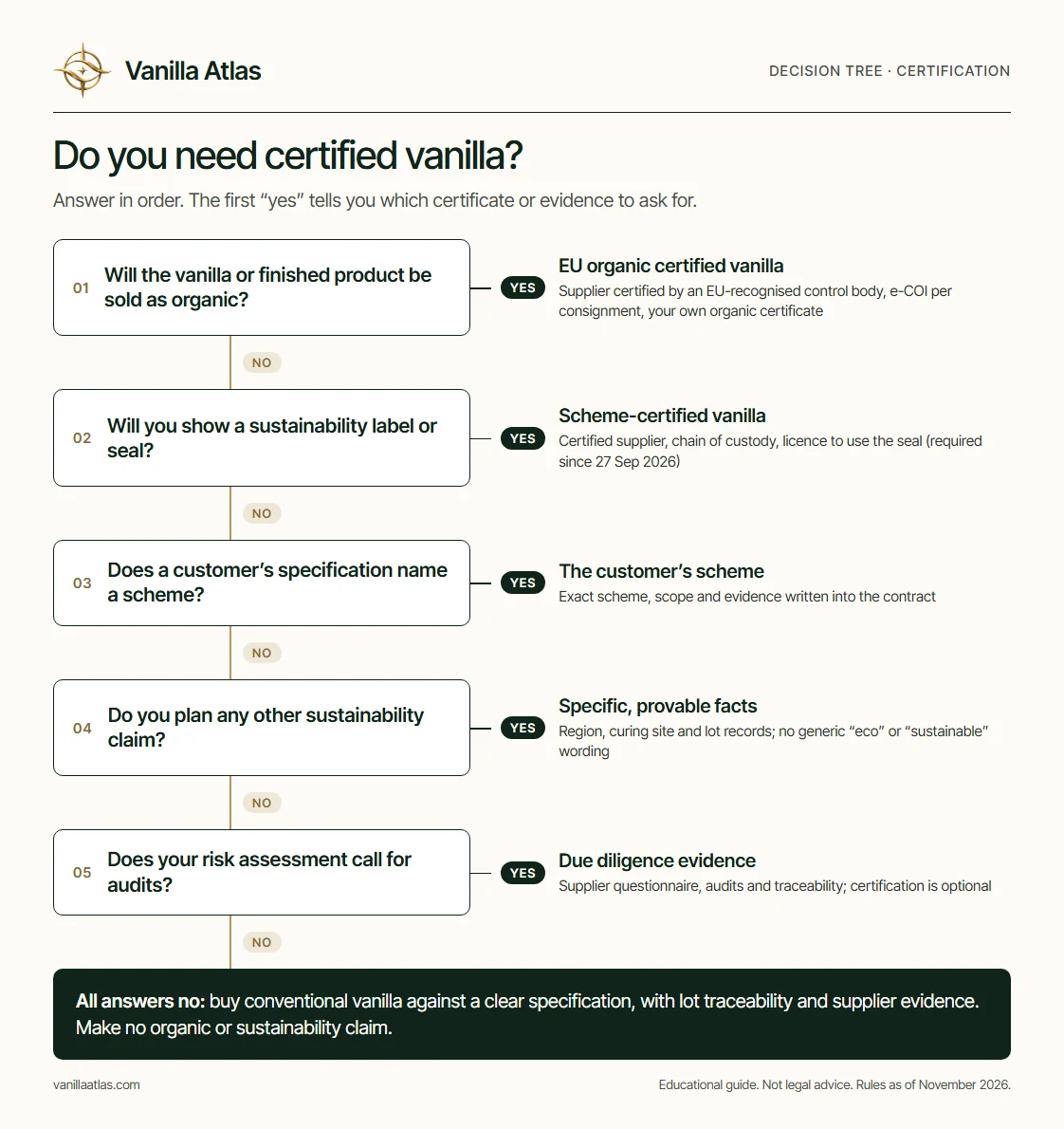
- Will the vanilla or the finished product be sold as organic? If yes, buy EU organic certified vanilla with an e-COI per consignment, and make sure your own company is certified.
- Will you show a sustainability label or seal? If yes, buy from a supplier certified under that scheme, with chain of custody and a licence to use the seal.
- Does a customer’s specification name a scheme? If yes, follow the exact scheme, scope and evidence the customer asks for.
- Do you plan any other sustainability claim? If yes, make it specific and provable, such as region and traceability, and avoid generic terms.
- Does your risk assessment require audits or due diligence? If yes, use supplier questionnaires, audits and traceability; certification is one option among several.
If every answer is no, conventional vanilla bought against a clear specification is the right choice, and you avoid paying for a certificate nobody will use. If any answer is yes, a certified vanilla supplier with the right scope becomes part of the specification.
What should you ask a certified vanilla supplier before ordering?
Before you order organic vanilla beans wholesale in Germany or any certified lot, ask a certified vanilla supplier for the current certificate, the control body’s name and code, confirmation that vanilla and every activity from curing to export are in scope, an example e-COI or chain-of-custody document, the lot codes it will use, and its lead time and price for certified versus conventional lots.
Ask for both prices. Certified lots carry certification costs, segregated handling and a smaller supply pool, so the difference varies by supplier and season. Comparing both quotes shows what the certificate costs you and whether your claim justifies it, and it shows how sustainable vanilla sourcing fits your budget. Our vanilla RFQ template can carry the certification lines.
Subject: Certification requirements, vanilla beans for Germany
We are [company], buying vanilla beans for [application] in Germany. Our product will carry [the EU organic logo / the [scheme] seal / no certification claim].
Please send your current certificate, your control body and code, and confirm that vanilla and all activities from curing to export are covered. Please quote both certified and conventional lots, if available, with lead times.
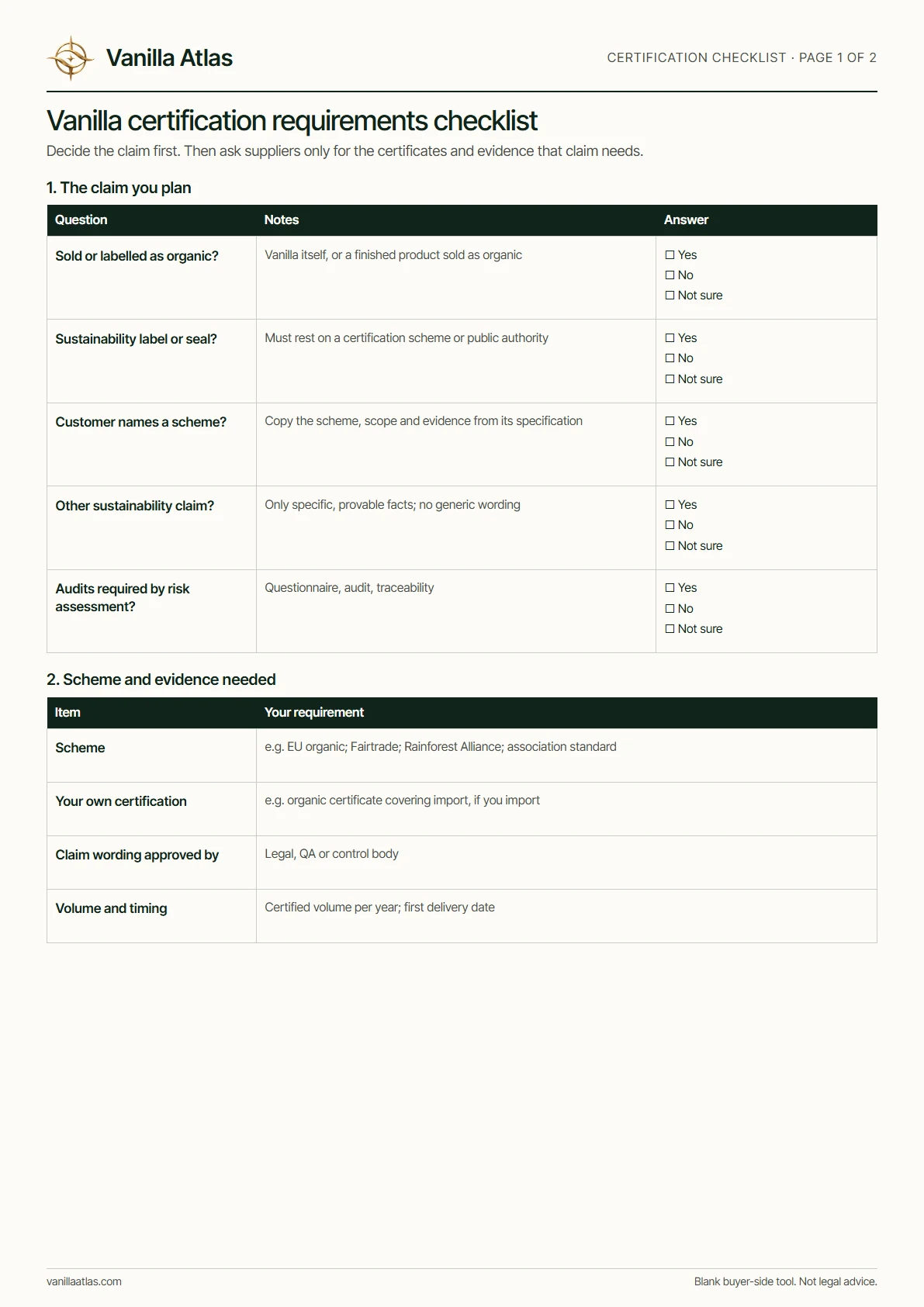
Download the certification requirements checklist
The two-page PDF turns this guide into a form: the claim you plan, the scheme and evidence it needs, and the five certificate checks, with a column for the supplier’s answer. Use it to standardise certification questions for organic vanilla beans wholesale in Germany and every other claim.
Where Vanilla Atlas fits
Vanilla Atlas supplies Indonesian Vanilla planifolia in five selections. Our product pages make no organic or certification claim, and we describe a lot as organic or certified only when a valid certificate covers it. Each quote states the lot’s handling chain, and Germany is on our Shipping & Destinations page.
A batch-specific certificate of analysis is not currently available, and we will mark anything we cannot provide rather than promise it. This guide is buyer-side information, not legal advice; confirm claim wording with your own adviser or control body.
Tell us your certification requirements, and we will say plainly whether we can meet them for the lot you are considering.
Frequently asked questions
Do I need organic certification to sell vanilla in Germany?
Only if you call it organic. Terms such as “Bio”, “öko” and “organic” are reserved for products certified under Regulation (EU) 2018/848 at every stage, including your own company. This applies to organic vanilla beans wholesale in Germany as much as to retail packs. Conventional vanilla can be sold with a specification and traceability, but without organic wording.
Does a German importer of organic vanilla need its own certificate?
Yes. According to the German federal food agency BLE, importers in Germany that bring in organic products from non-EU countries must be certified by a control body licensed in Germany for imports. A certified supplier alone is not enough.
What is an e-COI for organic vanilla?
An e-COI is the electronic certificate of inspection issued in the EU’s TRACES system for each organic consignment. It links the shipment to the certified exporter, and without it the European Commission says organic products are not released from their port of arrival.
Can I call vanilla sustainable without certification?
Not as a label or generic claim. Since 27 September 2026, sustainability labels must rest on a certification scheme or a public authority, and generic claims such as “eco-friendly” are banned without proof of excellent performance. Specific, provable statements about origin and traceability remain possible as part of sustainable vanilla sourcing.
Is Fairtrade vanilla also organic?
Not automatically. Fairtrade covers pricing and producer organisation rules, while organic status needs separate EU organic certification. Some lots carry both, so ask each certified vanilla supplier for every certificate and the e-COI rather than assuming one implies the other.
Is certified organic Indonesian vanilla available?
It can be, where an EU-recognised control body certifies the farms, curing and export. AGRINFO reports that an Indonesian control body, PT BIOCert Indonesia, was added to the EU list in May 2025. Ask each certified vanilla supplier for its certificate and lot availability early.
Sources and review scope
Sources checked 7 November 2026. This is buyer-side guidance, not legal advice. Legal summaries are simplified; German transposition of Directive (EU) 2024/825 is described from law-firm summaries. Lists of recognised control bodies change often; check the current consolidated Implementing Regulation (EU) 2021/1378. No price premium is quoted because no reliable public series for certified vanilla was found.
- Regulation (EU) 2018/848 on organic production and labelling.
- European Commission: Organic trade (imports and e-COI).
- BLE: Importing organic products from third countries.
- AGRINFO: Organic products, recognition of control bodies, revised 6 July 2026.
- FiBL: Smallholders need support under the new organic regulation.
- Directive (EU) 2024/825 on empowering consumers for the green transition, and Heuking and FGvW on German implementation.
- Lebensmittel Praxis: BÖLW figures, 2 November 2026.
- Fairtrade: Living income reference prices for vanilla, and Givaudan: Rainforest Alliance certified vanilla extracts, 2025.