
A vanilla bean flavor profile chart helps you shortlist beans by aroma, but the label on the bag cannot predict the whole eating experience. Species, curing, the individual lot and the recipe all affect the result. Start with the flavor you want, then compare samples in the food you plan to make.
For a familiar vanilla centre, begin by testing Vanilla planifolia. For a more floral or anise-led direction, include Vanilla × tahitensis in your comparison. Treat those as starting points. Neither species is automatically better, and an origin name is not a tasting guarantee.
Below, you will find a cited comparison chart, an explanation of curing, and a practical guide to choosing beans for baking, ice cream, chocolate and extraction. Research findings are identified as findings about particular samples; application suggestions are our editorial recommendations.
Vanilla bean flavor profile chart: four research examples
Read this chart as a set of research examples, not permanent national flavor rules. It compares published observations without inventing intensity scores or claiming that Vanilla Atlas has tested the lots described.
| Origin or sample context | Species in the cited work | Reported aroma direction | How to use the information |
|---|---|---|---|
| Madagascar, 2016 study sample | V. planifolia | A vanilla base with fatty and whisky-like nuances | A reference for comparison; do not assume every Madagascan lot has these notes |
| Comoros, 2016 study sample | V. planifolia | A pronounced smoky character | Ask whether smoke is desirable in your recipe and evaluate the actual sample |
| Tahiti, published Tahitian-vanilla research | V. × tahitensis | Anise and floral characteristics; the 2016 sample also had spicy nuances | A candidate for a floral or anise-led trial, with cultivar and lot still relevant |
| Indonesia, 2020 food-matrix comparison | V. planifolia | Woody character in sugared water; dairy character enhanced in chocolate | Compare in your intended food rather than buying from a pod description alone |
Sources: Shigeto, Hachisuka and Kumazawa, 2016; Brunschwig and colleagues, 2012; Januszewska and colleagues, 2020.
Shigeto’s study compared one commercial sample per origin, with different harvest years. It did not isolate geography from species, maturity and processing. The researchers called for a wider comparison. Its findings support curiosity about a lot, not a ranking of countries.
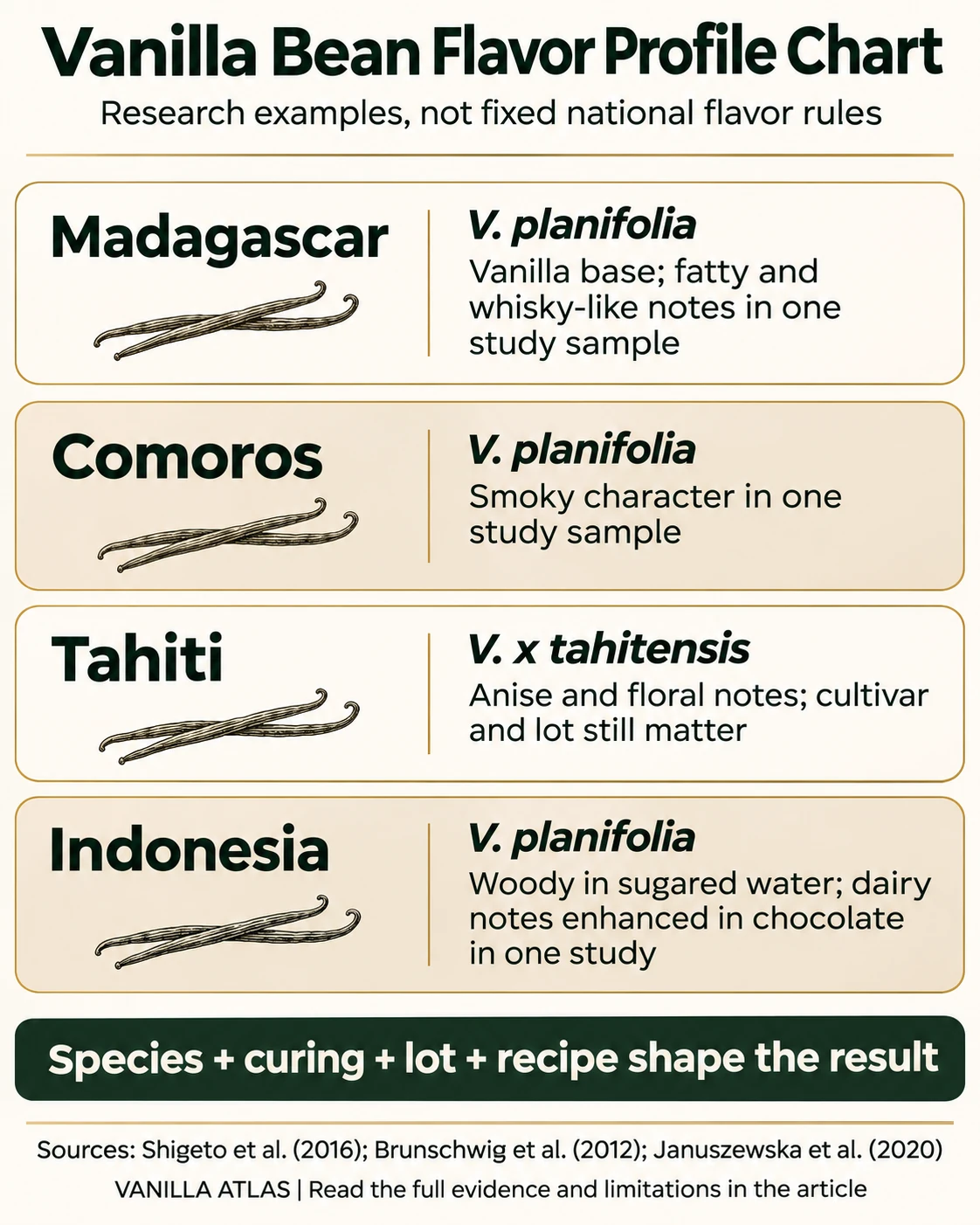
Download the vanilla bean flavor profile chart. Keep the sample limitations with the image when sharing it.
How to read vanilla bean flavor profile chart notes
Treat the descriptive words in a vanilla bean flavor profile chart as a vocabulary for comparison, rather than a list of added ingredients. Use your own words as well: a term is only helpful if you can recognise what it describes in the prepared sample.
| Tasting term | What to look for in your comparison | What the description does not establish |
|---|---|---|
| Vanilla-led | The familiar aroma you associate with vanilla | A complete chemical analysis or a universal quality score |
| Creamy or dairy-like | An aroma impression that seems rounded or reminiscent of dairy | The product’s ingredient or allergen declaration |
| Floral or anise-like | A flower-like or anise-like direction in the aroma | That flowers, anise or another flavouring were added |
| Woody or smoky | A wood-like or smoke-like nuance and its prominence in the recipe | Whether an unfamiliar taint or questionable product condition is acceptable |
Keep this distinction with the vanilla bean flavor profile chart when sharing it. Ask the supplier for actual product ingredients and relevant specifications; the tasting language alone cannot answer those questions.
Species and origin answer different questions
Species identifies the plant; origin identifies where it was grown. A country name does not replace botanical identification, and a botanical name does not tell you how a specific lot was harvested or cured.
The common sourcing comparison is V. planifolia versus V. × tahitensis. Published Tahitian-vanilla work links its distinctive aroma with anise and floral character, while also finding differences between Polynesian cultivars. That makes “Tahitian” an incomplete flavor specification on its own.
A 2024 molecular-aroma study by Tran and colleagues compared material from V. planifolia, V. tahitensis and V. pompona. Vanillin was especially important in the planifolia samples; other odorants helped distinguish the species. This chemical evidence is useful context, but it is not a consumer preference ranking.
For buying, record these fields separately:
- Species: the supplier’s botanical identification, rather than a marketing nickname.
- Declared origin: the country and any supported regional information.
- Lot: the batch that the sample and proposed delivery represent.
- Processing: the available harvest, curing and storage information.
- Sensory description: observations made under a stated tasting method.
When an offer says “Tahitian type”, ask what that means before assuming either origin or species. When it says “Indonesian vanilla”, ask about the lot rather than filling in a flavor description from memory.
What does Indonesian vanilla taste like?
Indonesian vanilla can show different characters; “always smoky” is too narrow. The chocolate study in this vanilla bean flavor profile chart is particularly helpful: the Indonesian sample’s character changed with the food base. That is a direct reason to test vanilla where you will use it.
An earlier IPB University study of vanilla extracts also described a sample from an Indonesian exporter with a creamy, sweet, vanilla-led aroma. It examined a small set of extracts, not every Indonesian bean. The journal issue is dated 2007, while the website’s citation metadata says 2013; the issue date is the one used here.
These studies do not prove a single preferred Indonesian profile. They show why a fixed country stereotype is a weak purchase specification. “Woody”, “creamy” or “smoky” should lead to a sample question: how apparent is the note, and does it work in my product?
For sourcing factors such as sample approval and supply requirements, use our separate Indonesian versus Madagascar vanilla comparison. This flavor guide focuses on sensory choice rather than declaring one origin superior.
How curing changes vanilla aroma
Curing develops the aroma of harvested vanilla; it is more than drying a green pod. During processing, changes in the bean allow aroma precursors to be transformed, including the release of vanillin from glucovanillin.
Munarso and colleagues’ 2024 Indonesian research describes four broad stages and differences in growers’ and exporters’ practices. The following is a simplified explanation, not a curing recipe or a description of every Vanilla Atlas lot.
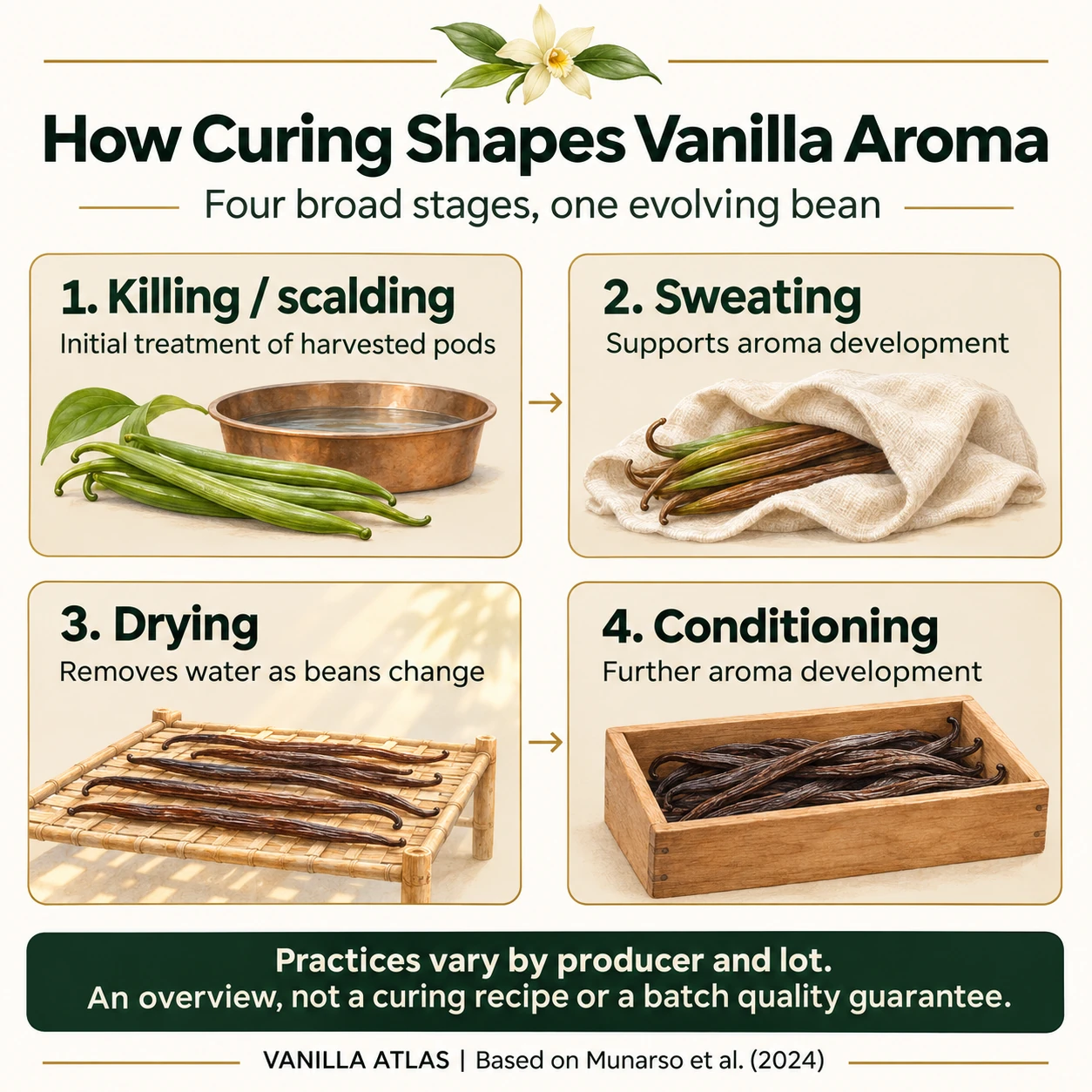
| Broad stage | What it contributes to the process | A useful buyer question |
|---|---|---|
| Killing or scalding | Stops continued growth and changes the bean tissue | What treatment was used for this lot? |
| Sweating | Supports the transformations involved in aroma development | How was the process monitored? |
| Drying | Removes water while the bean continues changing | What is the measured moisture result and method? |
| Conditioning | Provides a further period for aroma development before release | When was the lot conditioned, packed and sampled? |
The research reports variation in these practices. It does not justify a universal rule that a darker, wetter or longer bean tastes better. Nor does a statement such as “traditionally cured” give you a measured sensory profile.
For a home baker, the practical response is simple: buy enough for a small trial before committing to a large pack. For a manufacturer, request a representative sample, retain it appropriately and agree how the bulk lot will be compared with it.
Why vanillin percentage is not a complete flavor score
Vanillin is important, but one percentage cannot describe the balance of vanilla aroma. The 2024 molecular study found differences in other odor-active compounds within and between species. Those compounds help explain why two samples can have a different character even when both smell recognisably of vanilla.
A vanilla bean flavor profile chart should not turn chemical results into a national league table. A higher reported vanillin value is not, by itself, proof that you will prefer the bean in a delicate cream or a dark chocolate filling.
Ask how a result was measured and reported. Values expressed on a dry-matter basis and values for the product as received are not directly interchangeable. The report must also identify the sampled lot. A reference specification is different from that lot’s test result.
Likewise, a scientific dilution factor is not a consumer score. In aroma-extract dilution analysis, it describes detection during a particular analytical procedure. It should not be redrawn as “ten times tastier” or as an intensity rating for a recipe.
Use our vanilla bean grades guide for physical and commercial grade terms, and the moisture-content guide for buying-value considerations. Keep those decisions connected to flavor, without treating them as substitutes for tasting.
Choosing vanilla for baking, ice cream and chocolate
Choose a candidate for the flavor role, then validate it in your recipe. Use the vanilla bean flavor profile chart alongside the application suggestions below. These are starting points for a trial, not the results of a Vanilla Atlas comparative tasting.
| Your application | A useful starting comparison | What should decide the purchase? |
|---|---|---|
| Cake, biscuits and baked pastry | Two suitable planifolia lots, or planifolia versus tahitensis if you want a more aromatic departure | Aroma in the finished, cooled bake at a practical dose |
| Vanilla ice cream or custard | A familiar vanilla-led candidate against a more floral or anise-led candidate | Preference at the intended serving temperature and in the same base |
| Panna cotta or a lightly flavoured cream | A clean vanilla-led sample and a floral candidate | Whether the finish complements the cream without overwhelming it |
| Chocolate or a cocoa filling | Compare samples in the actual chocolate formulation | Whether vanilla adds the desired roundness or distinct note in that matrix |
| Homemade extract | Suitable sound beans in the same extraction method | Aroma of comparable extracts, then their performance in the intended food |
| A product where seeds are visible | Compare sensory fit alongside a format that is easy to prepare | Flavor, handling, visible appearance and cost together |
For baking: test the finished food
Do not promise that a particular country “survives heat best” without a relevant comparison. A strong aroma from the opened bag is useful to notice, but it does not establish the outcome after your mixing, heating and cooling steps.
Keep your normal recipe and process fixed. If you test a different dose, record that as a second question. Otherwise you cannot tell whether you preferred the lot or simply used more vanilla.
For ice cream: compare at serving temperature
Test both candidates in one base and serve them under the same conditions. Decide whether you want a familiar vanilla centre, a floral lift or another clearly described character. “Stronger” and “better” are separate judgements.
A chef may want a distinctive note to be noticed. A family making a classic custard may prefer the more familiar sample. Neither preference requires declaring the other bean inferior.
For chocolate: the food base matters
Januszewska’s work compared white and milk chocolate as well as vanilla in a simpler base. Origin-related differences were more apparent in white chocolate than in milk chocolate, and the study did not establish an overall consumer winner.
That finding supports an economical trial strategy: start with the recipe you actually sell or serve. A comparison in water can help describe a sample, but it cannot replace a test in chocolate.
How to use the vanilla bean flavor profile chart
Use the vanilla bean flavor profile chart to shortlist; use a controlled kitchen comparison to choose. This small trial is a practical screening exercise, not a trained sensory panel or a shelf-life validation.
- Write the flavor goal first. For example: “a familiar vanilla centre with little noticeable smoke” or “a floral, anise-led accent”. Avoid “the best vanilla”, which does not state what you need.
- Choose two relevant candidates. Ask for species, origin and lot identification. Buy or request samples that represent the material you could actually receive.
- Keep the base and process the same. Weigh the bean preparation, keep the pod-to-seed treatment consistent and record time, temperature and serving conditions.
- Hide the origin labels while comparing. Use simple codes so the reputation or price of an origin does not supply the answer for you.
- Record character, strength and preference separately. Write what you notice before choosing a favourite. Ask a second taster independently when practical.
- Recheck the result at a useful dose. A sample that only works at an impractical dose may be the wrong purchase even if you like its character.
- Keep the lot and method with the decision. If you reorder, ask whether the new supply is the same lot. Reassess a changed lot when consistency matters.
For a fuller sensory workflow, read how to compare vanilla aroma beyond origin. This article supplies the reference map; that guide goes deeper into evaluation technique.
A short tasting note that is useful later
Sample and lot: [code, species, declared origin, supplier lot].
Preparation: [recipe, bean weight, seeds/pod use, process, serving temperature].
Character: [vanilla-led, floral, anise-like, woody, smoky or other observations in your own words].
Strength and fit: [how noticeable it is; how well it supports the recipe].
Decision: [preferred candidate, useful dose, price comparison and what to confirm before ordering].
Describe an off-note separately from a desired aroma. Do not use a pleasant-sounding tasting term to explain away an unfamiliar taint or questionable condition. Check the product’s condition through the appropriate quality process before using it in food.
Five common vanilla bean flavor profile chart mistakes
- Treating origin as a guarantee. Use the vanilla bean flavor profile chart to ask better questions about a lot, rather than to skip the sample.
- Comparing unequal preparations. Whole beans, extracts, pastes and powders can differ in concentration and added ingredients. Set a fair preparation and read the product information.
- Buying by bean count alone. Different beans can have different mass. Record the quantity used rather than assuming one pod is equivalent to another.
- Confusing a descriptor with an ingredient. “Whisky-like” is aroma language in the cited study, not an ingredient declaration. Confirm actual ingredients or treatments with the supplier.
- Using one successful trial forever. Save the method and lot reference so a future delivery can be checked against the result you liked.
If a supplier gives “floral 8/10” or a similar figure, ask how it was obtained. Who assessed it, in which preparation, on what scale and against which reference? Without that information, the number is a marketing shorthand, not directly comparable data.
Frequently asked questions
What can a vanilla bean flavor profile chart tell me?
A vanilla bean flavor profile chart helps you choose which samples to compare and which aroma questions to ask. It cannot guarantee a lot’s flavor, predict your preference or prove a supplier’s quality. Pair the chart with the stated species, lot information and a trial in your own recipe.
What is the difference between Tahitian and Madagascar vanilla flavor?
Published Tahitian-vanilla studies describe anise and floral character. Madagascan planifolia can provide a familiar vanilla-led reference, with additional notes depending on the sample. Compare the stated species and actual lots in the same recipe; origin names alone do not establish which you will prefer.
Does all Indonesian vanilla taste smoky?
No single smoky profile describes all Indonesian vanilla. Published work includes different sensory descriptions and shows that the food base can change the perceived character. Ask for the lot’s sensory information and test a representative sample in your own application.
Which vanilla beans are best for baking?
Begin with beans that meet your flavor and handling needs, then compare them in the finished bake. Planifolia is a useful familiar reference; a floral or anise-led candidate may suit a different goal. There is no universal winning origin for every recipe, dose and preference.
Does more vanillin mean better vanilla?
Not automatically. Vanillin is an important aroma compound, but other odorants, their balance and the recipe also matter. Check the result’s method, basis and lot identification, and use sensory evaluation to decide whether the bean fits your application.
Can I use the same bean count when changing origins?
Use a measured quantity for a comparison, because pod sizes and masses vary. Keep the recipe, preparation and dose consistent first. Then make a separate dose trial if needed. Counting one pod of each can introduce a quantity difference before flavor is even compared.
Are the chart's notes guaranteed for Vanilla Atlas beans?
No. The chart summarises third-party research examples. It is not a Vanilla Atlas batch sensory report or certificate of analysis. Confirm the current product and lot information before ordering, and assess a sample if a particular flavor profile is essential.
Choose the flavor role before choosing the pack
Vanilla Atlas offers Indonesian vanilla selections for home kitchens and professional applications. Start with the format and preparation you need, then confirm which current lot information is available. We do not present this vanilla bean flavor profile chart as test results for our products.
Explore our vanilla selections or tell us about your application. A useful enquiry names the recipe or process, desired aroma direction, pack size or volume, destination and any sample or documentation requirements.
Save the vanilla bean flavor profile chart for your next comparison. The most useful result is a bean you enjoy in the food you actually make, with enough information to make that choice again.
Sources for the vanilla bean flavor profile chart
Reviewed 9 November 2026. No new tasting experiment was conducted for this article. Chart descriptors concern the cited materials, and pairing suggestions are editorial starting points. This vanilla bean flavor profile chart contains no invented sensory scores or nationwide flavor rankings.
- Shigeto, Hachisuka and Kumazawa (2016), Food Science and Technology Research 22(6), 811–816. Full text checked; one commercial sample per origin, not a controlled nationwide comparison.
- Brunschwig and colleagues (2012), Odor-active compounds of Tahitian vanilla flavor. Published abstract and highlights checked; cultivar-specific sensory character is reported.
- Januszewska and colleagues (2020), Impact of vanilla origins on sensory characteristics of chocolate. Published abstract checked; the study concerns particular vanilla materials and chocolate formulations.
- Tran and colleagues (2024), Molecular Aroma Composition of Vanilla Beans from Different Origins. Full paper in the ZHAW institutional repository. Chemical comparisons do not establish consumer preference for every commercial lot.
- Setyaningsih, Rusli and Muliati, Jurnal Ilmu Pertanian Indonesia 12(3), 173–181. Issue dated 2007; website citation metadata dated 2013. Small extract comparison rather than a national bean profile.
- Munarso and colleagues (2024), From bean to market: exploring the chemical and production dynamics of high-quality Indonesian vanilla. Used for processing context; no reported ranges are asserted as Vanilla Atlas batch measurements.


2 Comments