
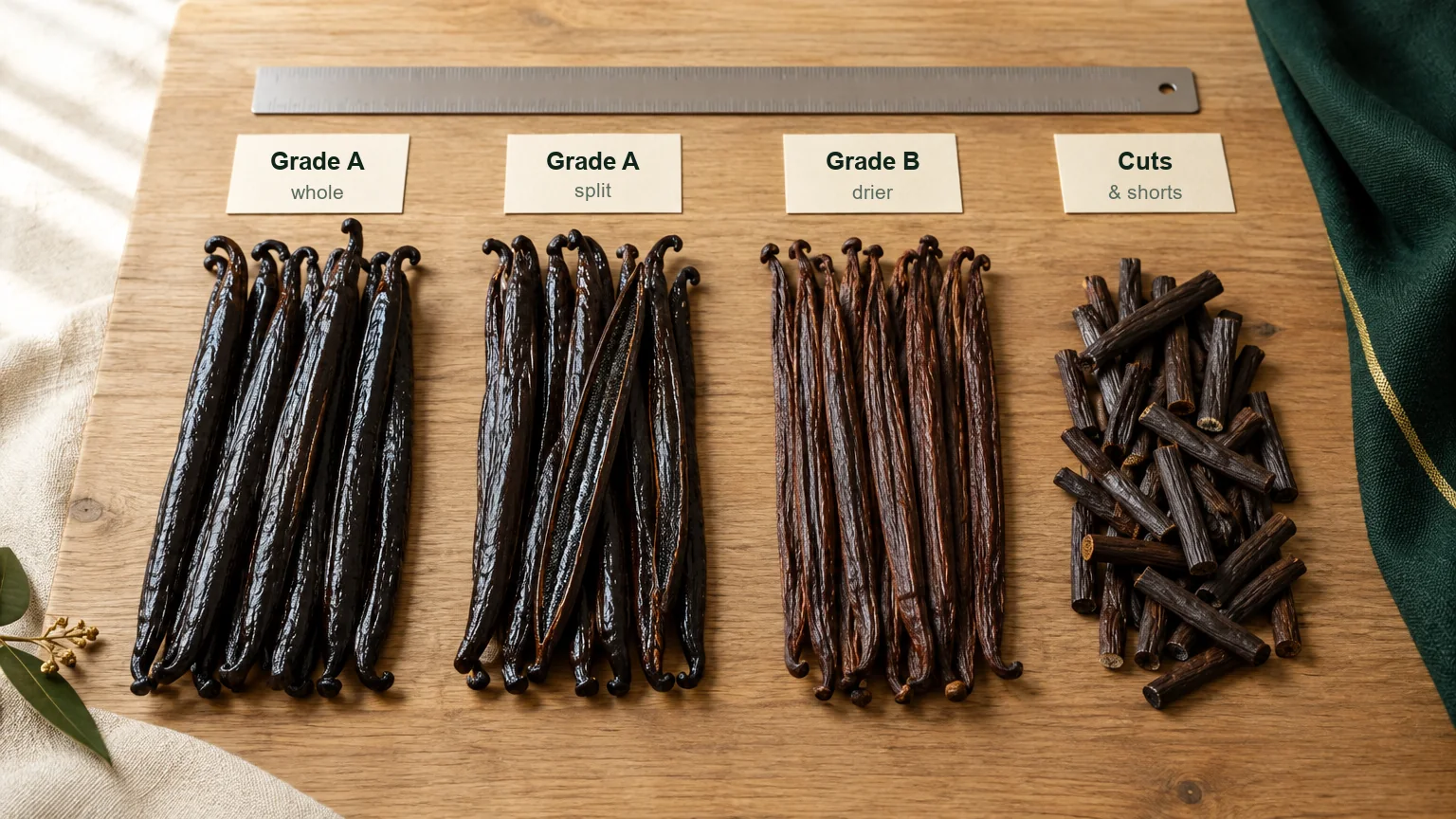
Vanilla bean grades describe how moist, supple, intact and even-coloured a cured pod is, not how good it tastes. “Grade A” usually means plump, oily beans with about 30–38% moisture, suited to scraping seeds. “Grade B” usually means drier beans with about 15–25% moisture, suited to extract. Neither label is defined by the international vanilla standard.
That last point matters more than most buying guides admit. This guide explains what vanilla bean grades mean in practice, how the ISO 5565-1 categories and the Indonesian SNI classes work, and seven checks that tell you which beans to buy for your use.
Key takeaways
- Grade A and Grade B are seller terms. ISO 5565-1 uses Categories 1–4, with “A” for whole pods and “B” for split pods.
- Moisture is the biggest practical difference. ISO allows up to 38% for Categories 1 and 2, 30% for Category 3 and 25% for Category 4.
- A split pod is not automatically lower quality. Under ISO, a split pod keeps the category of the equivalent whole pod.
- Buy Grade A for visible seeds and whole-pod presentation; buy drier beans for extract, where you pay for flavour solids rather than water.
- Ask for measured moisture and vanillin for the actual lot. A grade name alone is not a specification.
What are vanilla bean grades?
Vanilla bean grades are commercial labels that sort cured pods by appearance, moisture, suppleness, length and defects. Sellers use them to set prices and to signal intended use. Because each seller defines its own grades, two “Grade A” lots from different suppliers can differ noticeably in moisture, length and aroma.
There are three layers of vanilla bean grading you will meet, and most confusion about vanilla bean grades comes from mixing them up:
- Trade grades such as Grade A, Grade B, gourmet, extraction grade, prime, red, cuts and splits. These are market language.
- International standard categories in ISO 5565-1:1999, which define Categories 1–4 for pods plus limits for cut, bulk and powdered vanilla.
- National standards such as Indonesia’s SNI 01-0010-2002, which sets quality classes (Mutu I, II and III) with length, moisture, vanillin and ash requirements.
A good supplier can tell you how its vanilla bean grades map to the other two layers. If it cannot, treat the grade as a description, not a guarantee.
Grade A vs Grade B vanilla beans: what is the difference?
The main difference between Grade A vanilla beans and Grade B vanilla beans is moisture. Grade A beans are softer, oilier and heavier per bean because they hold more water. Grade B beans are drier, firmer and lighter, so a kilogram contains more beans and more flavour solids. Appearance, length and price follow from that.
| Property | Grade A (gourmet, prime, “black”) | Grade B (extraction, “red”, dry) |
|---|---|---|
| Typical moisture | About 30–38% | About 15–25% |
| Feel | Supple; bends without cracking | Firm or leathery; may crack when bent |
| Surface | Glossy, oily, dark brown to black | Matte, drier, often reddish-brown |
| Splits and marks | Few; usually whole | More splits, marks or uneven colour accepted |
| Seeds | Easy to scrape | Harder to scrape; better infused or ground |
| Beans per kg | Fewer | More |
| Best uses | Pastry, ice cream, custard, visible seeds, retail packs | Extract, infusions, vanilla powder, cooking where pods are removed |
| Price per kg | Higher | Lower |
The moisture bands above are common trade ranges, not limits from a standard. Always check the supplier’s measured value.
Is Grade A better than Grade B? Not in every use. Grade A vanilla beans are better when you want plump beans, easy seed scraping or a premium look. For extract, well-cured Grade B vanilla often gives better value because you are not paying for water. A poorly cured Grade A bean can taste weaker than a well-cured Grade B one.
Our guide to gourmet vs extraction-grade vanilla beans covers this choice for food manufacturers in more depth.
Is there an official grading standard for vanilla beans?
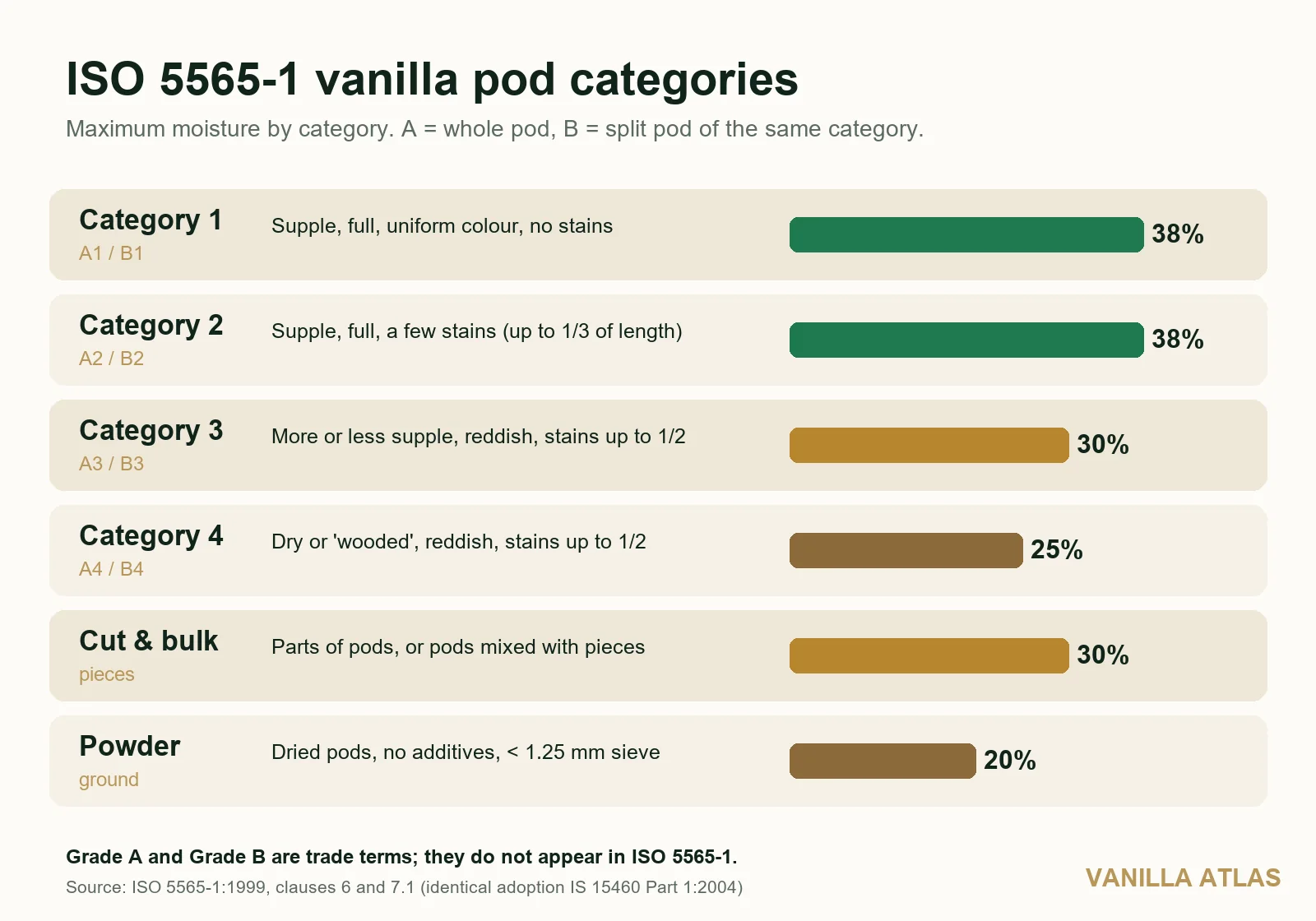
Yes. The international reference is ISO 5565-1:1999, “Vanilla [Vanilla fragrans (Salisbury) Ames] — Part 1: Specification.” It classifies whole pods into four categories, each with a non-split “A” and a split “B” version, and sets maximum moisture levels. ISO confirmed the 1999 edition in 2017, and a revision is under development.
The categories below follow the identical Indian adoption of the standard, IS 15460 (Part 1):2004, which reproduces the ISO 5565-1:1999 text.
| ISO category | Pod description (summarised) | Moisture, max |
|---|---|---|
| Category 1 (A1 whole, B1 split) | Whole, sound, supple and full; typical flavour; uniform dark chocolate-brown to reddish; no stain other than the mark | 38% |
| Category 2 (A2, B2) | As Category 1, but may have a few stains totalling no more than one-third of the pod length | 38% |
| Category 3 (A3, B3) | More or less supple; reddish; numerous stains up to half the pod length; a few red filaments up to one-third of the length | 30% |
| Category 4 (A4, B4) | Dry or “wooded”; reddish; several stains up to half the pod length | 25% |
| Cut and bulk vanilla | Parts of pods or a mix of pods and pieces | 30% |
| Vanilla powder | Ground dried pods, no additives, passes a 1.25 mm sieve | 20% |
Source: ISO 5565-1:1999, clauses 6 and 7.1, as adopted in IS 15460 (Part 1):2004.
Three points in the standard are useful for anyone comparing vanilla bean grades or reading a vanilla bean grading claim:
- Grade A and Grade B do not appear in it. The letters A and B in ISO mean whole and split, not first and second quality.
- All pods must meet basic rules. They must not be mouldy, moth-eaten, oxidised, blistered or treated in a way that changes their natural vanillin, and they must smell typical of vanilla.
- Length is not a category criterion. ISO asks for pods to be packed in bundles of the same length, but it does not rank pods by length.
A rough working match is that Grade A corresponds to ISO Categories 1 and 2 and Grade B to Categories 3 and 4. That match is an approximation; only an inspection of the actual pods can place a lot in an ISO category.
Are split vanilla beans lower quality?
No, not automatically. In ISO 5565-1, a split pod (B1, B2, B3 or B4) has the same characteristics as the whole pod of the same number. A B1 pod is a Category 1 pod that has split. Splitting often happens in mature, well-filled beans during curing.
Splits matter for presentation and handling, not for flavour as such:
- For retail packs and visible decoration, whole pods look better and travel more neatly.
- For extract or infusion, splits make no practical difference and can be cheaper.
- An open pod exposes seeds, so storage and packaging need more care.
When you compare vanilla bean grades from different sellers, ask whether “split” is listed separately and what share of splits a lot may contain. Our vanilla bean defects guide explains how to write that tolerance into a specification.
How does moisture change vanilla bean grades and value?
Moisture sets most of the price difference between vanilla bean grades. Water adds weight and suppleness, which shoppers like, but it adds no flavour. When you compare offers for extract or processing, compare the price of dry matter, not just the price per kilogram.
Use this formula:
Price per kg of dry matter = price per kg ÷ (1 − moisture as a decimal)
Here is a worked example using Vanilla Atlas list prices for 1–9 kg orders on 8 November 2026 and the midpoint of each reference moisture range:
| Vanilla Atlas selection | Price per kg (USD) | Reference moisture | Midpoint | Price per kg dry matter (USD) |
|---|---|---|---|---|
| Gourmet | 190 | 28–35% | 31.5% | 277 |
| Select | 175 | 25–30% | 27.5% | 241 |
| Classic | 160 | 24–28% | 26.0% | 216 |
| Dry Whole | 100 | 18–25% | 21.5% | 127 |
| Shorts | 90 | 18–25% | 21.5% | 115 |
Reference ranges are product specifications, not batch test results. Prices change; check the product page before ordering.
The lesson is general: drier beans cost far less per unit of flavour solids. That is why extract makers often choose Grade B vanilla. Moisture also affects storage. Very moist beans need careful packing to avoid mould, while very dry beans can become brittle. Our vanilla bean moisture content guide covers dry matter and water activity in detail.

What vanillin content should good vanilla beans have?
ISO 5565-1 notes that cured pods usually contain 1.6–2.4% vanillin on a wet basis. Below 1.6% may point to faulty processing. Above 2.4% calls for more testing, because synthetic vanillin may have been added. The standard treats these as usual values, not as category limits.
Vanillin varies for reasons that have nothing to do with vanilla bean grades. Harvest maturity, curing and the plant itself all matter. A CIRAD study of 30 vanilla accessions found vanillin potential in ripe Vanilla planifolia fruit ranging from 1.80% to 4.58% of dry weight across genotypes.
Two practical rules follow:
- Check the basis. “Dry basis” figures look higher than “wet basis” figures for the same bean. A bean with 3.0% vanillin on a dry basis and 38% moisture contains about 1.9% on a wet basis (3.0 × 0.62).
- Do not buy on vanillin alone. Vanilla flavour comes from hundreds of compounds. Vanillin is a useful check, not a full flavour score.
How are Indonesian vanilla beans graded?
Indonesia grades vanilla under SNI 01-0010-2002 (Panili), which sorts cured beans into Mutu I, Mutu II and Mutu III. The classes set minimum length, maximum moisture, minimum vanillin and maximum ash. Exporters also use trade vanilla bean grades, so ask which system a quotation refers to.
| SNI class | Pod form | Min. length | Max. moisture | Min. vanillin (dry basis) | Max. ash (dry basis) |
|---|---|---|---|---|---|
| Mutu I | Whole, not cut | 11 cm | 38% | 2.983% | 8% |
| Mutu II | Whole or cut | 8 cm | 30% | 2.250% | 9% |
| Mutu III | Whole or cut | 8 cm | 20.88% | 1.500% | 10% |
Values as summarised in the Directorate General of Estate Crops’ 2008 technical guide to vanilla cultivation. Confirm against the current SNI text from Badan Standardisasi Nasional before using them in a contract. The standard is still used in farmer training (Universitas Sebelas Maret, 2026).
Note that the SNI vanillin figures are on a dry basis. Converted to a wet basis, Mutu I at 38% moisture corresponds to about 1.85% vanillin, which sits inside the ISO “usual” range. For more on how Indonesian beans are grown and cured, see Indonesian vanilla explained.
Is the white coating on vanilla beans mould or vanillin?
It can be either, so look closely. ISO 5565-1 allows pods to be “naturally frosted” with crystals of natural vanillin. Vanillin frost forms fine, glittering, needle-like crystals that sit on the surface. Mould tends to look fuzzy, cottony or powdery, often grey, green or white, and smells musty.
A quick check:
- Crystals look like tiny glinting needles or frost, catch the light and sit on a bean that still smells of vanilla.
- Mould looks soft, fuzzy or hairy, may spread in patches and smells damp, musty or sour.
If you are not sure, separate the beans and contact the seller. Never sell or use beans you suspect are mouldy. A fuller visual guide is in our French buyers’ quality guide.
7 checks to choose the right vanilla bean grade
Choose vanilla bean grades by use first, then confirm the lot with seven checks. Start with what you will make, because that decides how much moisture, length and appearance are worth paying for. Then check the beans in your hand or the data on the specification sheet.
- Start with your use. Visible seeds, ice cream and retail gifts need Grade A vanilla beans. Extract, infused syrups and powder work well with Grade B, cuts or shorts.
- Ask for measured moisture. Request the lot’s moisture result and the test method. ISO 5565-2 describes the reference method.
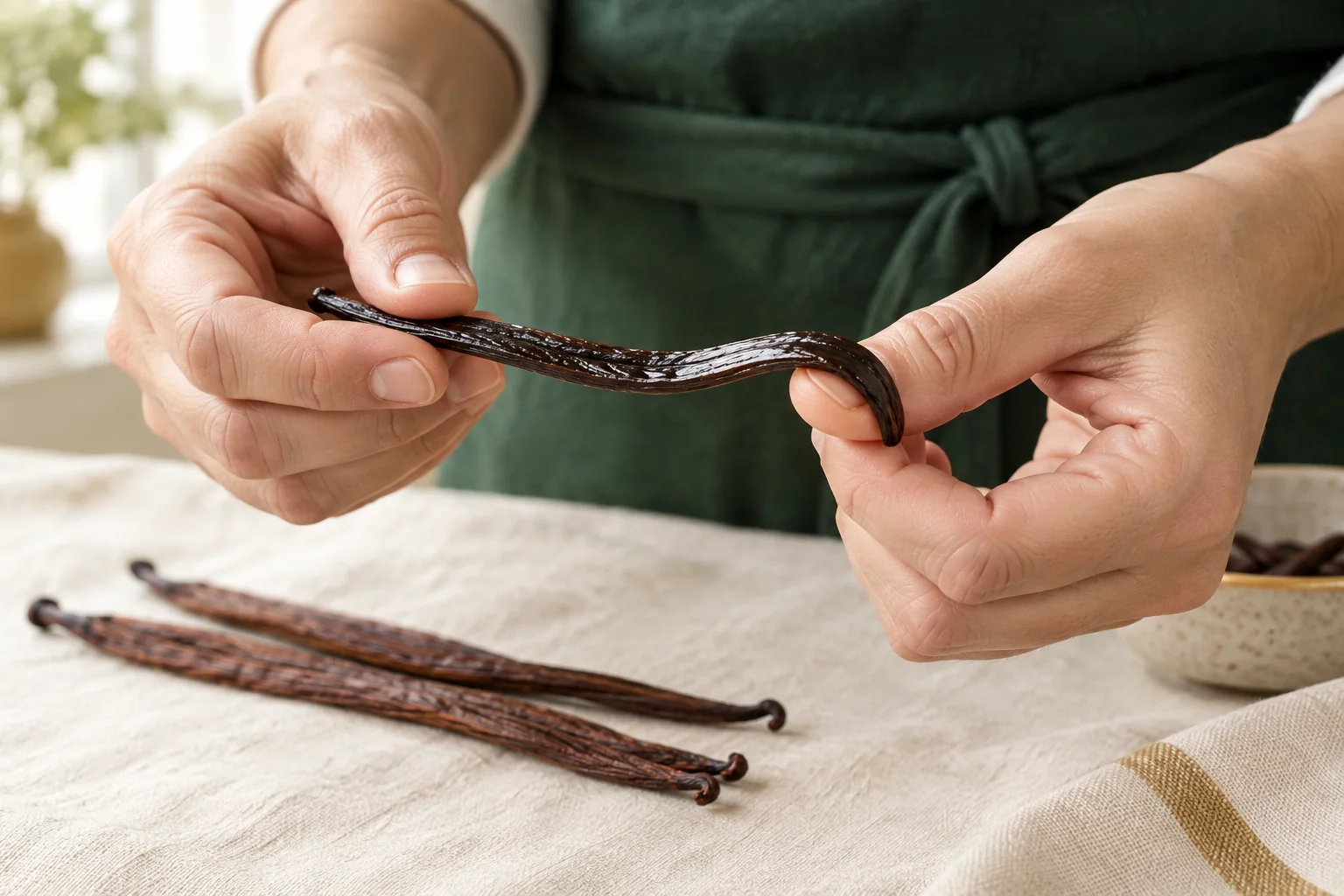
- Bend one bean. A Grade A vanilla bean should bend around a finger without cracking. A Grade B bean may be firmer; brittle beans that snap are very dry.
- Look at the surface. Expect dark brown to black and slightly oily for Grade A. Reddish, matte beans are typical of drier grades.
- Smell it. The aroma should be clean and typical of vanilla: sweet, rich, sometimes woody or smoky. Reject musty, sour or chemical smells.
- Check length and splits. Measure a handful. Agree on minimum length and the share of split pods if presentation matters.
- Confirm vanillin and the basis. Ask whether vanillin is reported on a wet or dry basis, and compare like with like.
A structured sample check is the safest way to confirm vanilla bean grades before a larger order. See how to evaluate vanilla bean samples for a full checklist.
Which vanilla bean grade is best for your use?
For most home and professional uses, match the grade to whether the bean stays visible. If seeds or the pod are part of the finished product, pay for Grade A. If the bean is steeped and removed, a drier grade usually gives more flavour per dollar.
| Use | Recommended grade | Why |
|---|---|---|
| Crème brûlée, custard, ice cream with visible seeds | Grade A | Supple pods scrape easily and give plentiful seeds |
| Whole-pod decoration or gift packs | Grade A, whole (non-split) | Appearance and length matter |
| Homemade vanilla extract | Grade B, cuts or shorts | More dry matter per kilogram; looks do not matter |
| Vanilla sugar or vanilla powder | Grade B or shorts | Drier beans grind and dry more easily |
| Infused syrups, sauces and drinks | Grade B or Grade A | Either works; choose on price and aroma |
| Food manufacturing and flavour houses | Depends on the specification | Set moisture, vanillin and microbiology limits per process |
Manufacturers buying in volume should read extraction-grade vanilla beans for extract manufacturers, which explains how to specify beans for maceration.
How do Vanilla Atlas selections compare with common vanilla bean grades?
Vanilla Atlas sells five Vanilla planifolia selections from Indonesia that span the usual range of vanilla bean grades, from Grade A to Grade B. The table maps each selection to the market terms buyers know and to the closest ISO moisture ceiling. It is a reference guide; it does not replace a lot-specific specification.
| Vanilla Atlas selection | Reference length | Reference moisture | Closest market term | Closest ISO moisture ceiling |
|---|---|---|---|---|
| Gourmet | 14–22 cm | 28–35% | Grade A, gourmet | Categories 1–2 (max 38%) |
| Select | 14–22 cm | 25–30% | Between Grade A and Grade B | Category 3 (max 30%) |
| Classic | 12–22 cm | 24–28% | Between Grade A and Grade B | Category 3 (max 30%) |
| Dry Whole | 10–22 cm | 18–25% | Grade B, extraction | Category 4 (max 25%) |
| Vanilla Bean Shorts | Below 10 cm | 18–25% | Cuts or shorts | Cut and bulk vanilla (max 30%) |
Reference ranges come from the Vanilla Atlas product pages. They are not certificates of analysis. Ask us for the measured values of the lot you are offered.
You can compare all five on the Vanilla Atlas products page. If your use needs a specific moisture, length or split tolerance, contact us with your requirements and we will confirm what the current lot can meet.
Frequently asked questions about vanilla bean grades
What does Grade A vanilla bean mean?
Grade A is a trade term for supple, oily, well-filled vanilla beans with relatively high moisture, usually about 30–38%. The beans are easy to split and scrape, so they suit pastry, custard and ice cream. Grade A is not defined in ISO 5565-1, so ask the seller for measured moisture and length.
Is Grade B vanilla good for baking?
Yes, if the bean is steeped and removed, as in custards, syrups and sauces. Grade B vanilla beans are drier, so scraping seeds is harder. For visible seeds or decoration, Grade A works better. For extract, Grade B usually gives more flavour per dollar because it contains less water.
Which vanilla bean grade is best for homemade extract?
Grade B, extraction-grade beans, cuts or shorts are usually the best value for homemade extract. They contain more dry matter per kilogram, and their appearance does not matter once they are soaked. Well-cured beans of either grade make good extract; avoid beans that smell musty or look mouldy.
Do vanilla bean grades affect flavour?
Not directly. Vanilla bean grades describe moisture and appearance, while flavour depends mainly on the plant, harvest maturity and curing. A well-cured Grade B bean can taste stronger than a poorly cured Grade A bean. Smell and, where possible, a small test batch are better guides to flavour than the grade name.
What is Grade C vanilla?
Grade C is a seller term with no standard definition in any vanilla bean grading system. Sellers use it for very dry beans, broken pieces, short beans or lower-aroma material, usually sold for extraction or grinding. Ask what the seller means, and request moisture, vanillin and a photo of the actual lot before buying.
Is “Bourbon vanilla” a grade?
No. Bourbon vanilla describes origin, not grade. It refers to Vanilla planifolia grown and cured in the Indian Ocean region, such as Madagascar, the Comoros and Réunion. Bourbon vanilla is sold in several vanilla bean grades, from gourmet to extraction. Indonesian vanilla is the same species but should not be sold as Bourbon.
Choose the use first, then the grade
Vanilla bean grades are useful shorthand, but the label alone cannot tell you what you are buying. Decide how you will use the beans, compare moisture and price per kilogram of dry matter, and ask for measured values for the lot. A good supplier will answer in numbers.
If you want help matching vanilla bean grades to a recipe, product or process, send us your requirements.
Sources
- International Organization for Standardization. ISO 5565-1:1999, Vanilla — Part 1: Specification. Confirmed 2017; revision in progress.
- Bureau of Indian Standards. IS 15460 (Part 1):2004 / ISO 5565-1:1999, Vanilla — Specification. Identical adoption; clauses 4–7 used for categories, moisture and vanillin.
- Badan Standardisasi Nasional. SNI 01-0010-2002, Panili. Class values as summarised in Direktorat Jenderal Perkebunan (2008), Pedoman Teknis Budidaya Vanili.
- Universitas Sebelas Maret. Sosialisasi uji vanili berdasarkan SNI 01-0010-2002. Jurnal SEMAR, 2026.
- CIRAD. Quantification of the aromatic potential of ripe fruit of Vanilla planifolia and related species and hybrids.
- Vanilla Atlas product pages and Store API, read 8 November 2026, for reference specifications and prices.
Prepared by Vanilla Atlas. This guide is general buying information and does not replace a contract specification or laboratory testing.



5 Comments