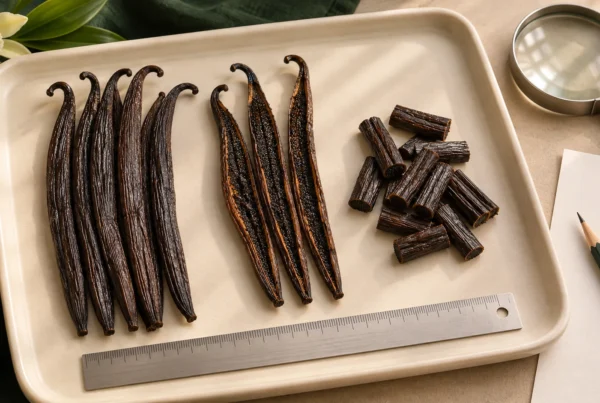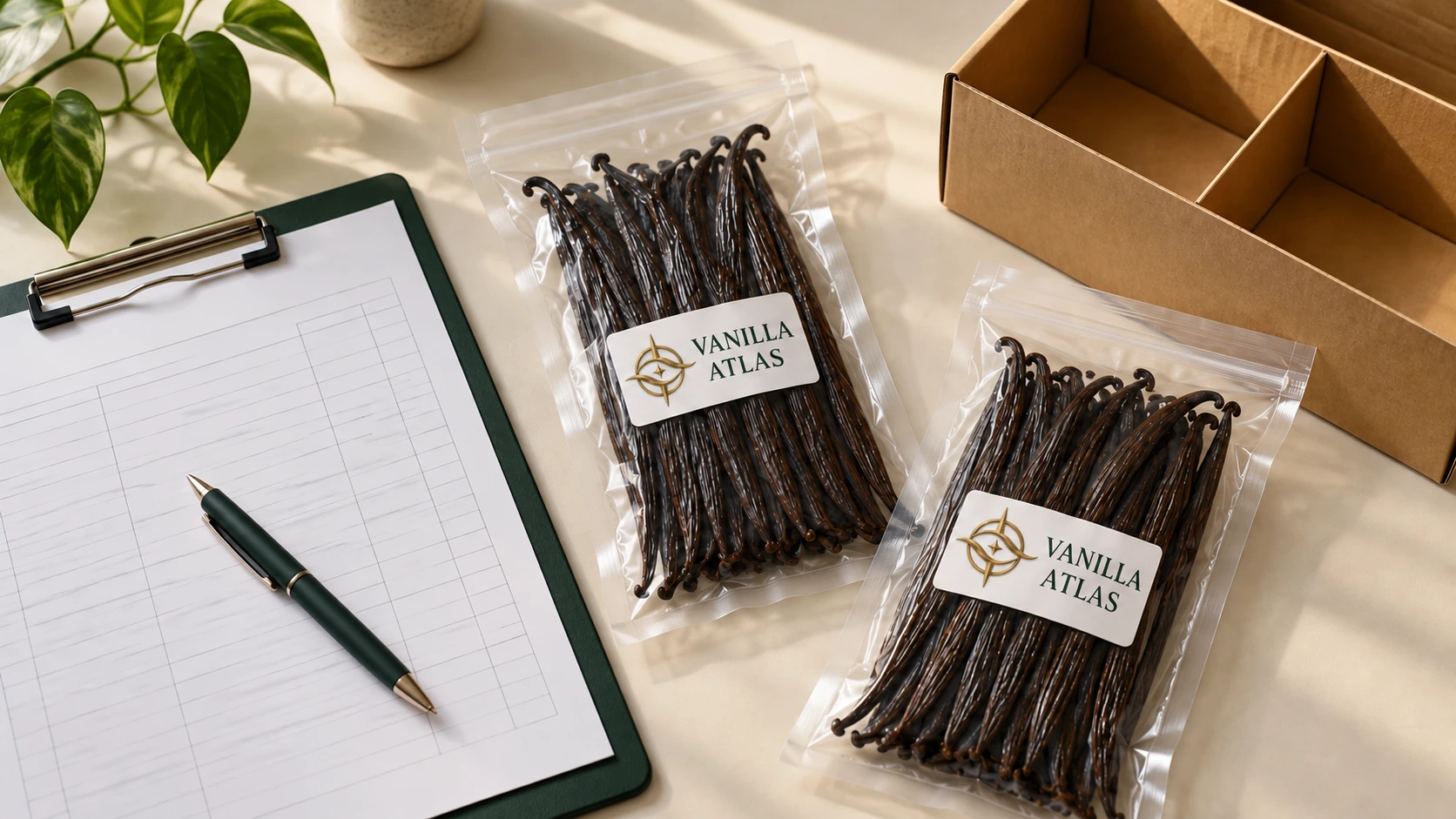
The invoice says 20 kg. The cartons also total 20 kg. That still leaves a question: which beans are in each carton, and which test report covers them?
Vanilla import documents should connect the purchased product, supplier lot, test sample, packed cartons, transport record, and US receiving record. Build a lot-to-carton cross-reference, reconcile quantities and document versions before dispatch, and record any repacking or lot changes. Review applicable entry requirements separately with the responsible importer and filer.
This guide covers document reconciliation for cured vanilla beans sold for food use. It complements our supplier-document request checklist, which explains what to ask a supplier for. Here, the task is to make those records work together for a particular shipment.
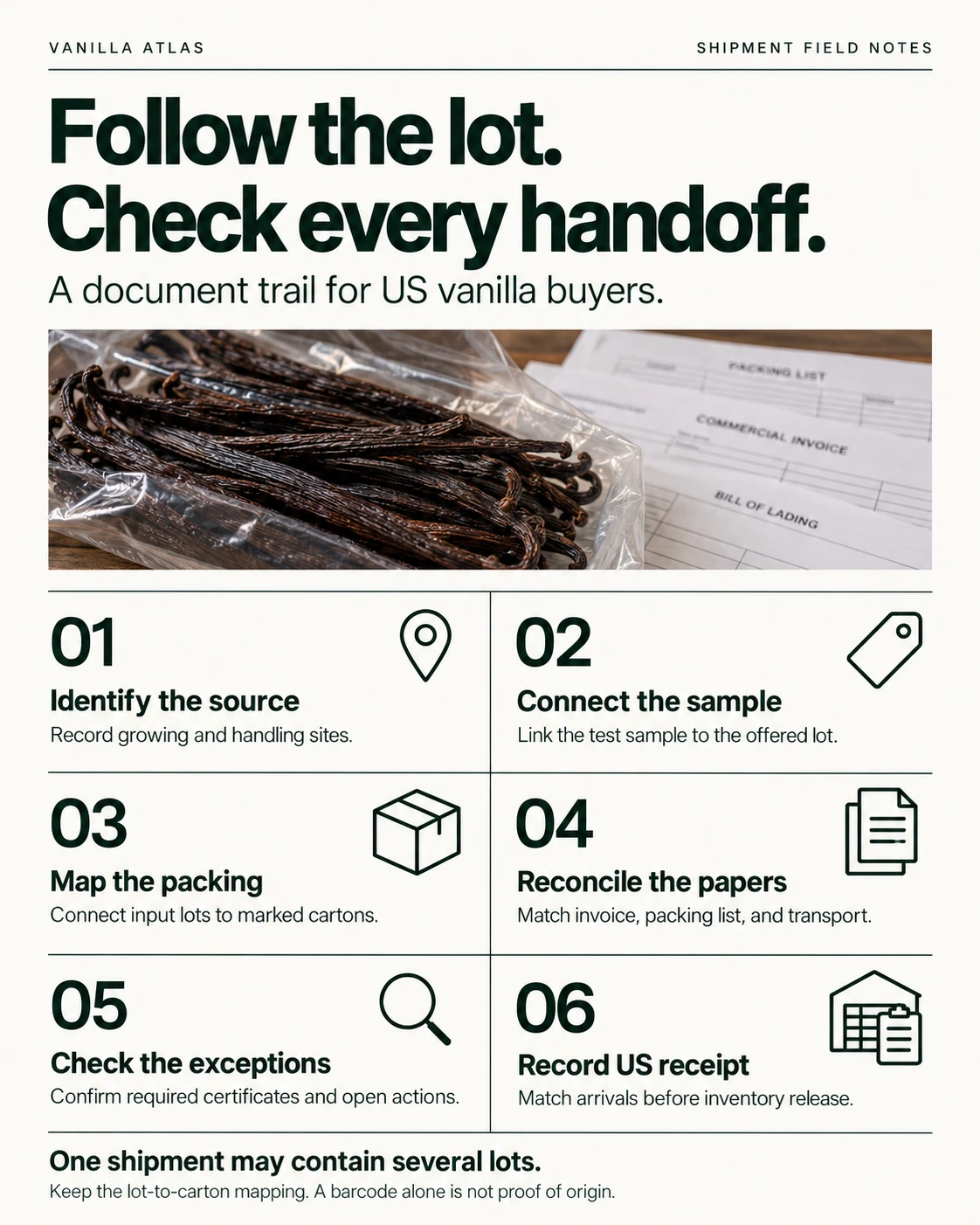
1. Organize vanilla import documents by shipment
Organize your vanilla import documents in an index with the purchase-order reference, supplier identity, product description, shipment reference, lot codes, and links to the latest approved files. Give each open discrepancy an owner. A shared folder is useful only if the reviewer can identify the version that was accepted.
Separate a shipment reference from a product lot code. One shipment may contain several lots; one lot may leave in several shipments. Preserve both relationships.
Vanilla import documents and shipment cross-references
| Record | Connection to verify | Question before dispatch |
|---|---|---|
| Purchase order and agreed specification | Ordered product to accepted requirements | Does the description identify species, form, pack size, and the agreed specification version? |
| Supplier lot record | Offered material to sourcing and handling records | Which sites handled this lot, and were any inputs combined? |
| COA or test report, where required | Tested sample to the offered lot | Can the sample be linked to the beans being packed? |
| Packing record and packing list | Lot codes to marked packages and quantities | Can each carton be traced to its contents? |
| Commercial invoice | Sale to product and shipment | Do quantity, description, parties, value, and references agree with the order and shipping records? |
| Air waybill or bill of lading | Transport booking to shipped cargo | Are consignee, package count, and shipment references reconciled at the appropriate document level? |
| US receiving record | Arriving packages to the expected lots | Do marks, quantities, condition, and any deviations support inventory release? |
These are buyer-side review fields. They do not prescribe a universal invoice layout. The International Trade Administration document guide distinguishes invoices, packing lists, and transport documents and explains why their information must be consistent. Have the filer confirm the exact data needed for the transaction.
2. Connect vanilla traceability documents to source sites
Useful vanilla traceability documents show where an identified lot came from, where it was handled, what happened to it, and where it went. Start with the supplier's actual records, then test whether the links are complete.
Ask for growing or source locations, curing or processing sites, packing and storage sites, relevant dates, and the identity of the businesses responsible. Record changes rather than overwriting the earlier history. “Indonesia” may establish a country-level claim, but it cannot answer a question about a specific handling site.
Fields to connect vanilla traceability documents
| Traceability field | Practical record | Common gap to resolve |
|---|---|---|
| Source identity | Supplier or source reference and recorded location | A sales address is substituted for a growing or processing location |
| Handling history | Facility, activity, date, and lot reference | Packing is documented but curing or storage is omitted |
| Sampling | Sample ID, collector, date, source lot, and report reference | A report is supplied without a link to the current lot |
| Repacking or combining | Input lots, quantities, activity, output lot, date, and operator | A new label hides which inputs were used |
| Dispatch | Carton marks, lot allocation, net quantity, and shipment reference | Only the shipment total is recorded |
| Receipt and onward movement | Receiving date, quantities, locations, status, and subsequent dispatch references | Stock from different lots is merged without a mapping record |
A barcode or QR code can retrieve this information. It cannot establish the truth of missing source records. Ask the supplier to demonstrate the trail for one proposed carton before relying on the format across the order.
3. Match vanilla traceability documents to the tested sample
Check whether vanilla traceability documents connect the approved sample to the offered lot and identify the sample in the test records. A photograph of similar beans cannot close that link.
If the supplier allocates a different lot after sampling, request a documented review of the change. The same applies when material is regraded, combined, or repacked. Your quality reviewer should decide whether the existing evidence still applies or whether further sampling or testing is needed.
Keep commercial specification checks distinct from food-safety verification. Agree methods, units, and reporting basis for any moisture or vanillin result used in the purchase decision. Use our sample-evaluation guide for the physical review alongside these records.
4. Map vanilla import documents to packed cartons
The following numbers and codes are illustrative only. They are not Vanilla Atlas shipment records, a recommended order size, or laboratory evidence.
Assume a 20 kg order contains two accepted lots, packed into four cartons. Each carton contains five sealed 1 kg packs from a single lot.
Vanilla import documents example: two lots in one shipment
| Shipment reference | Carton mark | Supplier lot | Pack allocation | Net quantity |
|---|---|---|---|---|
| EXAMPLE-S01 | C01 | EXAMPLE-A | 5 × 1 kg | 5 kg |
| EXAMPLE-S01 | C02 | EXAMPLE-A | 5 × 1 kg | 5 kg |
| EXAMPLE-S01 | C03 | EXAMPLE-B | 5 × 1 kg | 5 kg |
| EXAMPLE-S01 | C04 | EXAMPLE-B | 5 × 1 kg | 5 kg |
| Shipment total | 4 cartons | 2 lots | 20 packs | 20 kg |
The invoice quantity reconciles to 20 kg, while the packing record shows 10 kg from each lot. Any lot-specific test evidence must be linked to the corresponding material through the sampling record. Gross weight includes packaging and should be recorded separately; it need not equal the net product quantity.
If carton C03 arrives damaged, this mapping identifies the expected lot and quantity in that carton. It does not prove that every other carton is unaffected. The receiving team must assess the condition, possible shared exposure, and the appropriate scope of any hold.
For mixed-lot cartons, add a pack-level allocation. Do not label the shipment as one homogeneous lot merely because it has one invoice number.
5. Reconcile vanilla import documents before dispatch
Review vanilla import documents against the final packing record, not just the quotation. Record discrepancies while the supplier can still inspect packages and correct paperwork.
Resolve discrepancies in vanilla import documents
| Finding | Immediate review action | Evidence needed to close it |
|---|---|---|
| Invoice says whole beans; packing list says pieces | Ask supplier and filer to reconcile the actual product description | Corrected, approved documents describing the goods |
| COA names a different lot | Keep the lot review open | Accepted sampling link or further evidence for the offered lot |
| Package marks do not appear on the packing list | Request the lot-to-carton allocation | A verified mapping that matches physical labels |
| Net and gross weights are confused | Separate product from packaging weight | Corrected weights and explanation of any remaining difference |
| Supplier changes a source, site, or lot after approval | Reopen the affected checks | Revised traceability, quality, and applicable certificate review |
| Transport document combines several consignments | Check the house/master document relationship with the forwarder | A clear link between the buyer's cargo and the transport records |
Keep superseded vanilla import documents with a correction note. Ask the issuer to amend its own document; do not edit a laboratory report or supplier-issued certificate to make the identifiers fit.
Transport documents become available at different stages. Agree when drafts and final versions will be reviewed, and who must report a change after dispatch approval. Our bulk packaging guide covers the physical marks, seals, and receiving checks that support this process.
Which regulatory records need a separate check?
Reconciled paperwork helps identify the shipment. It does not settle every admissibility or food-safety question.
FDA's Importing Human Foods guidance describes prior notice, applicable facility registration, truthful English labeling, and import-alert review. Agree who supplies the data, who files it, and who confirms completion. Supplier records support the work of the responsible importer and filer.
For Indonesian vanilla, check precise source and handling locations against the current Import Alert 99-52. As checked on 30 October 2026, the alert addresses certain foods, including spices, from Java and Lampung and distinguishes regional shipment-certification requirements from firm-specific treatment. For covered spice shipments, BPOM is the designated certifying entity. Confirm the actual product and supply chain with the importer and filer; a routine COA does not replace a required shipment certificate.
For organic orders, confirm certification scope and a valid NOP Import Certificate associated with the shipment. USDA AMS explains how the exporter's certifier issues the electronic certificate. The reference in your shipment index should lead to the relevant certificate information, not an unrelated operation's certificate.
Does FSMA 204 automatically cover cured vanilla beans?
Cured vanilla beans are not listed as a standalone category on the FDA Food Traceability List, checked on 30 October 2026. The additional recordkeeping rule concerns listed foods and certain foods containing listed ingredients in the same listed form. Assess the actual product and operation before assigning requirements; a vanilla-containing food may need a different analysis from cured beans.
The fields suggested for vanilla traceability documents are a purchasing and traceability framework. They are not presented as a mandatory FSMA 204 template. Other applicable records, importer obligations, and contractual requirements still need review.
6. Close vanilla traceability documents at US receipt
Complete your vanilla traceability documents with the arrival date, shipment reference, carton marks, lot codes, counts, and condition. Reconcile received quantities with the packing list. Photograph label or seal discrepancies and keep the evidence with the receiving record.
If something differs, identify affected stock and record its disposition under the buyer's procedures. Assign the quality decision to the responsible reviewer. A receiving signature confirms a handoff; it does not, by itself, establish that the lot passed quality review.
Update vanilla traceability documents when stock is split between warehouse locations or sent onward. If the supplier later raises a concern about a lot, the record should help identify which stock remains and which recipients received it. Agree record retention and retrieval requirements with your compliance team rather than applying one blanket period to every file.
A vanilla import documents request you can send
Please provide a document index for our proposed shipment, linking the purchase order, supplier lots, sample and test references, packing records, carton marks, invoice, and transport documents.
Show any repacking or combination of lots and identify the source and handling sites. Distinguish shipment-level references from lot-level records. Please flag unresolved differences and confirm which final documents will follow after booking or dispatch.
Notify us of any change to the allocated lot, source, handling site, pack allocation, or certificate status before shipment. Provide the revised records for review.
Add the accepted document requirements and change-notification process to the vanilla bean RFQ and purchase agreement.
Test the document trail before the first order
Run a desk trace using one marked carton
Ask a colleague who did not assemble the file to choose one carton from the proposed packing list. Give that reviewer access to the approved vanilla import documents and ask them to reconstruct its contents without relying on a verbal explanation from purchasing. This is a practical readiness exercise, not a certification audit or a substitute for required verification.
Start with the carton mark. Identify the supplier lot, the quantity allocated to that carton, the packing event, and any input lots recorded for that event. Next, find the sample reference and the report your quality team accepted. If those records use different identifiers, the reviewer should be able to locate the cross-reference that explains the relationship.
Then work forward. Identify the invoice and transport references expected to accompany the carton, the destination receiving location, and the person responsible for checking arrival discrepancies. For stock already received, ask where the quantity is now: still in storage, used in production, dispatched onward, or recorded under another disposition.
Record where the exercise stopped, which vanilla traceability documents were missing, and who will resolve the gap. Agree a retrieval expectation suited to your operation and applicable obligations. Do not report an invented response time as evidence of readiness. Repeat the affected part of the exercise after the record is corrected, and retain the review outcome with the shipment index.
Keep an accountable correction log
For each correction to vanilla import documents, record the document name, original version, discrepancy, issuer contacted, replacement version, reviewer, review date, and decision. Link the correction to the affected shipment and lots. If a field was intentionally left blank, explain why; otherwise, the next reviewer may mistake an unresolved item for an accepted exception.
Suppose a packing list was revised after cartons were redistributed between pallets. The reviewer should confirm the new allocation against the actual packed goods and identify which other references need updating. A changed file name alone does not establish that the physical shipment was rechecked.
Assign follow-up according to the issue. Purchasing coordinates the commercial description with the supplier. Quality reviews sample linkage and lot acceptance. The forwarder or filer resolves transport and entry-data questions within its role. Warehouse staff confirm the marks and quantities physically received. Name the responsible person rather than assigning every open item to a generic team inbox.
Before closing the review, confirm that the latest vanilla traceability documents are available to receiving staff and that superseded copies are clearly identified. Use the index to show the accepted version and remaining actions. This preserves the reason for each decision and makes the next handoff easier to check.
Frequently asked questions
Are vanilla import documents the same as traceability documents?
They overlap. Import and transport records identify the transaction and shipment. Traceability records connect the product's source, handling, lots, packages, and subsequent movements. A shipment number alone may not identify every lot it contains.
Can one shipment contain several vanilla lots?
Yes. Keep each lot's package allocation and relevant review evidence identifiable. A single invoice or transport reference does not require all the beans to be treated as one lot.
Can a COA cover a different lot with the same grade name?
A grade name alone does not establish that link. The reviewer needs evidence connecting the tested sample to the offered material and must decide whether the report is applicable.
Is a QR code enough to prove vanilla origin?
No. A QR code can retrieve records, but the underlying source and handling records still need verification. Check the actual information and its connection to the shipment.
What if the beans are repacked after approval?
Request the input-to-output lot mapping, quantities, activity, date, and responsible facility. Review whether packing changes affect the accepted sample evidence, quality decision, or applicable certificates before approving dispatch.
Tell us your shipment-document requirements
Share your intended application, product form, proposed order size, and the lot or carton records your receiving team needs. Specify which evidence must be reviewed before purchase, dispatch, and receipt.
Vanilla Atlas will need to confirm document availability for the actual lot and transaction. This guide does not establish that every record or certificate described is currently available.
Tell us your document requirements.
Sources and review scope
Sources checked 30 October 2026. The worked example is synthetic and the reconciliation tables are buyer-side recommendations. Confirm transaction-specific requirements with the responsible importer, quality reviewer, and customs filer.