For most French ingredient buyers, “vanilla” has meant Madagascar for so long that the origin is rarely questioned. That habit works until a policy change, a poor harvest or a price swing in one country reaches every supplier at once.
Indonesian vanilla can serve French ingredient buyers as a second origin alongside Madagascar, not as a replacement. Indonesia is widely described as the second-largest vanilla producer, but it supplied only 0.5–2% of France’s whole-bean imports in 2023–2025. Adding an Indonesian vanilla supplier for France spreads origin risk, provided each lot passes the same specification and application tests.
En bref : la vanille indonésienne peut devenir une deuxième origine aux côtés de Madagascar, sans la remplacer. Elle ne représente que 0,5 à 2 % des importations françaises de gousses entières en 2023–2025. Testez chaque lot selon vos spécifications avant d’en faire une source régulière.
This article is for importers, distributors and manufacturers in France who are reviewing where their vanilla comes from, or looking for an Indonesian vanilla supplier for France. It uses French customs data reported to the UN, explains where Indonesia fits among alternative vanilla origins, and sets out a staged way to test it. It does not claim that any origin is better than another.
Why should French buyers consider alternative vanilla origins?
French buyers should consider alternative vanilla origins because one country dominates their supply. Madagascar accounted for 70–84% of France’s whole-bean import volume every year from 2019 to 2025. When one origin carries that much weight, a policy change, a poor harvest or a price swing there affects nearly every lot a French buyer can obtain.
France: whole vanilla bean imports (HS 090510), 2019–2025
| Year | Total imports (tonnes) | Average unit value (USD/kg) | Madagascar share of volume | Indonesia (tonnes) | Indonesia share of volume |
|---|---|---|---|---|---|
| 2019 | 502.3 | 399.8 | 77.3% | 7.8 | 1.6% |
| 2020 | 438.0* | 276.4 | 73.2% | 5.7 | 1.3% |
| 2021 | 862.2 | 208.3 | 69.9% | 3.9 | 0.5% |
| 2022 | 1,031.3 | 211.1 | 76.2% | 5.0 | 0.5% |
| 2023 | 644.9 | 192.6 | 75.5% | 13.1 | 2.0% |
| 2024 | 2,034.3 | 54.4 | 84.3% | 12.4 | 0.6% |
| 2025 | 1,195.6 | 64.0 | 73.2% | 6.4 | 0.5% |
Source: UN Comtrade, France as reporter, imports of HS 090510, retrieved 3 November 2026. Unit value is reported value in US dollars divided by net weight. *The 2020 total weight is the sum of partner weights, because the all-partner weight was not reported.
Policy in the dominant origin moved these figures. Madagascar set a minimum export price of US$250 per kilogram from July 2020, according to Mintec, and reversed it in May 2023, as Pacific Trade & Invest reports. In 2026, Capmad reported a floor price restored on green vanilla. The trade code mixes grades, so read unit values as a trend rather than as prices for any lot.
Is Indonesia a major vanilla producer?
Yes. CBI, the Dutch import-promotion agency, describes Indonesia as the second-largest vanilla producer after Madagascar. Published production figures differ by source and year, so we do not quote a tonnage. Yet France imports little directly from Indonesia: 3.9 to 13.1 tonnes a year between 2019 and 2025.
Some Indonesian vanilla may still reach France indirectly. The Netherlands and Germany appear in French import data as trading partners, and their re-exports do not record the growing origin. The gap between Indonesia’s role as a producer and its small direct trade with France suggests that most Indonesian vanilla goes to other markets or arrives through intermediaries. Even so, direct Indonesian supply to France is small, which is why many buyers have never tested an Indonesian vanilla supplier for France. Our guide to Indonesian vanilla explains where it grows and how it is cured.

How does Indonesian vanilla compare with Madagascar Bourbon vanilla?
Indonesian vanilla is mostly Vanilla planifolia, the same species sold as Madagascar Bourbon, so the main differences come from farm practice, harvest timing and curing. Trade descriptions often call Indonesian vanilla woody and deep. Neither origin is better in general; the right choice depends on the lot and the product.
“Bourbon” is a geographic trade name for vanilla from the Indian Ocean region, so Indonesian vanilla should not be sold as Bourbon. If your recipe was tuned to one Madagascar lot, expect to adjust the dose or blend when you add a new origin. Our Indonesian vs Madagascar comparison covers price and supply, and our guide to comparing vanilla aroma sets out a coded test.
Which alternative vanilla origins can French buyers use?
Alternative vanilla origins for French buyers include Indonesia, Uganda, Papua New Guinea, Mexico, the Comoros and Réunion for Vanilla planifolia, and French Polynesia for Vanilla tahitensis. They differ in volume, species, price and documentation. Most buyers add one origin at a time rather than spreading orders thinly.
Alternative vanilla origins seen in France’s import data
| Origin | Main species | France, 2025 (UN Comtrade) | What French buyers should know |
|---|---|---|---|
| Madagascar | V. planifolia | 874.8 t; 73.2% of volume | The reference origin; policy changes there move the whole market |
| Indonesia | Mostly V. planifolia | 6.4 t; 0.5% | Large producer, small direct route to France; confirm species for each lot |
| Uganda | V. planifolia | 71.4 t; 6.0% | Already the second direct origin by volume |
| Papua New Guinea | V. planifolia and V. tahitensis | 11.8 t; 1.0% | CBI notes Tahitian-type vanilla is grown here too |
| French Polynesia | V. tahitensis | 6.5 t; US$555.6/kg | A different species and price tier, not a like-for-like swap |
| Réunion | V. planifolia | Part of France, so not a customs import | Protected as an EU PGI since 2021; small volumes |
The Réunion entry matters for labels. INAO reports that “Vanille de l’île de La Réunion” became a protected geographical indication on 27 August 2021, which restricts how that name can be used. Origin names on French labels need the same care as any other claim.
When does Indonesian vanilla wholesale make sense for a French buyer?
Indonesian vanilla wholesale makes sense when you want a second source for continuity, a blend component with a deeper profile, or a separate product line where origin is part of the story. It makes less sense when your label promises Madagascar or Bourbon, or when a recipe cannot tolerate re-testing.
- Continuity. A qualified second vanilla origin gives you options when the first is disrupted.
- Blending. Some flavour houses blend origins for depth; test the blend rather than the parts before buying Indonesian vanilla wholesale for it.
- Product lines. A named Indonesian origin can suit a dark chocolate or a speciality range, if your records support the claim.
- Price diversification. Unit values differ by origin and year, but never compare a quote with an aggregate trade value.
Is Indonesian vanilla cheaper than Madagascar vanilla?
Not reliably. In France’s import data, Indonesian vanilla had a lower average unit value than Madagascar vanilla in 2019, 2020, 2022 and 2023, but a higher one in 2021, 2024 and 2025. Volumes from Indonesia were small and grades were mixed, so these averages cannot predict the price of an Indonesian vanilla wholesale quote.
Average unit value of France’s imports by origin (USD/kg)
| Year | Madagascar | Indonesia | Indonesian volume (tonnes) |
|---|---|---|---|
| 2019 | 449.9 | 383.5 | 7.8 |
| 2020 | 333.4 | 305.5 | 5.7 |
| 2021 | 233.5 | 290.9 | 3.9 |
| 2022 | 239.8 | 201.7 | 5.0 |
| 2023 | 211.0 | 192.5 | 13.1 |
| 2024 | 54.4 | 134.3 | 12.4 |
| 2025 | 65.4 | 110.1 | 6.4 |
The 2024 Madagascar figure stands out: France imported 2,034 tonnes that year, its largest volume in the period, at the lowest average value, after Madagascar ended its minimum export price. Compare quotes for the same grade, form and moisture, delivered to the same place. A second vanilla origin is worth adding for supply resilience and fit, not as a bet that it will always cost less.
What should you ask an Indonesian vanilla supplier for France?
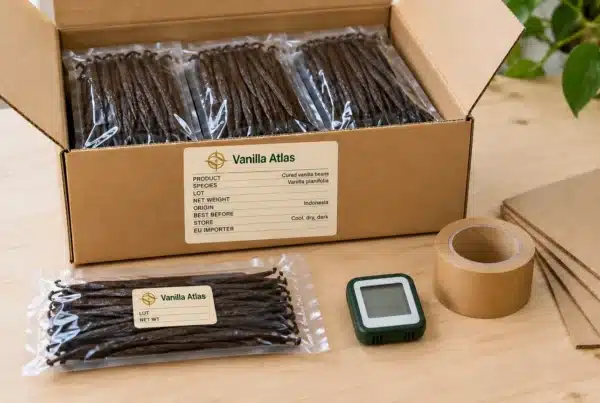
Ask an Indonesian vanilla supplier for France to confirm its legal identity, the lot’s species and specification, its traceability records, a representative sample, packaging and labels, and who will act as EU importer. Ask which documents are available now and which are not, and get both answers in writing.
Three of our guides cover this in detail: the vanilla supplier checklist for France, the traceability questions for French importers, and the specification guide for visible pastry use. Treat them as one process: identity first, then records, then the lot itself.
How do you add Indonesian vanilla as a second origin?
Add Indonesian vanilla in six steps: define its role, check your label claims, shortlist suppliers, match your specification with coded samples, run a pilot lot, and review the volume split every season. Keep your current origin throughout, so the second vanilla origin is judged on evidence rather than adopted under pressure.
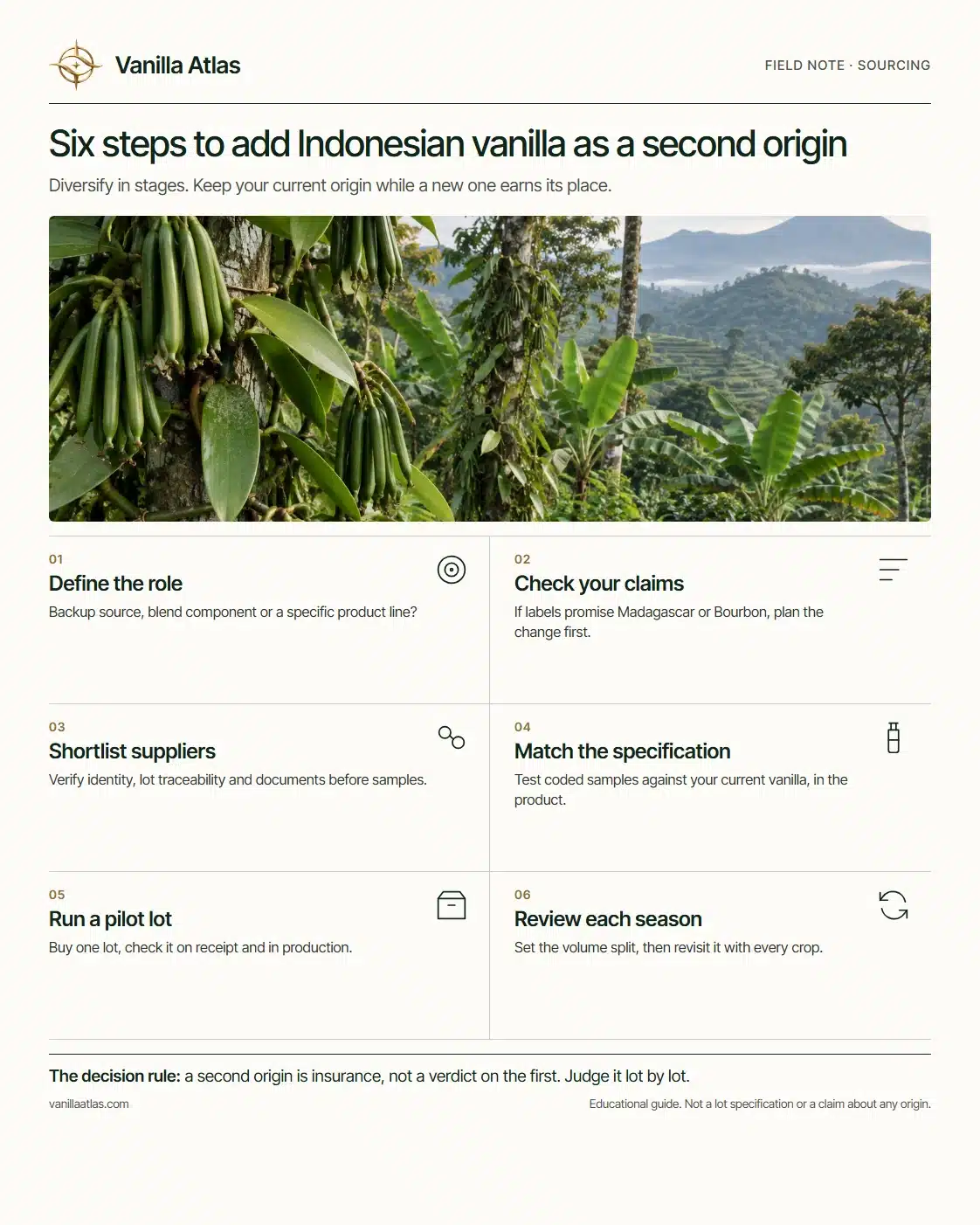
- Define the role. Decide whether Indonesian vanilla is a backup, a blend component or a product line, because each needs a different specification.
- Check your claims. Review labels, specifications and customer contracts for origin wording before any switch.
- Shortlist suppliers. Verify identity, traceability and documents before you ask for samples.
- Match the specification. Test coded samples against your current vanilla, in the finished product.
- Run a pilot lot. Buy one lot, inspect it on receipt and run it through production.
- Review each season. Set a volume split and revisit it with each crop and each price change.
What are the risks of a second vanilla origin, and how do you manage them?
The main risks of a second vanilla origin are inconsistent lots, unfamiliar documentation, flavour differences in an established recipe, and small volumes that are hard to scale. With any Indonesian vanilla supplier for France, each one can be managed with written specifications, representative samples, traceability records and a pilot lot before larger orders.
Risks of adding a second vanilla origin and how to manage them
| Risk | Why it arises | How to manage it |
|---|---|---|
| Lot-to-lot variation | A 2024 Indonesian field study found about half of farmers did not sort beans, and fear of theft can lead to early harvest | Written specification, representative samples, inspection on receipt |
| Flavour change | Curing and lot differences change the aroma profile | Coded tests in the finished product; adjust dose or blend |
| Documentation gaps | Many handoffs between farm, collector, curer and exporter | Traceability questions answered in writing before purchase |
| Label claims | Origin names and “Bourbon” wording carry meaning | Review labels and contracts before switching |
| Scale | Small direct trade flows to France | Confirm available volume and lead time before committing |
The field data comes from Munarso et al. (2024), based on 68 interviews in seven Indonesian provinces. It describes common practice, not every supplier.
How should a French distributor present Indonesian vanilla to customers?
Present Indonesian vanilla by its own name: origin, species, form and grade, with a sensory description for each lot. Avoid comparisons that rank origins, and do not borrow names such as Bourbon or a protected origin. Customers trust a precise description more than a borrowed reputation, and precise wording keeps claims defensible.
A short product note might state that the lot is Indonesian Vanilla planifolia, give its form and grade, and describe the aroma your own panel found. Add the uses it suited in your tests. If you sell to consumers, keep sustainability wording specific and supported by records, as our traceability guide explains. Presenting a second vanilla origin this way also makes it easier to switch lots without rewriting every label.
Where Vanilla Atlas fits
Vanilla Atlas is an Indonesian vanilla supplier for France and other markets, offering Vanilla planifolia in five selections, from Gourmet to Shorts. Each quote states the lot’s handling chain. France is on our Shipping & Destinations page, with availability, charges and timing confirmed for each order.
We are not asking anyone to replace Madagascar. A batch-specific certificate of analysis is not currently available, and selection names are not lab results, so please test our lots the way this article describes. If Indonesian vanilla wholesale earns a place in your range, it should be on evidence.
Start a sourcing conversation and tell us the role you have in mind, your application, expected volume and delivery country.
Frequently asked questions
Is Indonesian vanilla a good alternative to Madagascar vanilla?
It can be a good second origin, not an automatic replacement. Indonesian vanilla is mostly the same species, Vanilla planifolia, but curing and lots differ. Test each lot against your specification in the finished product before adding it to regular supply.
Is Indonesian vanilla Bourbon vanilla?
No. Bourbon is a geographic trade name for vanilla from the Indian Ocean region, such as Madagascar, Réunion and the Comoros. Indonesian vanilla is usually the same species, Vanilla planifolia, but it should be sold under its own origin.
What are the alternative vanilla origins for French buyers?
Alternative vanilla origins include Indonesia, Uganda, Papua New Guinea, Mexico, the Comoros and Réunion for Vanilla planifolia, and French Polynesia for Vanilla tahitensis. They differ in volume, species, price and documentation, so add one at a time.
Why have vanilla prices in France changed so much?
The average unit value of France’s whole-bean imports fell from about US$400 per kilogram in 2019 to about US$54 in 2024, according to UN Comtrade data. Policy and supply changes in Madagascar, the dominant origin, were a major factor.
How much vanilla does France import from Indonesia?
Direct imports are small. UN Comtrade data reported by France show 3.9 to 13.1 tonnes of whole vanilla beans a year from Indonesia between 2019 and 2025, equal to 0.5–2% of France’s import volume.
How do I find an Indonesian vanilla supplier for France?
Shortlist suppliers who can confirm legal identity, lot traceability and documents, and who can ship to France. Request representative samples, test them in your product, run a pilot lot, and confirm who will act as EU importer before ordering at scale.
Sources and review scope
Sources checked 3 November 2026. Trade figures are aggregate customs statistics, not prices or grades for any lot; 2025 data can be revised. Madagascar policy dates come from trade press and market reports rather than official texts. Production rankings vary between sources, so no tonnage is quoted. No origin is claimed to be better than another.
- UN Comtrade: France imports, HS 090510, 2019–2025, retrieved 3 November 2026.
- CBI: The European market potential for vanilla, updated 2 May 2023.
- Mintec: Madagascar lifts minimum export price on vanilla.
- Pacific Trade & Invest: The floor and ceiling of vanilla pricing.
- Capmad: Madagascar restores a floor price on green vanilla, 2026.
- INAO: IGP Vanille de l’île de la Réunion.
- Munarso S.J. et al. (2024). From bean to market: exploring the chemical and production dynamics of high-quality Indonesian vanilla. Front. Sustain. Food Syst. 8:1425656.