
A price list and a bag of good-smelling beans are easy to get. The questions that protect a French order come later: who is the legal supplier, which lot is this, and who answers for it once it enters the EU?
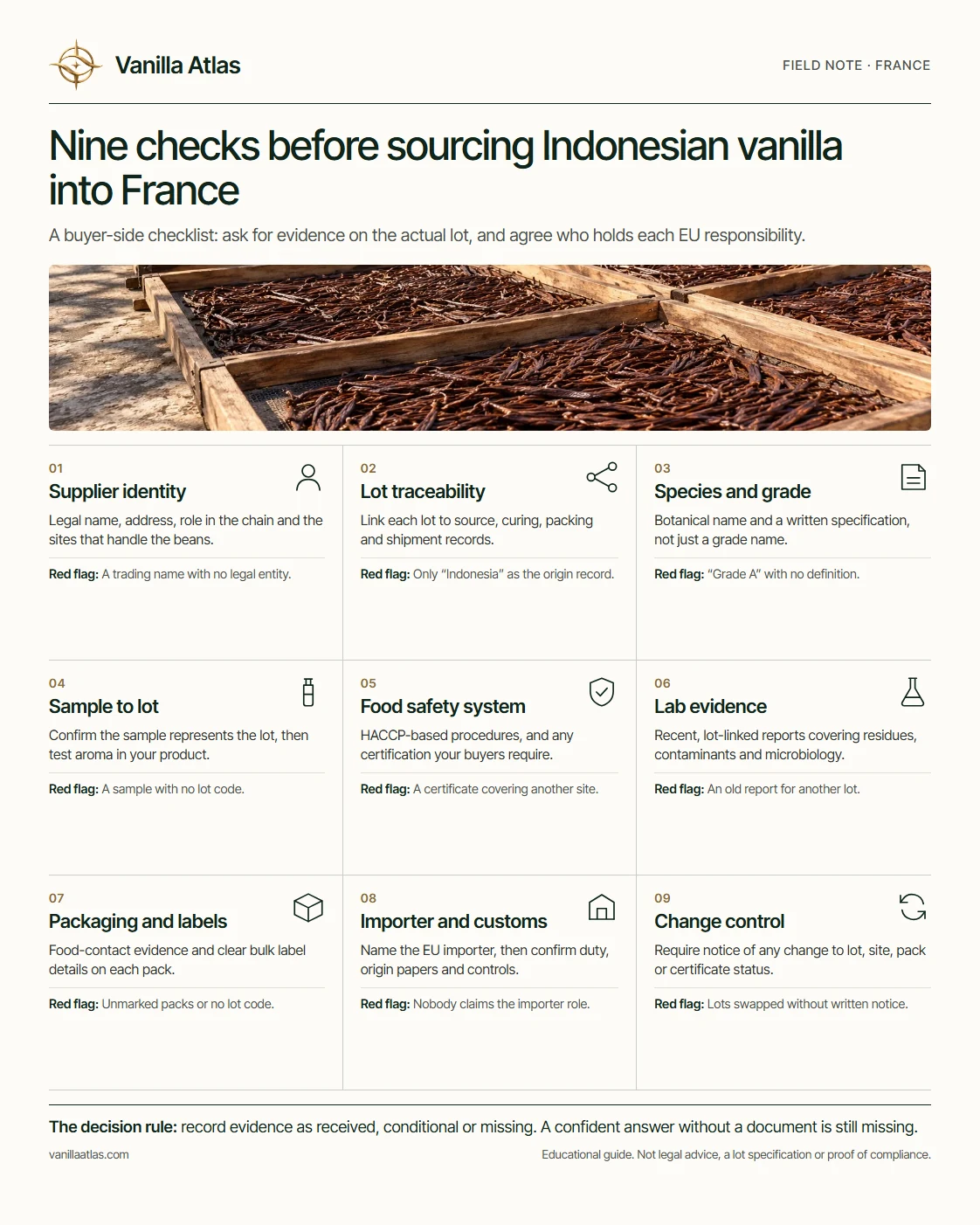
A vanilla supplier checklist for France should verify nine things: supplier identity, lot traceability, species and grade, sample-to-lot links, food safety system, lab evidence, packaging and labels, importer and customs roles, and change control. Ask for documents about the actual lot, and agree in writing who holds each EU responsibility. The EU importer carries legal duties that a supplier abroad does not.
This guide is for importers and ingredient distributors sourcing Indonesian vanilla for French customers. Use it when you source vanilla beans for France, before you request a quotation or commit to a first lot. It is a buyer-side working tool, not legal advice, so confirm requirements with your importer, customs adviser and quality reviewer.
Why you need a vanilla supplier checklist for France
Most of the vanilla France imports has a familiar route. Our guide to Indonesian vanilla beans in France shows Madagascar at 73.2% of France’s whole-bean import volume in 2025 and Indonesia at about 0.5%. With a less familiar route, buyers have fewer habits and references to fall back on, so the checks have to be explicit.
EU rules also change who holds the risk. Under Article 18 of Regulation (EC) No 178/2002, food businesses must be able to trace one step back and one step forward. The Commission’s guidance explains that this duty reaches the Indonesian vanilla importer in the EU, while exporters in third countries are not themselves bound by it. If you need source records from Indonesia, your contract has to ask for them.
In France, the DGCCRF describes documentary checks on plant-origin food at border posts, with physical checks and laboratory sampling on a random basis. A file assembled after the goods have shipped is a weak position to be in.
The vanilla supplier checklist for France at a glance
Use this table to source vanilla beans for France from any new supplier. Record what you actually received, not what you were promised. Each check is explained in the sections that follow.
Vanilla supplier checklist for France: nine checks
| Check | Ask for | Red flag |
|---|---|---|
| 1. Supplier identity | Legal entity, address, registration and role in the chain | A trading name with no legal entity behind it |
| 2. Lot traceability | Lot code linked to source area, curing, packing and shipment | “Indonesia” as the only origin record |
| 3. Species and grade | Botanical name and a written specification | “Grade A” with no definition |
| 4. Sample to lot | Sample ID tied to the offered lot, and a retained reference | A sample with no lot code |
| 5. Food safety system | HACCP-based procedures; certificate and scope where required | A certificate that covers a different site |
| 6. Lab evidence | Dated, lot-linked reports from a competent laboratory | An old report for another lot |
| 7. Packaging and labels | Food-contact evidence and complete bulk label details | Unmarked packs or no lot code |
| 8. Importer and customs | A named EU importer, confirmed commodity code and shipping documents | Nobody claims the importer role |
| 9. Change control | A written duty to notify changes before shipment | Lots swapped without notice |
Sourcing Indonesian vanilla: check the supplier and the lot
Check 1: Supplier identity
When sourcing Indonesian vanilla, start by finding out who you are actually dealing with. Ask for the legal entity name, registered address, business registration and contact person, then compare them with the invoice party. Ask which role this business plays: grower, curer, packer, exporter or trader. A trader can be a perfectly good partner, but you still need to know who handles the beans and where.
Our questions to ask an Indonesian vanilla supplier go further into capacity and process. That guide was written for US importers, so read its FDA references as US-specific.
Check 2: Lot traceability
EU law sets a minimum of one step back and one step forward. Sourcing Indonesian vanilla for demanding French customers usually needs more, because “Indonesia” covers many islands, farmers and curing practices. Ask for a lot record that shows source area, curing site, packing site, dates, quantities and any lots that were combined.

The Commission’s guidance suggests keeping supplier and customer names and addresses, product identification, and transaction dates and quantities. Treat that as your own baseline, then add the source fields you want. Our guide to tracing a lot through its documents shows how to reconcile lots with cartons and invoices; its worked example is for US receipt, but the logic carries over.
Check 3: Species and grade
Ask for the botanical name first. Then ask for a written specification covering form, length, moisture and its test method, and defect limits. Grade names are commercial labels, and two suppliers can mean different things by “gourmet”. CBI reports that ISO 5565-1, the vanilla specification, was still at draft international standard stage in its May 2026 update, so check the current edition before citing it in a contract.
See our gourmet vs extraction-grade comparison and moisture guide before writing those limits.
Check 4: Sample to lot
A sample is only useful if it represents what you will receive. Ask for a sample ID, the lot it came from, its date and the quantity that lot contains. Keep a sealed reference. Then run a physical inspection using our sample checklist and a coded sensory test using our guide to comparing vanilla bean aroma.
Check the food safety evidence
Check 5: Food safety system
CBI states that non-EU food businesses must maintain a procedure based on HACCP principles. Ask to see a summary of the hazard analysis and how it covers curing, drying, conditioning, storage and packing. CBI also lists FSSC 22000 as the most widely accepted food safety certification in this trade, with IFS and BRCGS sometimes requested by retail buyers.
These certificates are buyer requirements rather than a universal legal condition, so ask your own customers first. Where a certificate exists, read its scope and site address. A valid certificate for a different site tells you very little about this lot.
Check 6: Lab evidence
When you source vanilla beans for France, agree the test list before anyone pays for a laboratory. CBI’s buyer requirements for spices and herbs cover pesticide residues under Regulation (EC) No 396/2005, contaminants such as lead and polycyclic aromatic hydrocarbons, and the expectation that Salmonella is absent. Limits vary by commodity, and several contaminant limits name specific spices, so ask your quality reviewer which limits apply to vanilla rather than copying a table.
Three details decide whether a report is useful: whether it links to this lot, whether the laboratory is accredited to ISO/IEC 17025, and how old it is. CBI notes that buyers often expect reports no older than six months.
Also check whether increased official controls apply. CBI’s summary of Regulation (EU) 2019/1793 lists Indonesian nutmeg for aflatoxin checks at 50%, and includes a vanilla entry for pesticide residues. Those entries change over time and are specific to each origin, so read the current annexes for Indonesian vanilla before you book a shipment.
Check packaging, labels and customs
Check 7: Packaging and labels
The EU’s food contact materials rules start with Regulation (EC) No 1935/2004, which says materials must not transfer constituents at harmful levels or unacceptably change food. Plastic materials also fall under Regulation (EU) No 10/2011 and need a declaration of compliance through the supply chain, up to but not including retail. As an Indonesian vanilla importer, ask for that declaration for any plastic liner or pouch.
For bulk packs, CBI lists these label details: product name and variety, batch code, lot number, net weight, best-before date, storage conditions, country of origin, and the name and address of the responsible operator. Retail packs must also follow Regulation (EU) No 1169/2011. Our bulk packaging guide covers seals, moisture control and receiving checks.
Check 8: Importer and customs roles
Settle one question early: who is the importer of record? A French buyer can act as the Indonesian vanilla importer directly, or buy through a distributor or agent that does. Either way, the responsibilities below need a named owner before shipment.
Who usually handles what when you source vanilla beans for France
| Task | Supplier in Indonesia | EU importer | French buyer or distributor |
|---|---|---|---|
| Lot, curing and packing records | Creates and shares them | Requests and files them | States which fields it needs |
| Traceability under Article 18 | Contract duty only | Legal duty, one step back and forward | Legal duty for its own step |
| Customs entry and duty | Supplies invoice and origin papers | Declares and pays, usually through a broker | Agrees who bears the cost |
| Food safety of the lot in the EU | Supplies evidence | Verifies before placing on the market | Verifies for its own use and customers |
| Withdrawal if a problem appears | Supports with records | Acts and informs authorities where required | Acts for stock it has supplied |
This split is a common pattern, not a legal allocation for your transaction. Article 19 of Regulation 178/2002 sets withdrawal and notification duties for food businesses, so have your adviser confirm how they apply to you as an Indonesian vanilla importer.
Before you source vanilla beans for France at volume, check customs too: vanilla neither crushed nor ground falls under heading 0905 10. Confirm the commodity code and the duty rate in the EU’s Access2Markets database and TARIC on the day you budget. The EU and Indonesia concluded a trade agreement in 2025, so also check whether any preference is in force and what origin proof it needs. For organic vanilla, CBI notes that each batch needs an electronic certificate of inspection issued through TRACES.
Check 9: Change control
Many sourcing problems begin with a quiet substitution. Require written notice before any change to the allocated lot, curing or packing site, pack format or certificate status, and the right to re-approve. Put this in the purchase terms, and use our vanilla bean RFQ guide to set it out from the first enquiry.
Legal duty or buyer preference?
When working through a vanilla supplier checklist for France, suppliers and buyers often treat every document as equally mandatory. Sorting them saves time and money when sourcing Indonesian vanilla, and it stops a nice-to-have from delaying a real requirement.
Requirements to separate on a French vanilla order
| Item | Usual status | Practical note |
|---|---|---|
| Traceability records | Legal duty for EU food businesses | Extend to the source by contract |
| Compliance with residue and contaminant limits | Legal duty | Lab reports are how you verify it, so agree the test list |
| Food-contact compliance | Legal duty | Declaration of compliance applies to plastic materials |
| Food labelling | Legal duty, with details depending on pack type | Check bulk and retail packs separately |
| HACCP-based procedures | Legal duty as stated by CBI for non-EU food businesses | Ask for a summary and scope |
| Organic certificate | Conditional, only for organic claims | Needs the e-COI for each batch |
| FSSC 22000, IFS or BRCGS | Buyer requirement | Ask your customers before insisting |
| Sustainability schemes | Buyer requirement | Separate certified claims from general statements |
Download the vanilla supplier checklist for France
The one-page PDF records each check as received, conditional or missing, with space for open items and your decision. Use one sheet for each supplier and lot.

Once the vanilla supplier checklist for France is complete, the table below turns your results into a next step.
How to act on your checklist results
| Result | Reading | Next step |
|---|---|---|
| Identity or traceability is missing | You cannot yet tell who supplies what | Do not proceed until it is resolved |
| Sample passes but lab evidence is missing | Promising, not yet verified | Agree testing and who pays before a larger order |
| A certificate is conditional | May be fine, depending on your customers | Confirm whether your buyer truly requires it |
| All nine are received | Ready for commercial terms | Write the evidence into the purchase terms |
A request you can send to a supplier
We are evaluating Indonesian vanilla for customers in France. Please confirm your legal entity, role in the supply chain and all sites that handle this lot.
For the offered lot, please share the botanical name, written specification, lot record with source and curing information, and any current laboratory reports. Tell us which documents are available now, which depend on the order, and which you cannot provide.
Please also confirm the packaging material and its food-contact documentation, proposed label details, available shipping documents, and how you will notify us of any change before dispatch. Our importer of record will be: [name].
When sourcing Indonesian vanilla, a supplier that answers “not available” for an item is more useful than one that says yes to everything. The honest answer gives you something to plan around.
Where Vanilla Atlas fits
Vanilla Atlas supplies Indonesian Vanilla planifolia in five selections, for home kitchens, chefs and food businesses. We are based in Pati, Central Java, and France is on our Shipping & Destinations page, with availability, charges and timing confirmed for each order.
Apply this vanilla supplier checklist for France to us as well. This guide does not mean that every document it lists is available from Vanilla Atlas. A batch-specific certificate of analysis is not currently available, so tell us what your customers require and we will say plainly what we can and cannot provide for a given lot. Any Indonesian vanilla importer should get the same straight answer.
Submit your buyer requirements, including your application, expected quantity, documents needed and who will act as importer.
Frequently asked questions
What should a vanilla supplier checklist for France include?
It should cover supplier identity, lot traceability, species and grade, sample-to-lot links, food safety system, lab evidence, packaging and labels, importer and customs roles, and change control. Record each item as received, conditional or missing, and base decisions on documents for the actual lot.
How do I source vanilla beans for France from Indonesia?
Shortlist suppliers, request lot-linked documents and representative samples, and test them in your application. Name the EU importer, confirm the commodity code and duty, agree the test list and packaging, and write those terms into the purchase agreement before shipment.
Who is responsible for traceability when importing vanilla into the EU?
EU food businesses, including importers, must be able to trace one step back and one step forward under Article 18 of Regulation 178/2002. Commission guidance says exporters in third countries are not themselves bound by that article, so request source records by contract.
Does an Indonesian vanilla importer need FSSC 22000 from the supplier?
Not as a universal legal condition. FSSC 22000, IFS and BRCGS are generally buyer requirements. CBI states that non-EU food businesses need HACCP-based procedures. Ask your own customers what they require, and check the scope and site on any certificate.
What lab tests should I ask for when sourcing Indonesian vanilla?
Agree the list with your quality reviewer. It commonly covers pesticide residues, relevant contaminants and Salmonella, using a report linked to the lot from a laboratory accredited to ISO/IEC 17025. Check which limits apply to vanilla and whether official controls apply to this origin.
Does Vanilla Atlas provide all the documents on this checklist?
Not necessarily. A batch-specific certificate of analysis is not currently available, and availability depends on the lot and transaction. Share your requirements and we will tell you what we can and cannot provide before you commit to an order.
Sources and review scope
Sources checked 1 November 2026. This is a buyer-side guide, not legal or customs advice, and it has not had a legal review. The responsibility table is a common pattern rather than a legal allocation. The DGCCRF page and the Commission guidance were reviewed through search extracts, and regulations through official summaries. Duty rates are deliberately omitted, so confirm them on the day you budget.
- CBI: Buyer requirements for spices and herbs, updated 12 May 2026.
- European Commission: Guidance on Articles 11, 12, 14, 17, 18, 19 and 20 of Regulation (EC) No 178/2002.
- Regulation (EC) No 178/2002, consolidated text.
- DGCCRF: Contrôle à l’importation des denrées alimentaires.
- European Commission: Food contact materials legislation.
- European Commission: Access2Markets.
- Euronews: European Commission concludes free trade deal with Indonesia, 23 September 2025.
- Vanilla Atlas: Indonesian vanilla beans in France, for UN Comtrade import shares.



3 Comments