
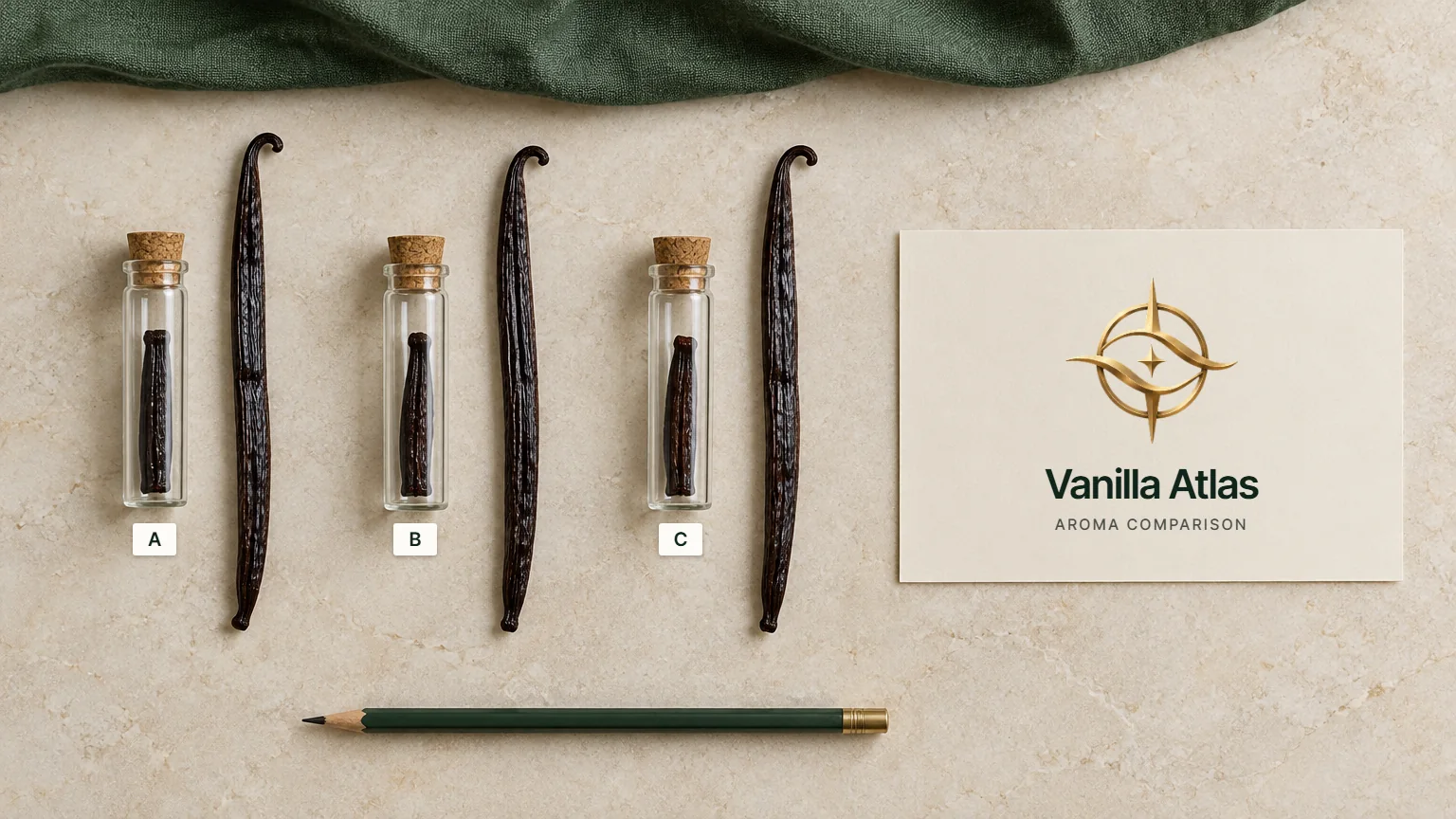
“Madagascar” on a specification sheet tells you where a bean grew. It does not tell you how that lot will smell in your crème anglaise next spring, or whether the replacement lot will match it.
To compare vanilla bean aroma fairly, assess coded samples from named lots under identical conditions: first the dry beans, then the product you actually make. Score fixed descriptors on one sheet, repeat the session, and choose the lot rather than the country. Published research shows that curing and post-harvest ageing can shift a vanilla aroma profile within one origin, and crop year may do the same.
This guide is for R&D teams, pastry chefs and flavour buyers in France who need to compare vanilla bean aroma with a small team. It covers the evidence behind the method, six practical checks, a printable worksheet and the questions to send a supplier.
Why an origin comparison is not enough
An origin comparison is a useful place to start. Our guide to Indonesian vanilla beans in France shows Madagascar at 73.2% of France’s whole-bean import volume in 2025, so Madagascar often becomes the reference by habit. Other origins then get described against that habit, as “smoky” or “less creamy”, before anyone has tested the lot in hand.
The research supports caution rather than dismissal. Origin can matter: one study found substantial analytical differences between traditionally cured Madagascar and Ugandan extracts. Yet other work shows wide differences inside one origin or one species, which a country name cannot predict.
What vanilla research says about origin, curing and aroma
| Study | What was compared | Finding | What it means for a buyer |
|---|---|---|---|
| Chen et al., 2025 | Ten pods: V. planifolia from Madagascar, Mexico and Réunion; V. tahitensis from French Polynesia and Papua New Guinea | Species separated more clearly than geography. One Madagascar pod stood apart from the other three, with higher guaiacol and creosol and relatively low vanillin | Confirm species first. Do not assume every lot from one country behaves alike. The authors call this a preliminary study |
| Ravier et al., 2024 | Fifty assessors at ISIPCA in France smelled and tasted scalded and scarified V. planifolia and V. pompona at 2 and 9 months after harvest | “Moist woody” was cited for every sample at 2 months, then disappeared from the scarified samples by 9 months. The authors suggest processing affected aroma more than species | Ask how the lot was processed and how long it has aged |
| Perez-Viveros et al., 2025 | Four traditional curing processes in Mexico, rated by 62 consumers | Samples differed significantly on 20 of 35 descriptors in one curing period and 13 of 35 in the other | A single country can produce clearly different vanilla aroma profiles |
| Zhang and Mueller, 2012 | Traditionally cured Madagascar and Ugandan beans, analysed by GC-MS and GC-olfactometry | 78 odour-active compounds were identified, with substantial differences between the two extracts | Origin can be a real variable, so keep it on the record |
None of these studies compares Indonesian lots with other origins, so they are not a verdict for or against Indonesian vanilla. Read together, they suggest a working rule: use an origin comparison to decide which samples to request, then decide on evidence from the lots themselves. Our Indonesian vs Madagascar sourcing comparison applies the same logic to price and supply.
What shapes a vanilla aroma profile?
A vanilla aroma profile is the set of odour notes a lot shows, and how strong each note is, recorded under stated conditions. Change the conditions and the profile you record can change too. Each factor below gives you a specific question for the supplier.
Factors behind a vanilla aroma profile and what to ask
| Factor | Why it matters | Question for the supplier |
|---|---|---|
| Species | In Chen et al., 3-methoxybenzyl alcohol reached 18–34% of volatiles in V. tahitensis and no more than 9% in V. planifolia | What botanical name appears on the lot record? |
| Curing method | Scalding, scarifying, sweating and drying steps change the result, as the Ravier and Perez-Viveros studies show | How was this lot killed, sweated and dried? |
| Post-harvest ageing | Descriptors shifted between 2 and 9 months in the ISIPCA panel | When was curing finished, and how long has the lot been conditioned? |
| Crop year and storage | Chen et al. name both as possible reasons for differences within a species and country | Which crop year is this, and how has it been stored and packed? |
| Moisture | Equal weights of beans can contain different amounts of dry matter (see our vanilla moisture guide) | What is the measured moisture, and by which method? |
| Food base | In the ISIPCA panel, smelling and tasting were assessed separately, and “roasted” appeared as a taste note only at 9 months | Can you supply enough sample to test it in our product? |
Vanillin is the obvious number to request, but it is not a complete answer. Across the ten pods in Chen et al., vanillin ranged from 35.1% to 81.9% of total volatiles, and Ravier et al. established no correlation between their chemical and sensory results. Keep vanillin data in your file where it is available, and still smell the lot.
What is vanilla sensory evaluation?
Vanilla sensory evaluation is a structured test in which people distinguish or describe vanilla samples under controlled conditions. It answers two separate questions: is there a perceptible difference between these lots, and what exactly is that difference? Choose the level of testing that matches the size of the decision.
Three levels of vanilla sensory evaluation
| Level | Who takes part | Method | Best use |
|---|---|---|---|
| Bench screening | Three to five people who regularly taste your products (our suggestion) | Coded samples, the worksheet in this guide, repeated on a second day | Shortlisting samples for a pastry kitchen or small workshop |
| Difference test | A larger group, sized with a sensory specialist | Triangle test, covered by ISO 4120 | Checking whether a replacement lot is perceptibly different |
| Descriptive panel | Trained assessors. Gu et al. trained 15 panellists over three sessions; ISIPCA gave 50 assessors five sessions | Sensory profile, covered by ISO 13299. Gu et al. rated six attributes on a 15 cm line scale | R&D, flavour development and repeat supply programmes |
The ISO sensory analysis standards also cover test rooms (ISO 8589) and the selection and training of assessors (ISO 8586). A bench test is not a validated panel, and its result should not be presented as one. For most pastry and small-batch decisions, though, a disciplined bench test beats an informal sniff at the supplier’s stand.
How to compare vanilla bean aroma in six checks
These checks let a small team compare vanilla bean aroma without a laboratory. They borrow the controls used in published panels and scale them down for a working kitchen.

Check 1: Identify each lot
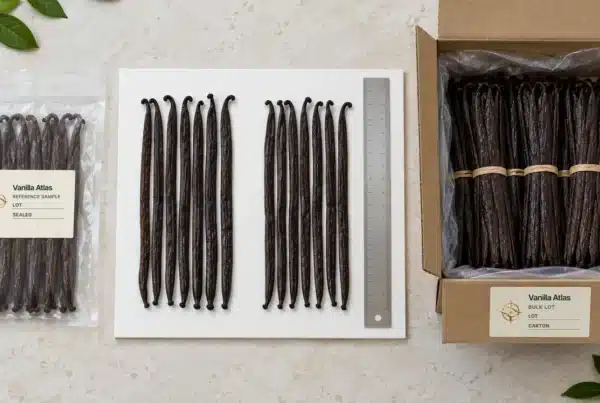
Record the supplier, lot code, species, origin, crop year, curing method and packing date before opening anything. Ask whether the sample was drawn from the lot on offer. Our vanilla bean sample checklist covers physical inspection and sample-to-lot links in more detail.
Check 2: Prepare every sample the same way
Use the same mass, cut and closed container for each lot, and rest them for the same time. Published methods differ: Gu et al. sealed 0.5 g of pulverised pod in a 50 mL flask, while the ISIPCA panel put about 0.05 g of bean in 15 mL vials 72 hours before testing. Neither is a universal rule. Pick one method, write it down and keep it for every session.
Check 3: Code and randomise
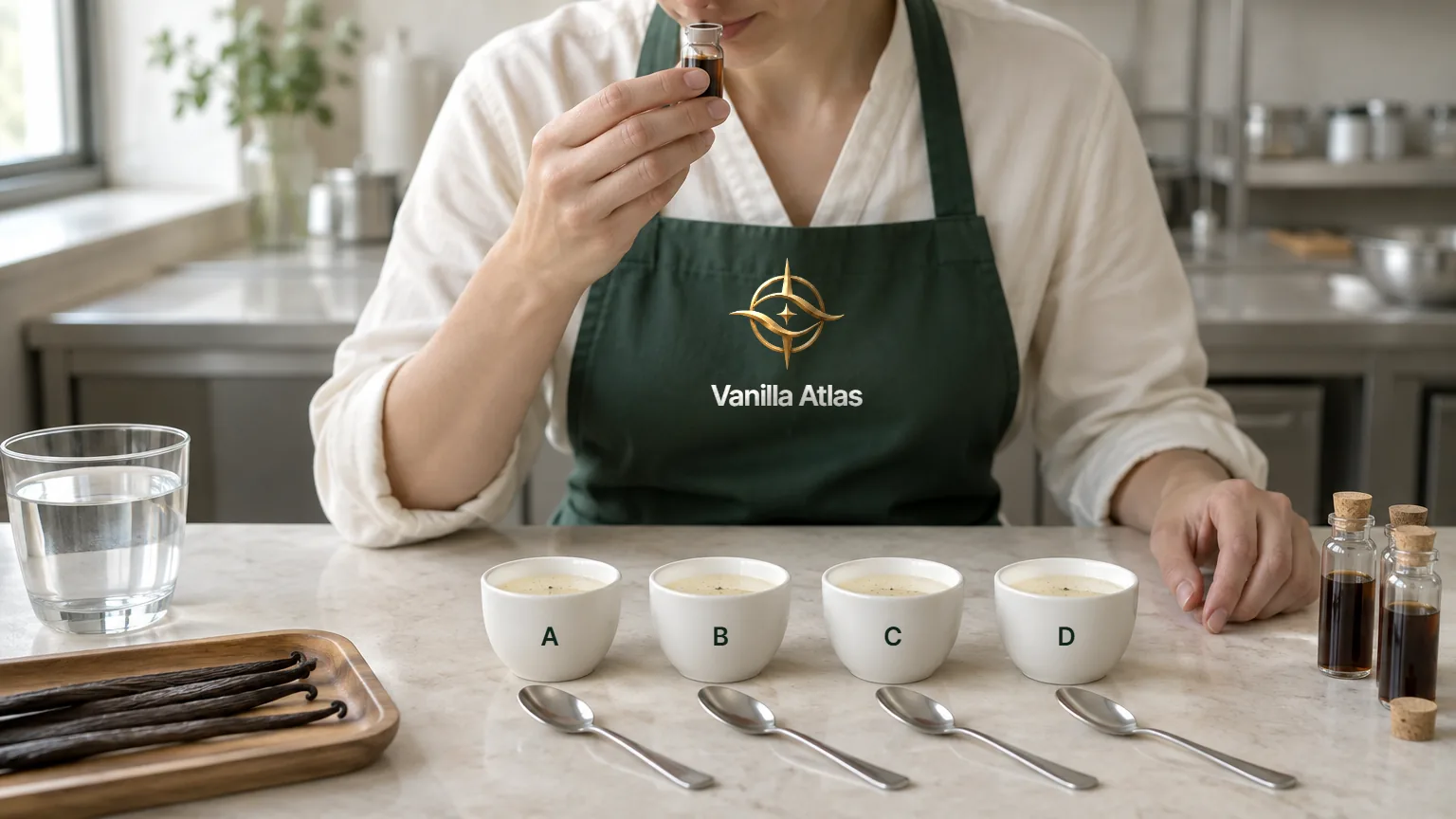
Ask someone who is not tasting to assign the codes and keep the key. Change the serving order for each person. Include your current vanilla as a coded control, because it gives every score a reference point. A visible country name sets an expectation before the vial is even open.
Check 4: Smell the headspace
Work in a quiet room free of perfume and cooking smells. The two panels above kept their booths between about 20 and 22 °C. Open one vial at a time, take short sniffs and score straight away. Gu et al. left 10 minutes between assessments so the aroma in the flask could rebuild, so do not hurry.
Check 5: Test in the product
Next, try a neutral dairy base. The ISIPCA panel infused beans at 0.15% in milk at 95 °C, held the milk at 55 °C and filtered it. Then move to your real product at your real dose: a crème pâtissière, a ganache or a glace base. Taste after chilling or setting, because a warm sample can mislead. Our French pâtisserie, chocolate and ice cream guide gives a dose trial you can combine with this step.
Check 6: Score, repeat and decide
Score each descriptor from 0 to 10 on the worksheet, then compare the averages and the spread between people. The 0–10 scale is our simplified choice for bench use, not a published standard. Repeat on another day with new codes. Keep a sealed reference sample of the lot you choose, so future deliveries can be compared with something real.
Download the vanilla aroma worksheet
Use this worksheet to compare vanilla bean aroma on one A4 page. It records a sample key, dry-bean scores, in-product scores and a final decision. Complete one sheet per assessor and per session, and keep the sample key away from tasters until scoring ends.
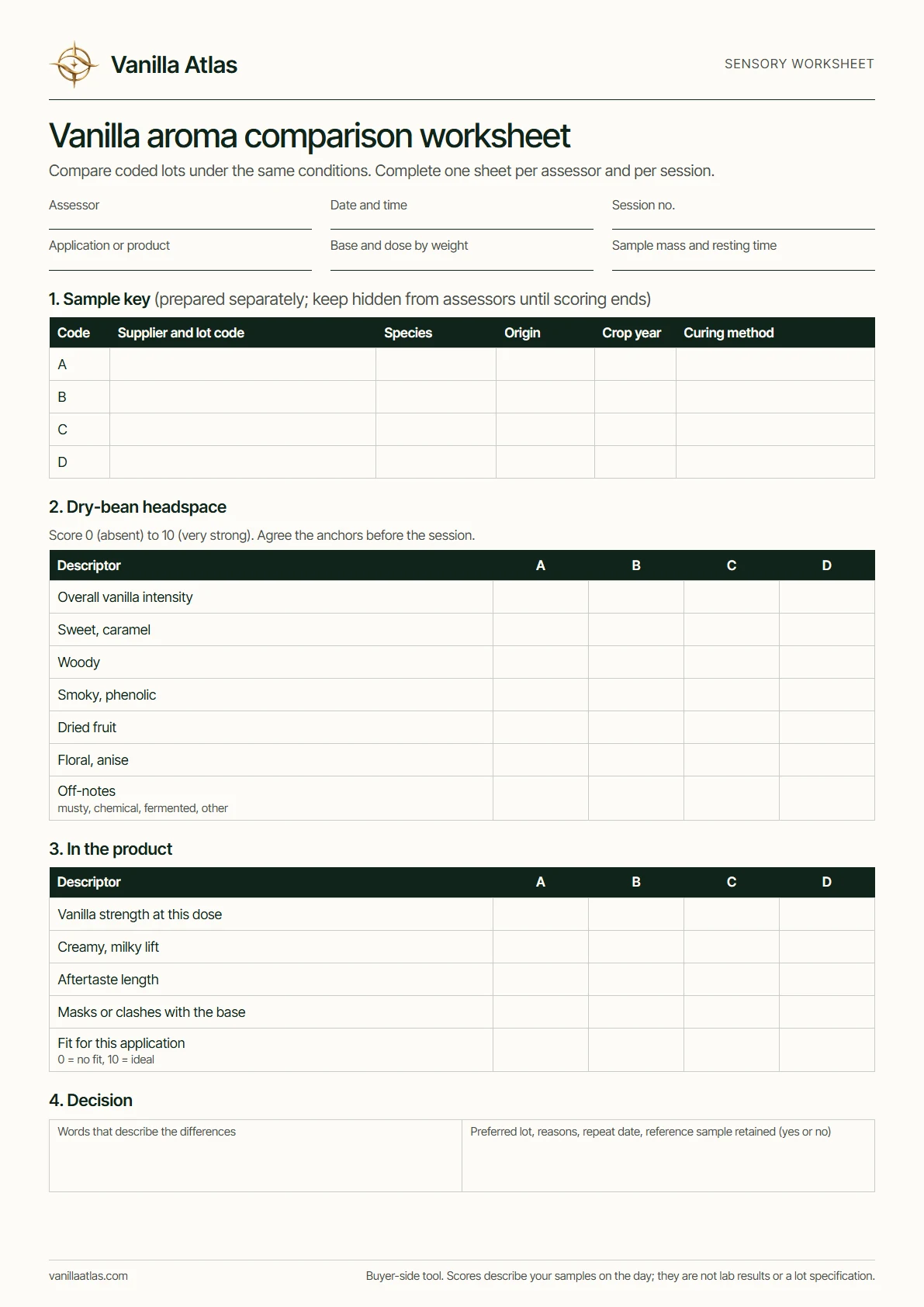
Before the first session, smell one sample together and agree what each word means to your team. Gu et al. used reference materials to align their panel on attributes including vanilla, sweet, fruity, smoky, woody and floral. The Perez-Viveros consumers linked chemical and fermented notes to lower liking, which is why off-notes get their own row.
Vanilla aroma profile descriptors used on the worksheet
| Descriptor | What to note | Why it helps the decision |
|---|---|---|
| Overall vanilla intensity | How strong the vanilla character is at first sniff | Sets the likely dose |
| Sweet, caramel | Rounded, sugary and cooked-sugar impressions | Useful for custards and caramel work |
| Woody | Dry wood, damp wood or resin | May add depth, or may dominate a delicate cream |
| Smoky, phenolic | Smoke, tar or medicinal edge | Decide whether it suits dark chocolate or clashes with dairy |
| Dried fruit | Raisin, fig or prune | Can suit rich, cooked desserts |
| Floral, anise | Perfumed or anise-like lift | Prompts a check on species, especially V. tahitensis |
| Off-notes | Musty, chemical, fermented or other faults | Stop and investigate before any further tasting |
These descriptors are buyer-side prompts drawn from published panels and trade language. They are not a grading standard, and scores describe your samples on the day.
How to read your vanilla sensory evaluation results
The result rarely arrives as a clear winner. Use the patterns below to choose your next step.
Reading vanilla sensory evaluation results
| What you see | Likely reading | Next step |
|---|---|---|
| Scores differ less between lots than between tasters | No clear difference yet | Align descriptors and repeat, or run a triangle test |
| A lot wins on the dry-bean sniff and loses in the product | Headspace does not predict performance in your base | Trust the product result |
| A lot is strong but woody or smoky notes dominate a cream | Good intensity, poor fit for that use | Test a lower dose, or try it in dark chocolate or caramel |
| Two sessions disagree | Too much variation in preparation or tasters | Check resting time and sample mass, then run a third session |
| The key reveals a surprise origin | Expectation and performance did not match | Record it and treat the lot on its merits |
Questions that improve an origin comparison
Origin stereotypes spread because they are easy to repeat. Each one can become a better question when you are looking at a real lot.
- “Indonesian vanilla is smoky.” Trade descriptions often say so, and CBI describes Indonesian beans as deep and rich. Some lots are not smoky at all, so ask how this lot was cured and score it. Our Indonesian vanilla guide explains the regions and curing steps.
- “Madagascar is creamy.” It may well be, but one Madagascar pod in Chen et al. stood apart from three others. Ask for the lot, not the reputation.
- “Tahitian is floral.” That is largely a species difference, so compare V. tahitensis separately from V. planifolia instead of treating it as an origin comparison alone.
- “Higher vanillin means stronger aroma.” Measure both. A vanillin figure and a sensory score answer different questions.
Turn the result into a buying specification
Once you compare vanilla bean aroma across lots, the result only protects you if it reaches the purchase order. Name the reference sample, the method, the descriptors that matter and the differences you would reject. Agree how a delivery will be compared with the reference, and what happens if it falls outside your limits. Our vanilla bean RFQ guide shows how to put those terms in writing.
Sensory acceptance does not replace other checks. It tells you nothing about food safety, contaminants, species authenticity or the documents your importer needs. Keep those reviews separate, and see our gourmet vs extraction-grade comparison if the application itself is still undecided.
Where Vanilla Atlas fits
Vanilla Atlas sells Indonesian Vanilla planifolia in five selections. We would rather have our beans judged in your product than accepted on a country name, so use the same method to compare vanilla bean aroma across our lots and your current supplier.
A batch-specific certificate of analysis is not currently available, and our selection names are not sensory grades. When you ask for a sample, ask which lot it represents and what is known about that lot, then score it against your current vanilla.
Request a representative sample and tell us your application, expected quantity and delivery country. France is on our Shipping & Destinations page; availability, charges and timing are confirmed for each order.
Frequently asked questions
How do you compare vanilla bean aroma without a laboratory?
Prepare coded samples from named lots in the same way, smell the dry beans, test them in a neutral dairy base and in your product, score fixed descriptors, and repeat on another day. This shows how lots differ for your use, but it is not a laboratory measurement.
Is vanilla sensory evaluation only for trained panels?
No. A small team can run a useful bench screening with coded samples and a written worksheet. Trained panels and ISO methods are better for R&D and for repeat supply decisions, and a bench result should not be presented as a validated panel result.
What is a vanilla aroma profile?
A vanilla aroma profile is the set of odour notes a lot shows and how strong each one is, recorded under stated conditions. It can shift with species, curing and post-harvest ageing, so always record the lot and the method beside the scores.
Is an origin comparison still useful when buying vanilla?
Yes, as a starting point. An origin comparison helps you decide which samples to request and can reveal real differences. It should not replace testing, because research also finds wide differences between lots and curing methods within one country.
Does a higher vanillin content mean a stronger vanilla aroma?
Not necessarily. Vanillin is one compound among many odour-active volatiles, and one French panel study established no correlation between its chemical and sensory results. Keep vanillin data where available, and still assess the lot by smell and in your product.
How many people do you need to compare vanilla aroma?
For bench screening we suggest three to five regular tasters, repeated on a second day. That is a practical suggestion, not a statistical standard. For a formal difference test or sensory profile, set the group size with a sensory specialist.
Sources and review scope
Sources checked 31 October 2026. Zhang and Mueller was reviewed at abstract level; the ISO standards were checked by title and edition listing, not full text. The bench method, group size and 0–10 scale are Vanilla Atlas suggestions, not validated protocols. Most of the studies are small, and none compares Indonesian lots with other origins.
- Chen L. et al. (2025). Authentic Aroma and Compound-Specific Isotope Ratios Profiles of Vanilla Pods. Molecules 30(4), 825.
- Ravier A. et al. (2024). Impact of the Post-Harvest Period on the Chemical and Sensorial Properties of planifolia and pompona Vanillas. Molecules 29(4), 839.
- Perez-Viveros I.J. et al. (2025). Influence of Traditional Vanilla Curing on Its Physicochemical Properties and Aromatic Profile. Foods 14(9), 1652.
- Zhang S., Mueller C. (2012). Comparative Analysis of Volatiles in Traditionally Cured Bourbon and Ugandan Vanilla Bean Extracts. J. Agric. Food Chem. 60(42), 10433–10444.
- Gu F. et al. (2015). Contribution of Bacillus Isolates to the Flavor Profiles of Vanilla Beans. Molecules 20(10), 18422–18436.
- CBI: The European market potential for vanilla, updated 2 May 2023.
- ISO: Sensory analysis standards (ICS 67.240).


2 Comments