

A customer judges a mille-feuille before tasting it. Black specks in the cream and a glossy pod on the plate both promise real vanilla, so the bean has to deliver on what the eye has already been told.
A vanilla bean suits visible use in French pastry when it is whole, supple enough to split and scrape cleanly, rich in moist seed paste, free of mould, and aromatic in the finished cream. Gourmet vanilla beans for pastry are usually chosen on these traits, often with moisture near 30% and length over 15 cm. Appearance alone does not prove flavour, so always test the lot in the recipe.
En bref : pour une vanille visible en pâtisserie, choisissez une gousse entière, souple et riche en graines, sans moisissure, puis goûtez-la dans votre crème. Une belle gousse ne garantit pas à elle seule un bon parfum.
This guide is for pastry chefs and the ingredient buyers who supply them in France. It answers the questions they most often ask before ordering: what “gourmet” means, which premium vanilla bean specifications matter, whether split pods are a problem, and when a cheaper bean will do the job just as well.
What are gourmet vanilla beans for pastry?
Gourmet vanilla beans for pastry are cured vanilla pods selected to be seen and scraped, not only infused. They are typically long, soft and moist. “Gourmet” is a trade term rather than a legal grade, so its meaning changes between suppliers and needs a written definition on every order.
CBI, the Dutch import-promotion agency, says no single organisation sets vanilla standards, and that beans are graded under the producing country’s national standard. ISO 5565-1 gives general guidance. The word itself can mislead: the same CBI page describes “Grade A Prime Gourmet” at about 30% moisture, and also lists another “gourmet” class at 35–38% that it calls inferior, because it is unstable and prone to mould.
Vanilla classifications described by CBI
| Trade class | Moisture (CBI) | What it means for pastry |
|---|---|---|
| Grade A / Prime Gourmet | About 30%; typically over 15 cm | Flexible and soft, so suited to splitting and scraping |
| “Gourmet” in CBI’s other moisture classes | 35–38% | Very soft, but unstable and prone to mould; check storage plans |
| TK | About 30% | Described as balancing vanillin and moisture |
| Rouge (red) | 22–25% | Drier; better suited to infusion than to scraping |
| Grade B / extract | About 20% | Usually too dry to scrape, though some beans may allow it |
| Very dry | 15–20% | Brittle and shrunken; for milling or extraction, not display |
The right-hand column is our practical reading for pastry, not CBI’s wording. For a fuller comparison, see gourmet vs extraction-grade vanilla beans.
What counts as visible use in French pastry?
Visible use means the customer can see the vanilla itself, either as a whole pod or as black seeds. These are different requirements. A whole pod needs to look good on the plate, whereas visible vanilla seeds only need the bean to release plenty of paste. Separating them is how vanilla beans for chefs get bought at the right price.
How much appearance matters by pastry use
| Use | What the customer sees | Traits that matter most | Do you need a top gourmet bean? |
|---|---|---|---|
| Whole pod as garnish on an entremets or plated dessert | The pod itself | Length, colour, sheen, no splits or stains | Usually yes |
| Mille-feuille, flan pâtissier, crème légère, tart cream | Visible vanilla seeds in the cream | Suppleness, seed paste yield, aroma | Often, but a split pod can work just as well |
| Crème anglaise or chantilly with specks | Fine seeds | Seed paste yield and aroma | Not always; compare a mid-tier lot |
| Strained infusion, caramel or syrup | Nothing | Aroma at your dose | No; test a Select or Classic bean first |

Which traits make a vanilla bean suitable for visible use?
Six traits decide whether a bean works for visible use: whole form, suppleness, seed paste yield, aroma in the cream, length and weight, and surface condition. The first and last two are about looks and handling. Yield and aroma are what the customer actually tastes, and none of the six is enough alone.

1. Whole form
CBI places stiff, split or cracked beans in Grade B or C, so whole form is part of how the market prices gourmet vanilla beans for pastry. It matters most when the pod itself is on show. See the split-pod section below before paying extra for it in a cream.
2. Suppleness
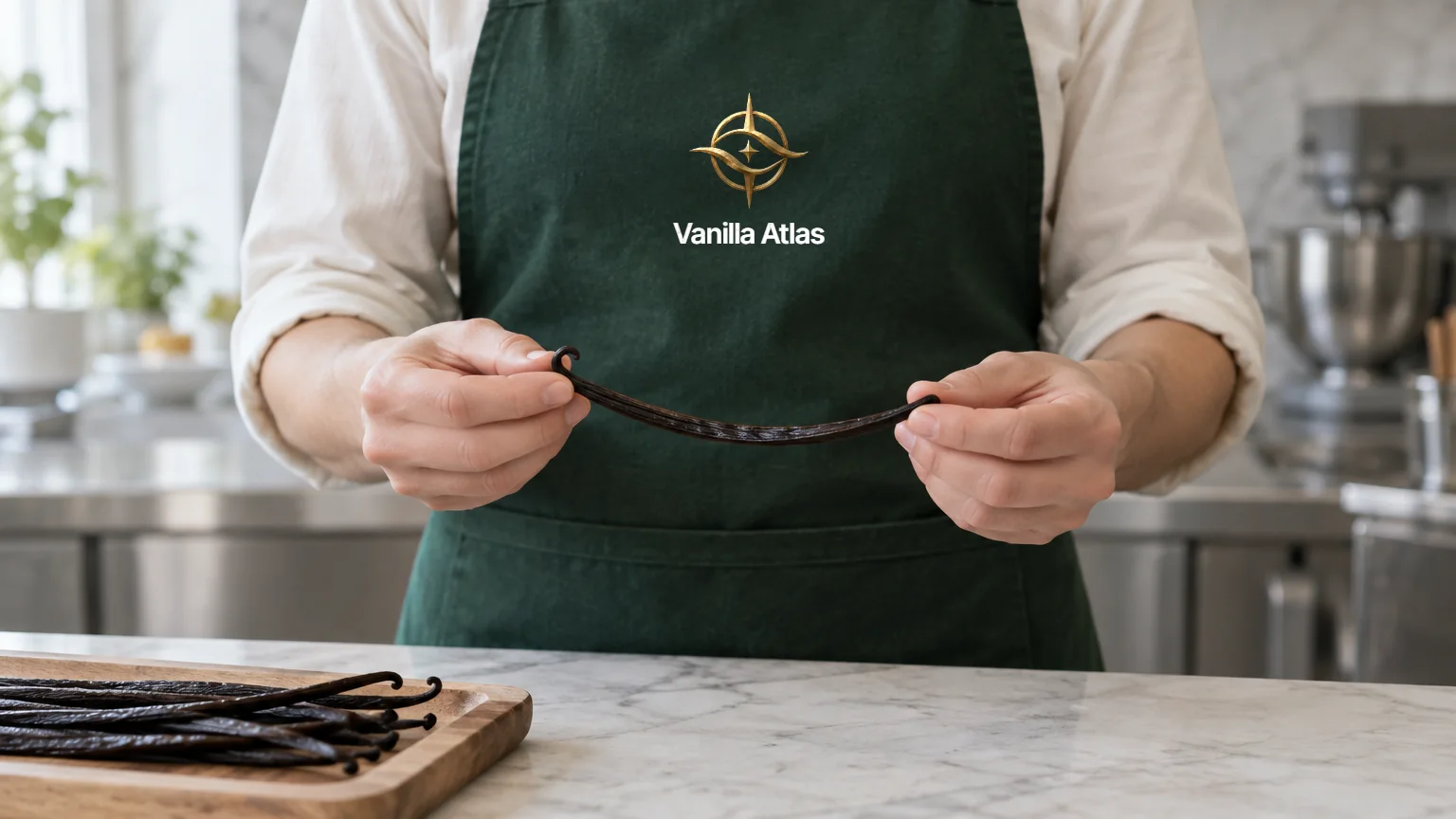
A supple pod bends gently without cracking, and it opens cleanly under a knife. CBI describes Grade A as flexible and soft to the touch. Suppleness mostly reflects moisture, so ask for a figure with its test method. Our moisture guide explains why two lots with different moisture give different value per kilogram.
3. Seed paste yield
The paste creates the specks, which makes yield the most useful number when comparing vanilla beans for chefs. CBI notes that Grade B beans are usually too dry to scrape the seeds, which the trade calls “caviar”. Neither CBI nor ISO guidance gives a yield benchmark that we can cite, so measure it yourself: scrape several pods from each lot with the same knife and weigh the paste.
4. Aroma in the cream
When buying vanilla beans for chefs, flavour is the point of the seeds. Smell the pods, then infuse them at your dose and taste the cold cream, because cream dulls and changes what you smell in the pod. Our guide to comparing vanilla bean aroma sets out a coded test and a worksheet.
5. Length and weight
CBI reports that Grade A beans are typically over 15 cm. For vanilla beans for chefs, length matters on the plate, but it can mislead in the kitchen, because a long thin pod may give less paste than a shorter plump one. Record the weight per bean, and dose by weight rather than by counting pods.
6. Surface and defects
On gourmet vanilla beans for pastry, look for even dark colour and an oily sheen, and reject any mould. Fine white crystals that glint can be vanillin, known in French as givre, whereas fuzzy or musty growth suggests mould. If you are unsure, set the beans aside and contact the supplier rather than using them.
Are split vanilla beans bad for pastry?
Split vanilla beans are not automatically bad for pastry. A split lowers the commercial grade and matters when the whole pod is on display, but it does not by itself mean weak flavour. If you only need visible vanilla seeds in a cream, a clean split with sound seed paste may perform just as well.
Split rate still belongs in premium vanilla bean specifications for two practical reasons. It affects the price you should pay, and an open pod may dry out sooner or be harder to store, which is our practical caution rather than a tested finding. Ask for the share of split pods by count, from a stated sample size. Where the seeds are the point, a lower-priced lot with some clean splits can be the better buy.
What premium vanilla bean specifications should you ask for?
Ask for species, form, length, weight per bean, moisture with its method, split rate, defects and lot code, together with a sample. These premium vanilla bean specifications turn “gourmet” into something you can check on delivery. The trade reference points below are starting points to negotiate, not universal limits.
Premium vanilla bean specifications for visible pastry use
| Specification | Trade reference point | What to write on the order |
|---|---|---|
| Species | Commonly Vanilla planifolia | The botanical name for this lot |
| Length | Grade A typically over 15 cm (CBI) | Minimum and range in cm, and how many pods were measured |
| Moisture | About 30% for Grade A; 35–38% is flagged as unstable (CBI) | Range in %, with the test method |
| Split rate | Stiff, split or cracked beans fall to Grade B or C (CBI) | Maximum share by count, from a stated sample size |
| Vanillin | Buyers look for a minimum of 1.5–2% (CBI) | Result and method if tested; never as a substitute for tasting |
| Defects | No universal tolerance that we can cite | Your limits for stains and foreign matter; no mould |
| Lot and sample link | Buyer-side good practice | Lot code, and confirmation that the sample came from that lot |
The international standard is also in motion. ISO 5565-1:1999 remains the published vanilla specification, and CBI’s May 2026 update reports a revision at draft stage, so check the current edition before citing it in a contract. For the full buying process, use our vanilla supplier checklist for France or RFQ guide.
Can a vanilla bean look good and still taste weak?
Yes. Appearance can signal care and condition, but research does not show that it guarantees flavour. Vanilla aroma also depends on curing, ageing, species and the lot, so a handsome pod can disappoint in the cream. Treat appearance as the first filter, and let the tasting decide what you buy.
- Grade and aroma can be linked. Takahashi et al. (2013) compared Madagascar red whole beans with cut beans, finding more vanillin and β-damascenone in the whole beans and more guaiacol in the cut beans. That covered one comparison in one origin.
- Chemistry and perception can diverge. Ravier et al. (2024), working with 50 assessors at ISIPCA in France, established no correlation between chemical and sensory results, and suggested processing affected aroma more than species.
- Beans vary within an origin. Chen et al. (2025) found vanillin from 35.1% to 81.9% of total volatiles across ten pods, and attributed differences within a species and country to factors such as curing, storage and crop year.
These are small studies, and none tested visual grading in French pastry directly. They justify a test on your own bench, rather than a rule that looks never matter.
How do you test gourmet vanilla beans for pastry before ordering?
Test gourmet vanilla beans for pastry in five steps: identify the lot, inspect the pods, flex them, scrape and weigh the seeds, then taste the finished cream against your current vanilla. It takes a single session, a scale and one batch of cream, and it shows what appearance cannot.
- Identify the lot. Record the lot code, species, date and supplier. Our sample checklist covers how to link a sample to its lot.
- Inspect a counted sample. Measure length, weigh each bean, and count splits, stains and any signs of mould.
- Flex the pods. Bend each gently and record how many crack.
- Scrape and weigh. Split several pods with the same knife and weigh the paste per pod, keeping the method the same for each lot.
- Taste in the product. Make one cream base, dose by weight, code the samples, chill them and compare with your current vanilla. Check how the specks look too.
Our French pâtisserie, chocolate and ice cream guide adds a dose trial for vanilla beans for chefs working across several products.
Can Indonesian vanilla beans be used for visible pastry use?
Yes, when the lot meets the same physical and flavour tests as any other origin. Indonesian Vanilla planifolia is the same species sold as Madagascar Bourbon, and it is often described as woody and deep. Whether the seeds suit a delicate cream depends on the lot, so compare it directly rather than assuming.
A deeper profile may suit browned butter, caramelised puff pastry and dark chocolate, while a very delicate crème anglaise can make woody or smoky notes more obvious. Those are starting hypotheses to test. They are not fixed traits of an origin, as our guide to Indonesian vanilla explains.
Download the gourmet vanilla specification sheet
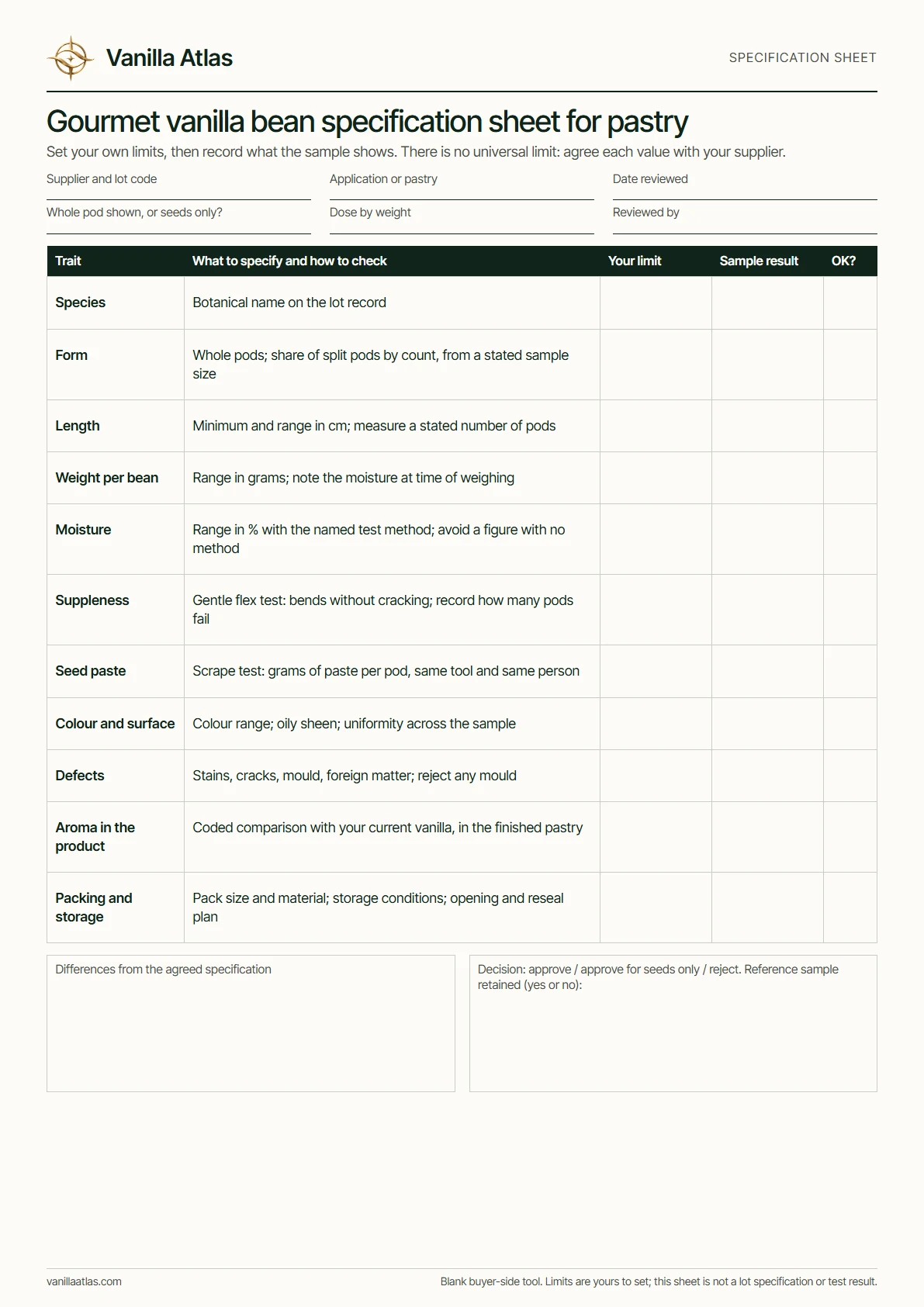
When comparing gourmet vanilla beans for pastry, the one-page PDF lists each trait with room for your limit, the sample result and a decision. Use it to record premium vanilla bean specifications for each lot. It also asks the question that sets the budget: is the whole pod on show, or only visible vanilla seeds?
Download the specification sheet (PDF)
Where Vanilla Atlas fits
Vanilla Atlas sells Gourmet Vanilla Beans, our Indonesian Vanilla planifolia selection for fine pastry, along with four other selections, including Select and Classic for uses where the pod is not on show. Our Gourmet reference values are 14–22 cm, 28–35% moisture and 3–6 g per bean.
Those are reference ranges rather than batch test results, and a batch-specific certificate of analysis is not currently available. Please confirm current lot details before ordering, and run the five-step test above on what you receive. France is on our Shipping & Destinations page, with availability, charges and timing confirmed for each order.
Request gourmet specifications and tell us your pastry, whether the pod or only the seeds will show, and your expected quantity.
Frequently asked questions
What is the best vanilla bean for pastry?
There is no single best bean. For visible use, look for gourmet vanilla beans for pastry that are whole, supple and rich in seed paste, and confirm the aroma in your cream. For strained infusions, a less expensive bean may perform just as well.
What moisture should gourmet vanilla beans have?
CBI describes Grade A gourmet beans at about 30% moisture, and flags a 35–38% class as unstable and prone to mould. Treat these as trade reference points, and ask for the moisture range and test method for the lot you are buying.
How long should vanilla beans for chefs be?
CBI reports that Grade A beans are typically over 15 cm. Length matters most when the whole pod is displayed. When you only need seeds, check paste yield and weight per bean as well, because a long, thin pod may give less paste.
Do you need gourmet beans for visible vanilla seeds?
Not always. Visible vanilla seeds depend on a bean that scrapes well and tastes right, so a mid-tier or clean split lot may work. Compare lots in your cream before paying for perfect appearance that the customer will never see.
How can you tell if a vanilla bean is good by looking at it?
You can only partly tell. Look for whole, even, dark and glossy pods with no mould, then flex one to check suppleness. Looks cannot confirm aroma, so split a pod, smell the paste and taste it in the finished cream.
Is the white coating on a vanilla bean mould?
It may not be. Fine white crystals that glint can be vanillin, known in French as givre. Fuzzy, raised or musty-smelling growth suggests mould. If you cannot tell the difference, set the beans aside and contact your supplier before using them.
Sources and review scope
Sources checked 2 November 2026. Trade classes come from CBI and are reference points, not universal limits. Takahashi et al. was reviewed at abstract level, and ISO 5565-1 by its listing rather than its full text. We found no published seed paste benchmark or study of visual grading in French pastry, so the flex and scrape tests, split-pod reasoning and pastry fit notes are practical Vanilla Atlas guidance, not validated methods.
- CBI: Entering the European market for vanilla, updated 2 May 2023.
- CBI: Buyer requirements for spices and herbs, updated 12 May 2026, for the ISO 5565-1 revision status.
- AFNOR listing of ISO 5565-1:1999, Vanilla: Specification.
- Takahashi M. et al. (2013). Key odorants in cured Madagascar vanilla beans of differing bean quality. Biosci. Biotechnol. Biochem. 77, 606–611.
- Ravier A. et al. (2024). Impact of the Post-Harvest Period on the Chemical and Sensorial Properties of planifolia and pompona Vanillas. Molecules 29(4), 839.
- Chen L. et al. (2025). Authentic Aroma and Compound-Specific Isotope Ratios Profiles of Vanilla Pods. Molecules 30(4), 825.


3 Comments