Vanilla bean moisture content changes texture, the amount of dry matter in each kilogram, and the evidence buyers need for storage and processing decisions. Higher moisture can help culinary handling; lower moisture increases dry matter per kilogram. Neither figure alone proves better flavor, extraction yield, or safety.
For US importers, ingredient distributors, and extract manufacturers, the useful question is: what does this lot deliver for my application at the quoted price?
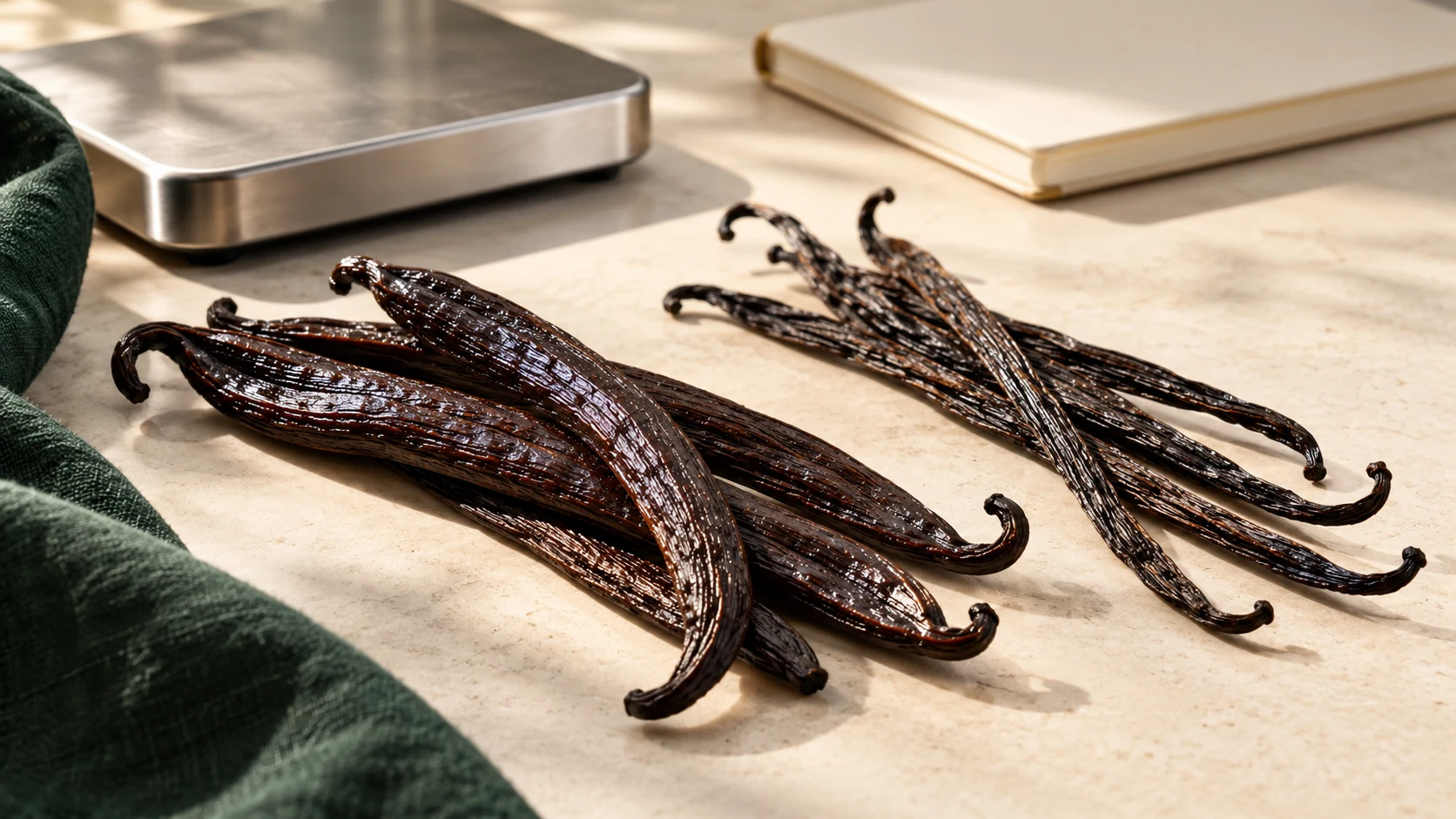
A flexible bean may be valuable when a chef needs to split a pod and scrape its seeds. An extract manufacturer may value a different combination of dry matter, aroma, and processing performance.
Here is how to compare those needs without treating moisture as a universal quality score.
What does vanilla bean moisture content measure?
Moisture content describes how much water a sample contains. On a wet-weight basis, a bean sample with 30% moisture contains approximately 30 g of water and 70 g of dry matter per 100 g.
Throughout this guide, moisture percentages use that wet-weight basis. A dry-basis result uses a different denominator, so the numbers are not interchangeable.
Use this simple calculation:
Dry matter = bean weight × (1 − moisture fraction)
For a 1 kg lot at 30% moisture:
1 kg × (1 − 0.30) = 0.70 kg of dry matter.
Dry matter includes the bean’s non-water material. It is not a measurement of extractable flavor, vanillin alone, or finished extract yield.
What moisture content is suitable for vanilla beans?
There is no single moisture target that answers every buyer’s needs.
As trade context, the Netherlands’ Centre for the Promotion of Imports from developing countries describes familiar Grade A/gourmet beans at about 30% moisture and Grade B/extract beans at about 20%. Those figures are useful reference points, rather than universal US acceptance limits or a Vanilla Atlas specification. CBI: vanilla quality classifications.
Agree on the actual specification with the supplier, then evaluate a representative sample.
| Buyer application | Why moisture matters | What should decide acceptance |
|---|---|---|
| Pastry, ice cream, and other scraped-seed applications | Supple pods can be easier to split and scrape | Handling trial, aroma in the recipe, dimensions, and defects |
| Extract and flavor manufacturing | Water changes dry matter purchased per kilogram and bean-weight calculations | Moisture result, sensory evaluation, relevant chemistry, and extraction trial |
| Ingredient distribution | Moisture affects product positioning and the handling conditions buyers must maintain | Customer specification, lot consistency, packaging, and storage evidence |
Treat grade names as a starting point for discussion. Write measurable acceptance criteria into the purchase specification.
For a broader application comparison, read our gourmet vs extraction-grade vanilla bean guide.
How does moisture change the value of a kilogram?
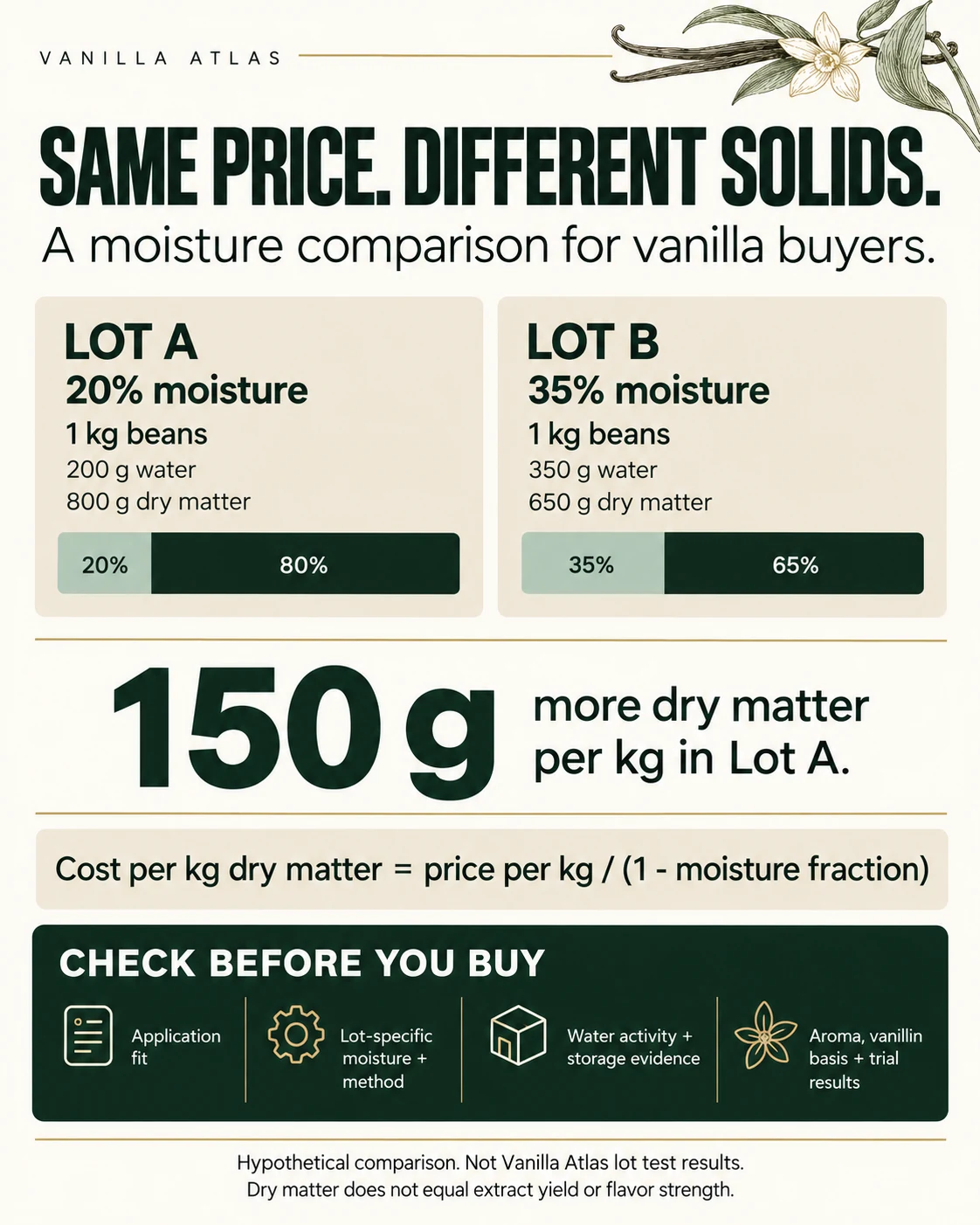
Two lots can carry the same price per kilogram while delivering different amounts of dry matter.
The table below isolates that effect.
Hypothetical calculation: all lots cost $100/kg, use wet-basis moisture, and exclude freight, duties, testing, rejects, and processing costs. These are not market quotations or Vanilla Atlas lot measurements.
| Moisture | Water per 1 kg beans | Dry matter per 1 kg beans | Cost per kg of dry matter |
|---|---|---|---|
| 20% | 200 g | 800 g | $125.00 |
| 25% | 250 g | 750 g | $133.33 |
| 30% | 300 g | 700 g | $142.86 |
| 35% | 350 g | 650 g | $153.85 |
Cost per kg of dry matter = price per kg of beans ÷ (1 − moisture fraction)
At the same $100/kg price, the 35% moisture lot costs about 23.1% more per kilogram of dry matter than the 20% moisture lot.
That does not mean its flavor is 23.1% weaker or that the drier lot will produce 23.1% more extract. Those questions require sensory and process evidence.
What discount would make two lots equal on dry matter alone?
Suppose the 20% moisture lot costs $100/kg. A 35% moisture lot would need to cost $81.25/kg to match its dry-matter cost:
$100 × 0.65 ÷ 0.80 = $81.25
This is a useful negotiation reference when the two lots are otherwise suitable. A culinary buyer may reasonably pay more for better handling or appearance; an extractor should also compare the cost of achieving the required finished-product performance.
Does higher moisture mean stronger vanilla flavor?
No. Moisture measures water, not aroma intensity.
Research on Hainan vanilla compared beans through several curing stages and found substantial changes in flavor-related metabolites. The practical implication for procurement is to assess curing and flavor evidence alongside moisture, rather than infer flavor strength from one percentage. Cai et al., 2019, Molecules.
Texture also deserves its own assessment. A 2025 study of vanilla drying measured dry matter and firmness separately and found that they did not change in a simple parallel pattern throughout processing. A hand-feel check can inform inspection, but cannot replace a moisture measurement. Lalanne-Tisné et al., 2025, research abstract.
Ask the supplier to identify whether any vanillin result is reported as received or on a dry-weight basis, and compare results on the same basis. Then test the sample in the intended recipe or extraction process.
How does moisture relate to mold risk and storage?
Moisture content and water activity are different measurements.
Moisture describes total water. Water activity, written as aw, describes water availability through its equilibrium behavior. Foods with the same moisture content can have different water activities. USDA Agricultural Research Service: Water Activity in Food.
FDA explains that some water is bound to food components and does not behave like freely available water. Water-activity measurements also depend on controlled measurement conditions, including temperature. FDA: Water Activity in Foods.
For purchasing decisions, this means a moisture number alone cannot establish a mold-free storage period.
Ask QA to review the lot’s water activity where relevant, microbiological evidence, packaging, storage conditions, and expected transport duration together. A sealed or vacuum-packed bag is a packaging choice; it is not, by itself, evidence of safety or shelf life.
Record the agreed receiving checks and the action to take if a shipment arrives outside specification. Avoid approving an entire lot from its appearance or the absence of an obvious off-odor alone.
Why does moisture matter to US extract manufacturers?
US vanilla extract rules use a specific bean-weight convention.
Under 21 CFR §169.3(b), one unit weight is 13.35 oz of beans at 25% moisture or less. Above 25%, the bean weight must provide equivalent moisture-free bean solids to that reference. Official CFR text, 2025 edition, §169.3.
The calculation gives these bean weights per unit:
| Bean moisture | Bean weight per unit |
|---|---|
| 20% | 13.35 oz |
| 25% | 13.35 oz |
| 30% | Approximately 14.30 oz |
| 35% | Approximately 15.40 oz |
For moisture above 25%:
Bean weight per unit = 13.35 oz × 0.75 ÷ (1 − moisture fraction)
Drier beans do not reduce the defined unit weight below 13.35 oz. This differs from the dry-matter cost comparison earlier in this guide.
Section 169.175 requires vanilla extract to contain at least one unit of vanilla constituent per gallon and at least 35% ethyl alcohol by volume. TTB describes the gallon as the finished product. Official CFR §169.175; TTB: Vanilla Extracts and Vanilla Flavors.
These calculations address the moisture adjustment only; they do not establish complete product compliance. Confirm the applicable current requirements and your manufacturing calculation before production.
For the wider procurement specification, see what US extract manufacturers should specify.
What measured specifications should buyers request?
Ask for evidence tied to the lot being offered, rather than a generic grade sheet.
| Request | What the response should identify |
|---|---|
| Lot identity | Species, origin, lot code, and the stock represented by the sample |
| Moisture | Result, wet- or dry-weight basis, method, test date, and sampling approach |
| Water activity, where relevant | Result, method, measurement temperature, and date |
| Flavor and chemistry | Sensory description; vanillin result, method, and reporting basis if tested |
| Condition and consistency | Dimensions, split/cut allowance, defects, and variation within the lot |
| Handling evidence | Packaging, storage conditions, shelf-life support, and transport assumptions |
| Acceptance process | Representative sample, application trial, receiving checks, and agreed tolerances |
A practical RFQ line is:
Please provide lot-specific moisture results on a wet-weight basis, including the test method, date, and sampling approach. Identify which additional results are measured and available, and which have not been tested.
For extract manufacturing, ensure the laboratory method is suitable for the intended regulatory use; a quick screening reading should not automatically be treated as equivalent to the method specified in §169.3.
Frequently asked questions
What is the best moisture content for vanilla beans?
The best target depends on the application. Culinary buyers may prioritize flexibility and scraping performance; extract buyers also need to compare dry matter, flavor, and processing results. Set a measured lot specification and verify the sample in use.
Are drier vanilla beans always better value?
No. They contain more dry matter per kilogram, but value also depends on price, aroma, defects, handling, and process performance. Use dry-matter cost to screen quotations, then validate the application result.
Can moisture content predict mold risk?
It cannot establish risk or shelf life by itself. Review water activity, microbiological evidence, packaging, handling, and storage conditions with the moisture result.
Is 35% moisture automatically too high?
It is not a universal acceptance or rejection threshold. Evaluate the lot against its intended use and supporting evidence. In the US vanilla-extract calculation, moisture above 25% requires an upward bean-weight adjustment.
Can I compare vanillin results from two suppliers directly?
Only after checking the methods and reporting basis. An as-received result and a dry-weight result use different denominators. Compare like with like, alongside sensory and application testing.
Request measured specifications for your application
Sourcing Indonesian vanilla for the US market?
Tell Vanilla Atlas your application, required quantity, destination, target moisture specification, and testing or documentation needs. Ask which lot-specific results are currently available and what still requires confirmation.
Request measured specifications
Editorial source note: The examples in this article are calculations, not Vanilla Atlas product test results. The legal references include the official 2025 CFR edition and TTB guidance; check the current eCFR text for a production decision. The 2025 texture study is used at abstract level.
References
- CBI — Entering the European market for vanilla. Trade descriptions used for context, not US regulatory limits.
- Cai et al. (2019) — Metabolite Transformation and Enzyme Activities of Hainan Vanilla Beans During Curing to Improve Flavor Formation. Original research; publication details and abstract checked through PubMed.
- Lalanne-Tisné et al. (2025) — Monitoring vanilla pod quality from Réunion island using near infrared spectroscopy. Original research; abstract consulted.
- USDA ARS — Water Activity in Food. Difference between moisture and water activity.
- FDA — Water Activity (aw) in Foods. Water binding and measurement conditions.
- 21 CFR §169.3 — Definitions, official 2025 edition. Bean unit weight and moisture adjustment.
- 21 CFR §169.175 — Vanilla extract, official 2025 edition. Extract standard of identity.
- TTB — Vanilla Extracts and Vanilla Flavors. Finished-product context and formula information.