
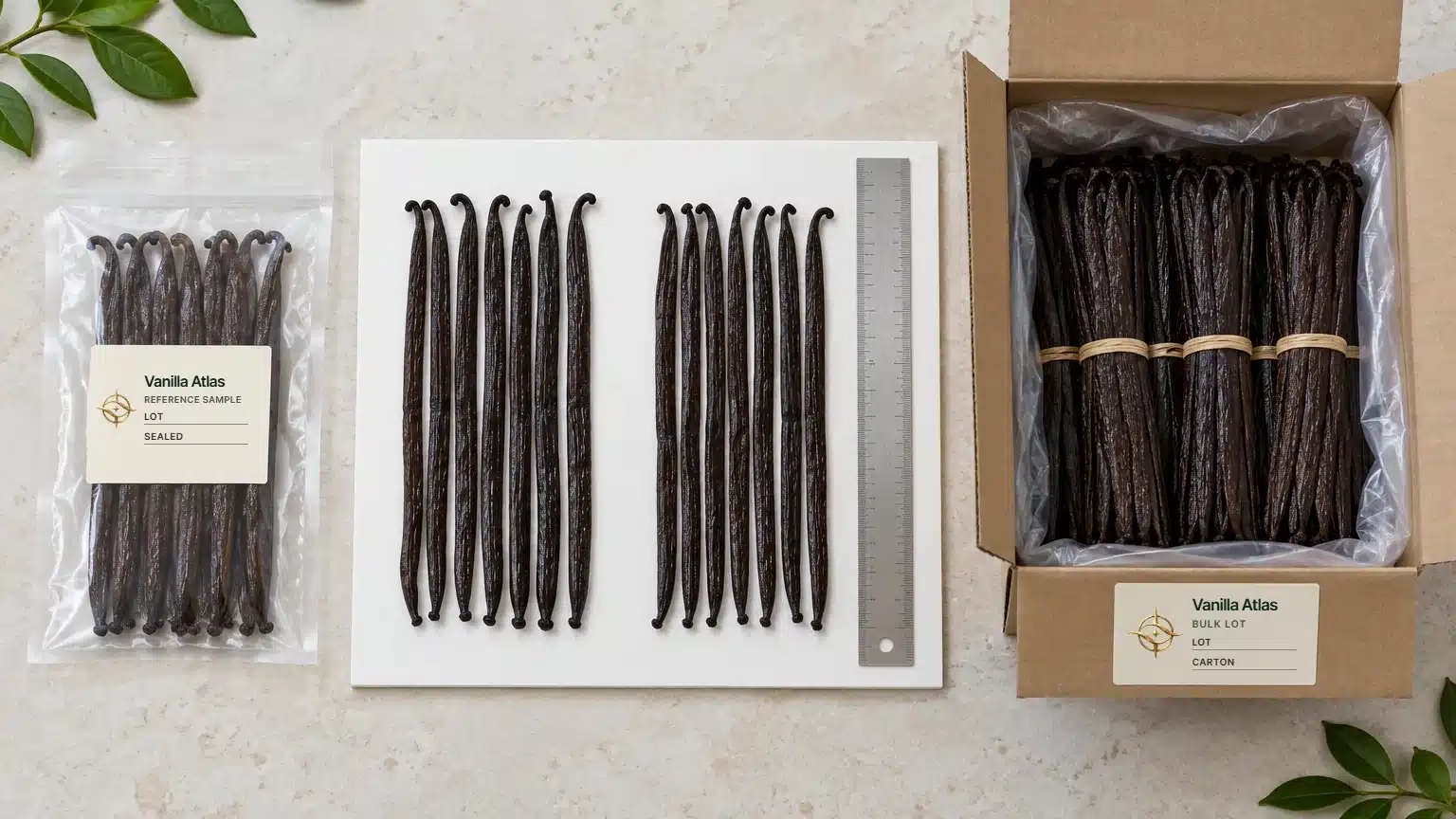
The sample was perfect. Ten weeks later the pallet arrives, and the first carton looks a little drier and a little shorter. Is that the same lot, a normal variation, or a problem worth raising?
To compare a vanilla sample with the bulk lot, keep a sealed reference from the approved sample, confirm the bulk lot code matches it, then draw pods from several cartons. Measure both the same way for length, weight, moisture, flexibility, defects and aroma, and judge the differences against tolerance bands agreed before shipment, not after.
En bref : conservez un échantillon de référence scellé, vérifiez que le numéro de lot du vrac est identique, prélevez des gousses dans plusieurs cartons, mesurez les deux de la même façon et jugez les écarts selon des tolérances convenues avant l’expédition.
This guide to vanilla sample evaluation in France is for importers and QA teams receiving bulk vanilla. It picks up where pre-order checks end: our vanilla bean sample checklist covers approving a sample, and this article covers checking that the bulk lot matches it.
Why can a bulk vanilla lot differ from the approved sample?
A bulk vanilla lot can differ from its sample for ordinary reasons: the sample was drawn from one part of a lot, beans vary from pod to pod, moisture shifts during storage and transit, and lots are sometimes re-sorted or combined before packing. A difference is not automatically a breach; it needs measuring against agreed bands.
Vanilla is a hand-sorted natural product, so some spread is normal. A 2024 study of Indonesian vanilla found that about half of the farmers interviewed did not sort beans, while about 70% of exporters sorted by length and size (Munarso et al.). Sorting at export reduces variation but does not remove it, which is why sample to batch consistency in vanilla has to be checked rather than assumed.
Common reasons a bulk lot differs from its sample
| Cause | What you see on arrival | Prevention |
|---|---|---|
| Unrepresentative sample | Bulk is shorter, thinner or more variable | Ask how the sample was drawn and from how many bags |
| Moisture change | Pods drier and stiffer, or softer and wetter | Agree packaging, a moisture method and a band |
| Re-sorting or blending | Mixed colours or lengths in one carton | Require notice of any change to the allocated lot |
| Different lot shipped | Lot code on cartons differs from the sample | Match lot codes on sample, cartons and invoice |
| Transit or storage damage | Condensation, mould, crushed pods | Specify packing and inspect on arrival |
What is a reference sample, and why should you keep it?
A reference sample is part of the approved sample, sealed, labelled with the lot code and date, and stored so it can be compared with the bulk lot later. It is your evidence of what you agreed to buy. Without it, any dispute about whether the bulk matches depends on memory and photographs.
Keep the reference in airtight, food-grade packaging, away from heat and light, and record how it was stored. Some buyers ask the supplier to keep a matching counter-sample, so both sides hold the same evidence. Agree how long each side keeps it, which should cover the time needed to receive, check and use the lot.
How should a vanilla sample be labelled and stored?
Label every vanilla sample with the supplier, lot code, sampling date, number of pods and who drew it, then seal it in airtight, food-grade packaging. Store the reference sample cool, dark and away from strong smells. Good labelling is what lets a vanilla sample evaluation in France stand up months later.
What to record on a vanilla reference sample
| Field | Why it matters |
|---|---|
| Supplier and lot code | Links the reference sample to the lot offered and shipped |
| Sampling date and person | Shows when and how the sample was drawn |
| Number of pods and bags sampled | Shows how representative the sample is |
| Seal and storage record | Shows the sample was not changed before comparison |
| Approval decision and date | Fixes what the buyer agreed to |
Split the approved sample in two if you can: one part for testing now, one sealed part kept untouched as the reference sample. Testing destroys or changes pods, so a single sample cannot serve both purposes. Record the storage conditions, because a reference that dried out on a warm shelf is no longer a fair comparison in a vanilla quality inspection.
How many pods should you sample from a bulk lot?
Draw pods from several cartons, from different layers, and record how many you inspect. The exact number should come from a sampling plan agreed with your QA team. ISO 948 describes sampling for spices, and the Codex general guidelines on sampling explain acceptance sampling for foods.
We do not prescribe a universal number, because it depends on lot size, how much variation you can accept and how much the decision is worth. What matters most is that the bulk sample comes from more than one carton and more than the top layer, and that the same plan is used every time. ISO 948 was last confirmed in 2024 and remains the current spice sampling standard.
Which traits should you compare between sample and bulk?
Compare lot code, length, weight per pod, moisture, flexibility, split and stained pods, colour, aroma and performance in your product. Measure each trait the same way for the reference sample and the bulk lot, on the same day if possible, so any difference reflects the beans rather than the method.
Traits to compare in a vanilla quality inspection
| Trait | How to measure | Why it matters |
|---|---|---|
| Lot code | Sample label, cartons and invoice | Confirms you received the lot you approved |
| Length | Average and shortest pod of a counted sample | Display use and grade |
| Weight per pod | Total weight divided by pod count | Dose by weight and dry matter |
| Moisture | Same method and basis for both | Handling, value and storage risk |
| Flexibility | Share of pods that crack when gently bent | Scraping and visible use |
| Splits and stains | Share of pods, from the same count | Grade and appearance |
| Aroma | Coded comparison, reference against bulk | Flavour consistency |
| Result in product | Same recipe and dose | The outcome you actually sell |
Our vanilla bean quality guide for France explains each physical trait, and our guide to comparing vanilla aroma sets out a coded test you can use for the aroma row.

What tolerance bands should you agree before shipment?
Agree a band for every trait you will compare, before the lot ships: for example a minimum length, a moisture range with its method, a maximum share of split or cracked pods, zero mould, and an aroma comparison against the reference. Bands make the vanilla quality inspection on arrival a measurement, not a negotiation.
The values depend on your use, so we do not suggest universal limits for a vanilla quality inspection. A pastry buyer will set tighter bands for length and splits than an extraction buyer. Write the bands into the purchase terms, alongside how samples are drawn and what happens when a result falls outside them. Our vanilla bean RFQ guide shows where these terms fit.
Example structure for tolerance bands (values are yours to set)
| Trait | Band format | If outside the band |
|---|---|---|
| Length | Minimum average and minimum single pod, in cm | Reassign to another use, or price adjustment |
| Moisture | Range in %, named method and basis | Re-test, then discuss with evidence |
| Split or cracked pods | Maximum share by count | Price adjustment or reassignment |
| Aroma | No perceptible loss against the reference in a coded test | Repeat the test, then raise a claim |
| Mould, off smell, foreign matter | None | Isolate the lot and raise a claim |
How do you run a vanilla sample evaluation in France on arrival?
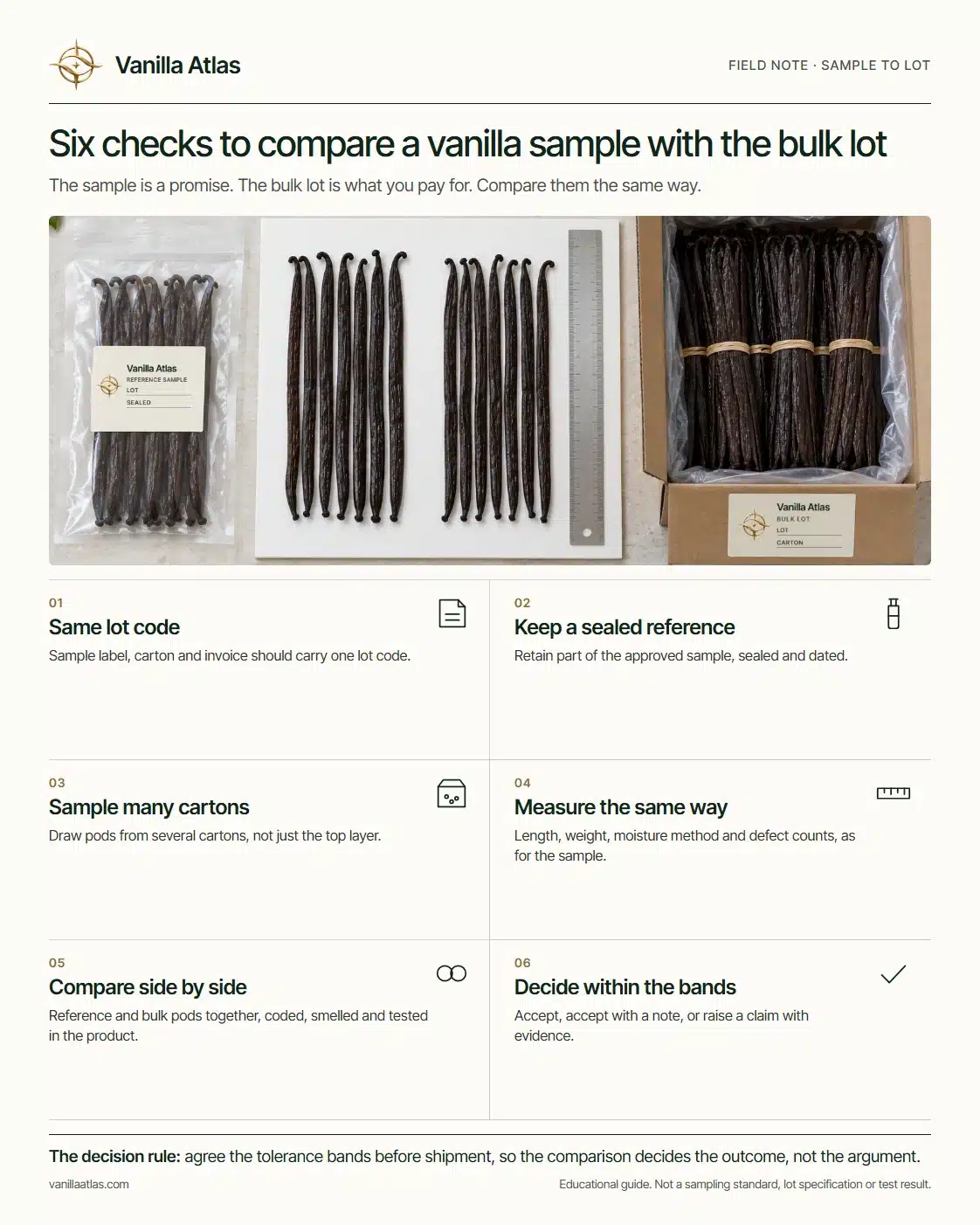
Run the arrival check in six steps: confirm the lot code, take the sealed reference out of storage, draw pods from several cartons, measure both sets the same way, compare aroma and product results, and decide against the agreed bands. Photograph and record everything on one worksheet, so the result stands on its own.
- Confirm the lot. Check that cartons, documents and the reference sample carry the same lot code. Note seals and any damage.
- Bring out the reference. Check its seal and storage record, and let it reach room temperature with the bulk pods.
- Draw the bulk sample. Take pods from several cartons and layers, following your sampling plan.
- Measure both. Length, weight per pod, moisture, flexibility, splits and stains, using identical methods.
- Compare aroma and product. Code the samples, smell them, and test both in the same recipe at the same dose.
- Decide. Accept, accept with a note, or raise a claim, and record the reason on the worksheet.
Download the comparison worksheet (PDF)

What if the bulk lot does not match the sample?
If the bulk lot falls outside the agreed bands, isolate the affected cartons, photograph them, keep the reference and bulk samples sealed, and notify the supplier in writing promptly with your measurements. Ask for their explanation and proposed remedy. Clear evidence gathered on arrival makes a reasonable resolution far more likely.
Not every difference found during a vanilla sample evaluation in France is a claim. A lot slightly drier than the sample may still suit your product, or another one. If it is fit for a different use, reassigning it may cost less than returning it. Where mould, off smells or foreign matter appear, stop using the lot and follow your food safety procedure; under EU law the importer must not place unsafe food on the market.
Subject: Lot [code], arrival comparison with reference sample
We received lot [code] on [date]. Comparing [number] pods from [number] cartons with the sealed reference sample from [date], we found [trait] outside the agreed band: [result] against [band]. Photographs and the completed worksheet are attached. The affected cartons are isolated, and both samples are retained. Please send your explanation and proposed remedy by [date].
Should you use third-party pre-shipment inspection?
Third-party pre-shipment inspection can help for large or first orders, because an independent inspector compares the lot with your specification before it leaves the origin. It costs money and still depends on a clear specification and sampling plan. For smaller orders, a pre-shipment sample from the actual lot is often enough.
Whichever you choose, ask for the pre-shipment sample or inspection to be drawn from the packed lot, not from stock in general, and to carry the lot code. Then compare it with your reference sample before you release payment or the shipment, so problems surface before transit and sample to batch consistency in vanilla is checked twice. Our traceability guide covers the records that link the sample to the packed cartons.
How does sample to batch consistency in vanilla affect long-term supply?
Good sample to batch consistency in vanilla builds trust that lets both sides simplify. When several lots match their samples, buyers can rely more on pre-shipment samples and less on arrival checks. When lots drift, tighter bands, more sampling or a different supplier may be needed. Keep the records, because the pattern across lots matters more than one result.
Track each lot’s comparison over time in one place: supplier, lot, date, traits measured and decision. After a few deliveries you will see which traits drift and whether bands need adjusting. Our vanilla supplier checklist for France covers the documents and roles behind each order.
Where Vanilla Atlas fits
Vanilla Atlas supplies Indonesian Vanilla planifolia in five selections. Each quote states the lot’s handling chain, and we can label samples with the lot they come from, so you can keep a reference and compare it with what arrives. France is on our Shipping & Destinations page, with availability, charges and timing confirmed for each order.
A batch-specific certificate of analysis is not currently available, and selection names are not lab results. That is why we recommend the comparison method in this guide for every lot, including ours. Tell us the traits and bands that matter to you before shipment, and we will tell you what we can confirm for the lot on offer.
Submit your sample criteria, including your application, the traits you will compare and the bands you want to agree.
Frequently asked questions
How do you compare a vanilla sample with the bulk lot?
Keep a sealed reference from the approved sample, check the bulk lot code matches, and draw pods from several cartons. Measure both the same way for length, weight, moisture, flexibility, defects and aroma, then judge differences against bands agreed before shipment.
What is a reference sample for vanilla?
A reference sample is part of the approved sample, sealed and labelled with the lot code and date, kept so it can be compared with the bulk lot later. It is the main evidence of what was agreed if the delivery differs.
Why do vanilla beans arrive drier than the sample?
Moisture can change during storage and transit, especially if packaging is not airtight or conditions vary. A sample drawn from one part of a lot may also be moister than the average. Agree a moisture band, method and packaging before shipment.
How many vanilla pods should I check from a bulk lot?
There is no universal number. Draw pods from several cartons and layers, follow a sampling plan agreed with your QA team, and record the count. ISO 948 and the Codex guidelines on sampling give general methods for sampling foods and spices.
What should I do if the bulk vanilla does not match the sample?
Isolate the affected cartons, photograph them, keep both samples sealed, and notify the supplier in writing with your measurements and the agreed bands. If the lot suits another use, reassigning it may be better than returning it.
Is pre-shipment inspection worth it for vanilla?
It can be for large or first orders, because problems are found before transit. It costs money and still needs a clear specification. For smaller orders, a lot-coded pre-shipment sample compared with your reference is often enough.
Sources and review scope
Sources checked 4 November 2026. ISO 948 and the Codex sampling guidelines are cited by title and status, not reproduced. The arrival steps, band structure and claim template are Vanilla Atlas suggestions, not a standard; no universal sample size or tolerance is given. The Indonesian sorting data comes from one field study of 68 interviews.
- ISO 948:1980, Spices and condiments: Sampling, confirmed in 2024.
- Codex Alimentarius: General Guidelines on Sampling (CXG 50-2004).
- Munarso S.J. et al. (2024). From bean to market: exploring the chemical and production dynamics of high-quality Indonesian vanilla. Front. Sustain. Food Syst. 8:1425656.


One Comment