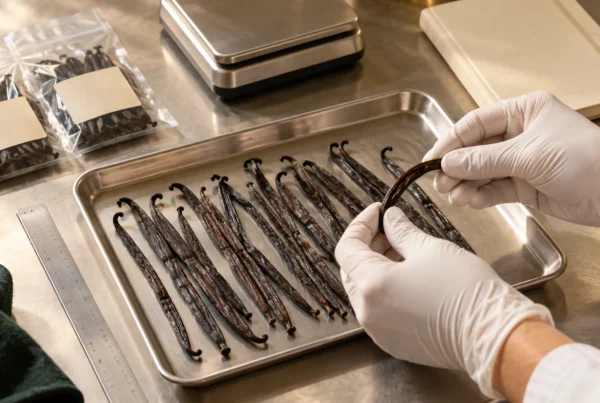
Ask two suppliers for the same specification before comparing their prices. A Madagascar gourmet quote and an Indonesian extraction-grade quote answer different buying questions.
To compare Indonesian vs Madagascar vanilla beans, confirm the species and offered lot, test both samples in the intended application, align measured specifications, and compare delivered costs on the same terms. Origin helps you build a shortlist; the purchase decision needs evidence from the lot you will receive.
The price assumption deserves checking, too. In 2025, US imports of vanilla that was neither crushed nor ground had average CIF unit values of US$52.54/kg from Indonesia and US$51.61/kg from Madagascar. Those figures do not support a blanket claim that Indonesian beans are cheaper. They also do not tell you the price of a particular grade. The calculations and limitations are set out below using US-reported UN Comtrade data.
What actually differs between the two sourcing options?
Both origins can be considered for a specification-led supplier search. The comparison becomes useful when it identifies what you need to verify.
Origin comparison and buyer verification questions
| Buying question | Indonesian vanilla offer | Madagascar vanilla offer | What the buyer should verify |
|---|---|---|---|
| Which species is offered? | Confirm the botanical name; Indonesian origin alone does not establish it. | Confirm the botanical name; a Madagascar or Bourbon description is not a complete specification. | Compare the declared species before interpreting aroma or chemistry. |
| What sensory profile should I expect? | Ask for the lot's curing history and sensory description. Avoid assuming every Indonesian lot is smoky. | A creamy, sweet profile is commonly used to describe Madagascar vanilla, but the offered lot still needs testing. | Run a coded comparison in the finished product. |
| Is the price lower? | The 2025 uncrushed, unground US import unit value was US$52.54/kg. | The equivalent 2025 figure was US$51.61/kg. | Use actual quotations for matched specifications, quantities, and delivery terms. |
| What does the trade flow establish? | The dataset records an existing US import flow from Indonesia. | It records a substantially larger US import flow from Madagascar. | Neither national total establishes an individual supplier's stock, capacity, or lead time. |
| Are entry checks identical? | Check the lot's regional origin and the current scope of FDA Import Alert 99-52. | That Indonesia-specific alert does not establish the requirements for a Madagascar shipment. | Review the actual supplier, product, and entry requirements for either origin. |
| How should acceptance work? | Approve the identified lot against written criteria. | Use the same acceptance framework. | Link the sample, test reports, and bulk shipment to the agreed lot. |
The sensory description above is a commercial reference, not a national quality standard. Nielsen-Massey's FAQ describes Madagascar's creamy, sweet character and identifies Vanilla planifolia in both Indonesia and Madagascar.
Origin, species, and grade answer different questions
Indonesia and Madagascar are origins. Vanilla planifolia is a botanical species. Gourmet, Grade A, and extraction-grade are commercial descriptions that need written definitions in the purchase specification.
Start with the botanical name. If a supplier offers Vanilla × tahitensis, record it separately from a V. planifolia comparison. The trade-price tables in this article cannot isolate either species.
“Madagascar Bourbon” is a geographic naming convention, not a statement that the beans contain bourbon whiskey. It also does not establish the moisture, vanillin result, defect tolerance, or remaining stock of the offered lot. Nielsen-Massey explains that geographic usage in its vanilla FAQ.
Then define what you mean by grade: permitted dimensions, whole or split condition, moisture reporting basis, defect limits, packaging, and intended use. Our gourmet vs extraction-grade guide explains why application changes the specification.
Compare aroma in your product, under the same conditions
A country description is a starting point for a sensory brief. It cannot replace an application trial.
Ask each supplier how the offered lot was harvested, cured, dried, and conditioned. Research on Indonesian vanilla discusses the relationship between production practices and chemical and physical quality; it does not establish the results for an untested commercial lot. See From bean to market, published in Frontiers in Sustainable Food Systems.
For a buying trial, code the samples so the evaluator does not see the origin label. Keep the recipe or extraction procedure, preparation, dose, time, and relevant processing conditions consistent. Include your current approved material when available.
For pastry or dairy, record aroma in the finished product, seed appearance where relevant, and handling or scraping performance. For extraction, record the bean preparation, loading basis, solvent conditions, processing time, and the results used to assess the extract.
If the trial uses equal as-received bean mass, record moisture as well. Equal bean weights may contain different amounts of dry matter. A comparison designed around equal dry matter asks a different question, so document the chosen basis before testing. The moisture-content guide explains the commercial distinction.
What do US trade data say about vanilla prices?
The following are calculated import unit values, using the latest completed calendar year, 2025. They are historical benchmarks, not October 2026 spot prices, retail prices, supplier quotations, or grade-specific price lists.
2025 benchmarks by origin and product form
2025 US import unit values by origin and product form
| Origin | Product form recorded in trade data | HS code | Net weight imported into the US | Reported CIF value | Calculated US$/kg |
|---|---|---|---|---|---|
| Indonesia | Vanilla, neither crushed nor ground | 090510 | 198,993 kg | US$10,454,977 | US$52.54 |
| Madagascar | Vanilla, neither crushed nor ground | 090510 | 1,342,436 kg | US$69,276,608 | US$51.61 |
| Indonesia | Vanilla, crushed or ground | 090520 | 35,361 kg | US$314,081 | US$8.88 |
| Madagascar | Vanilla, crushed or ground | 090520 | 33,295 kg | US$1,310,838 | US$39.37 |
How the figures were calculated: reported annual CIF value in US dollars divided by reported net weight in kilograms. Each ratio uses the total value and total weight for that origin and HS category, rather than averaging shipment prices. Source: US-reported 2025 HS 090510 records and 2025 HS 090520 records, retrieved 28 October 2026. Both categories have positive net weights that are not flagged as estimated in these records. Data may be revised.
What CIF means here: this is a statistical valuation basis that includes goods and delivery services to the importing country's border, including international freight and insurance. It is not the buyer's final warehouse cost and does not identify the Incoterm used in each contract. Review duties, brokerage, testing, and inland delivery separately. UN Comtrade explains the basis in its trade-valuation guidance.
What the table cannot tell you: the records do not separate Gourmet from extraction-grade, identify botanical species, report moisture or vanillin, or establish the condition of the material. The US$8.88/kg Indonesian crushed-or-ground figure must not be presented as a quotation for premium vanilla powder. Nor does its difference from Madagascar's figure prove that equivalent products traded at those two prices.
The relative price position changed between 2023 and 2025

2023 to 2025 unit values for vanilla neither crushed nor ground
| Year | Indonesia, calculated CIF US$/kg | Madagascar, calculated CIF US$/kg |
|---|---|---|
| 2023 | US$97.12 | US$173.79 |
| 2024 | US$54.68 | US$52.34 |
| 2025 | US$52.54 | US$51.61 |
Scope: US imports, HS 090510, vanilla neither crushed nor ground. These annual ratios combine the product mix recorded for each origin; they are not a constant-quality price index.
Indonesia had the lower unit value in 2023. In 2024 and 2025, the two averages were much closer, with Madagascar slightly lower. That is a reason to refresh quotations rather than carry an old origin discount into a new budget. It is not evidence that the same grade became interchangeable across the two supply chains.
Can these data price each commercial type of vanilla?
Commercial product types and trade-data coverage
| Product you want to buy | What this trade dataset can establish | What you still need |
|---|---|---|
| Gourmet or Grade A whole beans | An origin-level benchmark within the uncrushed, unground category, without a separate Gourmet price. | A current lot quotation against your physical and measured specification. |
| Extraction-grade whole beans | The same broad category, without a separate Grade B or extraction-grade price. | Moisture basis, chemistry requirements, defects, usable material, and application results. |
| A named botanical species | No species-specific unit value within either category. | Botanical identity and a quotation for the offered species and lot. |
| Crushed or ground vanilla | A separate form-level benchmark under HS 090520. | Product composition, processing history, condition, and agreed quality criteria. |
| Extract, paste, or a formulated blend | No price from the two bean/spice series analyzed here. | The exact formulation, relevant classification, specification, and supplier quotation. |
For commercial pricing, send the same vanilla RFQ specification to both suppliers. Use the trade data to question a quotation, not to substitute for one.
Compare the cost of the lots that pass your specification
Request quotations for the same quantity, packaging, delivery point, shipment window, and commercial terms. State the named place or port. A price at origin and a delivered US price need a cost reconciliation before they can be compared.
Keep the quoted goods price, freight, insurance, required testing, documentation, duties, brokerage, and inland delivery in separate lines. Where an item is already included in the supplier's delivery term, do not add it again. Have the broker confirm the applicable entry-date charges.
Then compare handling losses and process performance from the actual trials. A lower quoted kilogram price may produce a higher cost per usable batch if the lot misses your specification or needs more material to achieve the required result.
Do not apply an assumed moisture adjustment to the national trade averages above. Those records do not report the moisture of the goods.
US entry checks deserve a separate review
For either origin, determine the applicable food-import and supplier-verification requirements. Where FSVP applies, FDA describes a risk-based program covering the food and foreign supplier; a pleasant sample or a country label does not complete that work. See FDA's FSVP overview.
For an Indonesian offer, establish the lot's regional origin. As checked on 28 October 2026, FDA Import Alert 99-52 covers certain foods, including spices, from Java and Lampung, and sets out shipment-certification and firm-specific conditions.
Have the importer and broker verify coverage and required certification for the actual lot before booking. A generic laboratory report is not automatically the required shipment certificate. An export port outside the named regions does not establish where the material originated.
Qualify a second origin before allocating volume
The 2025 records show that US buyers imported uncrushed, unground vanilla from both origins. Madagascar's larger flow in this dataset describes historical trade scale. It does not promise availability from the supplier in your inbox.
Ask who grew, cured, processed, packed, and exported the offered goods, and how those records connect to the lot code. When diversification is the goal, check whether the two offers depend on the same intermediary or stock pool.
For each supplier, confirm the currently available quantity, expected replenishment, quotation validity, packaging, dispatch conditions, and process for a lot substitution. Qualify the alternative in the application before allocating regular volume to it.
Put both samples through one approval process
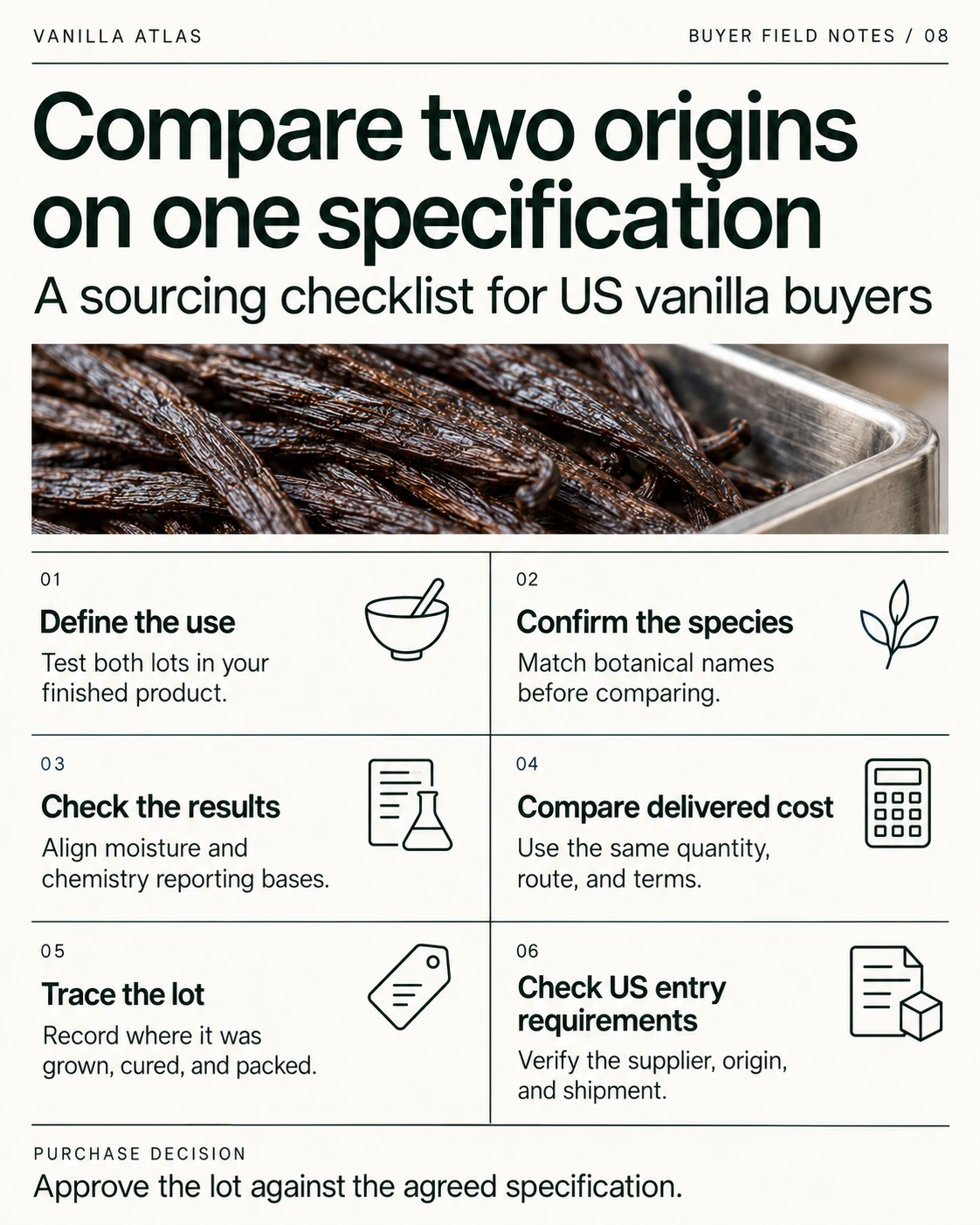
Use the same sample record for the two origins: supplier identity, botanical name, growing and processing locations, lot code, sampling method, measured results, application notes, price terms, and unresolved questions.
Keep a retained reference and define the receiving checks in the purchase order. If the offered lot changes after approval, review the replacement evidence before releasing the shipment. Our vanilla sample evaluation checklist covers the sample-to-bulk steps in more detail.
Your decision record should explain why the selected lot meets the application and purchase requirements, and what must be confirmed at shipment. “Preferred origin” alone leaves the receiving team little to enforce.
Frequently asked questions
Is Indonesian vanilla the same species as Madagascar vanilla?
Vanilla planifolia is a common commercial reference for both origins, but country names alone do not establish the species of an offered lot. Ask for the botanical name and record it in the specification. Keep offers of Vanilla × tahitensis separate when comparing species.
Is Indonesian vanilla cheaper than Madagascar vanilla?
Not consistently in the trade data analyzed here. For US imports of vanilla neither crushed nor ground, the calculated 2025 CIF unit values were US$52.54/kg from Indonesia and US$51.61/kg from Madagascar. These are annual averages across recorded product mixes, not quotations for equivalent grades.
Which origin is better for extraction or food manufacturing?
Select the lot that meets your application and measured specification at an acceptable delivered cost. Compare coded samples using the same procedure, and review chemistry, moisture basis, defects, traceability, and shipment requirements. Origin alone does not establish processing performance.
Can trade data give me a Gourmet, Grade B, or Tahitian vanilla price?
Not from the two HS categories used here. They distinguish vanilla neither crushed nor ground from vanilla crushed or ground, without separating commercial grades or botanical species. Obtain current supplier quotations for those specific products.
Does FDA Import Alert 99-52 cover every Indonesian vanilla shipment?
The alert's current scope is specific to certain foods, regions, and firms. Have the importer or broker check the actual lot, product, regional origin, and supplier status against the current FDA text before arranging a US shipment.
Discuss your application requirements
Considering Indonesian vanilla alongside an existing Madagascar supply? Send Vanilla Atlas your application, required species and specifications, proposed volume, destination, and documentation needs. Ask which lots and supporting measurements are currently available before setting a purchase decision.
Discuss application requirements
Sources and data notes
- UN Comtrade: 2025 US imports, HS 090510 and HS 090520. Reporter USA, partners Indonesia and Madagascar, all transport modes and customs procedures, original HS 2022 classification. CIF value divided by net weight; no grade or species attribution.
- UN Comtrade: 2023 US imports, HS 090510 and 2024 equivalent. Same scope and calculation as 2025.
- UN Comtrade: Trade valuation and Supplementary quantity units. CIF/FOB valuation and net-weight interpretation.
- Nielsen-Massey: Frequently asked questions. Commercial reference for species, Madagascar sensory description, and the geographic meaning of Bourbon.
- Frontiers in Sustainable Food Systems: From bean to market. Research on Indonesian vanilla production and quality; not evidence of Vanilla Atlas lot results.
- FDA: Foreign Supplier Verification Programs. Buyer-side supplier-verification context.
- FDA Import Alert 99-52. Current regional and firm-specific scope checked 28 October 2026. Recheck before shipment.
Trade figures were retrieved on 28 October 2026 and may be revised. They are historical aggregate import values, not Vanilla Atlas prices or measured product specifications. Shipment requirements must be checked for the actual product, lot, supplier, and entry date.