Last updated: September 2026 · Vanilla Atlas Insights.
If you make vanilla extract for the US market, the Code of Federal Regulations already fixes a large part of your specification: how many beans go into a gallon, and at what moisture those beans are counted. Everything else, including vanillin, microbiology, physical condition and documentation, is up to you and your supplier.
This guide is for extract manufacturers, flavor houses, distillers and procurement teams writing a specification or a request for quotation (RFQ) for extraction grade vanilla beans. It covers the regulatory arithmetic, why the moisture figure drives cost, which variables belong in the RFQ, and which documents a US import needs.
Vanilla Atlas is building its Indonesian supply position on measured evidence, and we are not there yet. Figures in this article come from US regulation and published research. None of them are measurements of a Vanilla Atlas lot.
1. The Regulatory Baseline: What 21 CFR Part 169 Requires
One unit per gallon of finished extract
Under 21 CFR § 169.175, vanilla extract must contain ethyl alcohol “not less than 35 percent by volume” and vanilla constituent “not less than one unit per gallon.” A gallon containing two or more units is sold as a “fold” product. A 2-fold concentrated extract carries two units per gallon (§ 169.176).
The gallon here is the finished extract, not the alcohol you start with. Specifications sometimes get this wrong, so it helps to state it correctly in yours.
The 25% moisture anchor
The unit is tied to bean weight. 21 CFR § 169.3(b) defines one unit weight as 13.35 ounces of vanilla beans containing not more than 25% moisture. For wetter beans, the unit is “the weight of such beans equivalent in content of moisture-free vanilla-bean solids” to 13.35 oz at 25% moisture. The regulation gives its own example: at 33.25% moisture, one unit weight is 15 ounces.
In metric terms, a single-fold gallon needs about 378 g of beans at 25% moisture, which works out to roughly 100 g of beans per litre of extract.
2. Why Extractors Rarely Buy Gourmet Beans
Paying for water
Gourmet or “Grade A” beans are typically sold at around 30% moisture or more. That suits pastry work, where the pod must stay pliable. For extraction, the extra moisture is weight you pay for and then discard.
At a constant price per kilogram, the arithmetic from §169.3(b) looks like this:
| Bean moisture | Beans per single-fold gallon | Beans per 1,000 gal | Extra bean mass vs 25% |
|---|---|---|---|
| 20% | 13.35 oz | 378.5 kg | 0% (no credit) |
| 25% | 13.35 oz | 378.5 kg | — |
| 30% | 14.30 oz | 405.5 kg | +7.1% |
| 33.25% | 15.00 oz | 425.2 kg | +12.4% |
| 35% | 15.40 oz | 436.7 kg | +15.4% |
A 35%-moisture lot needs about 15% more bean mass to reach the same legal strength. Unless the price per kilogram is at least that much lower, the wetter lot costs more per gallon.
Below 25%, drier beans get no regulatory credit
This point is often misread. A bean at 20% moisture still counts as 13.35 oz per unit, the same as a bean at 25%. The regulation gives no allowance for dryness below the anchor.
Drier beans still have value. A 20% bean carries about 10.7 oz of dry solids per 13.35 oz, compared with about 10.0 oz at 25%. That can mean more extractable flavor per gallon and more room to hit your sensory target. But the benefit shows up in your process results, not in the legal minimum. Beans that are too dry also bring risks: brittleness, lost aroma, and more breakage in transit.
For most extraction lines, the practical target is a band near, and at or below, 25%, with a stated tolerance.
What “extraction grade” usually means, and what it doesn’t
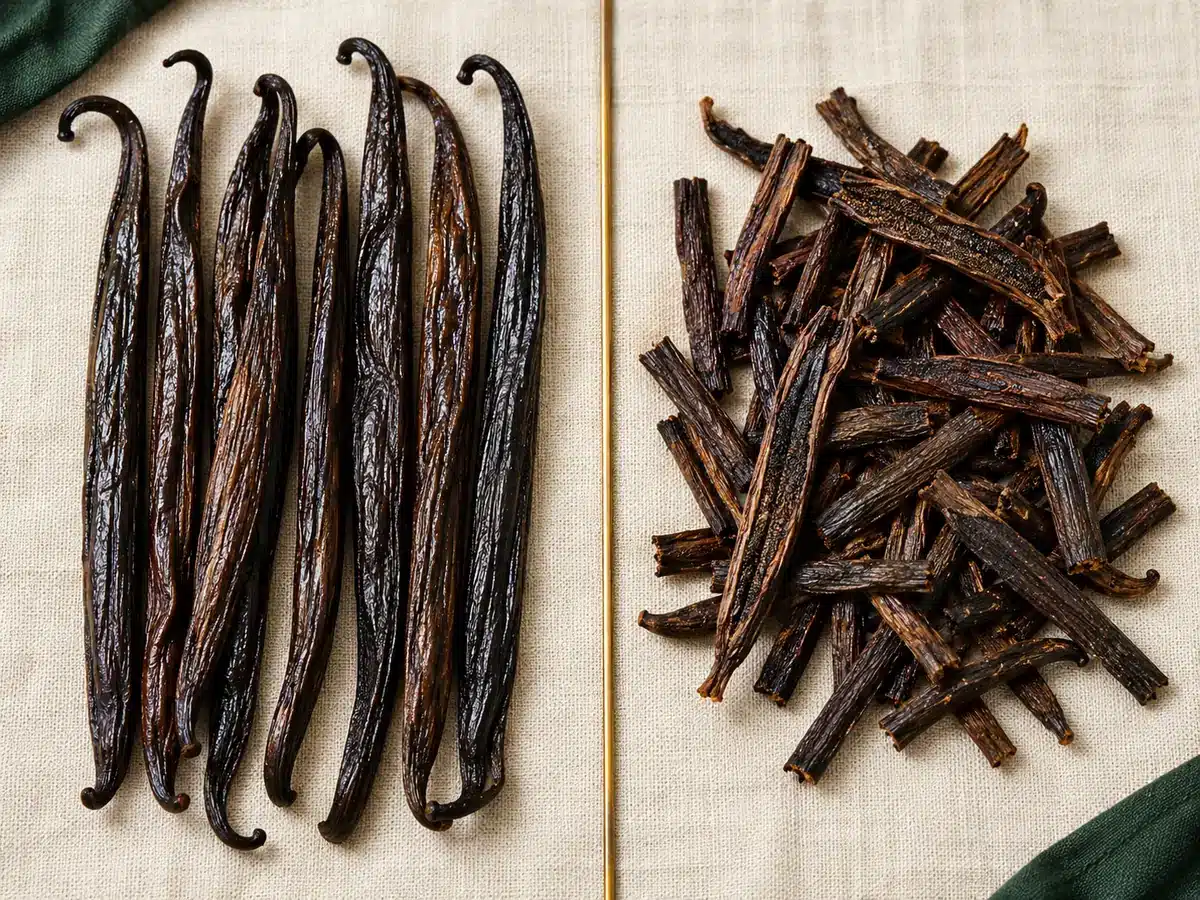
In trade use, “extraction grade,” “Grade B” or “cuts” usually means shorter, drier beans that may be split or cut and look less uniform. Those flaws matter little once the beans are chopped for percolation or maceration.
It does not mean lower hygiene, mould tolerance or unknown origin. And it has no fixed moisture value. Published Indonesian data shows how wide the range can be: Munarso et al. (2024) measured “Grade B” water content at 22.07 ± 9.36% across their samples (Frontiers in Sustainable Food Systems). A label narrows the range. Only a number in the contract fixes it.
If your product shows the bean or its seeds, a gourmet specification may be the better fit. Our comparison of gourmet vs extraction-grade vanilla beans explains how to choose by application.
3. The Variables That Belong in Your RFQ
Moisture: value, tolerance and method
State three things: a target value (for example, 22%), a tolerance (for example, ±3 points), and the test method. The method matters. §169.3(b) names a specific AOAC toluene-distillation procedure for regulatory purposes, and oven-drying methods can return different figures on the same beans because they also drive off volatiles. If your supplier’s COA and your incoming QC use different methods, you will dispute numbers that are not comparable.
Vanillin: state the basis
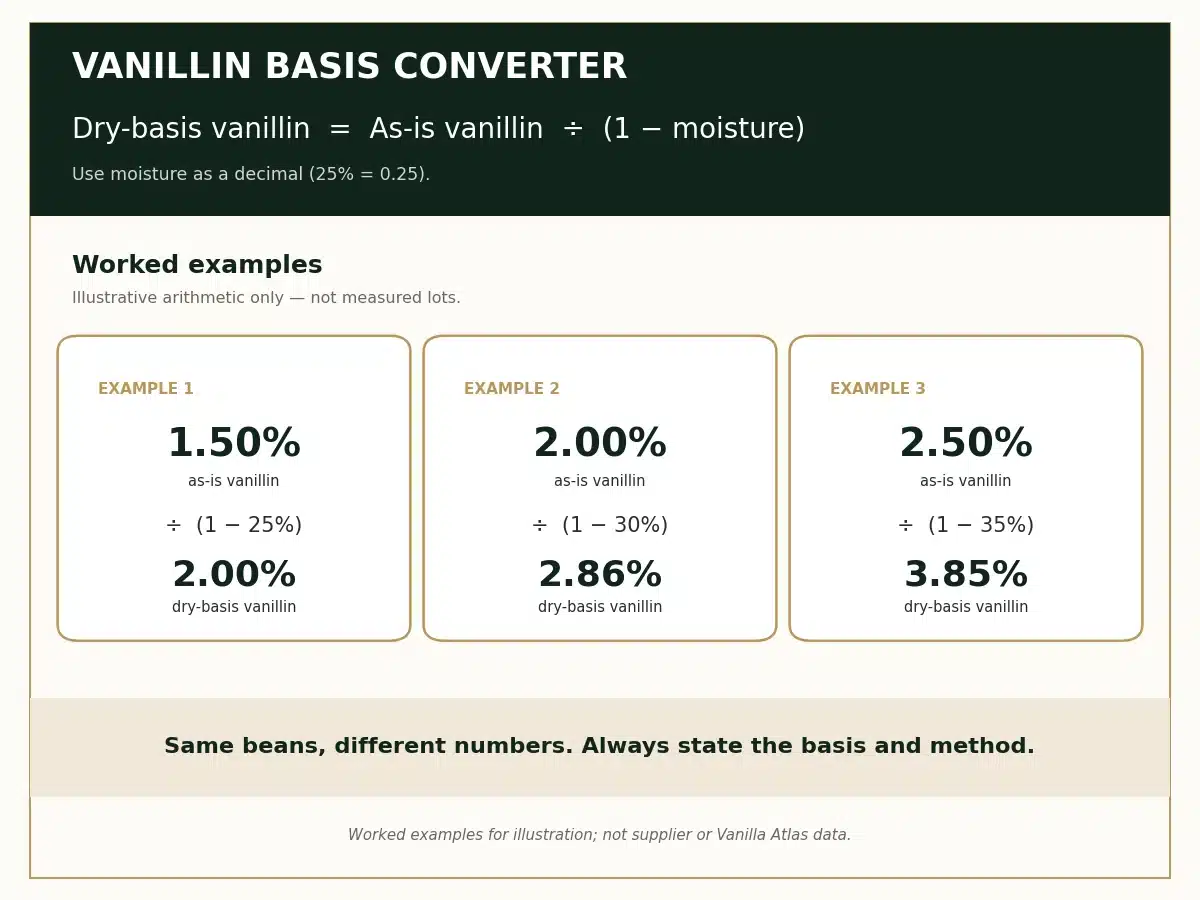
Vanillin is the most common single quality marker, but a percentage means little without its basis. The same beans can be reported as is (at their current moisture) or on a dry basis (moisture-free):
dry-basis vanillin = as-is vanillin ÷ (1 − moisture fraction)
A lot reported at 2.0% vanillin as is, with 25% moisture, is 2.67% on a dry basis. Specify dry basis, a minimum value, and the analytical method (HPLC is the usual choice; ISO 5565-2 covers vanilla test methods). European market guidance from CBI cites importer-preferred vanillin of “minimum 1.5–2%” (CBI). Treat that as a reference point for negotiation, not a regulatory floor.
Physical condition
For extraction, specify what you will accept (splits, cuts, short lengths, uneven color) and what you won’t: visible mould, foreign matter, insect damage, and off-odors such as phenolic, smoky or fermented notes. Buying cut beans is fine. Buying beans with mould is not.
Microbiological and contaminant limits
US federal rules set no numeric microbial limits for vanilla beans. These are contract terms, so set them with your food safety team and your customers’ audit requirements in mind. A typical panel covers:
- Total plate count (TPC) and yeast & mould: numeric limits in CFU/g
- Salmonella: not detected (a common contract convention is “negative in 25 g”)
- E. coli: numeric limit or absence
- Ochratoxin A (OTA): no US limit applies to vanilla, but if any of your volume goes to the EU, the 15 μg/kg reference that CBI cites is a sensible ceiling
Ethanol extraction reduces microbial risk in the extract itself. It does nothing for beans that go into vanilla powder, paste or seed inclusions on the same purchase order. It also won’t satisfy an auditor who asks for raw-material limits.
Authenticity
Adulteration with synthetic vanillin is a known risk for extracts. If your customers expect proof of natural origin, specify that you may run authenticity tests, such as stable-isotope analysis, on retained samples, and make the supplier’s cooperation a condition of the contract.
4. Documents and US Import Requirements
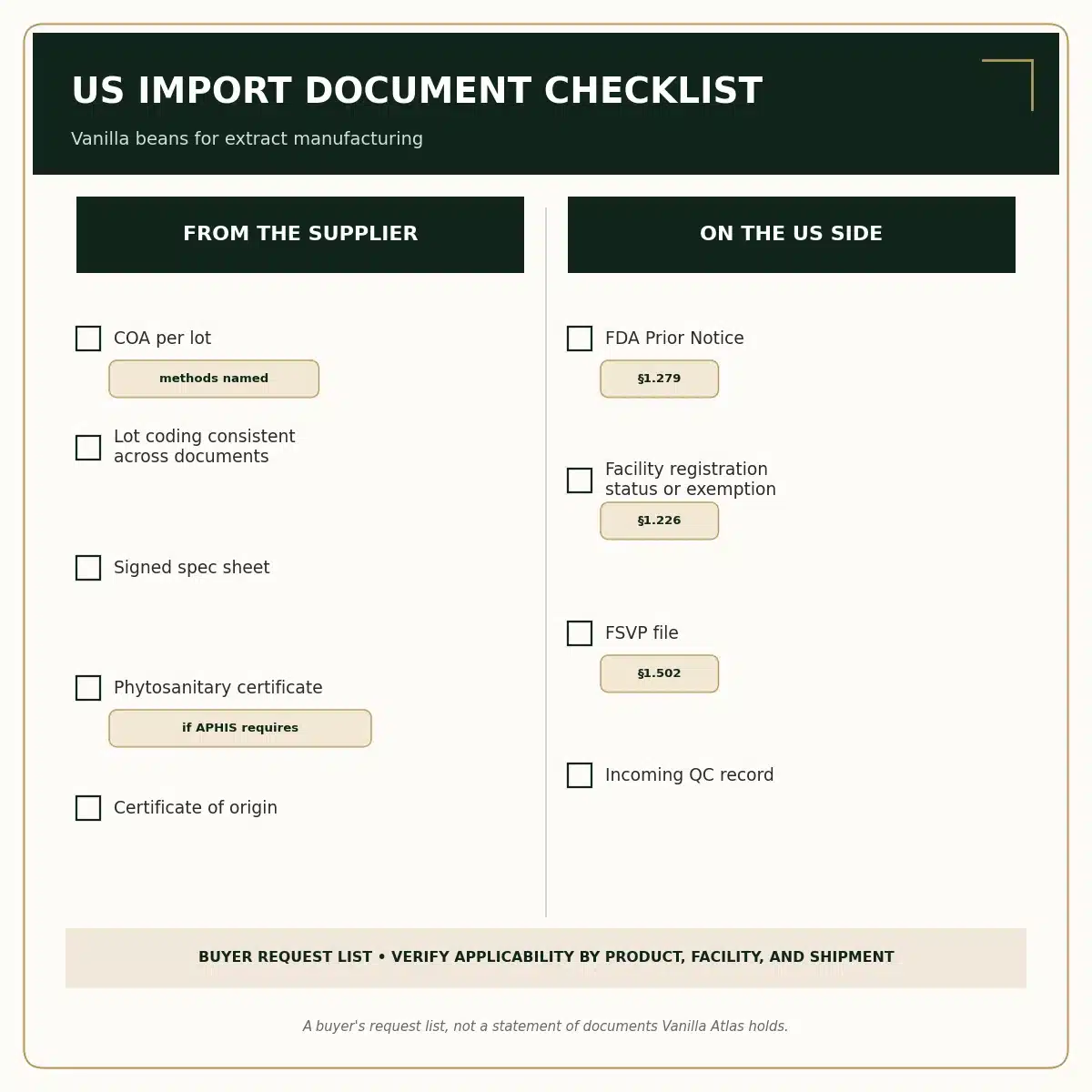
What to request from the supplier, per lot
- Certificate of Analysis (COA): moisture and vanillin with methods named, the microbial panel, lot code, and the laboratory’s identity
- Lot coding that is the same on bags, cartons, COA and packing list
- Specification sheet signed against your RFQ values
- Phytosanitary certificate where required. Whether USDA APHIS requires one depends on product form and entry conditions, so check APHIS’s import requirements with your customs broker.
- Certificate of origin and commercial documents
Obligations on the US side
- FDA Prior Notice must be submitted and confirmed before food arrives in the US (21 CFR § 1.279). This is usually filed by the importer or broker, but it depends on accurate supplier and facility data.
- Food facility registration. Foreign facilities that manufacture or process, pack, or hold food for US consumption register with FDA unless an exemption applies, such as for farms (21 CFR § 1.226). Ask which facility cures and packs the beans, and whether it holds a registration or relies on an exemption.
- Foreign Supplier Verification Program (FSVP). The importer must “develop, maintain, and follow an FSVP” for each food it imports (21 CFR § 1.502). Supplier documents are evidence for that program. They do not replace it.
5. A Specification Template for Extraction-Grade Vanilla
Extraction-Grade Vanilla Specification — Template
| Parameter | What to specify / method | Your value |
|---|---|---|
| Species | Botanical species and origin | |
| Commercial form / grade | Whole, split, cut; extraction-grade criteria | |
| Intended application | Extract, paste, grinding, or other processing use | |
| Moisture | Target range (%) + test method | |
| Vanillin | Target (%) + as-is/dry basis + test method | |
| Sensory profile | Aroma intensity/profile; unacceptable off-notes | |
| Physical condition / defects | Splits, cuts, mold, foreign matter, insect damage | |
| Microbiology | Buyer/destination limits + named methods | |
| Residues / contaminants | Pesticide residues, heavy metals, treatment status as applicable | |
| Packaging & lot coding | Food-contact pack, net weight, seal, lot traceability | |
| Documents | COA per lot, spec sheet, origin / phytosanitary / buyer-required documents | |
| Samples | Pre-shipment sample drawn from the invoiced lot; retained reference portion | |
| Commercial terms | Volume, frequency, Incoterm, destination port |
If a supplier can answer every row with a number, a method or a document, you can compare their quote with others on equal terms.
Filled in the template? Send it to our sourcing team. It tells us which specifications to validate first.
For a complete RFQ that adds US import documents, commercial terms and a red-flag screen, see how to write a vanilla bean RFQ.
6. How to Qualify a Supplier Against the Specification
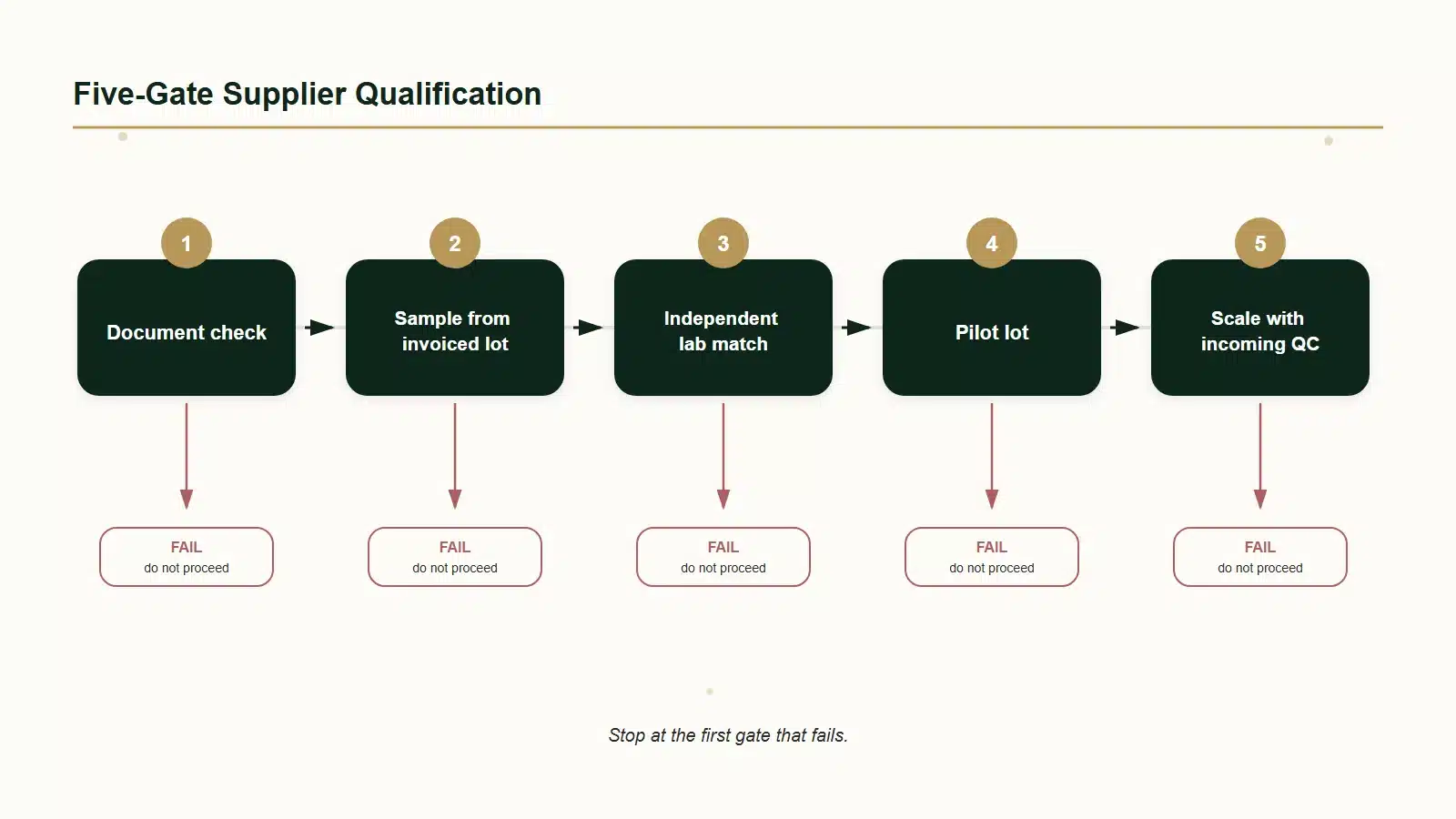
Qualify suppliers in order, and stop early if a step fails:
- Document check. Can the supplier show facility identity, the curing location, and a COA from a named laboratory?
- Sample check. Is the sample drawn from the lot you will actually be invoiced for, and coded to it?
- Independent test. Do moisture and vanillin from your own laboratory match the COA within tolerance, using the same methods?
- Pilot lot. Does a small commercial lot match the sample on arrival?
- Scale up, with incoming QC on every lot.
For grade vocabulary, sample inspection and general supplier questions, see our guide to understanding Indonesian vanilla.
Frequently Asked Questions
How many vanilla beans are needed per gallon of single-fold extract?
At least 13.35 ounces (about 378 g) of beans at 25% moisture or less, per gallon of finished extract, under 21 CFR § 169.3(b) and § 169.175. Beans above 25% moisture need proportionally more weight.
Why don’t extract manufacturers use Grade A gourmet beans?
Gourmet beans usually carry 30% moisture or more. Above 25%, the regulation requires more bean weight per gallon, so you pay for water. At 35% moisture, you need about 15% more bean mass.
Does buying beans drier than 25% reduce the legal minimum?
No. The unit weight stays at 13.35 oz for any bean at or below 25% moisture. Drier beans may give better extractive yield, but they earn no regulatory credit.
Should vanillin be specified on a dry or as-is basis?
Dry basis. As-is figures change with moisture, so two suppliers can quote different vanillin numbers for the same beans. Also name the analytical method.
For more on grading, sampling and supply, see our sourcing insights.
Where Vanilla Atlas Stands
Vanilla Atlas is building an Indonesian vanilla supply chain based on published test data, not on grade labels. We are still verifying suppliers, measuring samples and setting up laboratory testing, and we will publish specification figures only once we have the evidence behind them. We do not currently claim FDA facility registration, in-house laboratory results, or export-ready lots.
If you are writing an extraction-grade specification, send it to us. It tells us which numbers to validate first, and we will tell you plainly which ones we can support today and which we can’t yet.
Send Your Extraction Spec
Moisture target · vanillin minimum (dry basis) · micro panel · volume · destination port.
We’ll tell you what we can evidence today, and what we can’t yet.