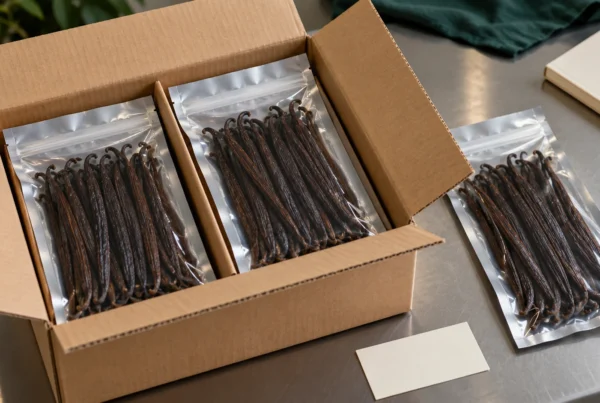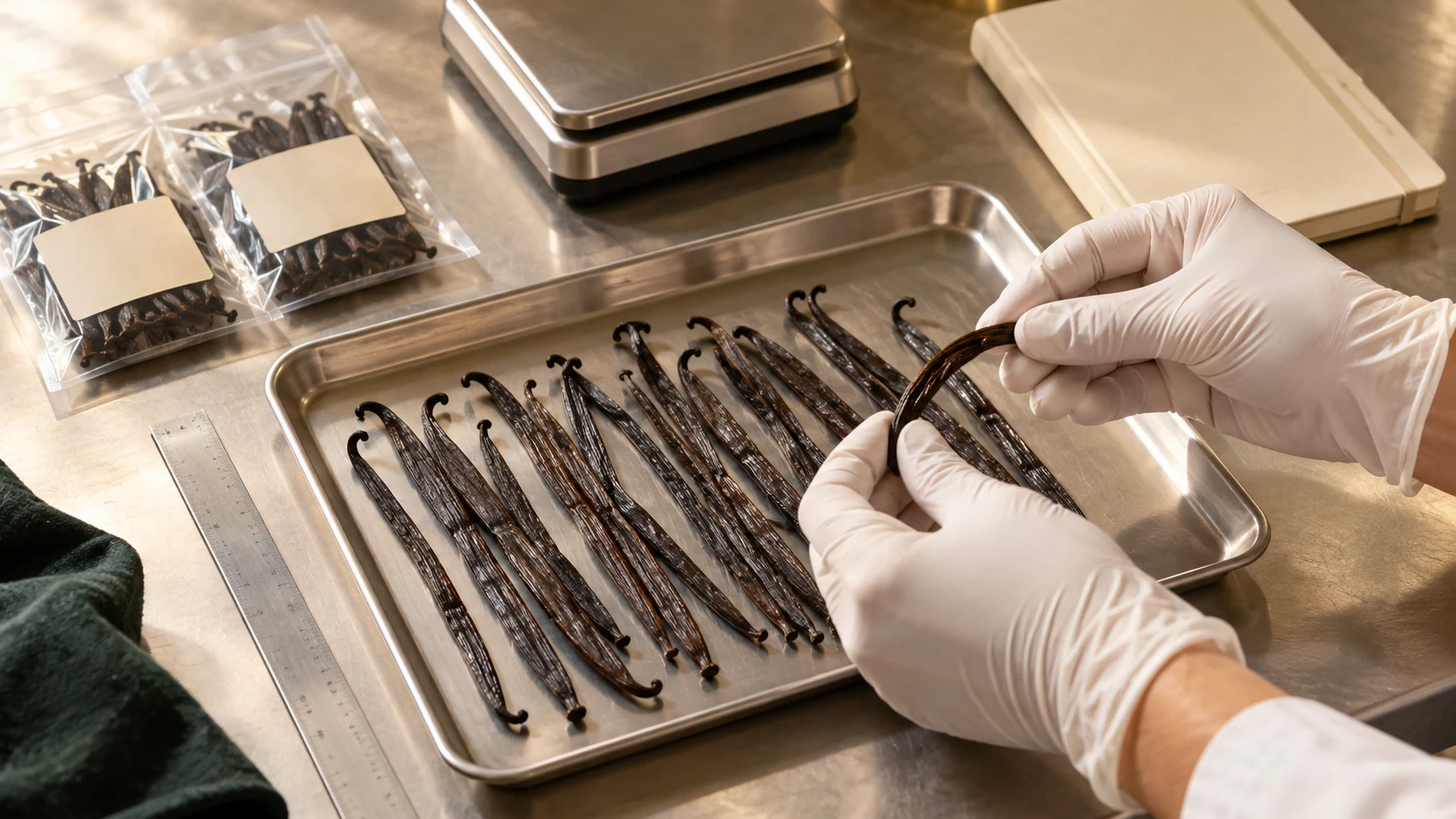
A sample can smell right and still tell you little about the shipment you are about to buy. Start with the lot code.
To evaluate vanilla bean samples, confirm which lot they represent, document the packaging, inspect and measure the beans, review lot-linked test results, and run a controlled application trial. Record the approval conditions, keep a reference sample, and verify the bulk shipment against the agreed specification.
For US importers and QA teams, this creates a record you can use when the order arrives. “Good aroma, nice beans” leaves too much room for disagreement.
1. Match vanilla bean samples to the offered lot
Before arranging delivery, ask the supplier:
Was this sample drawn from the lot offered in your quotation? Please identify the lot, explain how the sample was selected, and confirm whether that stock is still available.
A hand-selected presentation sample can help you decide whether to investigate a supplier. Its appearance alone gives you no basis for judging the variation in a bulk lot.
Record the lot code, species, stated origin, sampling date, sampler, selection method, and the containers or parts of the lot sampled. If the sample combines several lots, ask for the lot breakdown.
ISO 948, the spices and condiments sampling standard, covers subjects such as lot constitution, increments, laboratory samples, labeling, and sampling reports. Agree on a sampling plan with the supplier and your QA team before using sample results to accept a shipment.
If the quoted lot changes after your evaluation, confirm what must be checked again. A reference sample from an earlier lot remains useful for comparison, but the new lot needs its own evidence.
2. Define the specification and allocate the sample
Write down the intended use: scraped seeds for pastry, whole pods for resale, or beans for extraction. Then identify the properties that matter in that use.
For pastry, splitting and scraping may be central to the trial. For extraction, chemistry and processing performance may carry more weight. Our gourmet vs extraction-grade comparison explains how application changes the buying decision. If you are unsure which grade to sample, our guide to vanilla bean grades explains what Grade A and Grade B usually mean.
Set acceptance criteria before the sample arrives. A supplier’s “gourmet” label does not tell you your allowed split rate, length range, or moisture specification.
Sample requirements to agree
| Evaluation area | Define before requesting the sample |
|---|---|
| Product identity | Species, origin, whole/cut format, and lot identity |
| Physical condition | Length range, split/cut allowance, and defect categories |
| Measured properties | Moisture target and method; other tests required by the application or hazard assessment |
| Application | Recipe or process, dose, preparation conditions, and comparison reference |
| Evidence | Required reports, lot linkage, test dates, and any missing results |
| Bulk acceptance | Receiving checks, retained sample arrangements, and action on a mismatch |
How much sample should you request? Ask your laboratory for its requirements first, then allow separate portions for physical inspection, application trials, repeat work, and retention. There is no single gram amount that suits every test panel and shipment.
Arrange a separately collected laboratory portion where needed. Follow the laboratory’s collection, packaging, and handling instructions; do not use the portion you have already opened and handled for a test that requires an unopened or aseptically collected sample.
3. Document the package before opening it
Photograph the parcel, inner package, labels, and seals on arrival. Record the receipt date and any visible damage, leakage, condensation, insects, or unexplained material.
Compare the package label with the supplier’s sample record. Resolve a missing or conflicting lot code before treating the sample as representative of the proposed order.
Keep these three records together:
- The supplier’s description of what was sent.
- Your receipt record and photographs.
- The inspection and test results produced afterward.
A sealed pouch shows how the sample arrived. Your bulk order also needs an agreed packaging specification, storage instructions, and transport assumptions.
4. Inspect aroma, flexibility, dimensions, and defects
Use a clean inspection area and keep each sample identifiable throughout the check. Record what you observe before comparing suppliers or discussing a preferred result.
Physical inspection record
| Check | What to record | How it informs the decision |
|---|---|---|
| Aroma | Specific descriptors, intensity under consistent conditions, and any unexpected odor | Compare with the agreed sensory reference and investigate off-notes |
| Flexibility | Response to a gentle bend; ease of splitting and scraping on a designated trial pod | Judge handling for the intended application |
| Dimensions and weight | Individual measurements, range, count examined, and any pieces outside specification | See variation that an average or one selected bean can hide |
| Splits, cuts, and surface condition | Counts or weights by a defined category, with photographs | Compare the observed sample with the contractual allowance |
| Foreign material or suspected spoilage | Description, location, photographs, and affected portion | Put approval on hold for QA assessment |
| Consistency | Differences among pods or separately identified sample portions | Decide whether further sampling or supplier explanation is needed |
For aroma comparisons, use comparable portions and containers, the same preparation and assessment conditions, and a written reference. “Strong” becomes more useful when the record explains what was compared.
Report flexibility as an observation. It cannot establish a moisture percentage. Likewise, dark color or a glossy surface does not establish a vanillin result.
If you find white surface material, record it and ask QA to identify it. A photograph is not enough to settle whether it is crystallization, mold, or another material.
Appearance and aroma cannot clear a sample for food safety. FDA’s risk profile on pathogens and filth in spices treats microbial hazards and contamination as issues requiring control. Its findings are spice-sector context, not an estimate of the defect rate in your vanilla lot.
Why can a clean-looking sample miss a problem?
A small sample may contain none of the defective beans present in a larger lot.
Consider a calculated example, with a hypothetical 5% visible-defect rate. Assume independent random selections, a constant defect probability, and perfect detection when a defective bean is inspected:
Probability of finding at least one defect = 1 − (1 − p)ⁿ
Here, p is the assumed defect probability per bean and n is the number inspected. The calculation uses the binomial sampling framework described by NIST.
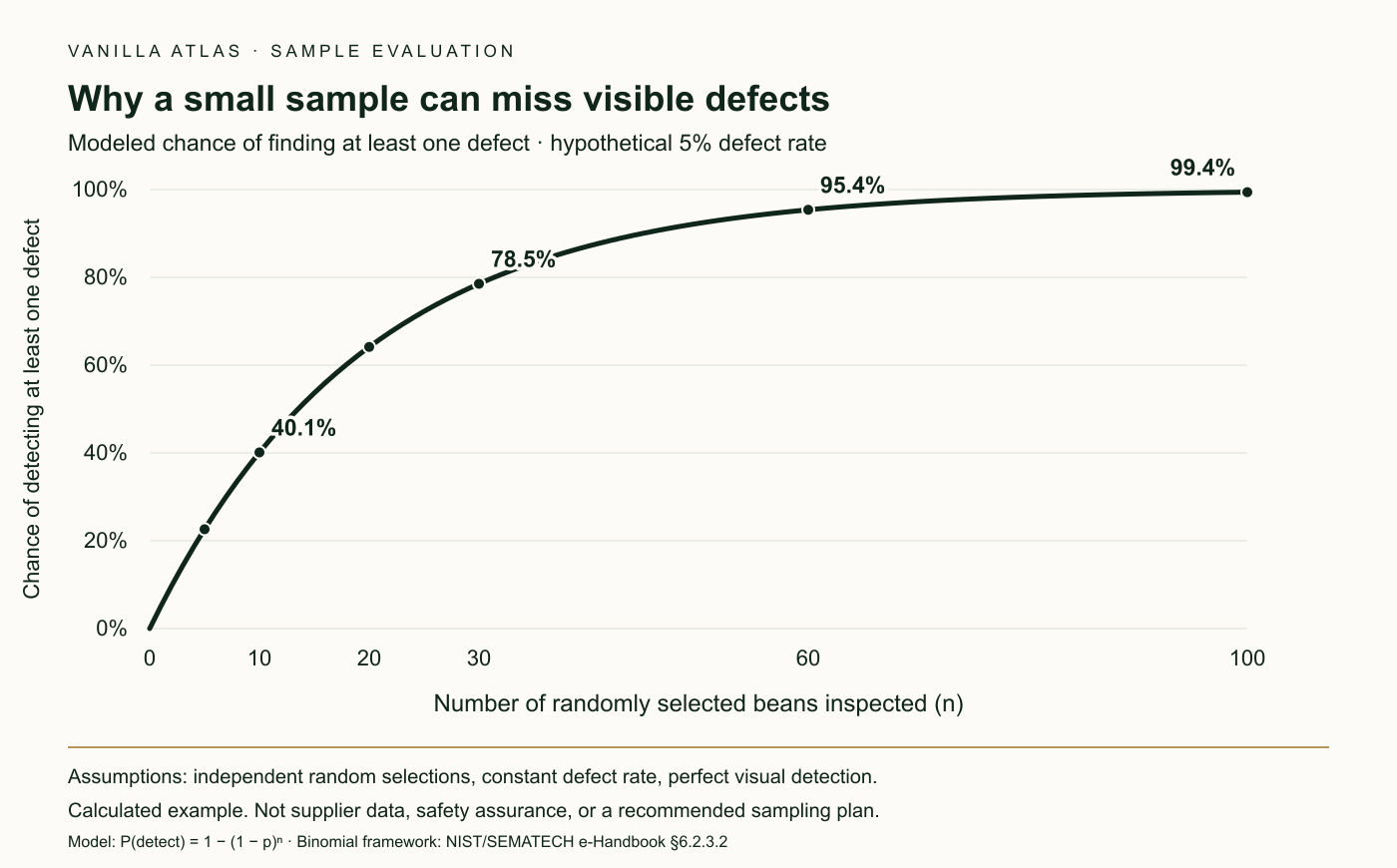
Hypothetical model, not supplier observations. The percentages describe the chance of detecting a defect under stated assumptions; they do not describe the chance that a lot is safe or acceptable.
Calculated sampling-probability example
| Beans inspected | Chance of finding at least one defect | Chance of missing every defect |
|---|---|---|
| 5 | 22.6% | 77.4% |
| 10 | 40.1% | 59.9% |
| 20 | 64.2% | 35.8% |
| 30 | 78.5% | 21.5% |
| 60 | 95.4% | 4.6% |
| 100 | 99.4% | 0.6% |
How much do 100 vanilla beans weigh?
For gourmet vanilla beans averaging 2.8–4 g each, 100 beans weigh approximately 0.28–0.40 kg (280–400 g), excluding packaging. This conversion uses the per-bean range reported in Slofoodgroup’s vanilla bean FAQ, a commercial reference rather than a universal specification. Actual weight varies with bean size, species, and moisture content; other lots can fall outside this range.
Calculate the weight as bean count × average weight per bean (g) ÷ 1,000 = kg. For example, at 3.5 g per bean, 100 beans weigh 350 g, or 0.35 kg. For your actual sample, weigh the beans without their packaging and record both the net weight and count.
When requesting a sample, specify the required net weight and its allocation for physical inspection, laboratory testing, application trials, and retention. Confirm the laboratory’s material requirements before dividing or opening its portion. The 100-bean row above illustrates detection probability; it does not establish the sample quantity needed for those separate tasks.
These counts are not a recommended sampling plan. Hand-selection, clustered defects, imperfect inspection, and sampling a substantial share of a finite lot can change the model. Microbiological sampling requires a plan suited to the organism, food, analytical method, and decision being made.
The useful buying lesson is to ask how the sample was taken. More beans do not correct a selection method that systematically leaves out the problem.
5. Review results that belong to the lot
For each required result, check the sample identity, lot code, test date, method, units, reporting basis, and issuing laboratory. Make sure the report describes measured results rather than a supplier’s general reference range.
Moisture: Confirm whether the result is wet basis or dry basis and which method was used. If supplier and receiving-laboratory methods differ, resolve comparability before setting a rejection rule.
Water activity: Review it where relevant to the hazard assessment and storage specification. Moisture measures water content; water activity describes water availability. Manitoba Agriculture explains why moisture alone cannot establish food safety or shelf life.
Vanillin and other chemistry: Where a chemistry specification is required, confirm the method and whether results are reported as received or on a dry-weight basis. ISO 5565-2 is a vanilla test-method reference; it does not mean the offered lot has been tested or meets your specification.
Microbiology and other hazards: Have the responsible QA or qualified person define the tests, sampling arrangements, and acceptance criteria. An entry such as “not detected” needs its method and analytical sample quantity to be interpretable.
For the commercial effect of moisture, use our vanilla bean moisture content guide.
Where FSVP applies, the US importer must address the applicable hazard analysis and supplier-verification requirements. FDA describes verification options including audits, sampling and testing, and review of relevant food-safety records, selected on a risk basis. A purchasing sample fits within that wider work; its sensory approval does not complete it. FDA’s FSVP overview.
6. Test vanilla bean samples in your application
After the appropriate safety clearance, compare coded samples in the recipe or process you plan to use. Keep preparation, dose, time, and other relevant conditions consistent, and include your existing reference when available.
For pastry, record splitting effort, scraping performance, and the result in the finished recipe. For extraction, record the bean preparation, starting moisture, loading basis, solvent conditions, processing time, and the properties you will use to judge the extract.
Changing several conditions between samples makes the result difficult to interpret. If the process needs adjusting, document that as a separate trial.
Record the sample code, procedure, observations, evaluator, date, and decision. Name any limitation—for example, a bench trial that has not yet been repeated at production scale.
7. Put the approval conditions into the bulk order
Use the same evaluation record to define what must carry through to the shipment.
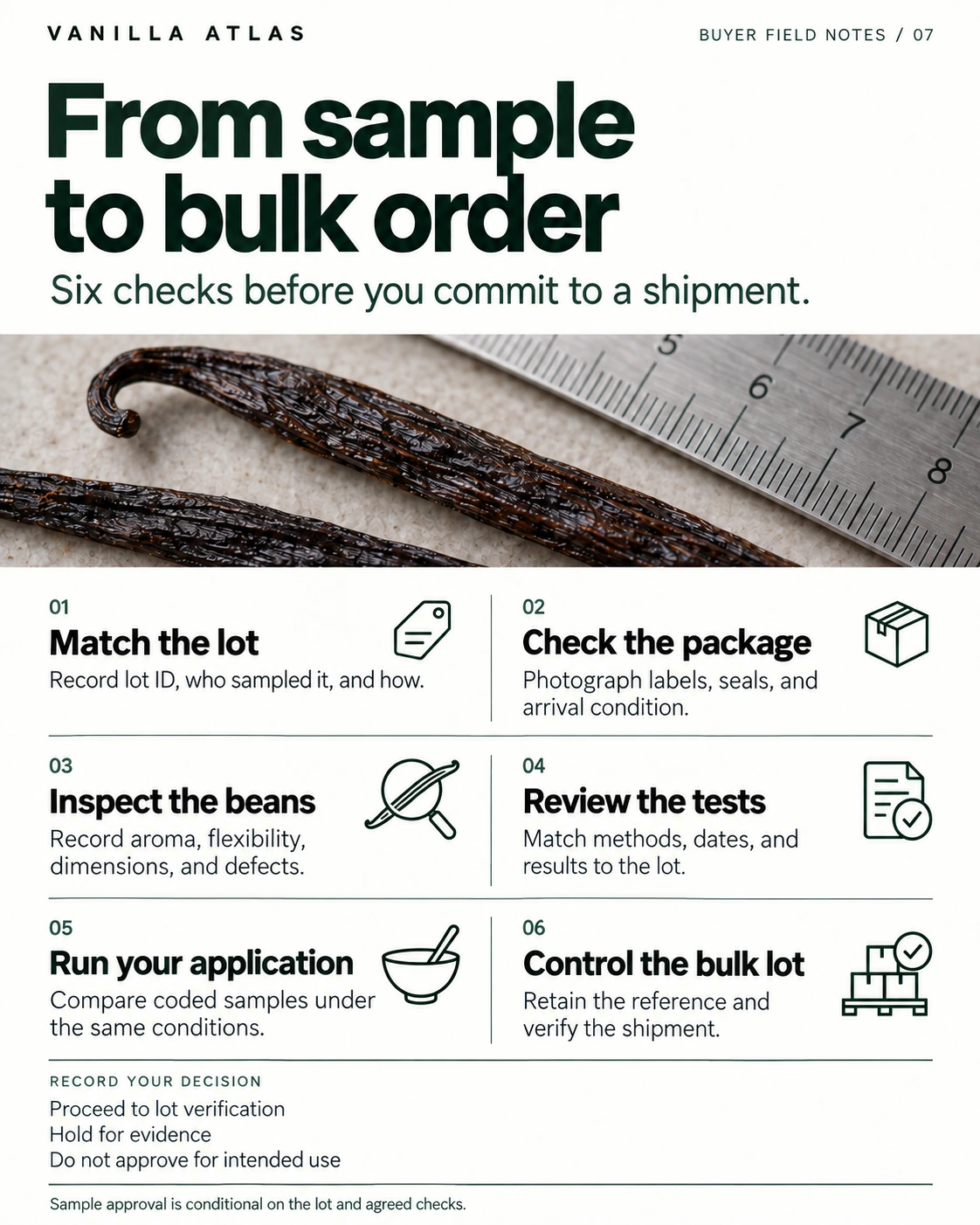
Approval decision and next action
| Decision | When to use it | What happens next |
|---|---|---|
| Proceed to lot verification | The sample meets the agreed application criteria and required evidence supports the next step | Identify the lot offered for purchase and complete the agreed pre-shipment and receiving checks |
| Hold for evidence | A lot link, result, method, or explanation is missing or unclear | Name the missing item, who must resolve it, and which approval remains pending |
| Do not approve for intended use | The sample fails an agreed requirement or an unresolved concern prevents approval | Record the reason and refer disposition to the responsible buyer or QA person |
Keep a labeled reference under agreed storage conditions, with its date and evaluation record. A retained sample can change during storage, so record those conditions when using it in a later comparison.
The purchase specification should identify the approved lot or required equivalence, measured limits and methods, packaging, defect allowances, receiving checks, and the procedure for handling a mismatch.
If the supplier substitutes stock, reopens or repacks the lot, or reports a relevant change, ask what must be reverified before dispatch. Your RFQ is the place to make those expectations explicit.
A sample-request message you can adapt
We are evaluating vanilla for [application], with a proposed bulk requirement of [quantity and frequency]. Please identify the lot your sample would represent, how it would be selected, and whether that lot is currently available. Our checks cover [physical criteria], [measured specifications], and [application trial]. Please distinguish available lot-specific results from tests still to be arranged. We also need the packaging details and proposed link between the approved sample and bulk shipment.
Replace the brackets with requirements you can actually assess. Ask the laboratory about sample quantities before fixing the total amount to send.
Frequently asked questions
How many vanilla beans should an importer inspect?
The count depends on the lot, selection method, defect criteria, tests, and level of assurance needed. Agree on the sampling plan with QA and the laboratory. The calculated chart above illustrates a limitation of small samples; it does not prescribe an inspection count.
Can I approve a sample by smell and flexibility alone?
Those checks help assess sensory character and handling. Approval also needs the relevant lot identity, measured specifications, and evidence required for the intended use and hazard assessment.
Does a vanilla sample need a certificate of analysis?
That depends on the purchase requirements and risk assessment. If a result is required for approval, obtain a report linked to the relevant lot and sample. Check the method, date, units, and reporting basis.
What if the supplier sends a different lot after sample approval?
Treat it as a change requiring review. Identify the replacement lot and repeat the checks needed to establish compliance with the purchase specification before releasing the shipment.
How much sample should I request for laboratory testing?
Get the quantity and collection requirements directly from the laboratory for your chosen tests. Add separately identified portions for application trials and retention where needed.
Submit your sample requirements
Requesting Indonesian vanilla bean samples for a US bulk order? Send Vanilla Atlas your intended application, proposed volume, physical criteria, required measurements, and laboratory or documentation requirements.
Ask which lot the sample would represent and which results are currently available.
References
- ISO 948:1980 — Spices and condiments: Sampling. Public scope and status consulted; the full sampling procedure is not reproduced.
- FDA — Risk Profile: Pathogen and Filth in Spices. Background on spice-sector hazards; no vanilla-specific prevalence claim is made.
- NIST/SEMATECH e-Handbook — Choosing a Sampling Plan with a Given OC Curve. Binomial framework used for the explicitly hypothetical chart.
- Manitoba Agriculture — Water Content and Water Activity. Distinction between moisture, water activity, and storage implications.
- ISO 5565-2:1999 — Vanilla: Test Methods. Public reference and status consulted; no full-method compliance claim is made.
- FDA — Foreign Supplier Verification Programs: Final Rule Overview. Applicable importer verification responsibilities.
- Slofoodgroup — Vanilla Bean FAQ. Commercial reference for the reported 2.8–4 g gourmet-bean weight range; the 100-bean conversion is calculated, not a measured Vanilla Atlas sample.
This article provides a buyer-side evaluation framework. Sampling plans, test methods, and acceptance criteria must be set for the actual lot and intended use. The chart contains calculated examples, not Vanilla Atlas test results.