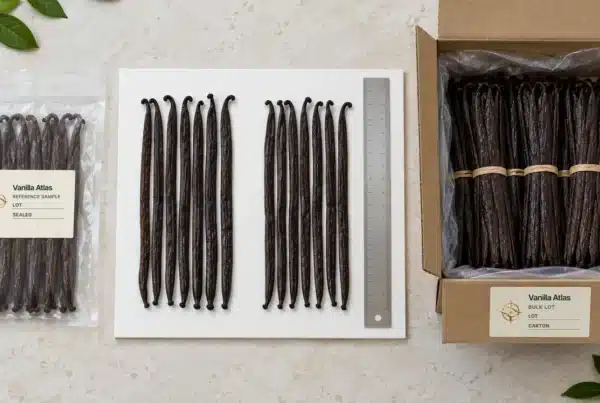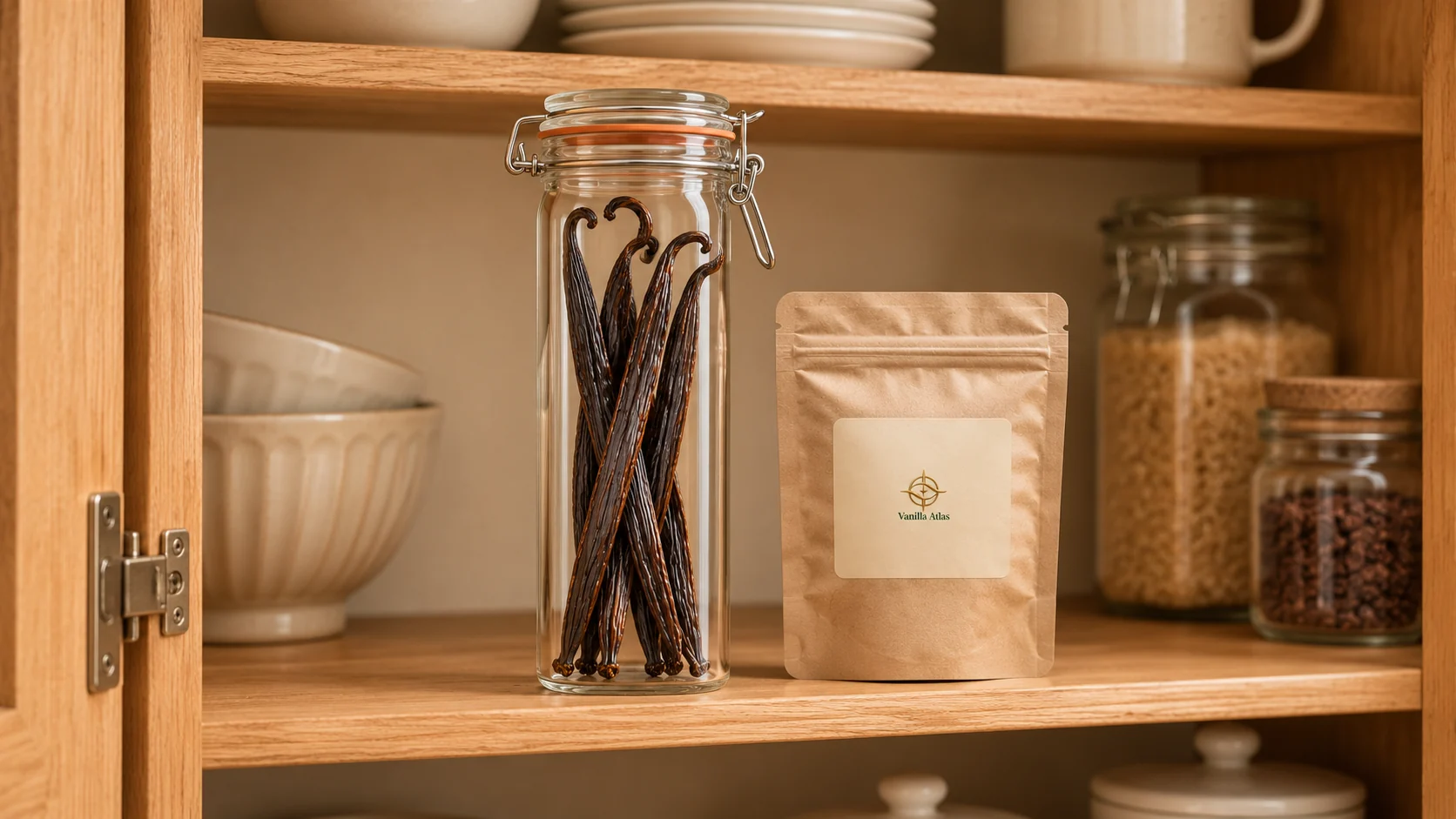
Put opened vanilla beans in a clean, dry, airtight jar or resealable food pouch. Close it as soon as you take out a pod and keep it in a cool, dark cupboard away from the oven, kettle and dishwasher. Keep the lot code and follow the storage and date instructions on your particular pack.
If you bake at home, one small jar may be all you need. If you bake for customers, the more useful question is how much stock to leave within reach. A pastry cook should be able to take out enough beans for tomorrow’s cream without opening the whole kilo beside a steaming pan.
How to store vanilla beans after opening: 5 steps
- Read the pouch before cutting it. Find the lot number, date and storage directions. If cutting the top will separate the code from the bag, take a photo first. Check whether the date applies to the unopened pack and whether the seller gives separate directions for opened beans.
- Prepare the container before handling the pods. Choose a food-safe jar with a well-fitting lid or a pouch with a working seal. Let a freshly washed jar, its gasket and its lid dry completely. A spice jar that still smells of cloves is the wrong jar for vanilla.
- Take out only what the recipe needs. Work on a clean, dry surface before you start heating milk or cracking eggs. Keep unused beans away from wet hands, spoons and chopping boards. Never rest an open pack on the lip of a saucepan.
- Reseal and label. Run your fingers along the full zipper or check that the jar lid sits evenly. Write the opening date and lot on the working container. Keep the original date too; transferring beans to a new jar does not restart the clock.
- Choose a steady cupboard. Store the closed container away from sunlight, heat and steam. A pantry shelf on the opposite side of the kitchen from the stove is a better spot than the cabinet directly above it. Return the jar there after each use.
Glass jar or original pouch: which works better?
Keep the original pouch if it closes tightly, stays dry and still carries its label. Choose a jar if you cut below the zipper, the seam has torn or the opening will only stay shut with a loose fold. A jar is particularly handy for two or three long beans: pick one tall enough for the pods with a lid that closes without trapping a tip.
| What you have | Where to put it | What to check next time |
|---|---|---|
| A few whole pods at home | A narrow, dry jar in a closed cupboard | The lid fits; no water beads inside. |
| An opened pouch with an intact zipper | The original pouch, pressed closed along its full width | No pod or fold is caught in the seal. |
| A clean, unused half-pod | A separate small sealed container with its original lot code | Use this piece before opening another pod. |
| One kilo for a small bakery | A working portion and separately sealed reserve portions | Each portion can be traced back to the supplier’s label. |
A decorative glass tube can be a perfectly useful container if its stopper still fits. Test the closure rather than choosing by appearance. Clear glass is fine inside a dark cupboard; setting the same tube on a sunny windowsill defeats the purpose of choosing a good storage spot.
Should vanilla beans go in the refrigerator or freezer?
For ordinary cured whole beans sold for pantry storage, use a cool cupboard unless the pack specifically directs otherwise. Nielsen-Massey’s storage guidance recommends an airtight container at room temperature and advises against refrigerating whole beans. Rodelle’s whole-bean instructions also advise against refrigeration or freezing after opening.
The practical problem is moisture: opening a cold pack in a warm, humid kitchen can leave condensation inside. If a sealed pack arrives cold, let it come to room temperature before opening unless its label requires cold storage. If your pantry stays hot for much of the day, ask the seller for the appropriate range for that batch. A different cupboard or a smaller purchase may be more useful than improvising a fridge routine.
How should a small bakery store 1 kg of vanilla beans?
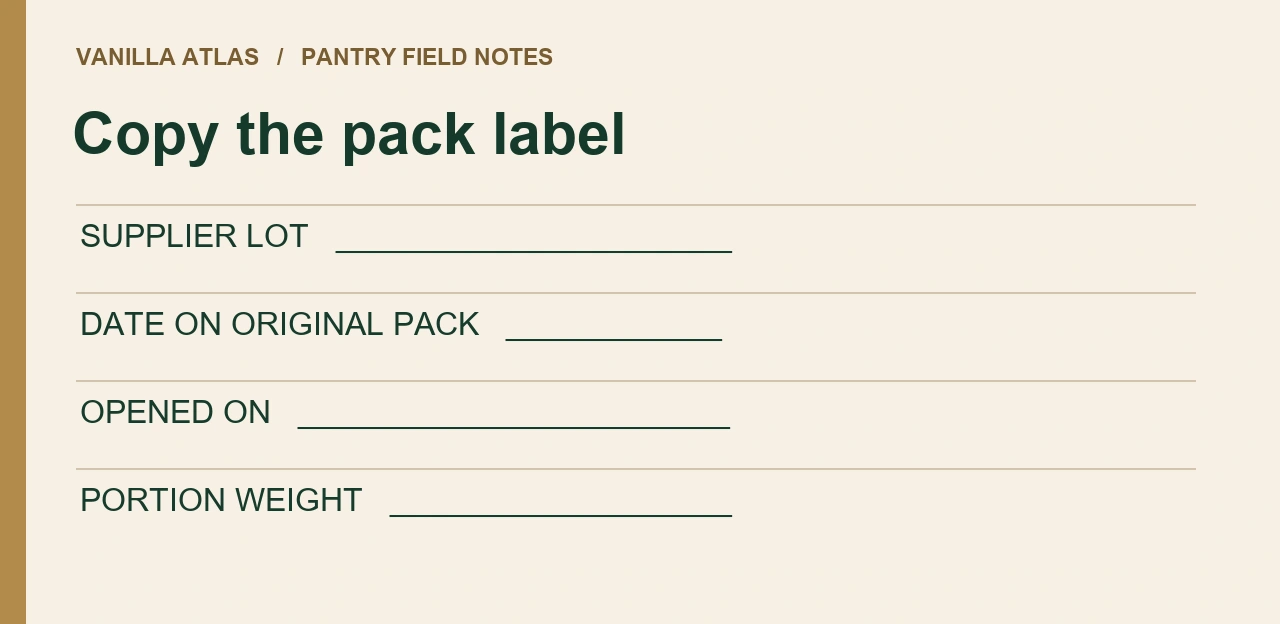
Set aside one working portion sized to your production schedule. Keep the rest in closed, labelled food-safe packs, separate from the prep bench. If the kilo arrives as smaller sealed inner packs, leave the extras unopened. There is no advantage to opening every bag just to put the beans in matching jars.
Worked example: A bakery that uses 20 g of beans per custard run and makes four runs before the next stock check needs 80 g at the bench. From a newly opened 1 kg pack, that leaves 920 g in reserve. The 80 g is a planning quantity, not a storage limit: change it when your recipe or order book changes. Weigh your own beans; pod counts vary.
Label the working jar with the product, supplier lot, original date and date opened. On reserve portions, add the net weight. When the jar empties, finish that lot and clean and dry the jar before refilling. Topping it up with a different lot makes a simple supplier question much harder to answer: which beans went into Friday’s custard?
What belongs on a vanilla bean storage label?
A working label should let the next baker answer three questions without finding the original delivery box: which vanilla beans are these, when was the pack opened and what date or directions came with them? Copy the original information rather than calculating a new date yourself. If stock is split between shelves, put a label on each portion.
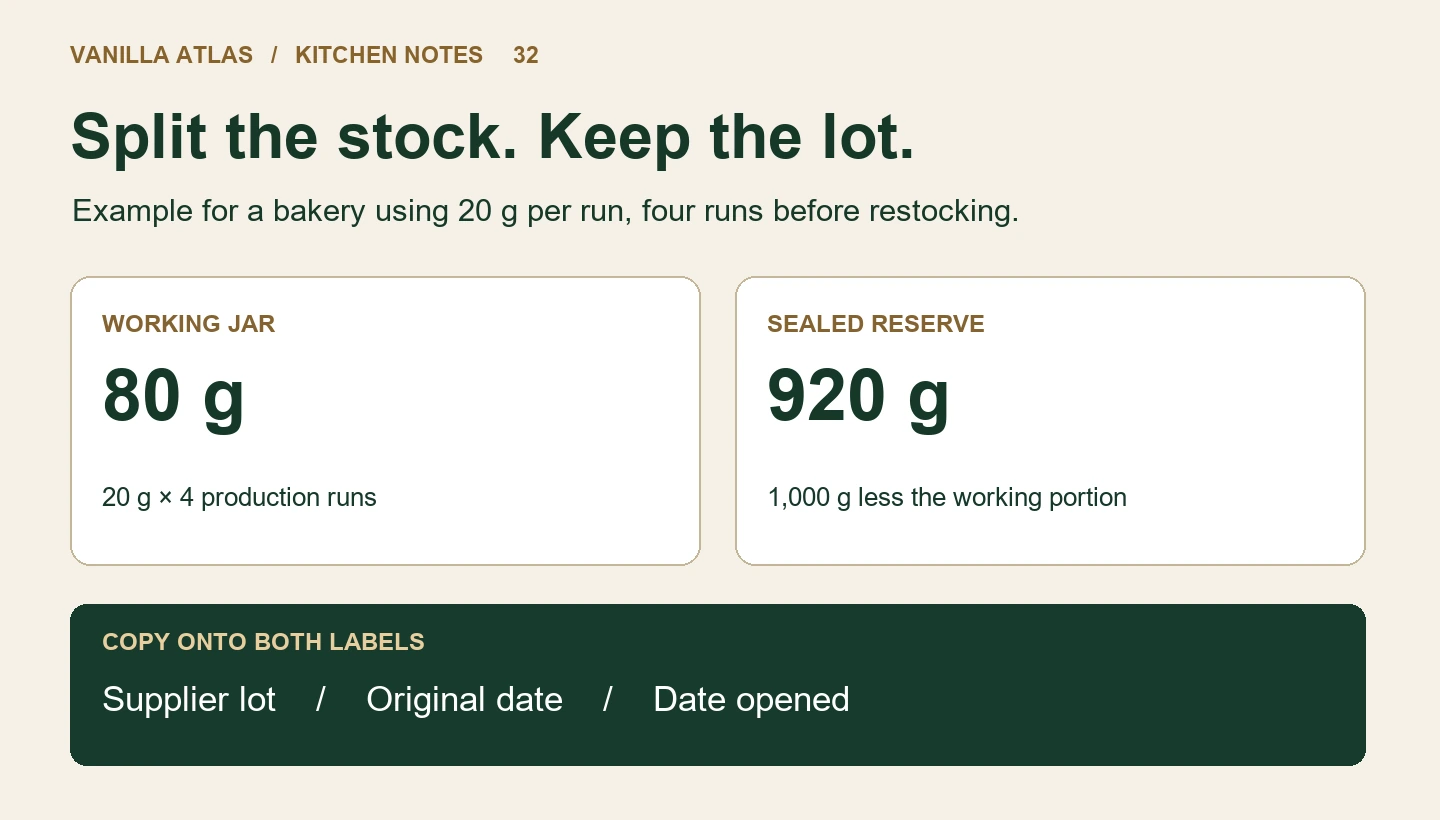
For example, suppose someone finds a small pouch at the back of the cupboard on Monday. A note saying only “vanilla” cannot tell them whether it is the reserve from last week or a different delivery. A matching lot code links the pouch to the supplier’s directions even after the outer carton is gone. Recording the weight on each reserve portion also lets you plan the next bake without opening a pouch to see how much is left.
Is buying a kilo sensible if you only bake occasionally?
Estimate your actual use before deciding how many vanilla beans to buy. Divide the pack weight by the weight you normally use in a week of baking. At 80 g a week, 1 kg represents about twelve and a half weeks of production. At 10 g a week, exactly the same pack represents 100 weeks. These are inventory calculations, not predictions of how long opened vanilla beans will keep. Compare the result with the dates and after-opening directions for the pack you can actually buy.
A home baker making a birthday cake twice a year needs a different vanilla bean storage plan from a bakery making custard every Friday. If estimated use stretches beyond the supplier’s guidance, choose a smaller pack where available or ask about individually sealed portions before ordering. Dividing an already opened pack into smaller jars can reduce handling; it does not turn those jars back into factory-sealed stock.
Which storage mistakes are easiest to miss?
Keeping the right jar in the wrong cupboard. Open the cupboard after the oven or dishwasher has run. If warm air or steam reaches that shelf, move the vanilla beans to a more stable spot. Choose a location that works during service, not just when the kitchen is empty.
Putting yesterday’s steeped pod back with unused vanilla beans. Once a pod has touched milk, syrup, batter or another ingredient, it has a different handling history. Keep it out of the pantry jar. If that recipe calls for retaining it, treat it as part of the prepared food and follow the handling instructions for that preparation.
Confusing a scent check with a safety check. A familiar vanilla smell does not resolve an unknown patch or a missing storage history. If the label is lost, keep the beans apart while you check your order confirmation, pack photo or supplier records. In a bakery, record which batch was used before you move on to the next.
How long do vanilla beans last once opened?
There is no single after-opening shelf life that applies to every pack. Start with the printed date, the supplier’s after-opening directions and what happened to your beans since opening. A date printed for a sealed pack does not tell you how long beans will keep after repeated handling in a hot bakery.
If the supplier lists a use-after-opening period, record it on the working jar. If the label gives only an unopened date, ask what the supplier recommends for your lot before planning several months of production. Do not extend the date because the jar has been resealed or because the beans still smell of vanilla.
Freshness matters differently from one recipe to the next. A pliable pod splits easily when you want visible seeds in pastry cream. A dry, otherwise sound bean may be awkward to scrape but still useful in pieces in a planned infusion. For a closer comparison, see which beans to choose for pastry, ice cream and extract. Dryness alone does not establish spoilage; a pleasant aroma alone does not establish safety.
White crystals, fuzzy patches or droplets: what should you do?
White marks are a reason to pause, not a diagnosis. Beanilla describes a natural frost of vanillin crystals that can develop on cured pods. Fine, glittering points can be consistent with crystals, but a photograph or a quick glance cannot reliably clear an uncertain pack for use.
- Dry, firm, with no suspicious change: check the label and handling history. If the only issue is that the bean is difficult to split, reserve it for a recipe that uses pieces. Do not add a wet paper towel, fruit peel or water to the storage jar to soften the remaining beans.
- Droplets inside a closed pack: set it aside, note when it was opened and whether it moved from cold to warm storage. Ask the supplier about the lot before putting it back into use. Drying the outside of the jar does not explain moisture inside it.
- Fuzzy growth, a musty odor or an unexplained patch: stop using the affected pack. Do not taste it, wipe the pods and return them, or try to rescue them in alcohol. A bakery should hold the lot and follow its food-safety procedure before releasing any associated stock.
If you contact the seller, send the lot code, a clear photo of the beans and packaging, the opening date and a short storage history. Keep the pack separate while you wait. If you cannot establish that suspect beans are suitable for use, discard them.
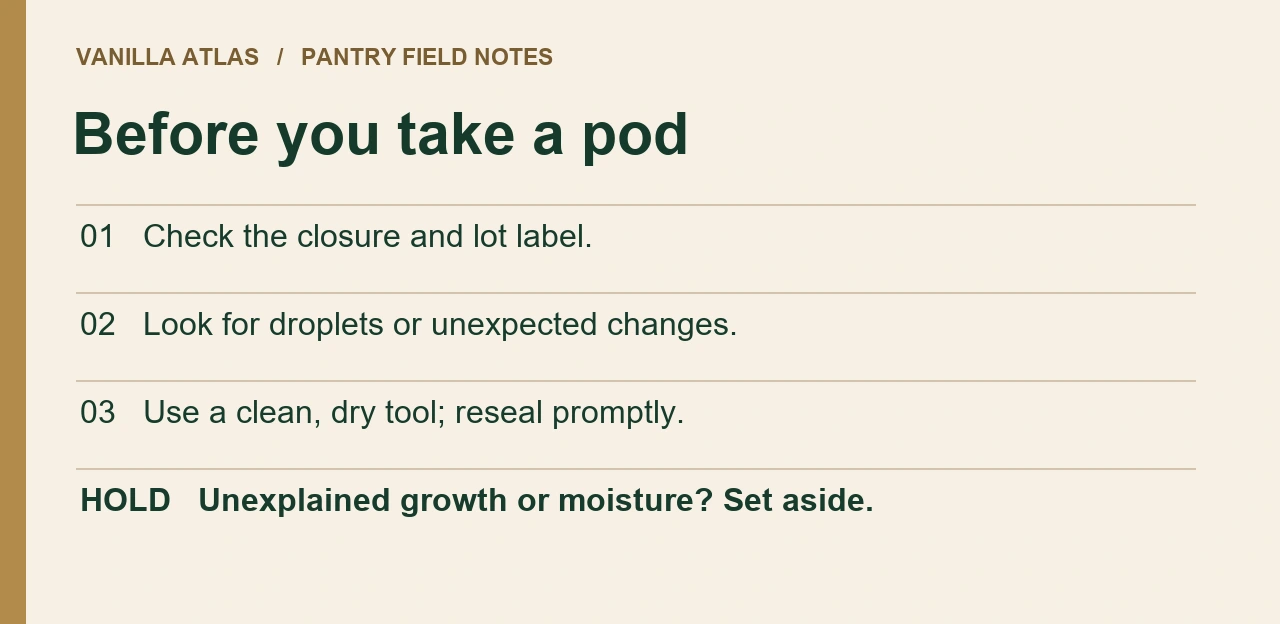
Three kitchen decisions, from first opening to the last pod
You need half a bean for tonight’s custard
Set out the knife, board and storage jar while they are still dry. Cut the vanilla bean crosswise to take the length your recipe needs, then split only the piece you are about to scrape. The other half can stay intact instead of having all its seeds exposed. Close the remaining half in a small container and put it ahead of the whole vanilla beans in the cupboard. Label it so nobody mistakes a clean, unused piece for a pod already steeped in cream.
Your kitchen receives a kilo in four sealed packs
Suppose the delivery is four 250 g inner packs, each labelled with the same lot. If your working quantity is 80 g, open one pack, take out 80 g and seal and identify the remaining 170 g. Leave the other three packs sealed. You still have 920 g in reserve, but only 170 g of that reserve has been opened. That distinction matters when the seller gives different directions for opened and unopened vanilla beans. Mark the opened reserve so the next shift knows which one to use first.
A second delivery arrives before the first is finished
Put the new delivery on its own shelf or in a separate bin, with the label facing out. Read the dates rather than assuming that the most recent delivery has the latest date. If both lots are suitable to use, schedule the one with the earlier applicable date first. If either lot is on hold, keep it out of the rotation altogether. For a bakery, a simple note such as “Tuesday pastry cream — lot from working jar” connects the finished batch to the actual vanilla beans used.
What should you ask the seller about an opened pack?
Use a specific question: “I opened lot [code] on [date]. The pack gives [printed date or instruction]. I keep it in [container and location] and use about [quantity] per week. Does the printed date apply after opening, and do you recommend a different working quantity or container for this lot?” This gives the seller a concrete vanilla bean storage question to answer. If you are asking about an unexpected change, include when you first noticed it and whether it appears on one pod or across the pack. Keep suspect stock out of use while the question is resolved.
A counter checklist for the next bake
Put this checklist where you measure ingredients. It is short enough to use while the mixer is running:
- Before opening: dry hands, dry tools, clean bench, recipe quantity ready.
- Before closing: no damp or used pod returned; seal shut from end to end.
- Before shelving: lot code, original date and opening date legible.
- Before refilling: check the reserve lot; empty, clean and dry the working jar.
Buying for a recipe or replacing stock? Explore Vanilla Atlas beans. If your question concerns a pack you already have, contact Vanilla Atlas for batch guidance and include the lot code so we can discuss the beans in your hand.
Vanilla bean storage FAQ
Should I wash vanilla beans before storing them?
No. Keep unused cured pods dry. Wash and dry the container before filling it, and take beans out with clean, dry hands or utensils.
Do I need a vacuum sealer for a few vanilla beans?
No. A clean, dry jar with a tight lid is a practical choice for a few pods. If the original food pouch reseals securely, you can keep them in it.
Do vanilla beans need to be aired every week?
Follow any airing instructions on your pack. Without a product-specific schedule, keep the pack closed between uses; there is no single timetable for all cured beans.
Can I store a vanilla bean that has been cut in half?
If the unused half stayed clean and dry, seal it separately, keep its lot information and use it first. A pod that has touched milk, batter or another food belongs outside the dry stock.
Can I put a dried-out bean in homemade extract?
If dryness is the only change and the bean is otherwise sound, a recipe using pieces may suit it better than scraping. Do not use extract or alcohol to salvage suspect beans.