A vanilla bean RFQ checklist for Germany should tell the supplier what the beans must do, how many net kilograms you need, where the goods must arrive and who will approve the lot. Ask the supplier to quote against those requirements line by line and identify every exception. That gives purchasing a comparable price and gives QA a sample it can release against the eventual order.
Download the editable vanilla bean RFQ checklist (Excel). Fill in the cream buyer column, send one copy to each supplier and ask them to complete the green reply columns. The second tab compares two offers on the same delivery basis.
Kurz gesagt. Für eine Angebotsanfrage zu Vanilleschoten nennen Sie den Verwendungszweck, die Menge in Netto-Kilogramm, den genauen Lieferort und die gewünschte Beschaffenheit. Bitten Sie um die Chargennummer des Musters, die verfügbaren Prüfunterlagen und eine ausdrückliche Angabe aller Abweichungen. So kann der Einkauf Angebote vergleichen und die Qualitätssicherung die Charge prüfen.
What goes in a vanilla bean RFQ checklist for Germany?
Send the same vanilla bean RFQ checklist to each supplier. Mark each requirement as essential, preferred or open to a proposal. If your team has not set a moisture range, for example, ask for the supplier’s typical range and the offered lot’s measured value. An invented target can exclude a suitable lot without improving the decision.
| RFQ field | What the buyer specifies | What the supplier returns |
|---|---|---|
| 1. Application | End product, process and trial criterion | Recommended format and reason |
| 2. Identity and grade | Accepted origin, species, whole/split/cut format | Botanical name, growing origin and grade definition |
| 3. Quality and moisture | Limits, units, test method and defect-count basis | Offered values, deviations and lot-linked evidence |
| 4. Volume | Trial quantity, first order and call-off schedule in net kg | MOQ, available kg per lot and price breaks |
| 5. Pack and label | Net kg per inner bag, outer carton and lot marking | Actual pack-out, materials and label example |
| 6. Destination and dates | Named place, German postcode, required arrival date | Incoterms® rule and version, dispatch and transit assumptions |
| 7. Price and scope | Currency, net-kg basis and same delivery point | Unit price, extra charges, payment terms and validity |
| 8. Documents | Evidence needed at quote, before dispatch and at receipt | Document, issuing party, applicable lot and due date |
| 9. Sample acceptance | Sample size, intended trial, pass conditions and decision owner | Sample ID, link to bulk lot and replacement-lot procedure |
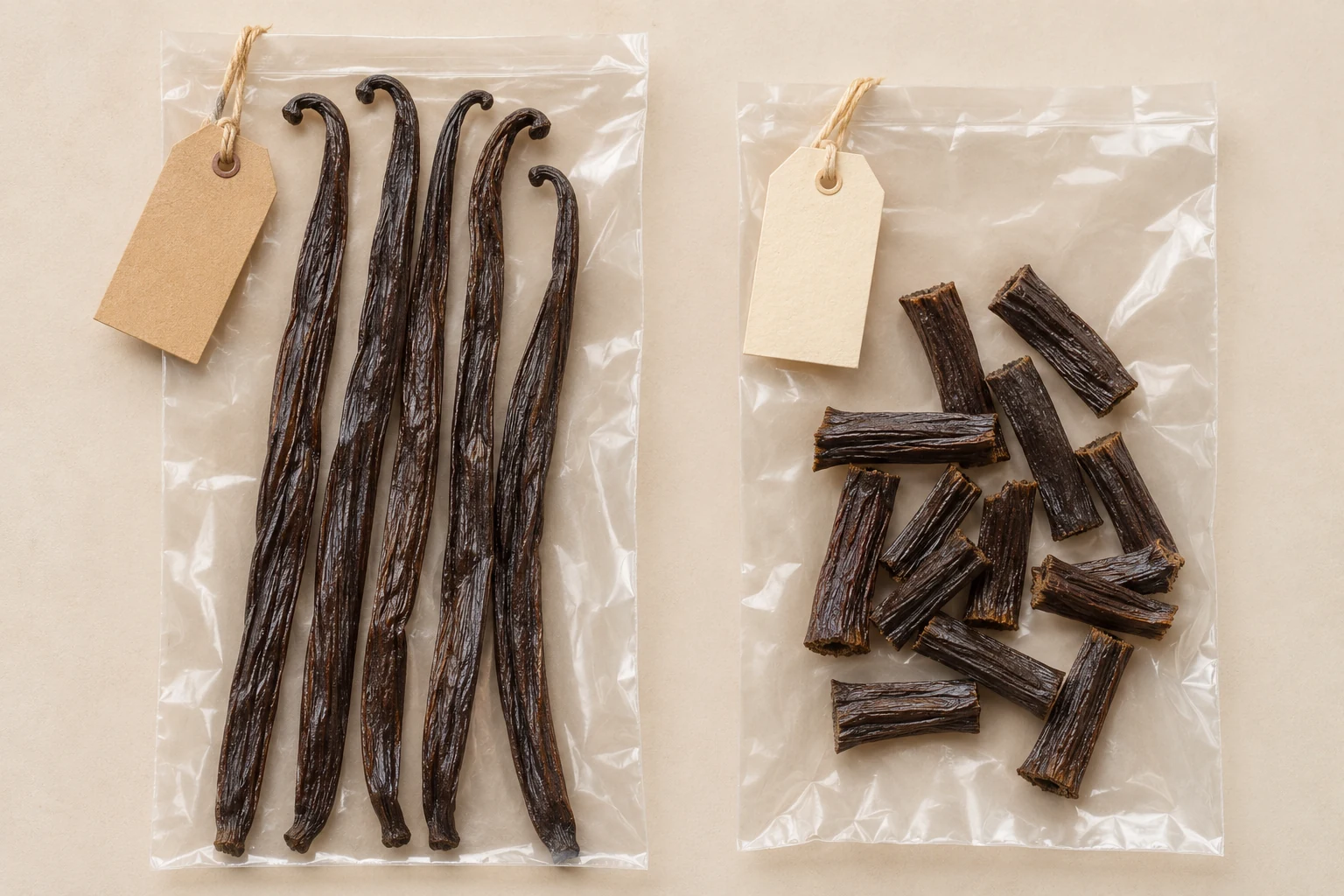
If a supplier offers an alternative, give it a separate line. A price for cut pieces can be worth testing for extraction. Keeping it separate preserves the comparison with suppliers who priced the whole pods on your original specification.
Which bean specifications matter for your application?
Start with what the operator does to the bean. A split down the seam can lower the resale value of a display pod, yet cause little difficulty for a manufacturer that chops every pod before infusion. The same split can matter again if the operator needs to scrape each bean by hand. State the operation, then describe what would make it fail.
| Buyer or process | What to request | What to verify in the trial |
|---|---|---|
| Importer repacking whole pods | Length band, proportion intact, pack size and condition on arrival | Count or weigh a defined sample against the resale specification |
| Dairy, pastry or confectionery manufacturer | Ease of scraping, seed appearance, aroma in the actual base | Use a fixed dose and process. Compare with your accepted reference |
| Flavour house or extract manufacturer | Permitted cuts, moisture basis, foreign matter and lot consistency | Use the same extraction setup and assess the finished extract |
Write out what a trade grade permits. For example, specify whether the length band applies to every pod or to an agreed proportion, and whether that proportion is measured by count or weight. If an origin is essential to the finished product, request the growing origin as a distinct field from the country of dispatch. For background on the growing regions, see the guide to Indonesian vanilla origin and sourcing.
Leave space on the vanilla bean RFQ checklist for a supplier recommendation. Give R&D’s objective, such as a visible seed speck in a light dairy base, and ask which lot the supplier would submit. Require a separate quotation if the recommendation changes the requested form, origin or price basis.
How should a buyer state moisture and defect tolerances?
For moisture, write the unit, basis, acceptable range and test method, or ask the supplier to propose them for QA review. For splits, shorts and other physical defects, specify what counts, how the sample is drawn and whether the percentage is by weight or by number. Those details decide whether two inspections can be compared.
Consider a buyer-defined example. A repacker inspects 50 whole pods and finds two below its minimum length. That is 4% by count. It says nothing about the percentage by weight, and it establishes no industry tolerance. If the purchase agreement sets a weight-based limit, weigh the affected pods and the inspection sample before recording a verdict.
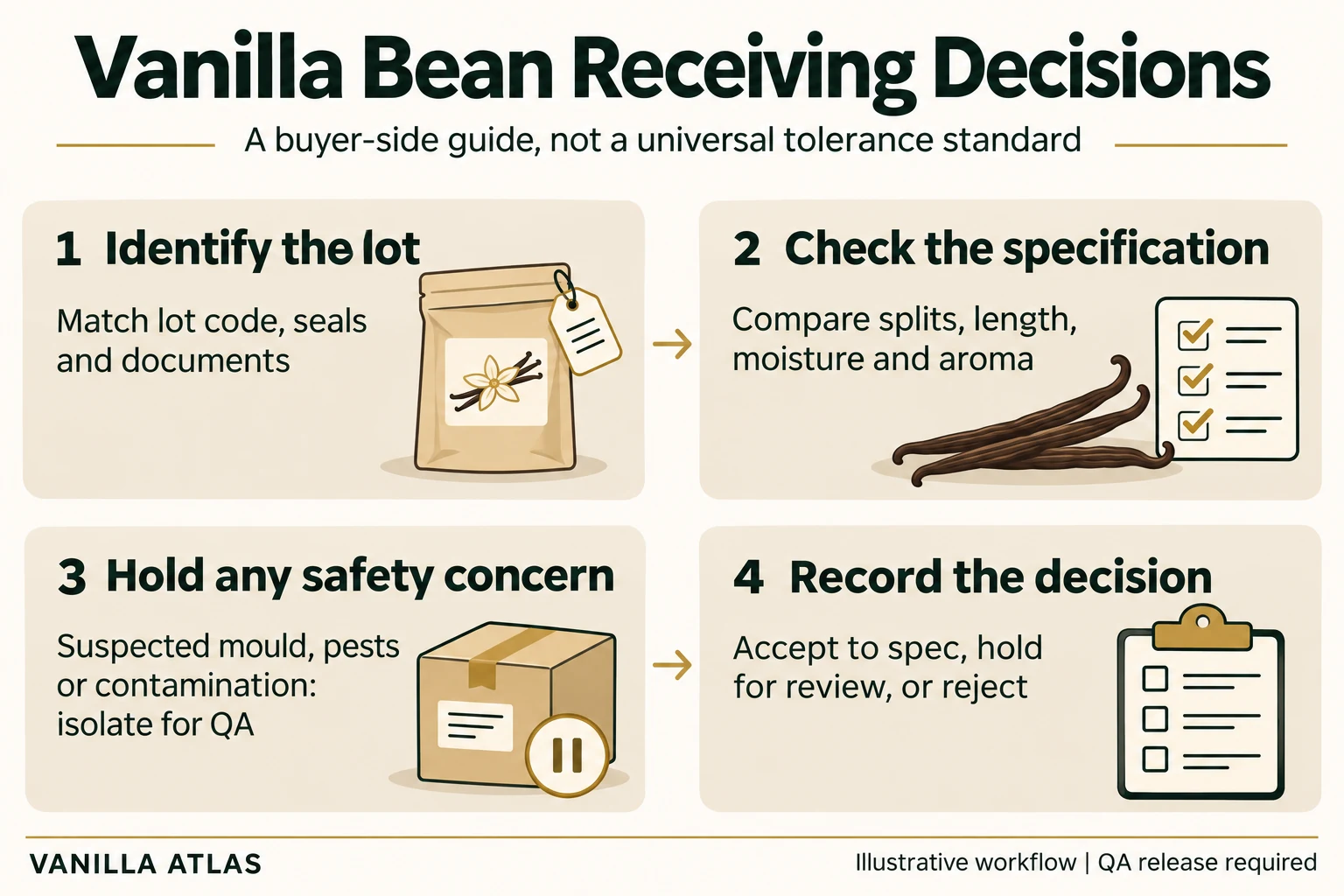
Keep a separate hold instruction for suspected mould, foreign matter, abnormal odour or a broken seal. Record the lot and isolate the affected stock for QA assessment. An allowance for short or split beans does not authorize release of a food-safety concern. Specify who may approve a commercial deviation and who has authority to release a lot. See the vanilla bean defect guide for German buyers.
For vanillin, only ask for an assay if the result affects your purchasing or process decision. Specify the requested units, analytical method and whether the result is reported as received or on a dry basis. Assign someone to reconcile differing methods before comparing two figures. Sensory acceptance still belongs in the intended product.
Which documents should German importers request, and when?
At quotation, ask for the current specification, traceability information and the status of any analyses or certifications your QA team requires. Before approving the shipment, obtain the evidence tied to the identified lot and agree the commercial and transport documents with your broker. A representative certificate of analysis (COA) helps you review the report format. Its results describe the sample identified on that report.
| When | Ask for | Buyer’s check |
|---|---|---|
| With the quote | Product specification and revision, origin, pack description, sample type, available supporting reports | Identify documents that are illustrative and mark pending items |
| Before lot release | Lot-specific COA or agreed tests, lot code and link to approved sample, evidence for required claims | Match identifiers, result, unit, method and date against the purchase specification |
| Before dispatch / at receipt | Commercial invoice, packing list, transport document as applicable, agreed origin evidence and pack marks | Match quantities and identifiers across records and the delivered cartons |
EU food traceability requires food businesses to identify their immediate supplier and the next business they supply. Keeping the lot code on the purchasing record, bag label and packing list gives the German importer a practical way to connect a delivery to those records. The supplier’s internal lot reference and the importer’s receiving reference can differ. Record the cross-reference. European Commission guidance on traceability.
For pesticide residues, have QA identify the relevant commodity and substances, then check the current EU maximum residue levels and request testing appropriate to the risk. Ask what the laboratory tested, at what reporting limits, on which sample. For a shipment marketed as organic, clarify the certified operator and scope and who arranges the electronic certificate of inspection in TRACES. Make this an explicit part of the inquiry when the claim matters. EU Pesticides Database and European Commission guidance on organic imports.
For a direct import, use the actual product description, origin and destination when checking import formalities with your customs representative. If a German manufacturer buys from an EU distributor that has already imported the goods, identify the distributor as your supplier and ask which records will accompany the delivery. The two buyers can use the same vanilla procurement checklist with different document owners. European Commission Access2Markets.
How do you get a price you can compare at the German delivery point?
In the volume section of your vanilla bean RFQ, put your first order in net kilograms on one line and your non-binding forecast on another. Ask for the minimum order quantity (MOQ), the price break at each call-off and the kilograms currently available under each lot code. If a supplier combines lots to reach your quantity, ask for that split before arranging the sample.
Name the delivery point precisely. With FCA at the named origin point, the buyer typically arranges the main carriage. With DAP at a named German receiving point, the seller arranges carriage there and the buyer handles import clearance and unloading. Write the agreed place and “Incoterms® 2020” beside the rule. Ask separately about payment timing, inspection and what happens after a rejected delivery. ICC Academy guidance on FCA and DAP.
Pack size can change the real comparison. A 25 kg order packed into small sealed inners may need more packaging and handling than a bulk pack. Your warehouse may also need smaller inners if it opens only a few kilograms per shift. Ask for net weight per bag, bags per carton, gross shipping weight and the cost of any requested pack change.
Use separate fields on your vanilla procurement checklist for the earliest dispatch date, expected transit time and required arrival window. A sample approval on Friday does not imply a Monday dispatch. If the lot must be held while a factory trial runs, specify the requested hold date and have the seller confirm the reservation and the quotation expiry in writing.
Which of two vanilla bean offers actually costs less?
In this hypothetical 100 kg order, Offer A quotes €85/kg with €700 of additional inbound costs to the buyer’s receiving point. Offer B quotes €89/kg with €100 remaining. For the same product specification, quantity, currency and destination, A costs €92/kg and B costs €90/kg. The extra costs in this example include everything needed to bring each quote to the same comparison point.
Comparable inbound cost per net kg = quoted unit price + additional inbound costs per order ÷ net kilograms. A costs €9,200 for the order. B costs €9,000. Record which freight, brokerage, testing or non-recoverable charges are already included, and enter each cost once. The workbook leaves an incomplete calculation blank. Enter zero only after you have confirmed the charge is genuinely zero.
For an extract manufacturer, moisture can change the interpretation again. If A has 22% moisture and B has 30%, their respective dry-matter costs are €92 ÷ 0.78 = €117.95/kg and €90 ÷ 0.70 = €128.57/kg. Here B costs less per delivered kilogram and A costs less per kilogram of dry matter. Neither number measures extract yield or sensory performance. Use comparable moisture tests and let the application trial decide whether that difference has production value.
What if a supplier returns an incomplete quotation?
Return the same vanilla bean RFQ checklist with the open cells highlighted. For each missing answer, agree who will provide it, by what date and whether it blocks a price comparison, a factory trial or release of the lot. For example, purchasing can compare payment terms while QA waits for a lot-specific report. It cannot approve the batch on the strength of a promised report.
How do you make sure the approved sample matches the order?
Start sample approval by asking whether the sample was drawn from the actual lot offered, from a representative lot or from an earlier crop. Record its code, sample mass, draw date and the available bulk quantity. If it is representative, R&D can test the product concept. Make commercial release conditional on approval of the allocation intended for shipment.
For example, a dairy manufacturer can divide one neutral base into a control and a test batch, hold the bean mass and infusion conditions constant, then assess aroma, visible seed distribution and any off-note after cooling. Decide the acceptance rule before opening the samples. Keep the reference, trial record and approver together so the next buyer can see exactly what passed.
Before issuing the purchase order, ask the supplier to repeat the approved lot code on its confirmation and advise you before substitution. If a different lot code is proposed, place the affected quantity on hold, obtain the relevant evidence and agree whether the trial needs repeating. If a carton arrives under a different code, record photographs and pack references and reconcile the discrepancy with QA before release.
How would a German dairy buyer complete the vanilla bean RFQ checklist?
Use this worked example to review the first supplier reply. The quantities and destination are illustrative. The same vanilla procurement checklist works for an importer if you replace the infusion trial with your resale inspection.
Buyer requirement. “Please quote 100 net kg of Indonesian cured whole pods for a dairy infusion, with the first delivery to our named receiving dock in Hamburg. State how many lots would cover the order. Price short pieces separately if you propose them for our process.”
Supplier reply to clarify. A supplier writes “100 kg available, sample attached” and quotes one price. The sample tag shows a lot code, but the quote covers two lots. Ask for the net kg, sample identity and available COA for each lot code. Request the carton allocation so the warehouse can keep the lots separate at receipt.
R&D and QA decision. R&D can run the infusion trial on the supplied sample. Record its lot code, dose, reference and result in the sample approval field. If it passes, identify exactly which kilograms the decision covers. Agree the sample approval route for the second lot before treating the whole 100 kg as available for production.
Purchase order wording. Carry the accepted revision of the vanilla bean RFQ checklist into the purchase order. Repeat the lot code and quantity for each approved line, the pack, unit price, delivery point and arrival window. Name the person who can accept a replacement lot and the evidence required. That gives receiving a decision it can act on when the truck arrives.
How do I send the vanilla bean RFQ checklist to a supplier?
Attach the completed vanilla bean RFQ checklist to a short email. Replace the bracketed items and specify dates with a month name or ISO format. If the full site address is confidential at first contact, give the city and postcode for an indicative quote and provide the named receiving point before requesting a firm delivered price.
Subject — Vanilla bean RFQ for [application], [first order in net kg], delivery to [German city and postcode]
Dear [supplier name],
Please quote [species, origin and format] for [end product or process]. Our first order is [net kg]. Our forecast is [kg over period, non-binding]. We need the first delivery at [place] by [date]. Our essential quality and pack requirements are in the attached vanilla procurement checklist.
Please enter the offered values, MOQ, unit price and currency, Incoterms® 2020 rule and named place, additional charges, payment terms and quote validity. Identify the available lot, the quantity it covers and whether you can reserve it until [date]. Quote alternatives on separate lines.
We would like [sample mass] for [trial]. Please state the relationship between sample and commercial lot, the documents available now and the date for outstanding reports. Flag any deviation and return the completed workbook by [deadline and time zone].
Kind regards, [buyer, company and purchasing contact]
Request a quotation from Vanilla Atlas. Include your application, first-order quantity, German delivery point and required sample decision in the inquiry. If you already have a specification, mention its revision and ask how to share it. Submit your completed buyer requirements.
Questions buyers ask before sending a vanilla bean RFQ
Can I request a quote before I know the right vanilla grade?
Yes. Give the application, the form your equipment accepts and your sample pass criteria. Ask the supplier to propose a grade and define it in measurable terms. An indicative quote can help you select candidates. Confirm the final specification before comparing firm offers.
What if the supplier cannot send a lot-specific COA with the first reply?
Ask which lot the example report covers, when the allocated lot can be identified and when its report will be available. Record the due date and person responsible. Keep any release that depends on that evidence pending until QA has checked it.
Should I quote my annual volume or my first shipment?
Give both and label them separately. Ask for a firm price on the first shipment and indicative price bands for later call-offs. State whether the forecast is binding and how often you expect deliveries. That lets a supplier distinguish available stock from future supply.
Does approval of a sample reserve the vanilla beans?
Only an agreed reservation tells you which quantity the seller is holding and until when. Ask for the lot code, reserved kilograms, expiry and any reservation conditions. Record the sample approval and commercial reservation separately.
What should I do if two suppliers quote different delivery terms?
Ask them to requote to the same named point or obtain the missing transport, clearance and other fees independently. Keep unknown costs marked as pending. Compare inbound cost per net kilogram only after the cost scope, quantity and currency match.
How should a German manufacturer use this RFQ with an EU distributor?
Give the manufacturing and receiving requirements as usual, then identify which party imported the lot and which documents the distributor can provide. Ask for its traceability reference and the link to the original lot before approving repeat orders.