
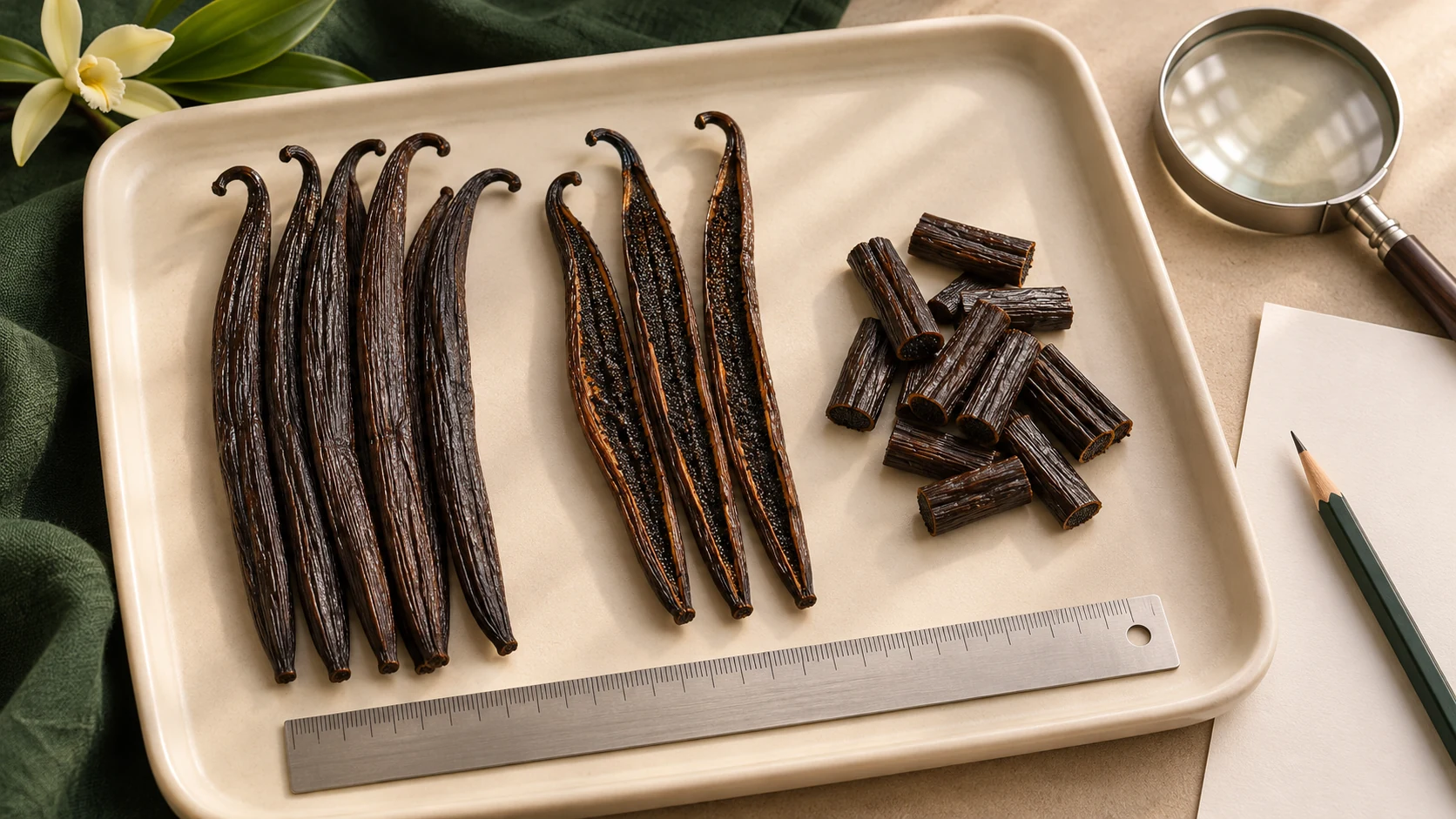
Vanilla bean defects should be assessed in three groups: appearance, performance in your application, and possible food-safety concerns. Splits, short lengths and dry texture may be acceptable under an agreed specification. Suspected mould, pest activity or contamination calls for a hold and QA assessment. A supplier’s grade name cannot replace that decision.
For German importers, ingredient distributors and manufacturers, the practical question is: does this lot meet our written requirements for this use? This guide to vanilla bean defects explains seven receiving checks, how to calculate a defect rate, and what to put in a purchase specification.
Which vanilla bean defects matter for your application?
A defect is a departure from an agreed requirement. The same split pod can fail a whole-bean presentation specification and fit a manufacturer’s extraction specification. Start with the intended use before deciding whether appearance affects value.
Use three review categories:
- Cosmetic or format: splits, cuts, short beans, curvature and colour variation. Assess against the ordered format and presentation needs.
- Functional: difficult scraping, unsuitable moisture, brittle handling, weak aroma or inconsistent dimensions. Assess against process requirements and an approved sample.
- Potential safety concern: suspected mould, pests, chemical taint or hazardous foreign material. Isolate for competent QA assessment; a commercial concession does not make unsafe food acceptable.
These categories are a buyer-side working framework, not an official German grading system. General food-safety duties apply separately from the quality terms in your contract. EU General Food Law, Article 14 prohibits placing unsafe food on the market.
Seven checks to put on your receiving sheet
| Check | What you may observe | Why it matters | Recommended first action |
|---|---|---|---|
| 1. Splits | A pod opened along its length | Presentation, exposed seeds and handling may differ | Compare the split definition and limit in the purchase specification |
| 2. Breakage and short pieces | Broken ends, cuts or beans below the ordered length | Whole-bean packing and dosing may be affected | Separate whole pods from pieces; use the agreed counting or weighing method |
| 3. Dryness and brittleness | Pods feel stiff, crack during handling or are hard to scrape | May suit a processing format but fail a flexible culinary-bean specification | Check the ordered format, moisture result and process trial |
| 4. Excess wetness or condensation | Free droplets, pooled liquid or wet packaging | Requires investigation of product and transport condition | Hold affected units; record seal, transit and storage conditions |
| 5. Surface deposits | White crystals, powdery patches or fuzzy material | Deposits cannot be cleared as harmless from colour alone | Record and isolate uncertain material for QA identification |
| 6. Aroma and colour | Uneven brown tones, weak aroma or an unusual taint | Appearance varies; off-odour may signal deterioration or contamination | Compare with a retained reference; escalate unexplained taint |
| 7. Foreign material and pests | Dirt, fibres, fragments, insects or webbing | May indicate handling failures or a safety hazard | Hold affected material and assess the lot’s scope |
Inspection guide only: these observations do not establish numerical acceptance limits or prove a lot is safe.
Are split vanilla beans a defect or an acceptable format?
Split vanilla beans are not automatically unsuitable. Their acceptability depends on the agreed format, condition and use. Whole-bean retail packs may need intact pods for appearance. A process that cuts or mills beans may place less value on intact length, provided the material meets all other requirements.
Define what “split” means before you order. Does a small opening count? Is a deliberate longitudinal cut included? Are split pods still sold as whole beans? Record the answers in your vanilla bean defects specification with a photographic reference approved by both parties.
A supplier’s statement “some splits allowed” is too vague for a purchase order. Specify a maximum, a measurement basis and a sampling rule. Keep breakage separate: one pod can be both split and broken.
For production priorities, compare our guides to vanilla for German food manufacturers and beans for German extract manufacturers. Processing suitability must be confirmed for the actual lot.
Are dry vanilla beans poor quality?
Dry texture alone does not settle the quality question. A drier bean may suit a processing specification while failing a requirement for pliable pods that are easy to split and scrape. Unexpected brittleness is a discrepancy to investigate, rather than a reason to assume that all dry vanilla is defective.
Ask for a moisture result with its test method, sample date and lot code. A bend test describes handling; it does not produce a moisture percentage. When you compare laboratory results, confirm that the methods and reporting bases are comparable.
Separate total moisture from water activity. They describe different properties; one result should not be substituted for the other. Ask your laboratory which measurements support your product, packaging and shelf-life assessment.
Do not infer safe storage life from flexibility, vacuum packing or one moisture number. Agree storage conditions, packaging and validation evidence with the supplier. Our vanilla bean moisture guide explains how water content also changes buying value.
Is the white coating vanillin crystals or mould?
White material on a vanilla bean may be vanillin crystals, but an uncertain deposit needs QA identification. The German transport-insurance information service notes that crystalline vanillin on pods is sometimes mistaken for mould. That explains a possible cause; it does not authenticate a particular delivery. GDV Transport Information Service: vanilla.
Crystalline deposits may look distinct or needle-like. Mould can appear fuzzy or powdery. Neither a photograph, colour nor a casual touch test reliably clears a suspect lot. Do not taste or deliberately sniff suspicious material to identify it.
If you cannot confidently identify a deposit through your approved procedure:
- Keep affected units isolated and prevent use in production.
- Photograph the deposit, pack condition and lot markings before disturbing them.
- Record how many units are affected and where they were found.
- Ask the responsible QA person or laboratory what examination and testing are needed.
- Document the decision and assess whether other units or lots are implicated.
Do not wipe suspected mould away and release the beans, or assume baking or alcohol extraction will make them safe. Germany’s BfR guidance on mould explains that mould can extend beyond visible growth and that many mycotoxins resist heat. This is general food-safety guidance, not evidence that a specific vanilla lot contains a toxin.
What quality tolerances should German buyers specify?
Write tolerances for the product you are buying; do not assume that a grade label supplies them. Cosmetic requirements, process limits, statutory obligations and safety-release decisions serve different purposes.
For example, a pastry supplier may prioritise intact length and easy scraping. An extract manufacturer may prioritise a consistent processing format and measured composition. Both need an effective food-safety assessment. Neither should copy a defect percentage from an unrelated offer.
Keep legal requirements and commercial specifications separate
Your QA or compliance lead should identify the requirements applicable to the actual product and supply chain. Visual inspection alone does not verify pesticide residues, other chemical hazards or microbiological condition.
For residue research, the European Commission’s EU Pesticides Database helps identify product/substance limits. The Commission states that the database is informational; the Official Journal contains the legal provisions. Confirm the correct product classification, applicable dates and any additional buyer requirements.
If your contract cites a standard, state its edition and applicable clauses. As checked on 8 November 2026, ISO lists ISO 5565-1:1999 as published and its replacement as under development. Review the applicable text before incorporating it into a contract. This guide does not reproduce paid standard tables or claim ISO certification for Vanilla Atlas.
A vanilla bean defects tolerance needs more than a percentage
For each defect, agree:
- Definition: what qualifies, with examples for borderline cases.
- Basis: percentage by mass, percentage by pod count, or another stated unit.
- Sampling: which packages are selected, how increments are taken and the inspection quantity.
- Decision rule: maximum, acceptance/rejection rule and treatment of an inconclusive result.
- Timing: pre-shipment, arrival or both, including storage conditions between checks.
- Authority: who may approve a concession and how it is recorded.
Who pays for sorting, losses and extra checks?
Agree this before a dispute. A lot can be safe yet fail a commercial length or split limit. Sorting that lot takes labour, may reduce saleable weight and can delay production. A lower invoice price only helps if it covers the actual cost and your team can use the remaining material.
For commercial vanilla bean defects, record any concession against the specific lot. State the affected quantity, extra sorting or testing, who pays, the revised use and the person who authorises release. Keep the original specification and inspection findings. A concession for one delivery should not silently change future orders. Potential safety concerns require a separate assessment.
If your organisation uses an acceptance-quality-limit sampling plan, have QA select its inspection level and acceptance/rejection rules. AQL is a sampling parameter, not proof that every lot contains less than a given percentage, and not permission to accept unsafe food.
How do you calculate a vanilla defect rate?
Defect rate by mass = mass assigned to the defect ÷ total inspected mass × 100. Use pod count only when the specification calls for it. A result by count cannot be compared directly with a limit by mass.
Here is an illustrative vanilla bean defects calculation, not an acceptance benchmark:
| Finding in a 2,000 g inspection sample | Measured mass | Calculated rate |
|---|---|---|
| Split material, including pieces also classed as broken | 40 g | 2.0% |
| Broken material, including pieces also classed as split | 30 g | 1.5% |
| Material included in both categories | 10 g | 0.5% |
| Combined split-or-broken material, counted once | 60 g | 3.0% |
The combined mass is 40 + 30 − 10 = 60 g. Adding the two rates without removing the overlap would report 3.5% and overstate the combined finding.
Keep individual defect rates and the combined rate if your contract requires both. Record the denominator, scale precision and classification rules. These figures describe the inspected sample; they do not prove that the whole shipment has exactly the same composition. No sample size or passing limit is prescribed here.
How should you inspect a bulk lot on arrival?
Use a documented vanilla bean defects check linked to the purchase specification and lot identity. An attractive hand-picked sample does not establish the condition of every package in the shipment.
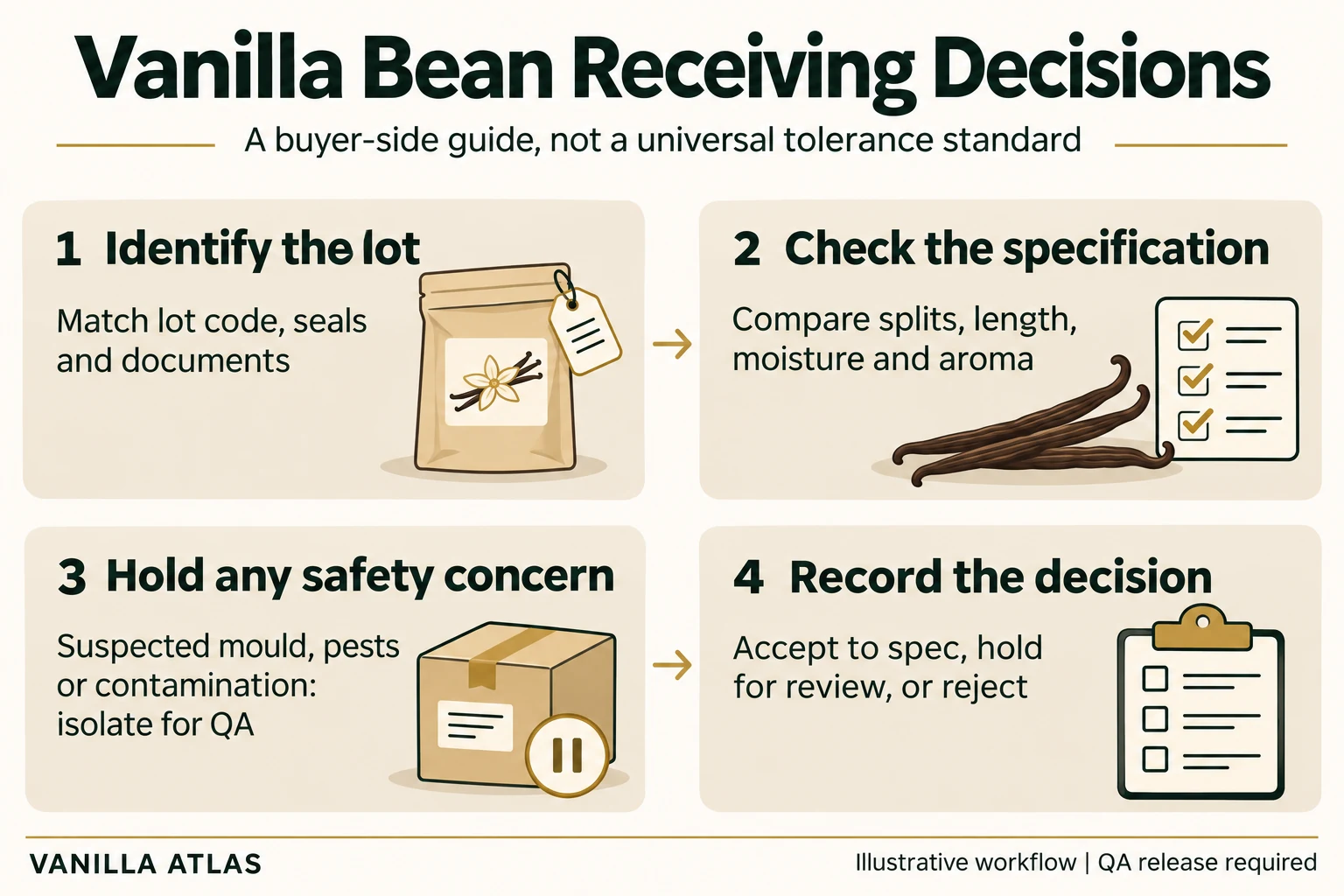
- Identify the delivery. Match the purchase order, supplier lot, package labels and accompanying records. Photograph seal damage or condensation before opening.
- Select packages under the agreed plan. Include the locations and increments specified by QA; do not take only the easiest top handful.
- Inspect format and condition. Record lengths, splits, breakage, deposits, aroma observations and foreign material with the agreed definitions.
- Obtain required measurements. Link laboratory reports to the lot and sampling event. Check methods, dates and specification limits.
- Compare with the approved reference. Use the retained sample and specification together. Escalate unexplained differences.
- Record release, hold or rejection. Name the decision owner, reasons, scope, date and any authorised quality concession.
Where contamination is suspected, control access and cross-contamination while the investigation proceeds. Do not mix questionable material into a conforming lot to dilute a finding.
Lot-level records also support traceability for German buyers. EU General Food Law, Article 18, requires food businesses to identify their suppliers and the other businesses they supply; keep those records accessible.
A copy-ready quality tolerance request
Send the following with your enquiry. Replace every bracketed field with an agreed requirement before ordering. A blank field is an unresolved requirement, not supplier approval.
Product and use: [species, origin, whole/split/cut format, culinary or industrial application].
Lot and reference: [lot code, quantity, approved sample identifier, approval date].
Physical requirements: [length range and method]; split maximum [value and % by mass/count]; broken/short maximum [value and basis]; combined-defect rule [definitions and overlap treatment].
Measured requirements: moisture [range, method and reporting basis]; other tests [analyte, method, limit, laboratory and report required]. Confirm any unresolved test scope with our QA lead.
Condition and safety: suspect deposits, infestation, contamination or unexplained off-odours trigger hold and QA assessment. No release through an informal price adjustment.
Sampling and delivery: [package selection, increments, inspection quantity, decision rule, pre-shipment/arrival checks, packaging and storage conditions].
Disputes and release: [notification procedure, evidence, retained samples, independent assessment and authorised decision owner].
This request is a procurement tool. It does not establish contractual terms until both parties agree them, and it does not replace the buyer’s food-safety responsibilities.
Frequently asked questions
Is there one German tolerance for split vanilla beans?
Do not assume a universal percentage. State the ordered format, split definition, maximum, measurement basis and sampling rule in the contract. Where a standard is referenced, identify its edition and relevant clauses. Commercial appearance tolerances do not replace applicable food-safety requirements.
Can split or broken vanilla beans be used for extraction?
They may fit a process that cuts or mills beans, subject to the agreed specification, lot condition and process validation. Splits or short length alone do not clear the material for use. Suspected contamination still requires QA assessment.
How can I tell vanillin crystals from mould?
Vanillin can form white crystalline deposits, while mould may look fuzzy or powdery. These are observations, not a reliable release test. Isolate uncertain material and use your approved QA or laboratory identification procedure. Do not taste suspicious beans.
Can mouldy beans be cleaned and used in extract?
Do not release suspect beans simply after wiping, heating or putting them in alcohol. Mould-related hazards can remain despite removal of visible growth. Hold the affected material for competent assessment and document the disposition.
Does a moisture result prove that vanilla is mould-free?
No. A moisture result describes the tested sample under the stated method. It does not replace examination, relevant testing, storage validation or an assessment of the lot’s history. Ask QA which evidence is needed for release.
What should I do when the bulk lot differs from the sample?
Keep it on hold, document the differences against the specification and approved reference, and notify the supplier under the agreed procedure. Check sampling representativeness and test methods before deciding on acceptance, a quality concession or rejection.
Discuss your vanilla bean defects specification
Vanilla Atlas offers Indonesian vanilla selections for culinary and processing enquiries. Batch COAs are not currently available. Product reference ranges are not verified results for a proposed lot; confirm which measurements and documents can be supplied before committing to an order.
To discuss vanilla bean defects and acceptance criteria, send your quality tolerance requirements with your application, destination in Germany, ordered format, defect definitions, sampling basis and required evidence. We can then establish which requirements need confirmation for the proposed supply.
Sources and review date
Reviewed 8 November 2026. The receiving framework and calculation are editorial buyer tools; they are not a published German tolerance table. Regulatory and standard references should be rechecked when contracting.
- EU General Food Law — Regulation (EC) No 178/2002, Articles 14 and 18.
- BfR — Mould in foods: health risks and how to avoid them.
- GDV Transport Information Service — Vanilla, crystalline deposits and transport condition.
- European Commission — EU Pesticides Database and its legal-information boundary.
- ISO — ISO 5565-1:1999 publication status and replacement development status.



One Comment