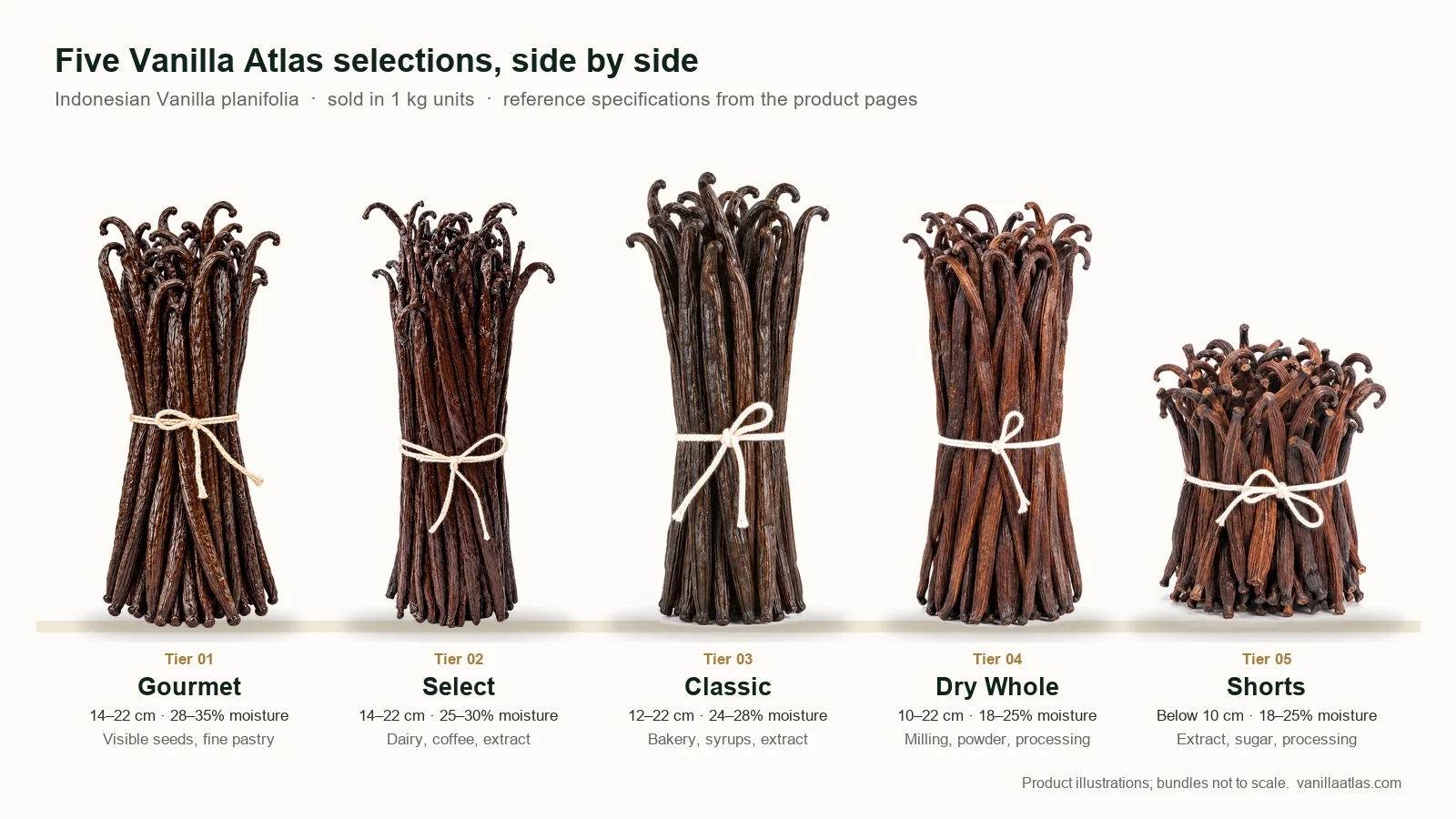
The Vanilla Atlas range is five selections of Indonesian Vanilla planifolia, sold in 1 kg units: Gourmet, Select, Classic, Dry Whole and Shorts. These Vanilla Atlas vanilla bean grades differ in moisture, length, condition and price. Choose Gourmet when the seeds or the whole pod will be seen. Choose Select for strong aroma in dairy, coffee and extract. Choose Classic for everyday bakery and syrups at a lower price. Choose Dry Whole for milling and powder, and Shorts for the lowest-cost extract, vanilla sugar and processing.
This guide compares the Vanilla Atlas vanilla bean grades by use, reference specification, beans per kilogram and value. It answers the questions customers ask before ordering: which grade to buy for pastry or extract, how Gourmet differs from Select, and what a 1 kg unit really holds. All figures come from the current product pages, checked on 11 November 2026. They are reference specifications, not results for the batch you will receive.
At a glance
- All five Vanilla Atlas vanilla bean grades are the same species from the same origin.
- Supple, moist pods (Gourmet, Select, Classic) suit scraping and infusing. Drier formats (Dry Whole, Shorts) suit milling, extraction and processing.
- Each listing is a 1 kg unit. Buying 10 kg or more of one grade lowers its price per kilogram.
- A higher grade buys appearance and suppleness. It does not guarantee better results in a jar of extract.
- Gourmet vs Select vanilla is about moisture and finish; Dry Whole vs Shorts is about length and price.
What is in each of the five Vanilla Atlas vanilla bean grades?
The five Vanilla Atlas vanilla bean grades run from Tier 01, the moistest and most supple pods, to Tier 05, short dry pieces. The table lists the published reference specifications.
| Selection | Length | Moisture | Vanillin | Weight per bean | Aroma | Reference condition |
|---|---|---|---|---|---|---|
| Gourmet (Tier 01) | 14–22 cm | 28–35% | 1.0–2.0% | 3–6 g | Strong | Plump, supple, rich in oil; no splits, cuts, defects or mould |
| Select (Tier 02) | 14–22 cm | 25–30% | 0.8–1.8% | 2–4 g | Strong | Plump, supple, oily; no cuts or mould |
| Classic (Tier 03) | 12–22 cm | 24–28% | 0.6–1.6% | 2–4 g | Mild | Supple, oily, whole; no cuts or mould |
| Dry Whole (Tier 04) | 10–22 cm | 18–25% | 0.4–1.0% | Under 3 g | Standard | Dry, whole; no cuts or mould |
| Shorts (Tier 05) | Below 10 cm | 18–25% | 0.2–0.8% | Under 3 g | Standard | Dry, some cuts; no mould |
Source: Vanilla Atlas product pages, checked 11 November 2026. Reference values, not batch test results.
Read the table in this order. Moisture tells you how supple the pod is and how much of the weight is water. Length and condition tell you how the pod looks and handles. Vanillin is one aroma marker, not a flavor score; our vanilla bean flavor profile chart explains why.
If you know the trade terms, Gourmet is closest to “Grade A”. Select and Classic sit between Grade A and Grade B. Dry Whole is closest to “Grade B” or extraction grade, and Shorts are cuts. The pillar guide to vanilla bean grades maps these terms to the ISO 5565-1 categories.
Which Vanilla Atlas selection should you choose?
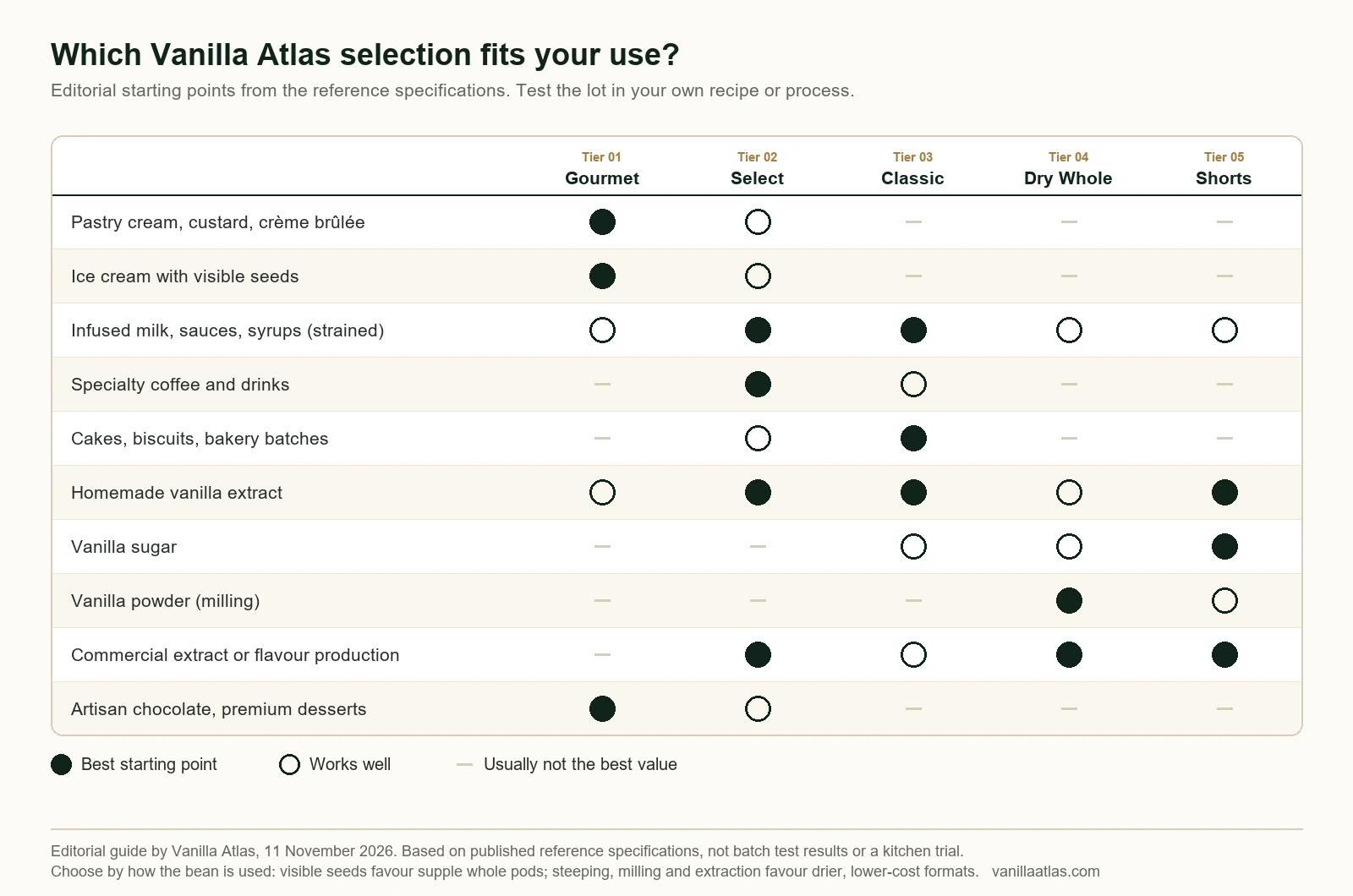
Start with how the bean will be used, not with the tier number of the Vanilla Atlas vanilla bean grades. If the seeds or the pod stay visible, pay for suppleness. If the bean is steeped and strained, milled or extracted, a drier and cheaper format usually gives more value.
| What you are making | Best starting point | Also works | Why |
|---|---|---|---|
| Pastry cream, custard, crème brûlée | Gourmet | Select | Supple pods split and scrape easily for visible seeds |
| Ice cream with visible seeds | Gourmet | Select | Plentiful seeds and strong aroma in a cold base |
| Strained milk infusions, sauces, syrups | Select or Classic | Gourmet, Dry Whole, Shorts | The pod is removed, so looks matter less |
| Specialty coffee and drinks | Select | Classic | Strong aroma; syrups can be made from either |
| Cakes, biscuits, bakery batches | Classic | Select | Mild aroma at a lower price per kilogram |
| Homemade vanilla extract | Select, Classic or Shorts | Gourmet, Dry Whole | Any sound bean works; you pay less for appearance |
| Vanilla sugar | Shorts | Classic, Dry Whole | Pieces dry and blend easily; length is irrelevant |
| Vanilla powder (milling) | Dry Whole | Shorts | Dry, whole beans for grinding and processing |
| Commercial extract or flavor production | Dry Whole, Shorts or Select | Classic | Set the choice by dry matter, process and specification |
| Artisan chocolate, premium desserts | Gourmet | Select | Presentation and handling matter |
How to choose in four steps
- Decide whether the bean will be seen. Visible seeds or pods point to Gourmet or Select.
- Decide how the bean is processed. Steeping and straining suit Select or Classic; milling suits Dry Whole; extract and sugar suit Shorts.
- Compare value on the right basis. Use price per kilogram of dry matter for extraction, and price per usable pod for pastry.
- Check the order rules. Each listing is 1 kg, and the 10 kg price applies to one grade at a time.
The decision table and these steps are editorial starting points based on the reference specifications, not results of a side-by-side kitchen test. For recipe-level advice, read our guide to vanilla beans for baking, ice cream and homemade extract.
Gourmet vs Select vanilla: what is the difference?
Gourmet vs Select vanilla comes down to moisture, bean size and finish. Both have a strong aroma and the same length range. Gourmet holds more moisture (28–35% against 25–30%), weighs more per bean (3–6 g against 2–4 g) and is specified with no splits or defects. Select is plump and oily but a little drier.
| Gourmet | Select | |
|---|---|---|
| Reference moisture | 28–35% | 25–30% |
| Weight per bean | 3–6 g | 2–4 g |
| Reference vanillin | 1.0–2.0% | 0.8–1.8% |
| Condition | No splits, cuts, defects or mould | No cuts or mould |
| Price, 1–9 kg / 10 kg+ | US$190 / US$180 per kg | US$175 / US$165 per kg |
| Choose it for | Visible seeds, plated desserts, premium pastry | Dairy, coffee, confectionery, extract |
In the Gourmet vs Select vanilla decision, when does Select make more sense? When you strain the pod out, make extract or flavor coffee and syrups, the extra suppleness of Gourmet is not visible in the result. Select keeps the strong aroma at US$15 less per kilogram. When does Gourmet earn its price? When a pastry chef scrapes seeds into a cream that guests will see, or when whole pods are part of the presentation. If you are still weighing Gourmet vs Select vanilla for a dessert menu, make the same dessert with each at the same dose and compare.
Both are sold by weight, which changes the Gourmet vs Select vanilla comparison for anyone who counts pods. Because Gourmet beans are heavier, a kilogram of Gourmet contains fewer pods than a kilogram of Select. That matters if you plan by pod count rather than by grams.
Is Classic a good everyday vanilla bean?
Yes. Classic is the practical everyday choice among the Vanilla Atlas vanilla bean grades for bakery, syrups and extract. Its pods are supple, oily and whole, with a milder aroma and a slightly wider length range (12–22 cm) than Select. At US$160 per kilogram, it costs US$30 less than Gourmet.
Choose Classic when vanilla is one flavor among several, as in cakes, biscuits and flavored drinks, or when you need many pods for batch production. Choose Select instead when vanilla should lead the flavor of a dairy or coffee product. If you are unsure between the two, compare them in the same recipe at the same dose before buying in volume.
Dry Whole vs Shorts: which suits processing and extract?
Dry Whole vs Shorts is a choice about length and price, not moisture. Both have reference moisture of 18–25% and weigh under 3 g per bean. Dry Whole pods are 10–22 cm and whole, with no cuts. Shorts are below 10 cm and include some cut pieces.
| Dry Whole | Shorts | |
|---|---|---|
| Length | 10–22 cm, whole | Below 10 cm, some cuts |
| Reference moisture | 18–25% | 18–25% |
| Reference vanillin | 0.4–1.0% | 0.2–0.8% |
| Price, 1–9 kg / 10 kg+ | US$100 / US$85 per kg | US$90 / US$75 per kg |
| Choose it for | Vanilla powder, milling, sauces, syrups, bulk processing | Homemade or commercial extract, vanilla sugar, flavoring |
In practice, Dry Whole vs Shorts is decided by how you process the beans. Choose Dry Whole when whole, uniform pods make milling or handling easier, or when you need a consistent piece size. Choose Shorts when length is irrelevant, such as in a jar of extract or a container of vanilla sugar, and price per kilogram matters most. Dry is not the same as spent: these beans are dried for processing, not used up. For a home extract that will be strained, Shorts are often the simplest saving. The Dry Whole vs Shorts price gap is US$10 per kilogram at both price levels.
How many vanilla beans are in 1 kg?
A 1 kg unit of Gourmet holds roughly 170–330 pods; Select and Classic hold roughly 250–500. The count follows from the reference weight per bean, so treat it as a planning range, not a promise.
| Selection | Weight per bean | Approximate pods per kg | Approximate cost per pod, 1–9 kg |
|---|---|---|---|
| Gourmet | 3–6 g | 170–330 | US$0.57–1.14 |
| Select | 2–4 g | 250–500 | US$0.35–0.70 |
| Classic | 2–4 g | 250–500 | US$0.32–0.64 |
| Dry Whole | Under 3 g | More than 330 | Under US$0.30 |
| Shorts | Under 3 g, pieces | More than 330 pieces | Under US$0.27 |
Calculated by Vanilla Atlas: pods per kg = 1,000 ÷ weight per bean; cost per pod = price per kg ÷ pods per kg. Ranges are rounded and use 1–9 kg list prices on 11 November 2026.
Weigh, do not count, when a recipe or process needs to be repeatable. Two pods of the same grade can differ by a gram or more. The vanilla bean moisture guide explains why weight and moisture change together.
Which Vanilla Atlas selection gives the best value?
Value across the Vanilla Atlas vanilla bean grades depends on what you are paying for. Per kilogram, Shorts and Dry Whole cost least. Per kilogram of dry matter, which removes the water, the gap narrows but the drier grades still lead. If you need visible seeds, only the supple grades deliver them, so price per kilogram is the wrong comparison.
| Selection | Price per kg, 1–9 kg | Price per kg, 10 kg+ | Cost per kg dry matter, 1–9 kg | Cost per kg dry matter, 10 kg+ |
|---|---|---|---|---|
| Gourmet | US$190 | US$180 | US$277 | US$263 |
| Select | US$175 | US$165 | US$241 | US$228 |
| Classic | US$160 | US$150 | US$216 | US$203 |
| Dry Whole | US$100 | US$85 | US$127 | US$108 |
| Shorts | US$90 | US$75 | US$115 | US$96 |
Calculated by Vanilla Atlas: cost per kg of dry matter = price ÷ (1 − moisture midpoint). Moisture midpoints from the reference ranges: 31.5%, 27.5%, 26%, 21.5% and 21.5%. Prices exclude shipping.
There is one surprise. Dividing price by the midpoint of the reference vanillin range puts Gourmet (about US$12.7 per gram at 1–9 kg prices) close to Dry Whole (about US$14.3). The higher moisture of Gourmet is partly offset by its higher reference vanillin. Treat this as an indication only: the product pages do not state the vanillin basis, and vanillin is not the whole flavor. For extraction economics in more detail, see extraction-grade vanilla beans for extract manufacturers.
What do the reference specifications mean?
The specifications for the Vanilla Atlas vanilla bean grades are reference ranges for each selection, not test results for the lot you receive. Batch certificates of analysis are not currently available from Vanilla Atlas. If your process needs measured moisture, vanillin or microbiology, discuss testing before you order.
Three points help when you read the specifications:
- Species and origin are the same across all five. Every selection is Indonesian Vanilla planifolia. The differences come from maturity, curing, drying and sorting, as our guide to Indonesian vanilla explains.
- Shelf life is a reference value. The pages list 2–3 years for Gourmet and 2 years for the others, assuming proper storage. It is not a guaranteed date for an opened pack.
- “No mould” is a reference condition. Inspect beans on arrival. White crystals can be vanillin, but anything fuzzy, damp or musty should be reported, not used.
How does ordering work?
Each listing is a 1 kg unit, priced in US dollars, with shipping charged separately. Buying 10 kg or more of one of the Vanilla Atlas vanilla bean grades lowers its price per kilogram. The 10 kg threshold applies to each grade separately, so 5 kg of Select and 5 kg of Classic do not qualify.
| Selection | 1 kg | 10 kg at the 10 kg+ price | Saving on 10 kg |
|---|---|---|---|
| Gourmet | US$190 | US$1,800 | US$100 |
| Select | US$175 | US$1,650 | US$100 |
| Classic | US$160 | US$1,500 | US$100 |
| Dry Whole | US$100 | US$850 | US$150 |
| Shorts | US$90 | US$750 | US$150 |
Source: Vanilla Atlas product pages, checked 11 November 2026. Shipping, duties and taxes are not included.
Before you order, check four things:
- Destination. We serve 13 destinations listed on the shipping and destinations page. Shipping cost and timing are confirmed for each order.
- Quantity. Smaller packs are not currently listed for any of the Vanilla Atlas vanilla bean grades. Ask us if you need a different quantity.
- Returns. Because vanilla is a food, returns are accepted for damaged, defective, spoiled or incorrect products only, reported within 14 days. See the refund and returns policy.
- Documentation. If you need a specification, test results or import documents, ask before ordering.
How should you store a 1 kg pack?
Keep vanilla beans in an airtight container at room temperature, away from heat and sunlight. Nielsen-Massey’s vanilla FAQ advises against refrigerating or freezing beans, because refrigeration can encourage mould. A bean that is still aromatic, moist and pliable can be used; a dry, brittle bean without aroma should be replaced.
Whichever of the Vanilla Atlas vanilla bean grades you buy, divide a kilogram into several smaller airtight packs when they arrive. Open one pack at a time, so most of the beans stay sealed. Dry Whole and Shorts are already dry and need the same protection from moisture and air.
Frequently asked questions
Which Vanilla Atlas vanilla bean grade is best for baking?
For pastry cream, custard and desserts with visible seeds, choose Gourmet, or Select as a slightly lower-cost option. For cakes, biscuits and bakery batches where the bean is not seen, Classic usually gives the best value. Test your recipe at a fixed dose before buying in volume.
Gourmet vs Select vanilla: what is the difference?
Both have a strong aroma and a 14–22 cm length. Gourmet is moister (28–35% against 25–30%), heavier per bean (3–6 g against 2–4 g) and specified with no splits or defects. Select costs US$15 less per kilogram and suits dairy, coffee and extract.
Which Vanilla Atlas selection is best for homemade vanilla extract?
Among the Vanilla Atlas vanilla bean grades, any sound bean works for extract, so you do not need to pay for appearance. Select or Classic give whole, supple pods; Shorts give the lowest price per kilogram, and length does not matter in a jar. Record the bean weight and alcohol volume so you can repeat a good batch.
Dry Whole vs Shorts: what is the difference?
In the Dry Whole vs Shorts choice, both are dry, with 18–25% reference moisture and under 3 g per bean. Dry Whole pods are 10–22 cm and whole, which suits milling and powder. Shorts are below 10 cm with some cut pieces, which suits extract and vanilla sugar at a lower price.
How many vanilla beans are in a kilogram?
It depends on which of the Vanilla Atlas vanilla bean grades you buy. Using the reference weight per bean, a kilogram of Gourmet holds roughly 170–330 pods, and Select or Classic roughly 250–500. Dry Whole and Shorts hold more than 330 pods or pieces. Weigh beans when a recipe must be repeatable.
Are Vanilla Atlas beans Grade A?
Gourmet corresponds most closely to the trade term Grade A. Select and Classic sit between Grade A and Grade B, Dry Whole is closest to Grade B, and Shorts are cuts. “Grade A” is a seller term, not an international standard, so compare the specifications rather than the label.
Can I mix grades to reach the 10 kg price?
No. The 10 kg or more price applies to each grade separately. For example, 10 kg of Classic qualifies, but 5 kg of Classic and 5 kg of Select do not. Contact us before ordering if you need a mixed wholesale quantity.
Do you sell vanilla beans in packs smaller than 1 kg?
The current listings are sold in 1 kg units only. If you need a different quantity, contact us with the grade, quantity and destination, and we will tell you what is possible. Do not assume a smaller pack is available.
Choose your selection
If you already know your use, go straight to the product page for the matching one of the Vanilla Atlas vanilla bean grades: Gourmet, Select, Classic, Dry Whole or Shorts. You can compare all five Vanilla Atlas vanilla bean grades on the products page.
Still unsure? Tell us what you are making: the recipe or process, whether seeds should be visible, your monthly use and your destination. We will suggest a selection and say plainly what we can and cannot confirm for the current lot.
Sources and method
Last updated: 2026-11-11. Reviewed 11 November 2026. This is a buying guide for the Vanilla Atlas range. Recommendations are editorial, based on published reference specifications; no new side-by-side kitchen or laboratory test was conducted.
- Vanilla Atlas product pages for Gourmet, Select, Classic, Dry Whole and Shorts — reference specifications, unit size and prices, checked on the review date.
- Vanilla Atlas shipping and destinations, refund and returns policy and terms and conditions — ordering, returns and documentation.
- Nielsen-Massey: vanilla FAQ — general storage guidance for whole vanilla beans.
- Calculations (pods per kg, cost per pod, cost per kg of dry matter, cost per gram of reference vanillin) by Vanilla Atlas from the reference ranges. Prices change; check the product page before ordering.