
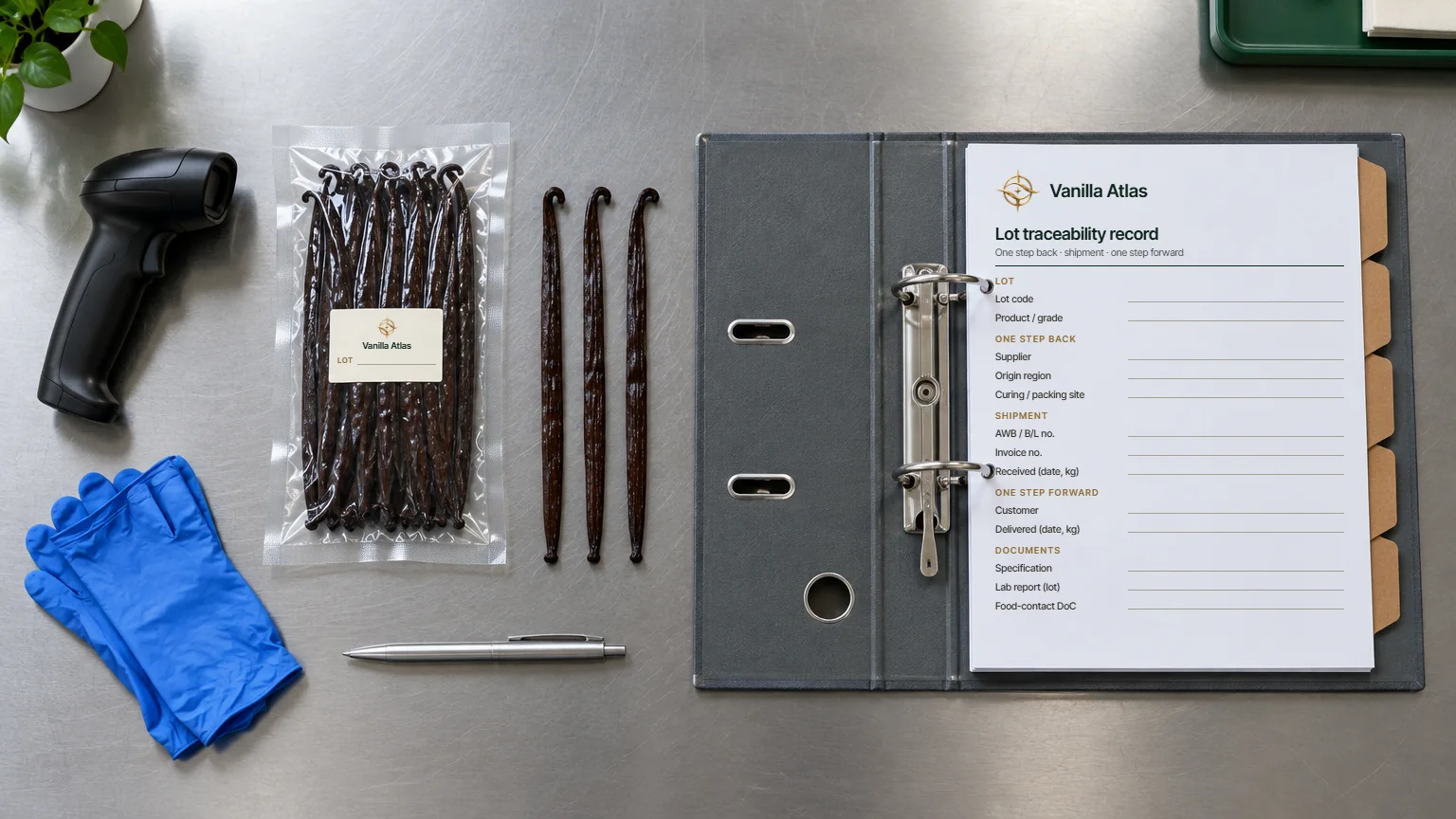
A German QA manager receives a lot of Indonesian vanilla from a trader in Rotterdam. The invoice names the trader, the carton names a lot, and the customer’s auditor asks a simple question: where was this vanilla cured, and which other deliveries came from the same lot? The answer depends on documents agreed before the order, not after.
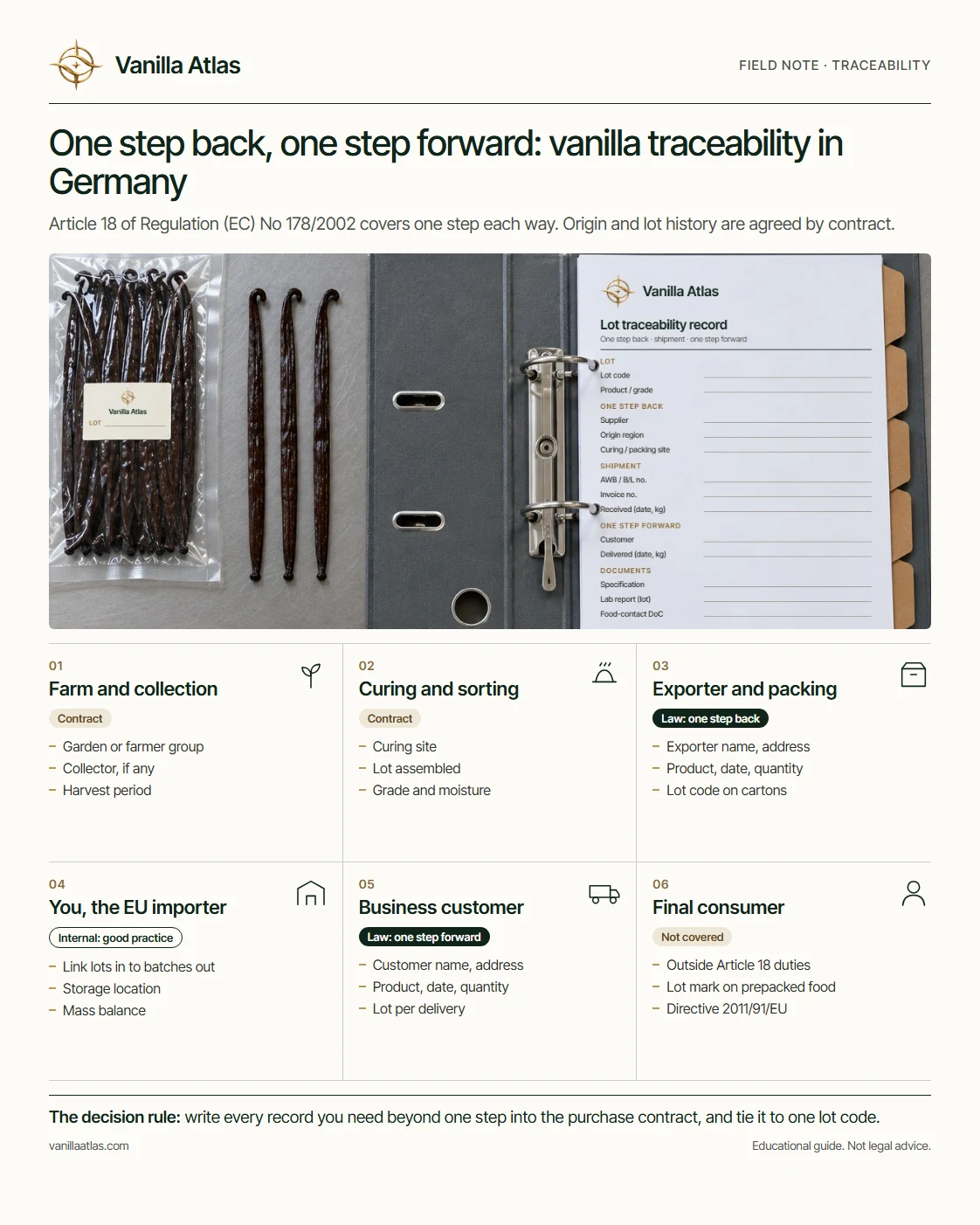
Vanilla traceability in Germany rests on Article 18 of Regulation (EC) No 178/2002: every food business must name the supplier it bought from and the business customer it sold to. Everything beyond that one step, such as farm, curing site or lot history, is a contractual request. Agree which documents the supplier will provide, lot by lot, before you order.
Kurz gesagt: Nach Art. 18 der Verordnung (EG) Nr. 178/2002 muss jedes Lebensmittelunternehmen in Deutschland Lieferanten und gewerbliche Abnehmer benennen können (eine Stufe zurück, eine Stufe vor). Herkunft, Aufbereitung und Chargenhistorie der Vanille sind vertragliche Anforderungen. Vereinbaren Sie vor der Bestellung, welche Unterlagen der Lieferant je Charge liefert, und lassen Sie fehlende Unterlagen ausdrücklich kennzeichnen.
This guide is for QA, procurement and compliance teams buying vanilla beans for Germany. It separates what the law requires for ingredient traceability from what your customers and certification schemes expect, then gives a documentation matrix you can send to suppliers. Our vanilla traceability guide for France covers chain-of-custody questions in more depth; this article focuses on German buyers and on documentation.
What does vanilla traceability in Germany legally require?
Vanilla traceability in Germany legally requires one step back and one step forward. Under Article 18 of Regulation (EC) No 178/2002, applied directly in Germany and enforced by the federal states’ food authorities, every food business must identify who supplied the vanilla and which businesses it supplied, and give that information to authorities on demand.
The European Commission’s guidance on Article 18 adds three points that matter for vanilla. The rule does not apply to exporters outside the EU, so the EU importer must be able to name the exporter. The regulation does not expressly require internal traceability, meaning a link between incoming and outgoing batches. And requests that go beyond one step are “part of the food business’s contractual arrangements”.
In practice, German buyers ask for much more than the law requires, because their customers, auditors and insurers do. That gap between legal minimum and real ingredient traceability is where vanilla supplier documentation is agreed, and where most vanilla traceability in Germany is actually decided.
What does one step back, one step forward mean for a vanilla importer?
For a vanilla importer, one step back means recording the exporter or trader that supplied each lot, and one step forward means recording every business customer that received it. The Commission guidance lists the minimum records: names and addresses, product identification, dates, and quantities, organised so they follow the physical flow of goods.
One step back, one step forward: legal minimum and good practice for vanilla
| Direction | Records the guidance says to keep | Good practice for vanilla (contractual) |
|---|---|---|
| One step back | Supplier name and address, product identification, date, quantity | Supplier lot code, origin region, curing and packing site, packing date |
| Internal | Not expressly required by Article 18 | Link each incoming lot to every outgoing batch, including splits and blends |
| One step forward | Customer name and address, product identification, date, quantity | Customer lot or order reference, quantity per lot |
| Retention | No minimum in Article 18; guidance suggests 5 years, or shelf life plus 6 months | Agree one period with suppliers and keep lab reports with the lot file |
The guidance also warns that invoices alone may not follow the physical flow, for example when goods sit in a third-party warehouse. Record where each vanilla lot was stored, not only who invoiced it. For prepacked vanilla sold onwards, Directive 2011/91/EU requires a lot indication on the pack.
Where does Germany’s vanilla come from?
Germany’s vanilla mostly comes from Madagascar directly, but a large share arrives from other EU countries. In 2025, Germany reported 744.6 tonnes of whole vanilla imports (HS 090510): 51.2% from Madagascar, 27.7% from the Netherlands, 9.4% from Czechia and 1.1% from Indonesia, according to UN Comtrade.
Germany’s imports of whole vanilla (HS 090510), 2023 to 2025
| Year | Total imports | From Madagascar | From Indonesia | Average value, all partners |
|---|---|---|---|---|
| 2023 | 270.6 t | 151.4 t (56.0%) | 11.5 t (4.3%) | 157.7 USD/kg |
| 2024 | 800.8 t | 365.5 t (45.6%) | 17.9 t (2.2%) | 41.2 USD/kg |
| 2025 | 744.6 t | 381.6 t (51.2%) | 7.9 t (1.1%) | 34.9 USD/kg |
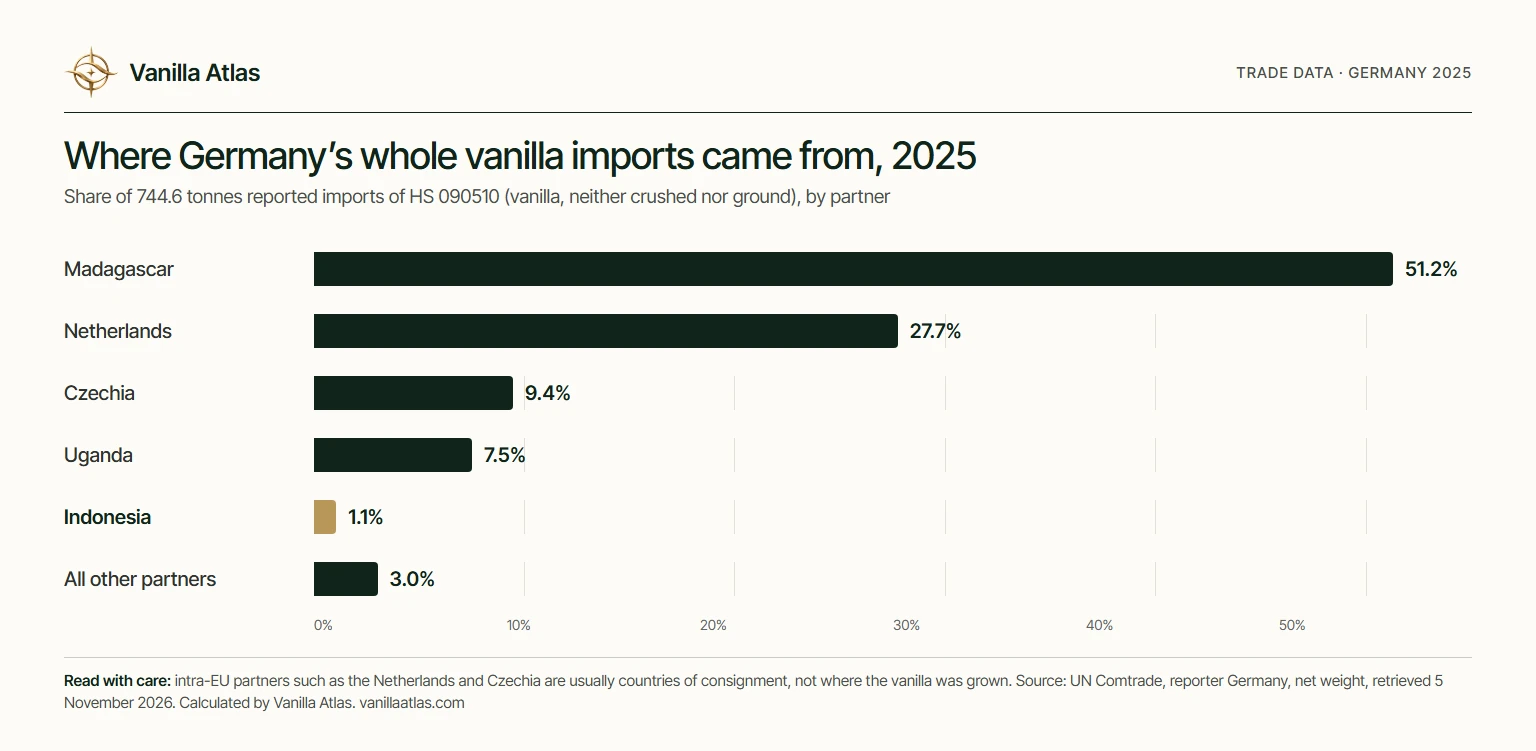
Why this matters for traceability: 37.9% of the 2025 volume came from EU partners, and in EU trade statistics an intra-EU partner is usually the country the goods were sent from, not where they were grown. If your supplier is a Dutch or Czech trader, your legal one step back ends there, while your customer’s origin question does not. Ask that trader for the origin and lot documents agreed in the contract.
For vanilla traceability in Germany, this means the contract, not the customs data, carries the origin story. Unit values differ widely between partners, which suggests mixed grades and forms within the code, so we do not compare prices here. Our origin comparison for French buyers discusses price trends.
Which documents should German B2B buyers request from a vanilla supplier?
German B2B buyers should request a signed specification, shipping documents that name the lot, a lot-linked lab report, a traceability record from packing back to curing, a food-contact declaration for plastic packaging, and certificates only where a claim depends on them. Each document proves something different, and none proves everything.
Vanilla supplier documentation matrix for German buyers
| Document (German term) | What it shows | What it does not show | When to require |
|---|---|---|---|
| Product specification (Produktspezifikation) | Agreed species, form, length, moisture method, defect limits | That a given lot meets it | Always, signed before the first order |
| Commercial invoice and packing list (Handelsrechnung, Packliste) | Seller, buyer, quantity, lot codes per carton | Origin of the beans or curing site | Every shipment |
| Air waybill or bill of lading (Luftfrachtbrief, Konnossement) | Shipper, consignee, route, date | What is inside each carton | Every shipment |
| Certificate of origin (Ursprungszeugnis) | Country of origin for customs purposes | Region, farm, curing site or chain of custody | When a customer or tariff regime needs it |
| Lab report for the lot (Prüfbericht) | Tested values for that lot, by a named lab and method | Other lots, or anything not tested | Per lot, with the tests you specify |
| Traceability record (Rückverfolgbarkeitsnachweis) | Lot path from curing and sorting to packing and dispatch | Farm-level origin unless recorded | Per lot; test it with a trace exercise |
| Food-contact declaration of compliance (Konformitätserklärung) | Plastic bag meets Regulation (EU) No 10/2011 | That the vanilla itself is safe | For plastic primary packaging |
| Supplier self-assessment (Lieferantenselbstauskunft) | Supplier’s own statements on processes and policies | Independent verification | At approval, reviewed periodically |
| Certificates, if claimed (Zertifikate) | Scope and validity of a named scheme, such as an organic certificate of inspection | Coverage of a lot outside the certified scope | Only when your product claim relies on it |
Our import documents guide shows how to reconcile these papers with one shipment, and the bulk packaging guide covers food-contact questions in detail.
How should you request vanilla supplier documentation in the EU?
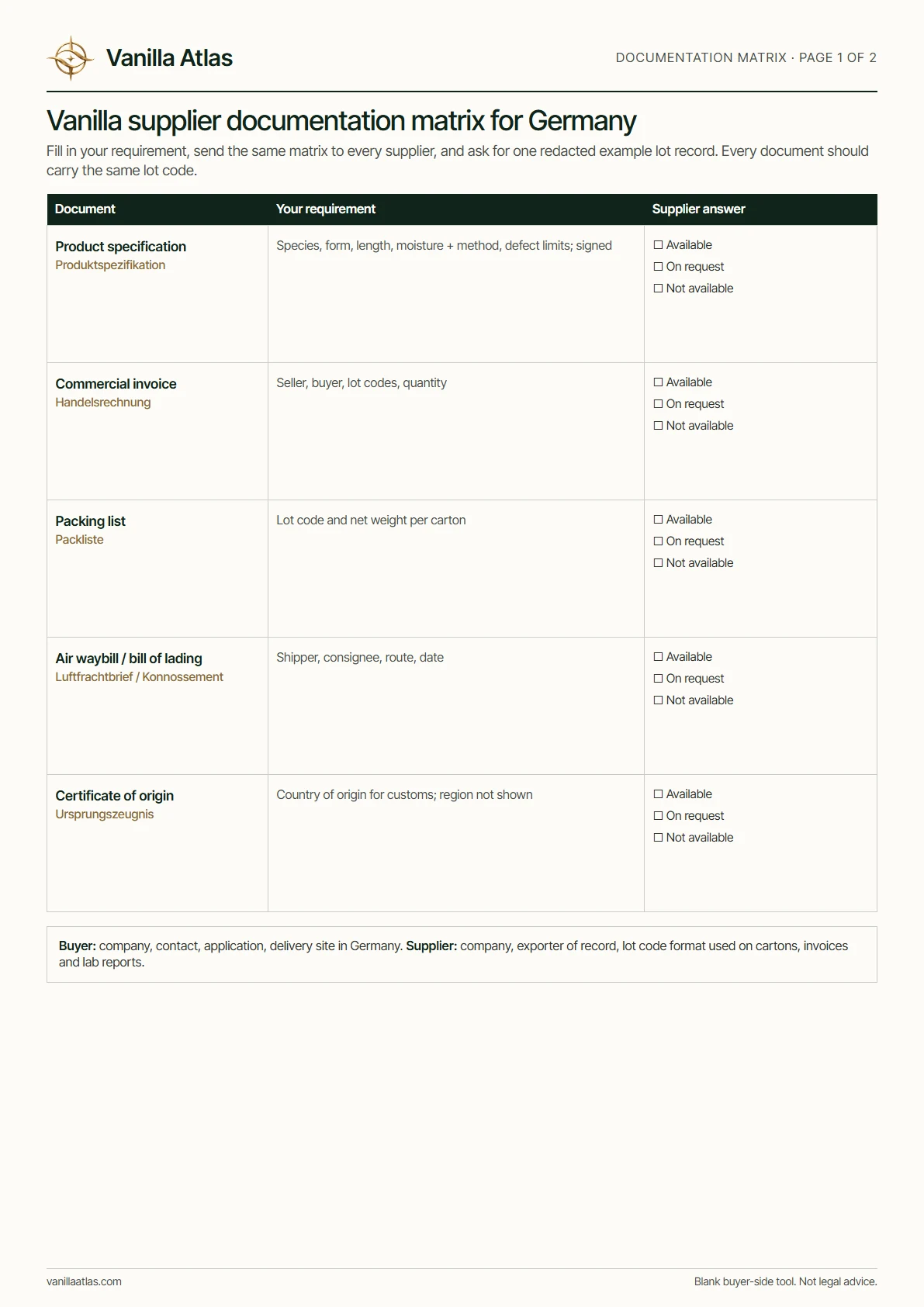
Request vanilla supplier documentation in the EU with one written matrix: list each document, ask the supplier to mark it available, available on request or not available, and ask for a redacted example before the first order. Tie every document to a lot code, and add a clause requiring notice before any change of site, lot structure or packaging.
Good vanilla supplier documentation is specific, lot-linked and honest about gaps. Three habits prevent most problems. First, ask for evidence rather than a “yes”: an example lot record shows more than a policy statement. Second, ask the same questions to every supplier, as in our vanilla RFQ template, so the answers compare. Third, write the agreed documents into the purchase contract, because the Commission guidance treats anything beyond one step as contractual.
Do the LkSG or the CSDDD apply to vanilla suppliers?
Neither law applies directly to an Indonesian vanilla supplier. Germany’s Supply Chain Due Diligence Act (LkSG) binds companies with at least 1,000 employees in Germany since 2024. Those companies pass due diligence down their chain, so smaller importers often receive codes of conduct, questionnaires and contract clauses from their customers instead.
The LkSG remains in force in autumn 2026. A bill to drop the annual report to the federal enforcement office BAFA was still before the Bundestag, according to law-firm summaries; internal documentation duties are unchanged. At EU level, the Omnibus I directive narrowed the CSDDD to companies with more than 5,000 employees and €1.5 billion turnover, applying from 26 July 2029, as Latham & Watkins summarises.
For a vanilla buyer, the useful response is the same either way, because both laws push ingredient traceability down the chain through contracts: know which customer questionnaires you must answer, and make sure your supplier can give the facts behind your answers. Do not pass on a supplier’s general statement as verified evidence.
Does the EU Deforestation Regulation cover vanilla?
No. Vanilla is not one of the commodities covered by the EU Deforestation Regulation, which are cattle, cocoa, coffee, oil palm, rubber, soya and wood and certain derived products. The European Commission gives application dates of 30 December 2026 for large operators and 30 June 2027 for small ones.
Two cautions follow. A supplier’s “EUDR-compliant” label on vanilla says nothing about its traceability, because the regulation does not apply. And products that combine vanilla with an in-scope commodity, such as chocolate containing cocoa, bring the cocoa under the regulation, not the vanilla.
What does IFS Food expect from vanilla traceability records?
IFS Food, a food safety standard widely used by German retailers, sets ingredient traceability expectations beyond the law. It expects a certified site to link product lots to raw-material batches and trace through to delivery to the customer. Version 8, mandatory for audits from 1 January 2024, also requires the traceability system, including a mass balance, to be tested at least once a year.
That test is where ingredient traceability and vanilla supplier documentation are checked in practice. If your customer is IFS-certified and runs a trace on a dessert batch, it will ask you which vanilla lot went in and where that lot came from. Certification-body summaries such as DQS also note that food fraud assessment outcomes feed into management review, and vanilla’s high value per kilogram makes it a natural item for that assessment.
How do you run a mass-balance check on a vanilla lot?
To run a mass-balance check on a vanilla lot, pick one received lot, add up every kilogram that came in, then account for every kilogram used, sold, held in stock, sampled or written off. The totals should match within your agreed tolerance, and you should reach the supplier’s lot record within the time your customers expect.
A mass balance is the most practical test of vanilla traceability in Germany, because it checks the physical flow of goods that the Commission guidance asks businesses to follow.
Example mass balance for one vanilla lot (illustrative figures)
| Line | Source document | Kilograms |
|---|---|---|
| Received, lot as on packing list | Packing list and goods-in record | 50.0 |
| Used in production batches | Batch records | 31.5 |
| Sold onward as whole beans | Delivery notes | 12.0 |
| In stock | Stock count | 5.8 |
| Retained and lab samples | Sample log | 0.4 |
| Unexplained difference | Calculated | 0.3 (0.6%) |
Vanilla can lose moisture in storage, so agree in advance how much weight loss you accept and record it as a separate line rather than leaving it unexplained. Then ask the supplier to show the same lot back to packing and curing. Time both halves, note every missing record, and repeat the test after any supplier change.
Which German terms appear in vanilla documentation requests?
German documentation requests for vanilla usually use the terms Rückverfolgbarkeit (traceability), Charge or Los (lot), Spezifikation, Prüfbericht (test report), Konformitätserklärung (declaration of compliance), Lieferantenselbstauskunft (supplier self-assessment) and Mengenbilanz (mass balance). Knowing them helps foreign suppliers answer German questionnaires accurately and keeps ingredient traceability records consistent across languages.
German and English terms in vanilla supplier documentation
| German | English | What the buyer usually expects |
|---|---|---|
| Rückverfolgbarkeit | Traceability | Lot path back to supplier, ideally to curing site |
| Charge / Los | Batch / lot | One code on cartons, documents and lab report |
| Spezifikation | Specification | Signed limits and test methods |
| Prüfbericht / Analysenzertifikat | Test report / certificate of analysis | Lot-linked results from a named lab |
| Konformitätserklärung | Declaration of compliance | Food-contact status of plastic packaging |
| Lieferantenselbstauskunft | Supplier self-assessment | Questionnaire on processes and policies |
| Mengenbilanz | Mass balance | Quantities in and out reconcile |
| Wareneingangskontrolle | Goods-in inspection | Check of lot, labels, seals and condition |
Germany’s food-book guidelines for spices (Leitsätze für Gewürze und andere würzende Erzeugnisse, 9 October 2025) include an entry for vanilla. They describe trade expectations rather than law; a Bundestag research note confirms the guidelines are not legally binding, though they are often cited.
What vanilla traceability claims are realistic for Indonesian vanilla?
Realistic traceability claims for Indonesian vanilla name what is recorded: the exporter, the lot code, the region or curing site where the lot was assembled, and the packing date. Claims of farm-level origin for every bean need records from the point of collection, because one lot can combine pods from several sources.
A 2024 study by Munarso and colleagues, based on 68 interviews with exporters and farmers in seven Indonesian provinces, found exporters drawing on their own gardens, their farmer groups and farmers outside those groups, with sub-district collectors also in the chain. Ask suppliers where their records start, and match your own wording to that starting point. Honest claims are the foundation of vanilla traceability in Germany, because your customer will repeat them.
Download the vanilla documentation matrix
The two-page PDF turns the matrix above into a form: one column for your requirement and one for the supplier’s answer, with available, on request or not available for each line. Use it to standardise vanilla traceability in Germany across every supplier you approve.
Download the documentation matrix (PDF)
Subject: Documentation request, vanilla beans for Germany
We are [company], buying vanilla beans for [application] in Germany. Please complete the attached documentation matrix, marking each line as available, available on request or not available, and send one redacted example lot record.
Please confirm the lot code structure you use on cartons, invoices and lab reports, and that you will notify us before any change of curing site, packing site or packaging.
Where Vanilla Atlas fits
Vanilla Atlas supplies Indonesian Vanilla planifolia in five selections. Each quote states the lot’s handling chain, and we answer documentation matrices line by line. Germany is on our Shipping & Destinations page, with availability, charges and timing confirmed for each order.
A batch-specific certificate of analysis is not currently available, and we will mark any other document we cannot provide rather than promise it. This guide is buyer-side information, not legal advice; confirm legal obligations with your own adviser or food authority.
Share your required documentation and we will reply with what we can confirm for the lot you are considering.
Frequently asked questions
Is vanilla traceability mandatory in Germany?
Yes, at the one-step level. Article 18 of Regulation (EC) No 178/2002 requires every food business in Germany to identify its supplier and its business customers for vanilla and give that information to authorities on request. More detailed origin or lot records are usually contractual, so vanilla traceability in Germany depends on what you agree with each supplier.
What does one step back, one step forward mean?
It means each business records who supplied the food and which businesses it supplied, with product identification, dates and quantities. It is the legal floor of ingredient traceability; it does not require a business to know every earlier step, such as the farm or curing site, unless a contract asks for it.
Do Indonesian vanilla exporters have to follow EU traceability rules?
Not by law. The Commission’s guidance says Article 18 does not apply to exporters outside the EU; the EU importer must identify the exporter. Buyers can still require lot records, origin details and documents from exporters through the purchase contract.
Which documents show where vanilla comes from?
A certificate of origin shows the country for customs. Region, curing site and lot path come from the supplier’s traceability record and packing documents. Ask for both as part of your vanilla supplier documentation, linked by one lot code, and test them with a trace exercise.
Does the EU Deforestation Regulation apply to vanilla?
No. Vanilla is not among the commodities covered, which are cattle, cocoa, coffee, oil palm, rubber, soya and wood. Products combining vanilla with an in-scope commodity, such as cocoa, are covered for that commodity.
How long should vanilla traceability records be kept?
Article 18 sets no minimum period. The Commission’s guidance suggests five years as a general rule, or the shelf life plus six months for products with a best-before date. For vanilla traceability in Germany, agree one period with your supplier and keep lab reports in the same lot file.
Sources and review scope
Sources checked 5 November 2026. This is buyer-side guidance, not legal advice. Legal summaries are simplified; LkSG amendment status comes from law-firm summaries and may change. Trade figures are as reported by Germany to UN Comtrade and were not adjusted. The mass-balance example uses illustrative figures.
- Regulation (EC) No 178/2002, Article 18.
- European Commission: Guidance on Articles 11, 12, 14, 17, 18, 19 and 20 of Regulation (EC) No 178/2002.
- Directive 2011/91/EU on lot identification, and Regulation (EU) No 10/2011 on plastic food-contact materials.
- UN Comtrade: Germany, imports, HS 090510, 2023 to 2025, retrieved 5 November 2026.
- Lieferkettensorgfaltspflichtengesetz (LkSG), and Taylor Wessing on the amendment bill.
- Latham & Watkins: EU Sustainability Omnibus published in the Official Journal, 27 February 2026.
- European Commission: Regulation on deforestation-free products.
- IFS: Food version 8 audits mandatory from 1 January, and DQS summary of IFS Food 8.
- Leitsätze für Gewürze und andere würzende Erzeugnisse, 9 October 2025 (BAnz AT 28.11.2025 B6), and Bundestag research service WD 5-031-17.
- Munarso et al. (2024), Frontiers in Sustainable Food Systems.


2 Comments