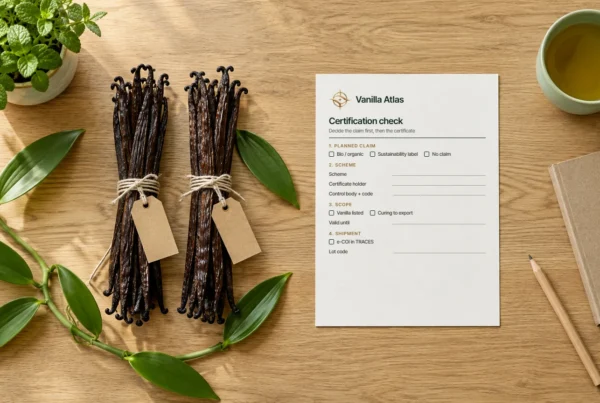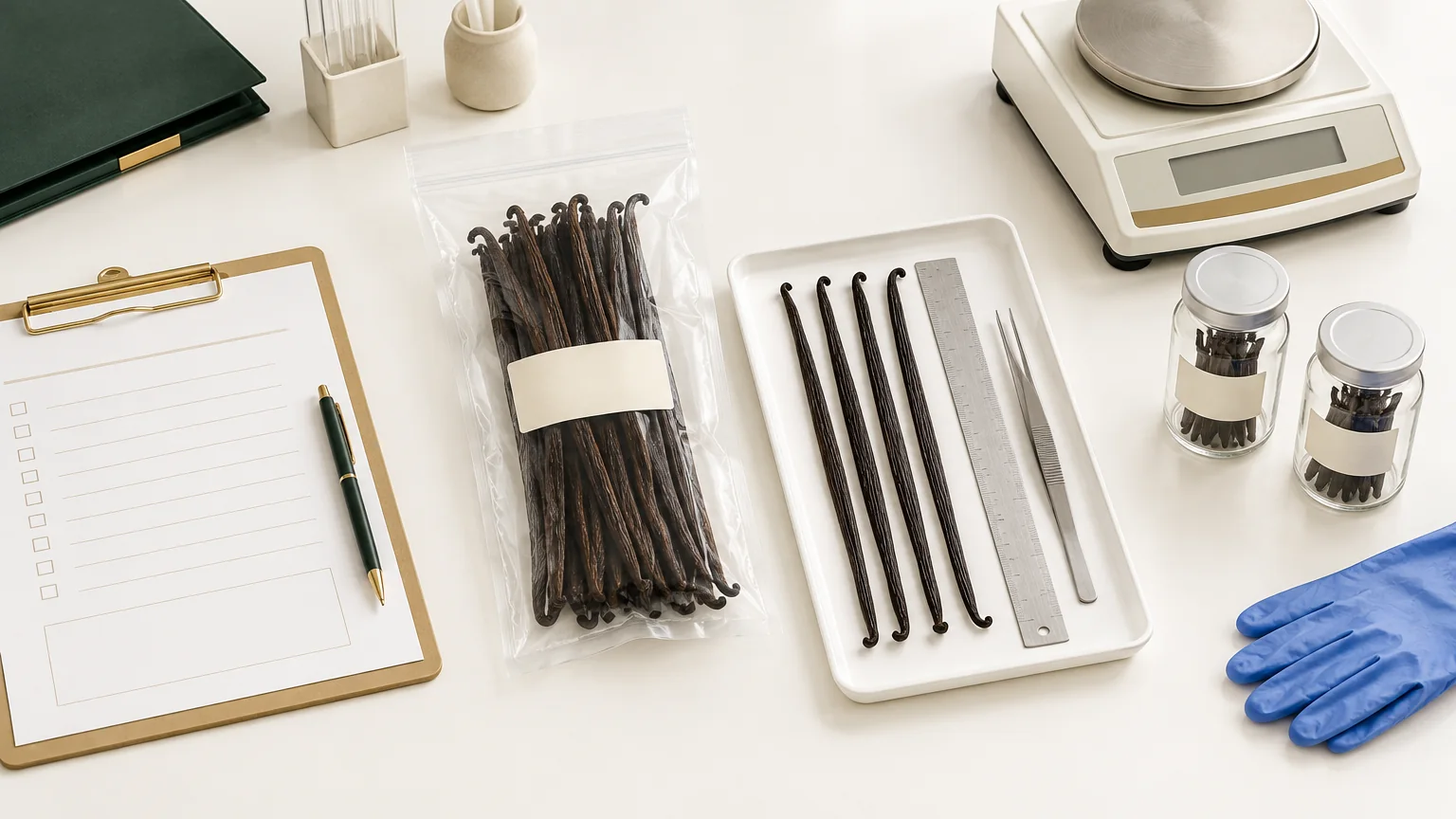
A vanilla sample checklist is a written set of gates that a sample must pass before your company releases a purchase order. For German QA teams, a sound vanilla sample approval covers nine gates: lot identity, arrival condition, specification match, physical inspection, measured values, a risk-based laboratory panel, an application trial, documents, and a recorded decision with a retained sample. Approve the lot the sample came from, not the supplier in general.
Kurz gesagt: Eine Musterfreigabe für Vanille braucht mehr als einen guten Geruch. Prüfen Sie Chargenbezug, Spezifikation, Feuchte, Rückstände und Kontaminanten, einen Anwendungstest und die Dokumente. Bewahren Sie ein Rückstellmuster auf und vergleichen Sie damit die Lieferung im Wareneingang.
This guide gives QA and procurement teams in Germany a vanilla sample checklist they can adapt, from the first representative sample to bulk-lot acceptance. It explains which EU limits are worth testing, how much sample to request, how to record the decision, and what to write into the order. It is editorial buying guidance, not legal advice or a certification scheme.
At a glance
- A vanilla sample approval is only as good as its link to a lot. Start with the lot code and the sampling record.
- EU law makes your company responsible for food safety but does not prescribe a sample approval procedure. The checklist is your evidence of control.
- Vanilla is classed as a fruit spice (code 0820070) for EU pesticide residue limits. EU contaminant rules set levels for lead, ochratoxin A and PAHs in dried spices.
- Decide the pass rules before the sample arrives, then record one of three outcomes: approved, approved with conditions, or rejected.
- Keep a sealed retained sample. It is your reference when the bulk lot arrives.
Download the printable vanilla sample checklist (PDF, 2 pages)
What is a vanilla sample checklist, and why does German QA need one?
A vanilla sample checklist turns “the beans look and smell good” into a record that someone else can audit. It lists what was checked, against which requirement, with what evidence, and who released the lot.
The legal background is simple. Under EU General Food Law, a food business operator must ensure that food meets food-law requirements at the stages under its control (Regulation (EC) No 178/2002, Articles 14 and 17). The hygiene regulation requires procedures based on HACCP principles (Regulation (EC) No 852/2004, Article 5). Neither tells you how to approve a raw-material sample. That is your procedure to design, and a certification auditor or customer will expect to see it applied.
Three different samples are often confused. Keep them apart in your records:
| Sample | Purpose | What it can tell you |
|---|---|---|
| Offer or presentation sample | First look at a supplier’s product | Whether the supplier is worth investigating; little about a specific lot |
| Lot-linked approval sample | Basis for sample approval (Musterfreigabe) | Whether the identified lot meets your specification |
| Retained sample (Rückstellmuster) | Sealed reference kept after approval | What you approved, for comparison with the delivery |
Only the second and third belong in a vanilla sample approval. A hand-picked presentation sample should never be the reference for a contract.
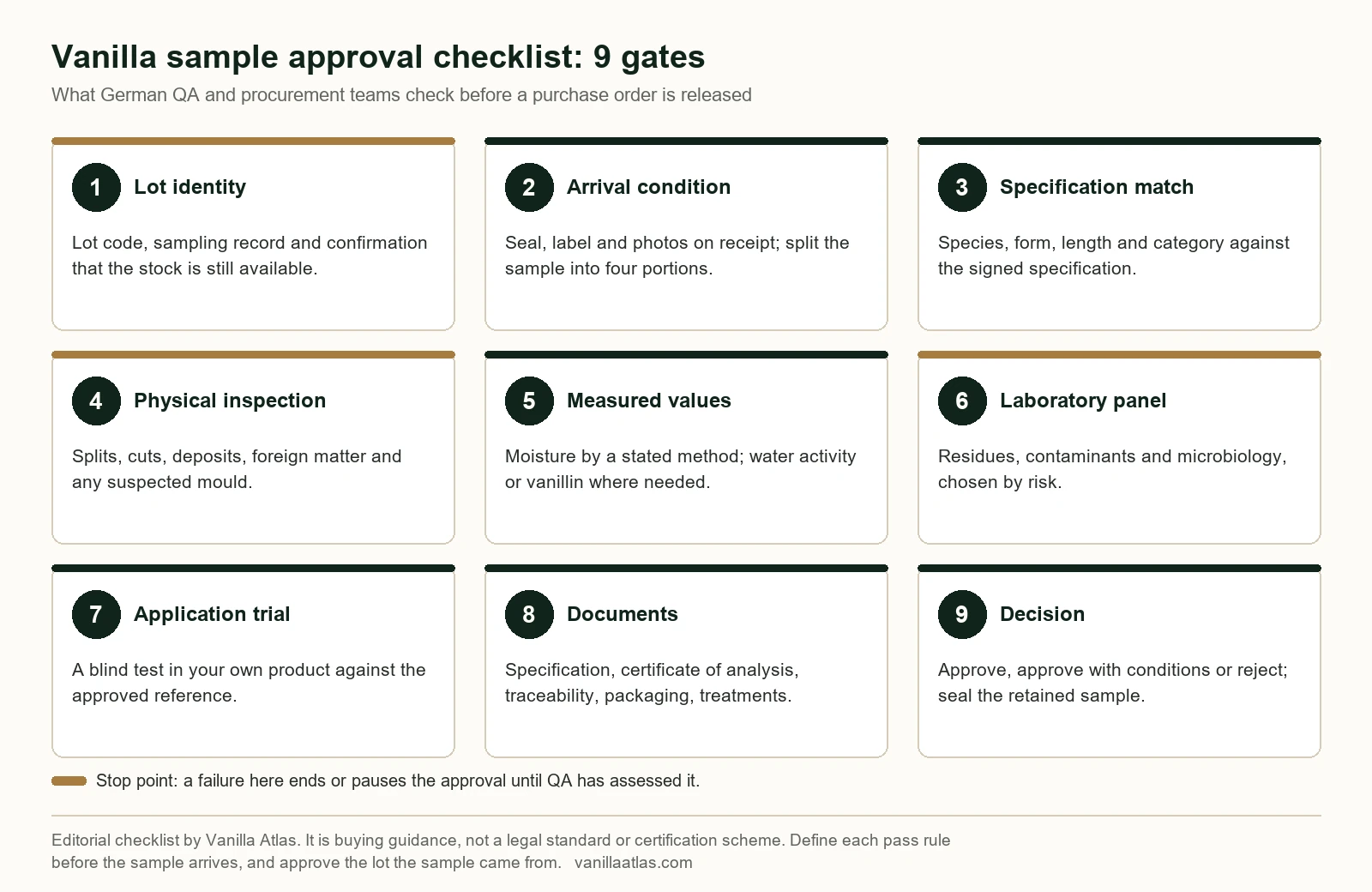
The vanilla sample checklist: 9 approval gates
Use the table as the master vanilla sample checklist. Each gate has a check, the evidence to file and a pass rule that your team defines before the sample arrives.
| Gate | What to check | Evidence to file | Pass rule to define in advance |
|---|---|---|---|
| 1. Lot identity | Lot code, quantity available, how and when the sample was drawn | Supplier sampling record; lot code on the pouch | Sample is drawn from the lot on offer |
| 2. Arrival condition | Seal, label, damage, condensation, odour on opening | Photos; receipt date; allocation into portions | Intact, identifiable, no cross-contamination |
| 3. Specification match | Species, form, length range, category or grade as defined in writing | Signed specification with version number | Every declared attribute matches |
| 4. Physical inspection | Splits, cuts, breakage, deposits, foreign matter, suspected mould | Counts or weights per defect, with photos | Within agreed tolerances; no safety concern |
| 5. Measured values | Moisture; water activity or vanillin where your use needs them | Lab report with method, basis and lot code | Inside the specification range, same method |
| 6. Laboratory panel | Pesticide residues, contaminants and microbiology, chosen by risk | Accredited laboratory report linked to the sample | No result above a legal limit or your own limit |
| 7. Application trial | Performance in your product against a reference | Trial sheet: dose, process, coded sensory result | Meets the sensory and process target |
| 8. Documents | Specification, certificate of analysis, traceability, packaging, treatments | Document set with dates and lot references | Complete, current and consistent |
| 9. Decision | Approved, approved with conditions, or rejected | Signed approval record; sealed retained sample | Named decision owner; conditions written into the order |
How to approve a vanilla sample in five steps
- Set the pass rules. Agree the specification, tolerances, test methods and laboratory panel before you request anything.
- Request a lot-linked sample. Ask for the lot code, the sampling record and enough material for four portions.
- Work through gates 1 to 8. Stop at any critical finding and assess it before continuing.
- Record the decision. Approve, approve with conditions or reject, then seal and label the retained sample.
- Carry the approval into the order. Write the lot code, limits and conditions into the purchase order and check the delivery against them.
The gates of the vanilla sample checklist run in order for a reason. If gate 1 fails, later results describe beans you will not receive. If gate 4 raises a safety concern, stop and assess it before spending money on gates 5 to 7.
Gates 1 and 2: Is the sample really from the lot you will buy?
Ask the supplier to confirm in writing that the sample was drawn from the lot in the quotation, how it was drawn, and whether that stock is still available. Record the lot code, sampling date, the person who sampled, and which packages were opened.
ISO 948, the sampling standard for spices and condiments, covers lot constitution, increments, laboratory samples, labelling and sampling reports. You do not need to cite it in every contract, but agreeing a sampling plan with the supplier stops a common dispute: a sample taken from the best carton.
Gate 2 of the vanilla sample checklist starts at the door. On arrival, photograph the parcel, inner pouch, label and seal before opening. Then divide the sample at once into labelled portions for the laboratory, physical inspection, the application trial and retention. If your laboratory needs an unopened or aseptically drawn portion, request it separately. A portion that has been opened, handled and smelled is not suitable for microbiology.
Gates 3 to 5: Does the sample match the written specification?
Compare the sample with a signed specification, not with a grade name; this is the core of any vanilla quality inspection. “Gourmet” and “Grade A” are seller terms. Our guide to vanilla bean grades explains how they relate to the ISO 5565-1 categories.
For the physical part of the vanilla quality inspection, count or weigh each defect class you have defined: splits, cuts, short pods, breakage and surface deposits. White deposits can be vanillin crystals or mould, and a photograph cannot settle which. Treat suspected mould, insects or foreign matter as a hold point for QA. The guide to vanilla bean defects and tolerances for German buyers gives the defect classes and a defect-rate calculation.
For measured values, check three things on every report: the method, the reporting basis and the lot code.
- Moisture. EU food law sets no moisture limit specific to vanilla beans. ISO 5565-1:1999 gives maximum moisture by category: 38% for Categories 1 and 2, 30% for Category 3 and 25% for Category 4. Your specification should state a range and the method. Results from different methods are not directly comparable.
- Vanillin. ISO 5565-1 notes that cured pods usually contain 1.6–2.4% vanillin on a wet basis. Ask whether a result is reported as received or on a dry basis. ISO 5565-2 sets out test methods for vanilla.
- Water activity. Moisture measures how much water is present; water activity describes how available it is. Add it where your hazard analysis or storage plan needs it.
Flexibility, gloss and colour are observations. They cannot stand in for a moisture or vanillin result. See our vanilla bean moisture guide for the commercial effect of moisture on dry matter.
Gate 6: Which EU limits and lab tests apply to a vanilla sample?
Gate 6 of the vanilla sample checklist is the laboratory panel. Choose it by risk, then check each result against the EU limit that applies to vanilla. The table lists the main references a German QA team should know. It was checked against the consolidated texts named in the sources on 10 November 2026.
| Parameter | EU reference | What it says for vanilla | QA note |
|---|---|---|---|
| Pesticide residues | Regulation (EC) No 396/2005 | Vanilla is product code 0820070 in the fruit spices group; limits are set per substance | Look up current limits in the EU Pesticides Database; order a multi-residue screen |
| Ethylene oxide | Regulation (EC) No 396/2005 | Residue is defined as the sum of ethylene oxide and 2-chloroethanol, expressed as ethylene oxide | Ask for a written statement that the lot was not fumigated with ethylene oxide; test if in doubt |
| Lead | Regulation (EU) 2023/915, entry 3.1.12.2 | 0.60 mg/kg for dried fruit spices | Categories follow the pesticide regulation’s product list |
| Ochratoxin A | Regulation (EU) 2023/915, entry 1.2.17 | 15 µg/kg for dried spices | Applies to dried spices generally, except Capsicum, which has its own level |
| PAHs | Regulation (EU) 2023/915, entry 5.1.10 | 10.0 µg/kg benzo(a)pyrene and 50.0 µg/kg for the sum of four PAHs in dried spices | Relevant where beans were dried with smoke or direct heat |
| Aflatoxins | Regulation (EU) 2023/915, entries 1.1.14–1.1.15 | Levels are set for named spices only; vanilla is not named | Test by risk, for example after a mould finding |
| Microbiology | Regulation (EC) No 2073/2005 | No criterion specific to spices | Set internal limits; many German laboratories refer to DGHM guideline and warning values |
| Irradiation | Directives 1999/2/EC and 1999/3/EC | Dried aromatic herbs, spices and vegetable seasonings may be irradiated in approved facilities and must be labelled | Ask for a treatment declaration |
Source: consolidated EU texts listed under Sources and method, checked 10 November 2026. Levels are quoted for orientation; the Official Journal text is the legal reference.
Two cautions apply. First, cured vanilla beans can hold 25–38% moisture, so confirm with your laboratory or competent authority that it assesses your product as a dried spice under these entries. Second, limits change. Draft amendments to the lead and PAH entries were circulated in late 2025 and early 2026, so check the current consolidated regulation before you set a pass rule.
Use a laboratory accredited to ISO/IEC 17025 for the methods you order, and make sure the report names the sample and lot code. DGHM guideline and warning values are recommendations published through DIN Media, not law.
Is Indonesian vanilla under increased EU import controls? Whole vanilla (CN 0905) was not listed in the annexes of Implementing Regulation (EU) 2019/1793 in the consolidated version of 18 February 2026. Indonesia’s only entry there was nutmeg, for aflatoxins. The annexes are reviewed regularly and were amended again in June 2026, so check the current version. This matters to us as well: Vanilla Atlas ships Indonesian vanilla, and we would rather you verify the list than rely on our reading of it.
Gate 7: How should you run the application trial?
Gate 7 of the vanilla sample checklist tests the sample in your own product, blind, next to your approved reference. Keep the recipe, dose, process and storage time the same for both. Code the samples so tasters do not know which is new.
Decide the basis before you start. Equal weights of beans with different moisture contain different amounts of dry matter, so an equal-weight trial and an equal-dry-matter trial answer different questions. Record which one you ran.
For bakery, dairy and confectionery, our application guide for German manufacturers maps bean format to the process. Extract and flavour producers should add extraction parameters, as set out in the guide to extraction-grade vanilla for German manufacturers.
Gate 8: Which documents complete a vanilla sample approval?
A vanilla sample approval needs a document set that names the same lot as the sample. Ask for:
- the product specification, with a version number and date;
- a certificate of analysis for the lot, showing method, basis, test date and laboratory, or a clear statement that only reference values are available;
- traceability details: grower region or collector, curing site, packing date and lot coding;
- a food-contact declaration for the primary packaging;
- statements on fumigation, irradiation and any other treatment;
- organic or other certificates only where you intend to make that claim.
A certificate of analysis is evidence, not a vanilla sample approval. Check that it belongs to the lot, that its date is plausible and that the method matches your specification. If the supplier offers reference values instead of batch results, record that plainly and decide which tests you will commission yourself.
Related guides cover traceability records for German buyers, food-contact packaging questions and how to evaluate an Indonesian vanilla supplier. If your site is certified to a GFSI-recognised standard such as IFS Food or BRCGS, the same file supports its supplier-approval and specification requirements.
Gate 9: Approve, approve with conditions, or reject?
Close the vanilla sample checklist by recording one of three outcomes, with the reason and the decision owner. Classify findings before you see the results, so that a good price does not soften the decision.
| Finding class | Examples | Usual outcome |
|---|---|---|
| Critical | Result above a legal limit; suspected mould, pests or foreign matter; species or treatment not as declared; sample cannot be linked to a lot | Reject, or hold until QA has assessed the risk |
| Major | Moisture, length, split rate or vanillin outside specification; application trial fails | Reject, or request a new sample from a re-sorted or different lot |
| Minor | A document is missing or out of date; a cosmetic deviation inside the agreed tolerance | Approve with conditions and a deadline |
A conditional vanilla sample approval is only useful if the conditions reach the purchase order. Write them into the order, for example: “Release subject to moisture 25–30% by the agreed method on the pre-shipment sample.”
Then seal and label the retained sample: product, supplier, lot code, date, approval number and storage conditions. Store it cool, dark and airtight. Cured vanilla changes over time, so note the date when you compare it later.
How much vanilla sample should you request?
Request enough for four separate portions: laboratory, physical inspection, application trial and retention. There is no universal gram figure, because laboratories need different amounts for different panels. Ask your laboratory first, then state the amounts in your vanilla sample checklist before you contact the supplier.
A planning example, with hypothetical numbers:
| Portion | Hypothetical amount | Who sets the real figure |
|---|---|---|
| Laboratory panel | 300 g | Your laboratory, by test panel |
| Physical inspection | 100 g | QA, by the number of pods in your inspection plan |
| Application trial | 100 g | R&D, by batch size and repeats |
| Retained sample | 2 × 100 g | QA; one sealed reference and one working reference |
| Total | 700 g |
These amounts are an illustration, not a standard or a Vanilla Atlas offer. A larger sample does not fix a poor selection method. Ten well-drawn increments tell you more than a kilogram from one carton.
How long is a vanilla sample approval valid?
A vanilla sample approval is valid for the lot it describes, not for a period of time. A new lot needs its own evidence, even from the same supplier and curing site.
Re-approve when any of these change:
- the lot code, crop year or curing site;
- the specification, grade or format;
- the packaging or storage conditions;
- the time between approval and shipment, if the beans may have dried or been re-sorted.
You can make a repeat vanilla sample approval lighter. One workable pattern is the full nine gates for a new supplier, then a reduced panel for later lots, with the full laboratory panel at a set frequency. Put that rule in your procedure so it is a decision rather than a habit.
From approved sample to bulk-lot acceptance
The approved sample becomes useful when the delivery is checked against it. Incoming goods inspection (Wareneingangskontrolle) should follow the same specification, methods and tolerances as the approval. In practice, the vanilla quality inspection on arrival reuses gates 2 to 5.
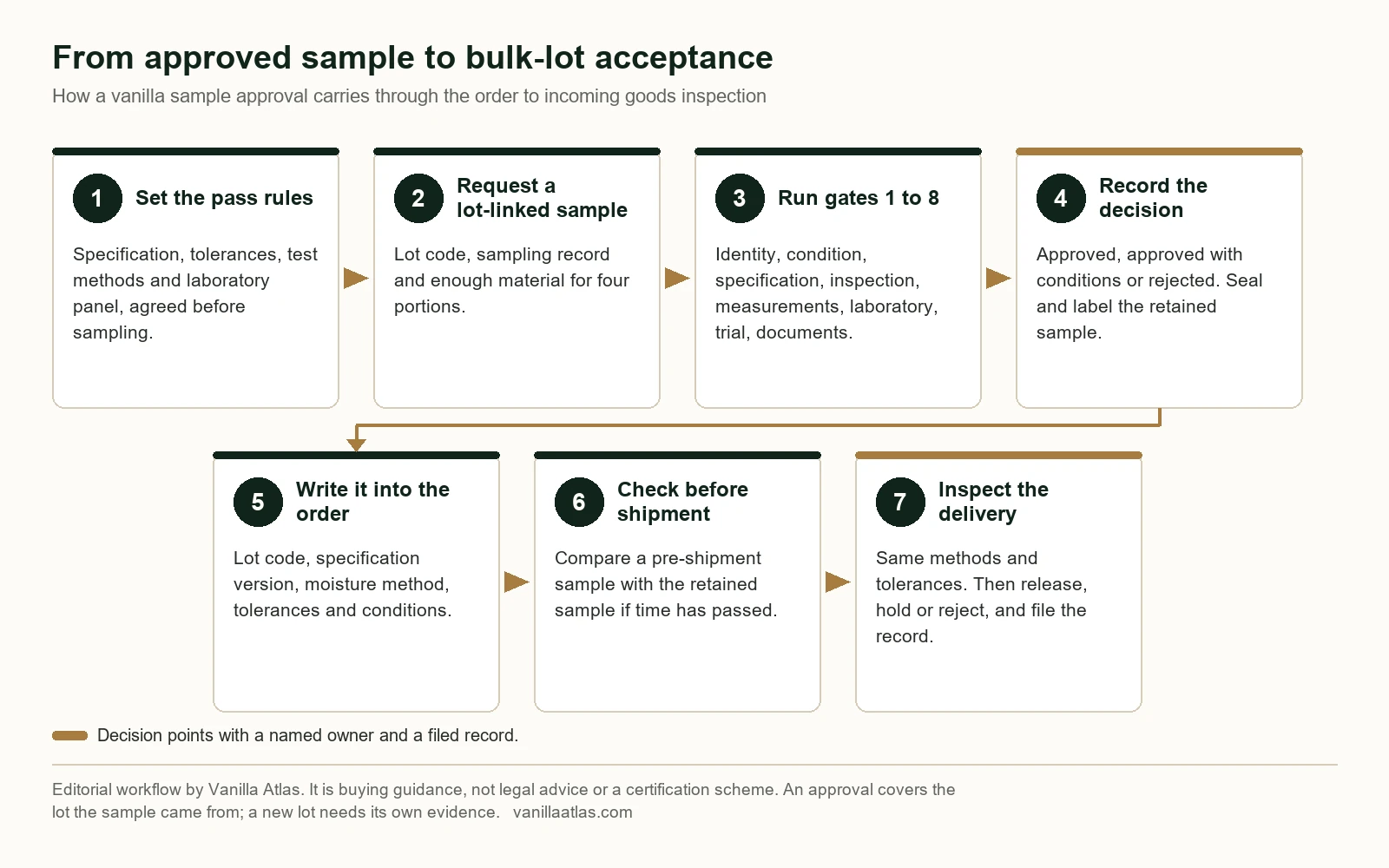
- Write the approval into the order. Name the lot code, specification version, moisture method and basis, tolerances, packaging and required documents.
- Ask for a pre-shipment sample if time has passed or the lot was re-packed. Compare it with the retained sample.
- Identify the delivery. Match the purchase order, lot code and package labels. Photograph damage or condensation before opening.
- Sample the delivery under your plan. Take increments from several packages, not the top of one carton.
- Repeat the agreed checks. Use the same methods as the approval and compare with the retained sample.
- Record release, hold or rejection. Name the decision owner and file the evidence with the lot, next to the completed vanilla sample checklist.
Beans can lose moisture in transit, so agree a moisture tolerance before shipment rather than arguing afterwards. Our guide on comparing a vanilla sample with the bulk lot covers tolerance bands and what to do when the delivery does not match. If the comparison involves two origins, see Indonesian vs Madagascar vanilla for German procurement teams.
EU General Food Law also requires you to identify your suppliers and customers for each food (Article 18). A lot-linked approval file makes that record easy to produce.
German QA terms for the approval file
German sites often keep records in German while corresponding with suppliers in English. These equivalents help both sides refer to the same step in a vanilla sample approval.
| English | German |
|---|---|
| Sample approval | Musterfreigabe |
| Retained sample, reference sample | Rückstellmuster |
| Incoming goods inspection | Wareneingangskontrolle |
| Specification | Spezifikation |
| Certificate of analysis | Analysenzertifikat |
| Lot, batch | Charge, Los |
| On hold / released | Gesperrt / freigegeben |
| Traceability | Rückverfolgbarkeit |
| Complaint | Reklamation |
What can Vanilla Atlas provide for your vanilla sample approval?
Vanilla Atlas supplies Indonesian vanilla beans in five selections, each sold in 1 kg units. The reference moisture ranges on our product pages, checked on 10 November 2026, are:
| Selection | Reference moisture | Format |
|---|---|---|
| Gourmet | 28–35% | Whole, supple |
| Select | 25–30% | Whole, supple |
| Classic | 24–28% | Whole, supple |
| Dry Whole | 18–25% | Whole, dry |
| Shorts | 18–25% | Short pods under 10 cm, some cut pieces |
Source: Vanilla Atlas product pages, checked 10 November 2026.
These are reference specifications, not batch certificates of analysis. A batch certificate of analysis is not currently available from us, so plan gates 5 and 6 around tests you commission.
The most useful first step is to send your criteria. Submit your sample acceptance criteria: application, specification limits, the tests you require, sample quantity and delivery point in Germany. We will answer line by line with what we can document for the current lot and what we cannot. That reply can go straight into gate 8 of your vanilla sample checklist.
Frequently asked questions
What should a vanilla sample checklist include?
A vanilla sample checklist should cover nine gates: lot identity, arrival condition, specification match, physical inspection, measured values such as moisture, a risk-based laboratory panel, an application trial, documents, and a recorded decision with a sealed retained sample. Define the pass rule for each gate before the sample arrives.
How many grams of vanilla should I request as a sample?
Request enough for four portions: laboratory testing, physical inspection, an application trial and a retained sample. Laboratories need different amounts for different test panels, so ask yours first and write the amounts into your vanilla sample checklist. As a planning illustration, 300 g for the laboratory plus 100 g for each other portion gives about 700 g.
Which lab tests should German QA order for a vanilla sample?
Order tests by risk, as part of a documented vanilla quality inspection. A sensible starting panel includes moisture, a multi-residue pesticide screen, lead, and microbiology such as Salmonella. Add ochratoxin A, PAHs, ethylene oxide or vanillin where your hazard analysis, the drying method or your specification calls for them. Use a laboratory accredited to ISO/IEC 17025.
Is a supplier’s certificate of analysis enough to approve a vanilla sample?
No. A certificate of analysis is evidence for one lot, not an approval. Check that it names the same lot as the sample, states the method and reporting basis, and comes from a competent laboratory. Then decide which results your own laboratory should verify.
Does EU law set a maximum moisture for vanilla beans?
We found no EU legal limit for moisture that is specific to vanilla beans. ISO 5565-1:1999 gives maximum moisture by category, from 38% for Categories 1 and 2 to 25% for Category 4. Moisture is therefore a contract matter: state a range and a test method in your specification.
How long should we keep the retained vanilla sample?
Set the period in your QA procedure. A common approach is to keep the sealed retained sample at least until the lot has been used and the related complaint period has passed. Store it cool, dark and airtight, and note that cured vanilla changes with time.
What happens if the bulk lot differs from the approved sample?
Put the delivery on hold, document the difference against the retained sample from your vanilla sample approval and the specification, and notify the supplier in writing with photos and results. Then follow the remedy agreed in the order: re-sorting, a price adjustment, replacement or rejection. Safety concerns need a separate QA assessment.
Can we approve a supplier once and skip sampling for later lots?
Not safely. A vanilla sample approval covers one lot, and curing, crop year and storage change the next one. You can reduce the work for a proven supplier, for example a shorter panel per lot and a full panel at set intervals, but record that rule in your procedure.
Sources and method
Last updated: 2026-11-10. Reviewed 10 November 2026. This vanilla sample checklist is an editorial buying tool by Vanilla Atlas, not a legal standard, an official German procedure or a certification scheme. No laboratory tests were conducted for this article. Confirm legal limits against the current Official Journal texts before use.
- Regulation (EC) No 178/2002, Articles 14, 17 and 18, and Regulation (EC) No 852/2004, Article 5 — operator responsibility, traceability and HACCP-based procedures.
- Regulation (EC) No 396/2005, Annex I as replaced by Regulation (EU) 2018/62 — vanilla listed as code 0820070 under fruit spices; ethylene oxide residue definition.
- Regulation (EU) 2023/915, consolidated version of 1 July 2025 — entries 1.1.14–1.1.15 (aflatoxins), 1.2.17 (ochratoxin A), 3.1.12 (lead) and 5.1.10 (PAHs).
- Regulation (EC) No 2073/2005 and DGHM guideline and warning values — microbiological criteria and German recommendations.
- Directive 1999/2/EC and Directive 1999/3/EC — irradiation of dried aromatic herbs, spices and vegetable seasonings.
- Implementing Regulation (EU) 2019/1793, consolidated version of 18 February 2026 — increased official controls; no CN 0905 entry found.
- ISO 948, ISO 5565-1:1999 and ISO 5565-2 — sampling, specification and test methods. Category moisture values as summarised in our grades guide; this article does not reproduce the paid standards.
- Vanilla Atlas product pages — reference moisture ranges checked on the review date.
For the US version, see how to evaluate vanilla bean samples.